
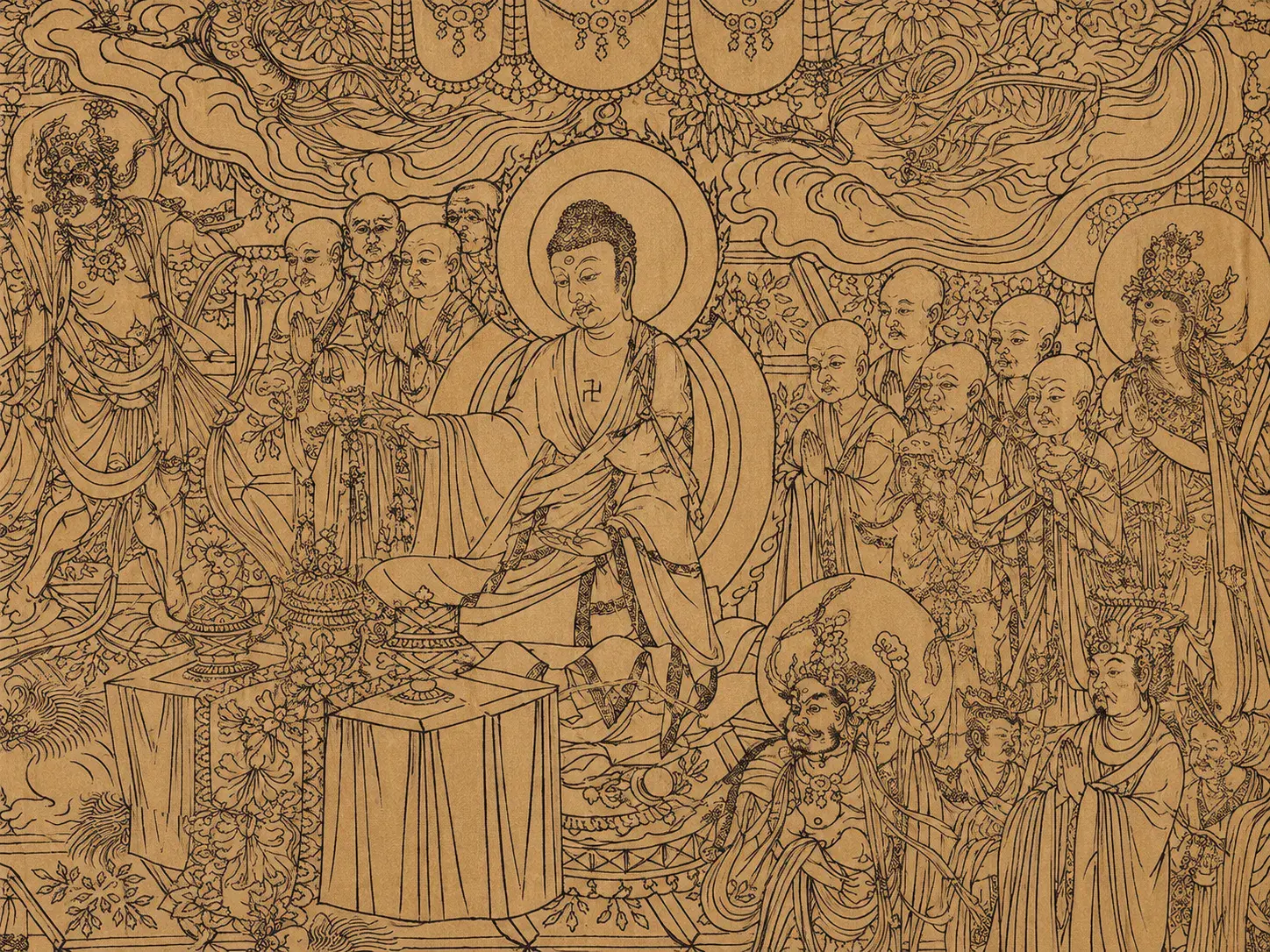
The famous Diamond Sutra scroll dated 11 May 868 is the earliest known complete printed book carrying a date. Produced by woodblock printing, it consists of printed sheets joined into a long scroll and was discovered among the manuscripts of Dunhuang's Library Cave. Its importance does not mean printing began in 868: Chinese printing was already established, and Buddhist communities had been important users of reproduced texts and images.
Diamond Sutra at a Glance
| Topic | Orientation |
|---|---|
| Text | Diamond Sutra |
| Religion | Mahayana Buddhism |
| Date | 11 May 868 |
| Printing | Woodblock |
| Format | Printed sheets joined as scroll |
| Discovery context | Dunhuang Library Cave |
| Current collection | British Library |
| Why important | Earliest dated complete printed book |
Keep two facts paired: the object is a dated complete printed book, and it is a woodblock product—not movable type and not a European press book.
What Is the Diamond Sutra?
The Diamond Sutra is a Mahayana Buddhist scripture. This guide focuses on the 868 scroll as a landmark of printing history; for the religious history of Buddhism in China, see the Buddhism in China guide.
As a text, it is part of a wider Mahayana literature concerned with insight and emptiness teachings. As a printing-history landmark, the 868 scroll matters because it survives as a complete dated printed book-scroll with an illustrated frontispiece. Use this page for book technology and the religion guide for broader Buddhist history in China.
Why This Copy Matters to Printing History
It carries an explicit date, survives as a complete printed book-scroll, and documents mature woodblock practice. International Dunhuang Programme / British Library materials treat it as the earliest dated complete printed book.
Those three qualities—date, completeness and woodblock technique—are why museums and UNESCO-linked overviews keep returning to this object. A dated colophon lets historians place the impression in late Tang book history. Completeness distinguishes it from fragments. Mature carving and printing quality show that Chinese paper woodblock workshops were already capable of sustained book production by 868. None of that means nothing was printed earlier.
The Date: 11 May 868
The colophon dates the printing to 11 May 868. That anchors the object in late Tang book history.
The date is why this scroll can support precise comparative claims against later landmarks such as Song movable type, Korea’s *Jikji* (1377) and Gutenberg’s fifteenth-century European system. It is a late Tang date for a woodblock book, not an invention year for all printing and not a movable-type date. Prefer “printed in 868” or “dated 11 May 868” over “printing invented in 868.”
Wang Jie and the Colophon
The colophon associates the printing with Wang Jie as a dedicatory act. Exact phrasing should follow British Library / International Dunhuang Programme translations.
Dedicatory colophons matter because they record patronage and intention, not only workshop technique. Wang Jie’s association is part of why the scroll is readable as a religious commission as well as a technological landmark. Traveler guides paraphrase cautiously rather than inventing eloquent vows beyond sourced descriptions.
How the Scroll Was Printed
Sheets were printed from woodblocks and joined into a long scroll. This is woodblock, not movable type.
Each sheet reflects relief carving: raised characters and lines take ink; paper receives the impression; sheets are then joined into scroll format. That process matches Chinese book and Buddhist scroll practice more closely than later fascicle norms in some other traditions. Movable type—separate reusable characters—is a later Chinese chapter associated with Bi Sheng and is not the method of this 868 object. Gutenberg’s press system is later still and European.
The Famous Frontispiece
The illustrated frontispiece is one of the best-known early printed images in world book history—an argument for looking at Buddhist print culture as visual as well as textual.
The frontispiece shows that early Chinese printing was already combining text and image on related blocks or related production steps. For printmaking context, see woodblock prints and printmaking. Looking only at characters misses half of what made Buddhist print culture persuasive and portable.
Buddhist Merit and Reproducing Texts
Reproducing sutras could be framed as meritorious. That religious incentive helps explain demand for multiples.
Printing fits merit logic because one commission can yield many identical copies for distribution, recitation and preservation. Manuscript copying could also be meritorious; printing changed the speed and uniformity with which multiples could be produced. Patronage inscriptions, including colophons, often make that religious economy visible beside the technical facts of carving and inking.
Why Buddhism Encouraged Printing
Standardization, dissemination and merit combined with workshop capacity. Buddhism was not the only driver of Chinese printing, but it was a major one.
Communities wanted correct texts widely available. Images supported devotion and teaching. Workshops capable of carving and printing made those goals practical at larger scale. Secular and commercial printing later expanded strongly, especially in the Song dynasty, so Buddhist demand should be read as a major early engine rather than the whole history of Chinese print.
Dunhuang and the Library Cave
The scroll was among manuscripts sealed in Dunhuang’s Library Cave and later entered the British Library. It is not still in Dunhuang.
Discovery context and present location are different facts. Dunhuang’s Library Cave preserved an enormous manuscript and printed corpus; the Diamond Sutra scroll is one famous object from that find. Travelers visiting Dunhuang see the cave complex and related museums; they should not expect the 868 scroll itself to be on local permanent display. Conservation and collection history placed the object in the British Library.
Where Was the 868 Scroll Printed?
Its exact production location is not securely known; Chengdu has been suggested as a possibility because it was a major printing center, but that origin is not securely established.
“Found at Dunhuang” is not the same as “printed at Dunhuang,” and “Chengdu possible” is not the same as “Chengdu proven.” Over-certain location claims usually come from collapsing regional printing strength into a single unverified workshop address.
Could Chengdu Be Relevant?
Chengdu appears in educational materials as a possible origin and as an early printing center. For traveler city context, see the Chengdu City Guide.
Sichuan/Chengdu’s importance in early Chinese printing history is real at a regional level. That regional strength makes Chengdu a reasonable hypothesis in some educational discussions of the 868 scroll’s origin. No specific tourist site can currently be identified as the proven workshop where this copy was printed.
Is It the World's First Printed Book?
It is commonly described more precisely as the world’s earliest dated complete printed book. Printing itself is older.
“First printed object ever” is too strong. Fragments, earlier block traditions and undocumented printings can exist without surviving as complete dated books. The Diamond Sutra’s strength is the combination of date, completeness and woodblock technique. Use the precise phrase when comparing it with later Song, Korean or European landmarks.
Where Is the Original Today?
British Library. Do not promise permanent public display; exhibitions rotate for conservation.
Check the British Library’s current exhibition information before travel if seeing the object is a priority. Digitized images and International Dunhuang Programme resources may be more reliably available than a guarantee of gallery display on a given week. Conservation needs often limit how long fragile scrolls can be shown.
Common Misconceptions
- Printing did not begin in 868.
- The Diamond Sutra was not made with movable type.
- It is not currently in Dunhuang.
- Its exact printing location is not certain.
- “Earliest dated complete printed book” is more precise than “first printed object ever.”
Correcting these five points prevents most viral misstatements. The scroll remains a landmark without needing inflated firsts or false locations.
FAQ
What is the Diamond Sutra?
A Mahayana Buddhist scripture; the 868 copy is a landmark woodblock-printed scroll. This page focuses on that copy as a printing-history object; for religious context, see Buddhism in China.
Why is the Diamond Sutra important to printing?
It is the earliest known complete printed book with a date. The combination of an explicit colophon date, complete scroll format and mature woodblock technique makes it a global landmark.
When was the Diamond Sutra printed?
11 May 868, per the colophon. That late Tang date places the woodblock scroll centuries before Bi Sheng’s movable type, Korea’s *Jikji* and Gutenberg’s European press system.
Was the Diamond Sutra printed with movable type?
No—woodblock printing. Sheets were printed from carved blocks and joined into a scroll; reusable-character type is a different later technology.
Where was it found?
Among Dunhuang Library Cave manuscripts. Discovery context at Dunhuang is certain; present collection location is the British Library.
Where is the Diamond Sutra now?
British Library collections. Exhibition display rotates for conservation, so confirm current public access before planning a visit around it.
Is it the oldest printed book?
Best phrased as the earliest dated complete printed book; printing predates 868. Earlier printing can exist without surviving as a complete dated book-scroll.
Was it printed in Chengdu?
Possibly suggested; not securely proven. Chengdu was a major early printing center, but the 868 scroll’s exact workshop location remains uncertain.
Why was Buddhism important to Chinese printing?
Religious demand for reproduced texts and images helped expand early print culture. Merit, dissemination and standardization encouraged multiples, while later Song commercial and educational printing broadened the story further.
Sources & Review
- International Dunhuang Programme / British Library — Diamond Sutra object and learning materials
- UNESCO Silk Roads overview of East Asian printing
- Chinese Printing
- Woodblock printing
- Song dynasty printing
Last reviewed: September 2026