Western Tombs at a glance
| Detail | Plan |
|---|---|
| Where | Yi County, Baoding prefecture |
| Who | Yongzheng, Jiaqing, Daoguang, Guangxu among them |
| Not here | Cixi and Ci'an |
| From the yamen | Not a combined morning |
| From Shijiazhuang | Not a casual add before Zhengding |
| Tour | Western Qing Tombs day |
The Western Qing Tombs stand in Yi County, in the hills west of the Baoding plain. The day is long from Beijing, and it is not a stroll from the Zhili governor's office. Emperors buried in this valley include Yongzheng, Jiaqing, Daoguang, and Guangxu. Cixi is not here. She is at the Eastern Qing Tombs in Zunhua, in Tangshan prefecture, on the other side of the capital.

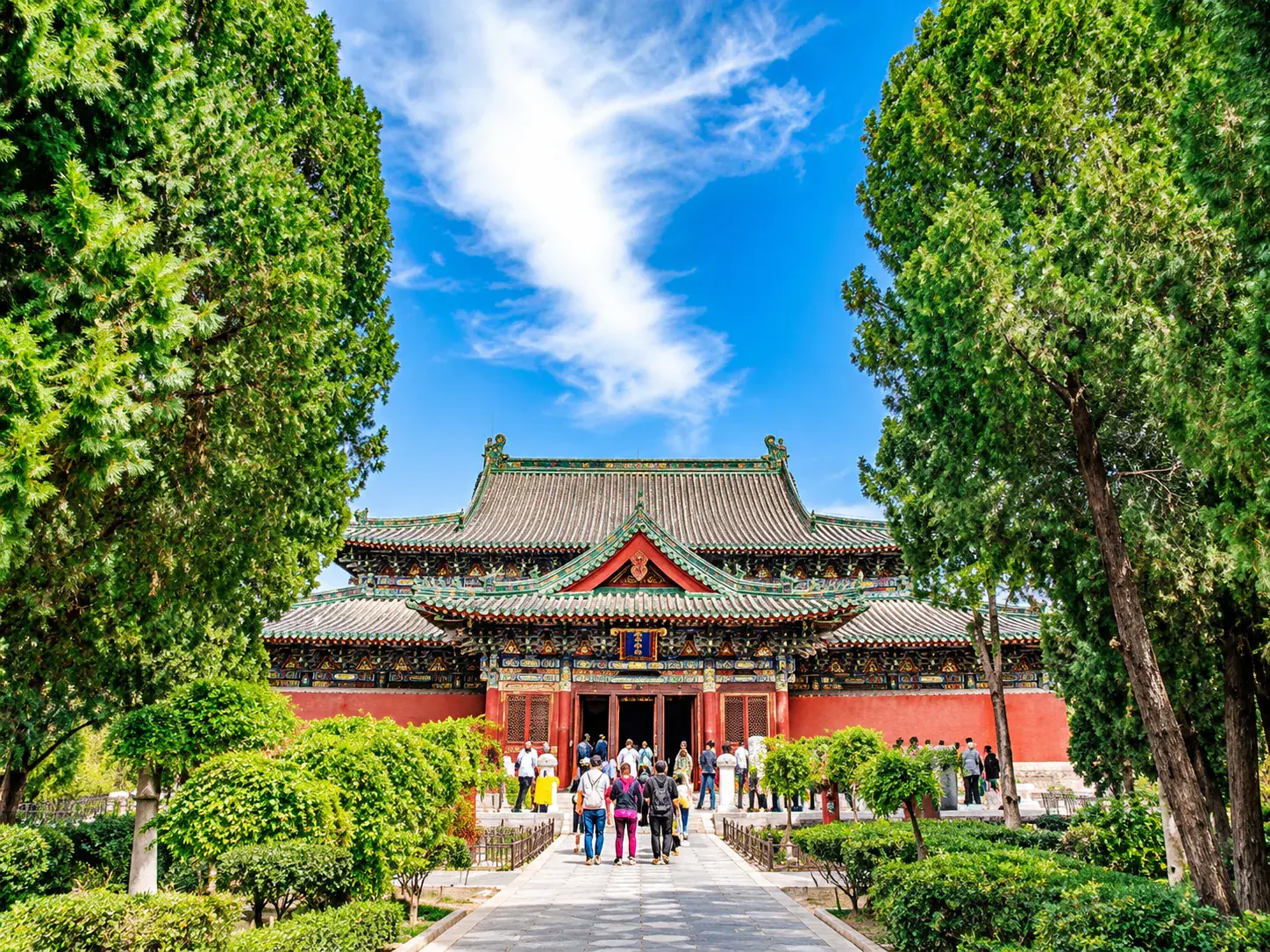
The picture above is not this cemetery. It shows two brick pagodas close together, above trees, with a modern skyline behind them. The nearer tower is octagonal, with a spherical finial. A taller, slimmer tower stands behind it. That frame is a Baoding-area skyline, not a tomb and not a temple you should rename from the caption. Dingzhou's Liaodi Pagoda is a different building again: one very tall Song tower, south of the city, often paired with the Qing examination hall there. Zhuozhou's Liao pagodas are two sites, not one courtyard. None of those is the stone arch you came to walk.
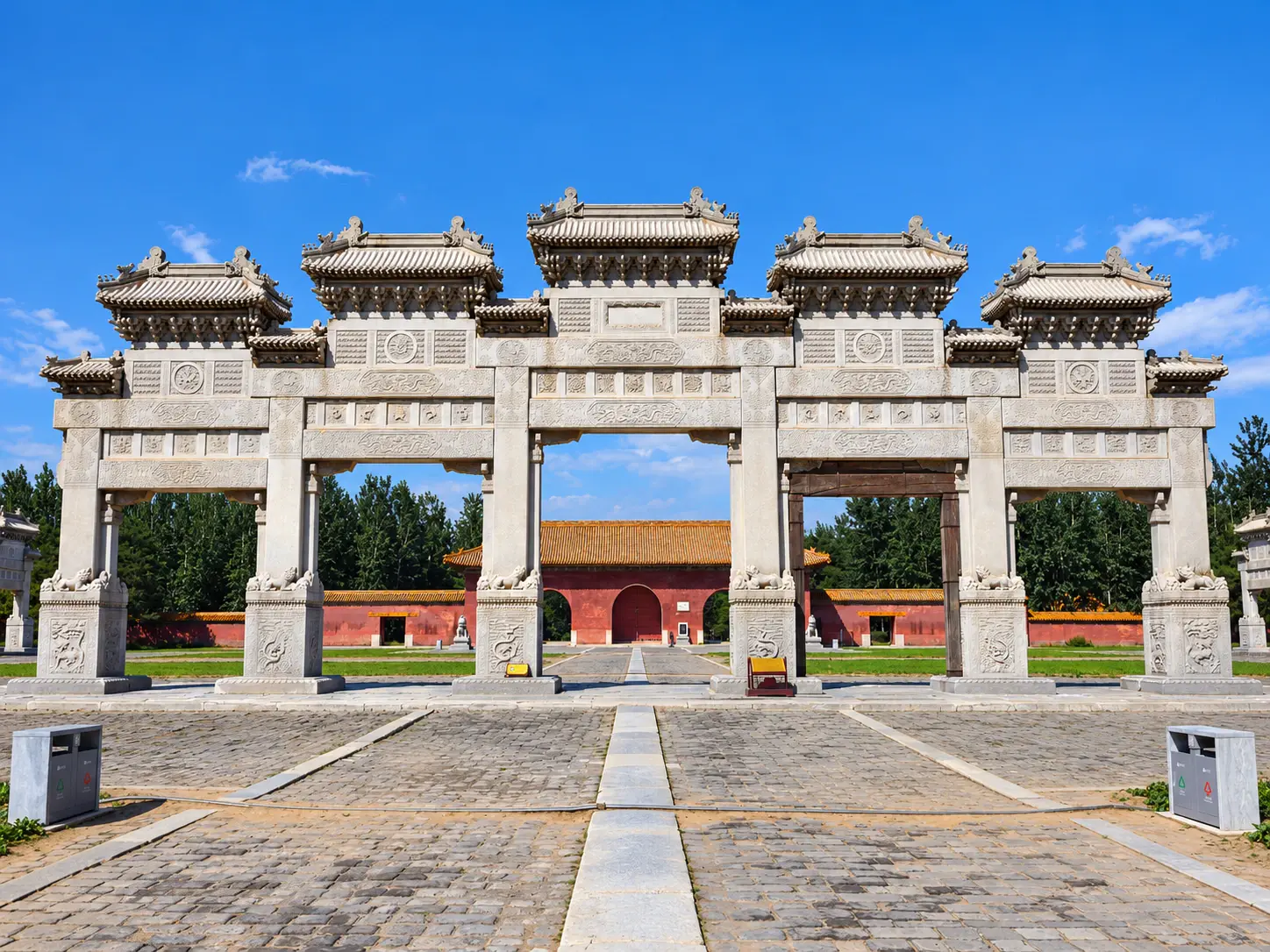
The photograph that matches the visit is the memorial archway at the tombs.
The archway, then the valley
You arrive at a stone memorial archway and a spirit way: gates, figures of animals and officials, and a long outdoor walk that is the visit, not the driveway before the visit. Groups who skip the statues to save minutes usually remember two courtyards they could not tell apart. Walk the approach slowly enough to see the stone as a sequence. It is outdoors, on uneven ground, in whatever weather Yi County is actually having.
The valley behind that approach is not one courtyard. The imperial mounds sit far enough apart that you ride between them. A plan that says "we will walk the whole cemetery" has not looked at the ground. Choose a first mound, walk it properly, and add a second only if legs and the return clock still agree. The site may run a shuttle or you may have a driver move you. Either way, the transfer is part of the day. It is not a city block, and it is not a reason to skip a real meal.
This cemetery is part of the wider imperial-tombs heritage that also includes the eastern Qing valley and the Ming tombs. That fact is context. It is not a permission slip to collect every cemetery in one weekend. On this date you are in Yi County only.
Who is buried here
Yongzheng's tomb is Tailing (泰陵). It is the mound that opened this western cemetery, and it is the right center of a first visit. His father, Kangxi, is in the eastern cemetery, not beside him. The western valley exists because Yongzheng was not buried in that older ground. You are not looking at one Qing graveyard with a gap in the middle of Hebei. You are looking at a choice that split the dynasty's tombs onto two roads.
Jiaqing is at Changling (昌陵). Daoguang is at Muling (慕陵). He abandoned an earlier tomb at the eastern cemetery after water seeped in, and the western rebuilding is the plainer complex, with unusual care for drainage. Do not expect four identical palace fronts. Guangxu is at Chongling (崇陵), the latest of the four, finished in the early republican years. Empresses and consorts have smaller tombs in the same landscape. A first day does not collect them. Name the emperor you care about, and let the others wait.
Cixi is not in any of those courtyards. Nor is Ci'an. Their tombs are Dingdongling, at the Eastern Qing Tombs near Zunhua. If a photograph of an empress dowager is why someone asked for "the Qing tombs," stop and turn the car around before it leaves Beijing. The eastern valley has its own guide at the Eastern Qing Tombs, and its own arranged day, the Eastern Qing Tombs day tour. Read them only as the contrast. The two cemeteries sit on opposite sides of Beijing. They are not a loop, and Zunhua is not a lane you pass on the way home from Yi County. The eastern valley is usually the busier one, because Cixi and Qianlong draw the coaches. This western valley is the quieter cemetery. Quieter still fills up at Qingming and in the early-October holiday. It does not mean a small site, and it does not mean you can arrive at noon. The Tangshan guide is the prefecture that contains the eastern cemetery. It is not a stop you add after this archway.
How much of the valley to take
Give Tailing and the spirit way the heart of the day. Add one further tomb if the group is strong and someone has named Jiaqing, Daoguang, or Guangxu out loud. Adding all four because a list exists is how the archway gets rushed and the drive back to Beijing slides into the dark. Extra mounds are for a group that has already said it wants them, or for another visit.
Confirm which halls and any underground chambers can be entered on your date. Chongling has had an underground palace open to visitors in some seasons. That is not a promise. An old photograph of a coffin chamber is not a door. Interior rules change. Follow the notice at the gate rather than a caption. Bring the identification you would use if entry is reserved or checked. Admission rules and last entry change. Check both for your date.
Schematic maps on site help once you are there. They are not a reason to skip the approach. Festival weeks change the mood, and Qingming in particular brings people who are tending graves, not collecting viewpoints. You are a visitor in a cemetery on those days. Walk more slowly. Do not treat the statues as a fairground.
The Baoding guide is the city you are not seeing today: the yamen and the lotus pond, which belong to each other and do not belong to this valley. If you are sleeping in Baoding and driving out in the morning, you still owe the cemetery the whole day. Closer than a Beijing hotel is not the same thing as nearby. Leave early. Do not walk the garden first and hope the archway will wait.
From a Beijing hotel, or from a night on the plain
The usual shape, when the tombs are the only wish, is a car from Beijing: out in the morning, the archway and the mounds, a meal, and back in the evening. The drive is longer than the one to the Eastern Qing Tombs. It takes the morning. It is not an outing you start after a late breakfast. The Western Qing Tombs day tour is that shape with the order set for you. It is a cemetery day. It does not collect the Zhili office on the way home, and it does not become a Baoding city tour under another name. There is no Baoding city tour on this site.
The train is the wrong substitute. Many fast trains from Beijing West to Baoding East take well under an hour, and you should confirm that timetable, but Baoding East is not the cemetery gate. From the high-speed station you would still need a car into Yi County, then the hours the valley requires, then a way back. The daylight dies in the vehicle. If you cannot use a car, say so before the date is fixed. Do not buy a rail ticket and assume a taxi from the East station will rescue a full tomb circuit. The from Beijing page separates the train you want for the yamen from the car you want for this valley.
A night in Baoding can shorten the morning drive compared with a hotel in central Beijing. It does not create a half day. Sleep there when the tombs are tomorrow and the yamen was yesterday, which is the two-night pattern on the itinerary. Tell the driver the time you must be back, in the driveway, not at the second mound when everyone is tired. This page does not publish a minute count for the road. Traffic, season, and works change it. An evening commitment in Beijing is either protected by leaving the valley earlier or it is dropped.
Self-drive is a different project: a license that allows you to drive, a car you are allowed to use, and parking at a rural cemetery. For a first visit, a driver who knows which gate you mean is the simpler plan. Show 清西陵 and 易县. "Baoding tombs" is how you end up at the wrong hill.
What does not fit after the archway
The yamen and the Ancient Lotus Pond are a walking day in the old center, written up on the Zhili governor page. They are level courtyards and a garden. They are a poor reward to promise after a spirit way. Once the car has pointed at Yi County, the garden does not reappear as a sign on the highway. Bread in the car is not a visit to the old center.
Dingzhou, with the single Liaodi Pagoda and the Qing examination hall, is south on the rail plain. It is the wrong direction once you are west of Baoding. Mancheng's Han tombs are a different century and a different hill, southwest of the city. Do not confuse them with this Qing valley, and do not promise that the jade suits are displayed there. Check what that site is actually exhibiting before you go. They are not a quick stop "on the way" to Tailing.
Shijiazhuang and Zhengding are further south again. The bronze, the stone bridge, and Cangyan Mountain are a Zhengding day or a two-day circuit, not an evening after Guangxu. A private driver based in Shijiazhuang belongs to that city. The Shijiazhuang guide explains why. Do not route this cemetery through the provincial capital for the sake of a tidy map.
The eastern tombs fail the same test from the other side of Beijing. So does any plan that treats Chengde's resort, or a Great Wall ridge, as a scenic coda to Tailing. A week can hold more than one of those days. This date cannot. Beijing remains the base you leave and return to. The Hebei guide is the wider choice among coast, capital, and tombs. Make that choice before the car is booked.
Walking, weather, and manners
The day is a long walk on stone, plus time in the car. Shoes matter more than a formal coat, except in winter, when you need both, because the courts hold wind and can hold ice. Summer asks for a hat, water, and a meal in the shade rather than a third mound in the hottest hour. Spring dust and autumn clarity are both normal. None of them is a reason to skip the spirit way. They are a reason to say, before you go, who cannot climb a threshold or stand through a long approach.
Children often like the stone animals more than a second hall. Let that be the visit. Do not march a tired child through every complex to justify the drive. Photographers often want longer on the archway than inside a named chamber. Both preferences should be said before someone adds another emperor to the list.
This is a cemetery. Quiet voices, no climbing on the statues, no drones over the courtyards, no picnic on the spirit way. Hall photography follows the door, which may forbid it even when the courtyard allowed it. If a family offering is underway, walk around it. Commercial costume sessions are a bad fit for a burial ground.
Scenic-site restaurants cook for a captive lunch. Eat where you are, then leave. Do not add a famous table back in Baoding as if it were on the way. Donkey-meat shaobing is a city snack, not a reason to detour to the yamen gate. If you want it, eat it on the city day, and ask the price before it is filled.
How the hours actually go
Leave with the archway as the first thing you will see, not the last. The road uses the freshest part of the morning, whether you start in Beijing or at a lodging in Baoding. A long sit-down breakfast on the way spends the spirit way's better light in a service area. Eat enough to start. Eat the real meal after the approach and after Tailing, when sitting down is a relief rather than a delay you will regret.
At the valley, walk the archway while you are still willing to stand still. The statues repay a slow pace more than a second mound does. Tailing's courts come next, while attention is intact. Only then choose whether Changling, Muling, or Chongling is the extra. Daoguang's plainer mound feels different from Yongzheng's ceremonial front. Guangxu's later complex is the one people ask about because it is the last of the four, and because an underground chamber is sometimes open. Ask at the gate that day. If the chamber is closed, the courtyard is still the visit. A closed door is not a reason to race to a third mound to make up for it.
The ride between gates is when additions get negotiated. Repeat the return time there. A group that is content at Tailing should leave content. A restless group can take one more named tomb. Nobody needs all four emperors in order to have seen this cemetery. Consort tombs look small on a map and still cost walking. Leave them unless someone has a particular name.
On the way back, do not invent a city stop because Baoding appears on the navigation screen. The yamen will be a gate in poor light, and the lotus pool will not be at its best as a leftover. Save both for the date that belongs to them. If you are returning to a Baoding lodging, the evening can be noodles and an early night before a different morning. If you are returning to Beijing, let the evening be nothing. The day was the valley.
If the day starts to shrink
Cut extra mounds first. Keep the archway, the spirit way, and Tailing unless the hall you came for is a different named emperor and that hall is actually open. Do not cut the approach in order to squeeze in the lotus pond. Do not cut the return buffer in order to squeeze in Dingzhou. If someone cannot walk the statues, see the archway and one court and go home. A shorter honest visit is better than a checklist finished in the dark.
When the group is split, the person who wants only Guangxu should say so at breakfast, and the day should still include the approach rather than a dash to the newest mound. The person who wants Cixi should not be in this car. Point them at Zunhua on a different date. The person who wants the yamen should be on the train to Baoding East on a different date, with the Zhili governor page as the walk.
What you tell a driver, or the tour, can be short. You want the stone archway, the spirit way, Tailing, and one further tomb only if the clock allows, a sit-down meal, and a return that does not depend on a heroic average speed. You do not want the eastern cemetery, a second county, the Song pagoda, or the governor's courtyards added because the morning still looks roomy. The morning is not roomy. It is the road to Yi County, and the archway is the start of the visit, not a viewpoint you tick from the window.
Ways to plan the days
The day tour is the way to keep the cemetery intact.
From Beijing
Time fit: 1 day
Yi County and back.
- From Beijing
Why choose it: Yi County and back.
After a Baoding night
Time fit: 2 days
Town first, tombs the next day.
- After a Baoding night
Why choose it: Town first, tombs the next day.
Not today
Time fit: 1 day
Eastern Tombs, which are Zunhua.
- Not today
Why choose it: Eastern Tombs, which are Zunhua.
Want Yi County as the only goal?
The Western Qing Tombs day is that booking.
Keep planning
Tombs questions
- No. She is at the Eastern Qing Tombs in Zunhua.
- Yongzheng, Jiaqing, Daoguang, and Guangxu.
- No. That is the wrong side of the morning.
- It is the picture. Allow the grounds.
- As a walking day with rest, not as a sprint from the yamen.
- The Western Qing Tombs day from Beijing.
Give the Western Qing Tombs the day
Come for the cemetery. Leave the lotus pool and the Eastern Tombs for other dates.