The town day
| Detail | Plan |
|---|---|
| First court | Zhili Governor's Office |
| With it | Ancient Lotus Pool |
| Food | Donkey-meat shaobing, price checked first |
| Not this morning | Western Tombs, Yesanpo, Dingzhou |
| Station | Baoding East, then a ride, not a walk into the hall |
| Tour gap | No Baoding city tour; this day is on your own or with a driver you arrange |
The walk that justifies a day in Baoding is two addresses in the old center. The Zhili Governor-General's Office (直隶总督署) and the Ancient Lotus Pool (古莲花池) belong together. They sit in the same district, a neighborhood apart. A morning that adds a county to them has already misunderstood the city.

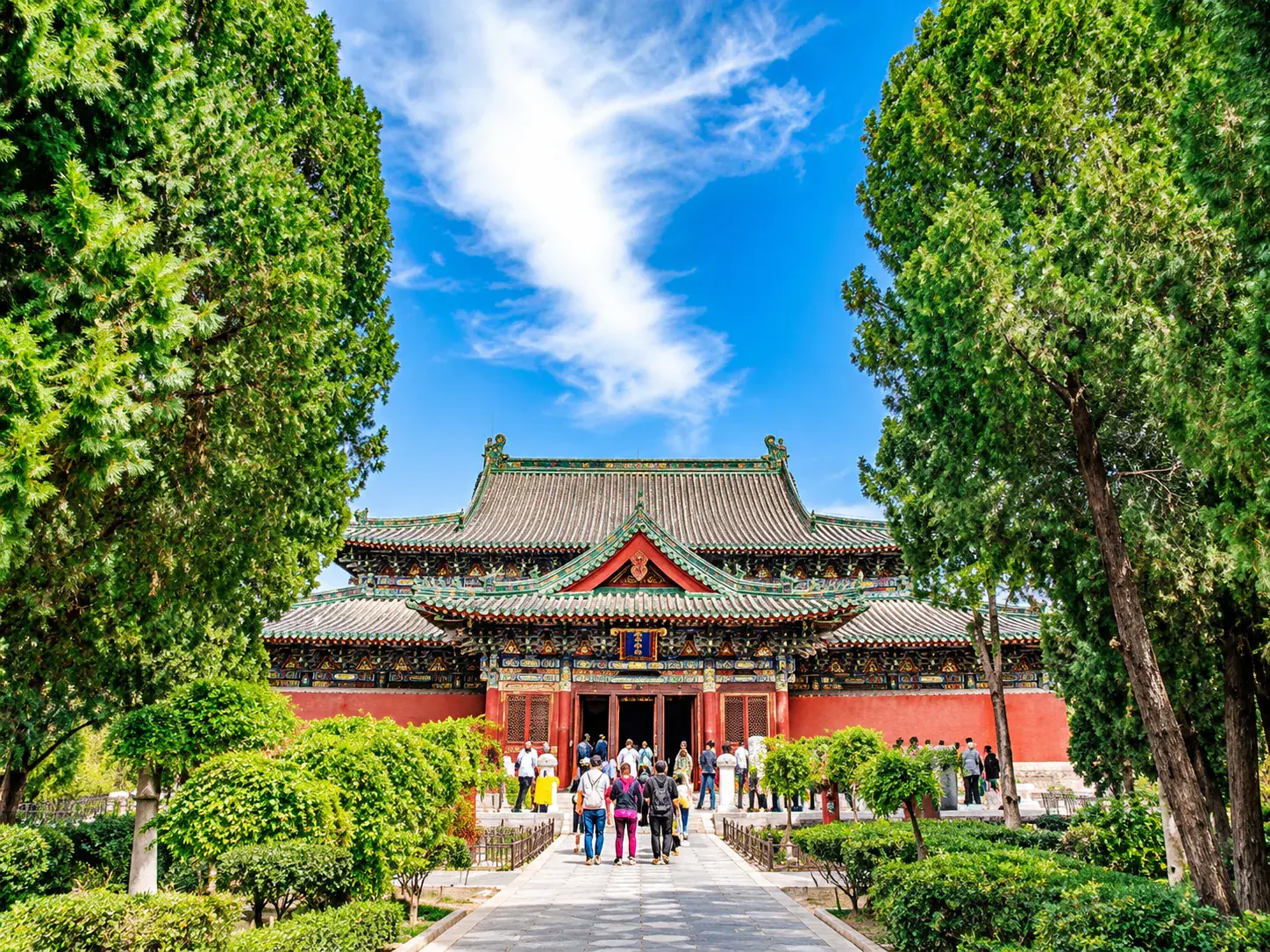
The photograph above is not the office and not the garden. It shows two brick pagodas close together, above trees, with a modern skyline behind them. The nearer tower is octagonal and finishes in a spherical finial. A taller, slimmer brick tower stands behind it. Leave the pair unnamed if you cannot tie it to a gate you have checked on the ground. Dingzhou's Liaodi Pagoda is a single very tall Song tower, south of here, a separate day often paired with that city's Qing examination hall. Zhuozhou's Liao pagodas are two different sites, not one courtyard, and not this frame. A wrong temple name sends the taxi to the wrong town.
What you are walking into
Zhili was the province ruled directly around the capital. The governor-general who sat in this compound held one of the senior provincial posts of the Qing, responsible for a territory that wrapped Beijing and covered much of what is now Hebei. Baoding held that seat for a long stretch of the dynasty. The modern provincial offices are in Shijiazhuang, and they are a later story. You came for the older one, which is still a set of courtyards you can walk.
The buildings are a yamen. Gates, halls, side courts, and a rear that was closer to residence than to ceremony. They are not a palace, and they are not a temple. There is no throne sequence hiding behind the third gate. The point is the order of the courts. A screen and a main gate set the axis. Halls along that axis are where rank was performed. Side courtyards held the daily work of a provincial government: papers, clerks, the business of ruling a large territory from a walled office. The further you go, the closer the plan gets to the people who lived here as well as governed. Give that sequence a morning. The gate is the picture people already have. The courtyards behind it are the visit.
Famous viceroys belong to the history of the post, not to a house museum of one man. In the later nineteenth century the viceroy's working headquarters shifted toward Tianjin. A long tenure in the job was often lived from the coast, not from a desk you should expect to find labeled as a private study. The Baoding compound is the seat you can still walk. Read the rooms that are actually open. Some of the story on the walls runs past the last Qing occupant into the early Republic, because the buildings kept being used. Do not arrive expecting a single frozen year.
The old military academy is a different interest and a different address. Officer training in the late Qing and the early Republic is why some people say "Baoding" in the first place. That school is not inside the yamen. After the office and the garden are finished, on a second morning in town, it can be a spare hour for someone who already cares. It cannot replace the courtyards. It cannot share a date with the tombs in Yi County.
How to use the courtyards
Arrive as close to opening as the train allows. The from Beijing page is the station half of that sentence. Baoding East is not this door. Take a taxi and show 直隶总督署. The English word yamen will not finish the ride. A photo of the two pagodas will not finish it either.
Walk the axis before you wander. People who begin in a side room and never come back to the central halls remember a scatter of displays and miss the government. The side rooms matter after the axis is clear. That is when the compound stops being a facade and becomes a workplace. Thresholds, a few steps, and open courts are the physical demand. This is not a gorge. It is also not a promise that every room is step-free. If someone in the group handles level streets and short steps, this is a fair day. Do not add a mountain path to prove the morning was active.
Summer courts are bright and short on shade. A hat and an early hour are the difference between reading a hall and photographing the gate and leaving. Winter is wind in the same courts. More of the visit feels indoor only because walls block the wind, not because the site is a heated gallery. The early October holiday and the lunar new year travel weeks can change both hours and crowds. Check the date you are actually going. This page does not invent a closing time.
Some rooms present the office as a court, and the tone is stern. That fits the building. It was a place of judgment as well as paperwork. With children, look into a room before you settle. The garden afterward is the easier hour. Adults who wanted only atmosphere will still have the axis, which is the part worth the train. You do not need to read every plaque. You do need to be able to say, at the end, that you walked from the public gate toward the private rear and understood that the distance was the point.
If the group is tired, cut side exhibitions before you cut the rear courts, and cut a second lap before you cut the garden entirely. The mistake is the opposite: a long sit in the first courtyard, a snack that becomes lunch, and a glance through the main hall on the way out. The hub is the wider map of what you are refusing by staying here. This page is only the walk.
The garden that shares the day
The Ancient Lotus Pool is the classical garden in this same district. Its history is usually traced to a Yuan-dynasty landscaping of an older marsh, repaired and extended through the Ming and the Qing. What you walk now is water, corridors, pavilions, and halls. In summer the lotuses are why the photographs exist. Summer is also the hottest and busiest version of the garden. In other months the flowers are gone and the garden still works, as shade, bridges, and rooms beside the water. Do not cancel a spring or autumn visit because a picture online was pink. Do not come in deep winter only for the flowers.
A Qing academy, the Lianchi Academy, stood in this garden. Part of the meaning is a school, not only a pleasure ground. You should not expect a reconstructed campus with a class in session. You should expect the water and the halls, and a story that includes students preparing for the civil exams. The examination compound people pair with the Liaodi Pagoda is in Dingzhou, a separate day to the south. Do not hunt for those cells along the pool. Different town, different morning.
The pool and the yamen are a neighborhood walk, not a second district. Do not call another car between them unless someone cannot walk that far. Shop streets are the texture in the middle, which is the right texture for this city. There is no palace wall to follow. You cross ordinary pavement and you arrive.
Do them on the same day, in either order. If the lotuses are in bloom and someone cares about the flowers, give the garden the light you actually want, morning or late day, and do not postpone it until dusk after a lunch that ran long. If the office is the reason you came, do the office first, while attention is intact, and let the garden be the second half. Both orders are honest. A third stop in the middle is how both become gates you photograph and abandon.
Bridges in the garden are part of the walk, not a viewpoint you tick from the entrance. Sit once. The point of pairing the sites is that the government office and the scholarly garden were the two public faces of the same old center. Seeing only one of them leaves Baoding as a single courtyard, which is thinner than the city is.
The bread between the gates
Donkey-meat shaobing (驴肉火烧) is the local snack: a baked wheat cake, split and filled with seasoned chopped donkey meat. You will see it near the old center, between the office and the garden and on ordinary streets beyond them. Hejian, in the Cangzhou belt, shares the reputation. You do not need to leave Baoding to eat it, and you do not need a shop name. A counter that is busy with people who live here is the right counter. A costumed lane is optional scenery, not a better recipe.
Ask the price before you order, and ask it about the piece in front of you. Sizes differ. A nod at a picture is easy to misread as the large one, and the filling is the part that changes the number. Wait for the number, then decide. One piece is a tasting between the courtyards. If you are hungry, eat another, or sit down for wheat noodles or dumplings. Those are the ordinary meal when someone will not eat donkey. You can skip the snack and still have done the city. You should not skip the snack because you failed to ask what it cost and then felt ambushed.
A small counter may not take a foreign card. Settle the price and the way you will pay before the bread is in your hand. Jars of pickled vegetables are what people carry away from this kind of street. You still do not need a famous name to find them. Do not turn the hour between the two sites into a restaurant quest across town. The halls are the reason the train was worth taking.
What this morning refuses
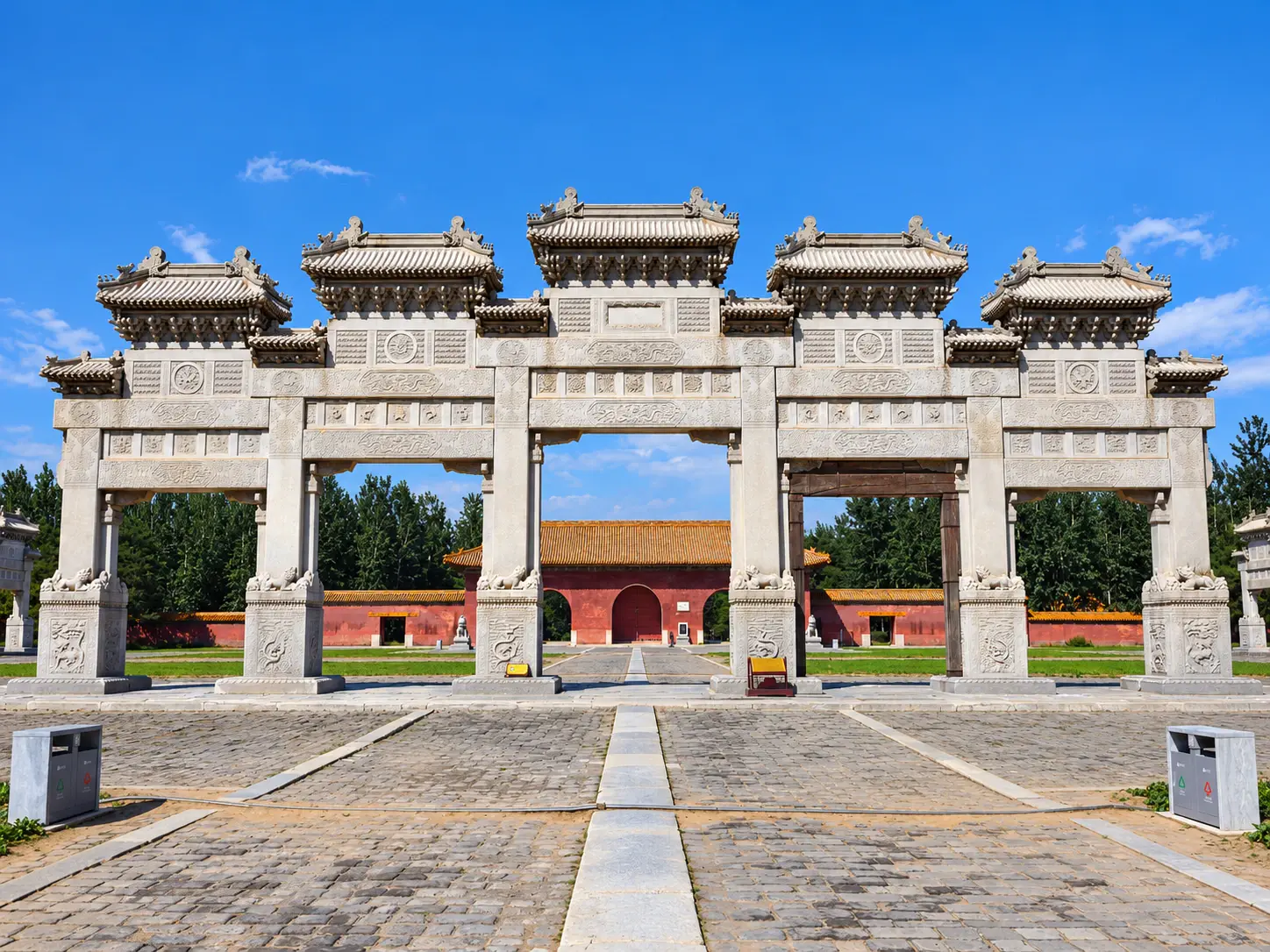
The Western Qing Tombs are in Yi County. They are a long day from Beijing and a long drive from this gate, not a stroll after the garden. Yongzheng, Jiaqing, Daoguang, and Guangxu are buried in that valley. Cixi is not. She is at the Eastern Qing Tombs in Zunhua, which is a different direction from Beijing and a different page. The walk among the western mounds is the Western Qing Tombs guide. If the archway is the wish, this walking page is the other date, or it is the date you are not using.
Yesanpo and Baili Gorge are in Laishui County. Each is a full scenic day. Do not put either of them beside the yamen the same morning. The gorge is stairs and a path that consumes daylight if you walk it. The wider Yesanpo country, river and hills, is its own date even when you never enter the gorge. A driver who says both are "on the way back toward Beijing" is describing a highway, not a visit.
Dingzhou's Liaodi Pagoda is one very tall Song brick tower, often paired with the Qing examination hall there. Go south by rail on a date that is not this one. It is not the pair of towers in the photograph, and it is not a lane behind the office. Stacking it with Yi County fails for a simpler reason: the pagoda is south on the plain, and the tombs are west in the hills.
The Mancheng Han tombs are a separate ride to the southwest, the rock-cut burial of Liu Sheng and Dou Wan. Do not promise that the jade suits are on display at the hill. Check what is actually exhibited before you go. Do not start that ride on the morning you owe to the yamen. If the suits are the point, confirm the cases you can see that week before you spend the afternoon. Chambers in a hillside and a museum case in another city are different errands.
From the platform to the plaque
Many fast trains from Beijing West to Baoding East take well under an hour. Confirm the timetable when you book and again on the morning you ride. The number on the ticket is not the visit. Station security, a taxi queue, and a cross-town ride sit on both ends. The high-speed station is not the yamen door. Show 保定东 if you are telling someone where the train arrives, and 直隶总督署 when you want the gate.
Some slower trains use Baoding Station (保定站), without the East. That stop is nearer the old center and still not the office. If the ticket does not say 保定东, do not assume you bought the fast hop. Read the characters before you tell anyone you will be at the garden at a particular minute. The from Beijing page is the full version of this arithmetic.
Save 直隶总督署 and 古莲花池 offline before the platform crowd eats your signal. Zhili is the Qing name on the plaque. Hebei is the modern province. A map search for a loose English nickname often fails. The garden is called a lotus pond, a lotus pool, and an ancient lotus garden in English. The characters do not multiply. A green city park that is not 古莲花池 is a different walk. Use the characters.
This page does not send you along a numbered metro line. For a short stay the clear tool is a taxi between Baoding East, the office, and the garden. Leave large bags at your lodging or in a locker you have found, not on the axis. There is no Baoding city tour on this site to book instead of that taxi. The arranged day that leaves from a Beijing hotel and does not come here is the Western Qing Tombs day tour. Use it when the cemetery is the wish. It will not pause at the lotus pool because the afternoon still looks empty.
A day trip, or the night that calms it
A same-day return can work when the morning train is early, the return is late, and every county has been refused out loud. You walk the office, you walk the garden, you eat the bread you priced, and you ride back to Baoding East with time for a queue and a wrong turn. If the only return you can hold forces you to leave the garden at a jog, this is not a day trip. Stay the night. Buy that return before you travel in a holiday week. A sold-out evening train is how a simple civic day becomes an unplanned hotel.
One night does not add the tombs. It adds a calm morning at the office, or it puts you closer to Yi County for a different date that is only the cemetery. The itinerary keeps those lengths apart. Sleep near the old center if the next morning is the yamen at opening. If the next morning is the tombs, sleep where a driver can find you, and do not also promise the garden before the car leaves. Changing lodging at noon spends the margin you came to buy.
If the journey continues south, Shijiazhuang is a new wish, not a coda after the pool. The bronze at Zhengding, the stone bridge in Zhao County, and the gorge at Cangyan have their own shapes. The Zhengding day tour is the bronze. The Shijiazhuang two-day tour adds the bridge and the mountain with a night. A Shijiazhuang private driver is the tool once you are already in that city and the day is a county road. None of those starts with a late breakfast beside the lotuses. Read the Shijiazhuang guide before you try to make them one gesture. Beijing is the city you leave in the morning. The Hebei guide is the province around both.
A mixed group, and the hour you protect
Someone who wants the courts, someone who wants flowers, and someone who wants a gorge are three trips. On this date the courts and the flowers can share the day. The gorge cannot. Say that before a car is ordered "just to see."
Knees that manage the yamen may still refuse Baili Gorge, and they may still need the tombs cut back to the archway and one mound. A successful city morning is not evidence that the valley will feel easy. The city morning is mostly level, with garden bridges and the occasional step. Laishui is steps. Yi County is a long walk on stone with real distance between mounds.
Children do well with the garden, the bread, and a short pass along the main halls. They do less well with every side room. Let the axis be the visit and the pool be the rest of the day. If a room feels like a courtroom, do not linger to prove a point. Photographers who want the two pagodas in the opening picture need a place they have checked and light that is not flat midday haze. That errand is not this axis, which wants an unhurried walk from the public gate inward.
If lotus season is why you came, protect the garden's hour and accept the heat. If the office is why you came, do not trade the rear courtyards for a longer lunch. If neither is why you came, you are reading the wrong page. Write the morning as two names and a snack whose price you asked before it was filled: 直隶总督署, then 古莲花池. Everything else in the prefecture can wait for a day that has room.
Ways to plan the days
A rail day from Beijing can hold the town. It cannot hold Yi County as well.
Walk
Time fit: 1 day
Yamen, lotus pool, snack, train.
- Walk
Why choose it: Yamen, lotus pool, snack, train.
With a night
Time fit: 2 days
Town day, tombs the next morning.
- With a night
Why choose it: Town day, tombs the next morning.
Rain
Time fit: 1 day
Stay in the courtyards and skip the scenic county.
- Rain
Why choose it: Stay in the courtyards and skip the scenic county.
Want the walking day left alone?
We will not add Yi County because the afternoon looks empty on a map.
Keep planning
Town questions
- Do not assume it. Check on the day, and still visit them as one walk.
- Donkey-meat shaobing. Ask the price. This guide names no shop.
- No. Yi County takes the day.
- No. The photo is two pagodas. The yamen is a courtyard visit.
- A taxi or a local ride. Do not expect the high-speed platform to face the gate.
- None on this site. The Western Tombs day does not stop for the lotus pool.
Walk the yamen and the lotus pool together
That pair is Baoding. The cemetery is a different morning.