Shanhaiguan at a glance
| Detail | Plan |
|---|---|
| First stop | The First Pass gate and the famous tablet |
| The geography | Old Dragon's Head, where the Wall enters the sea |
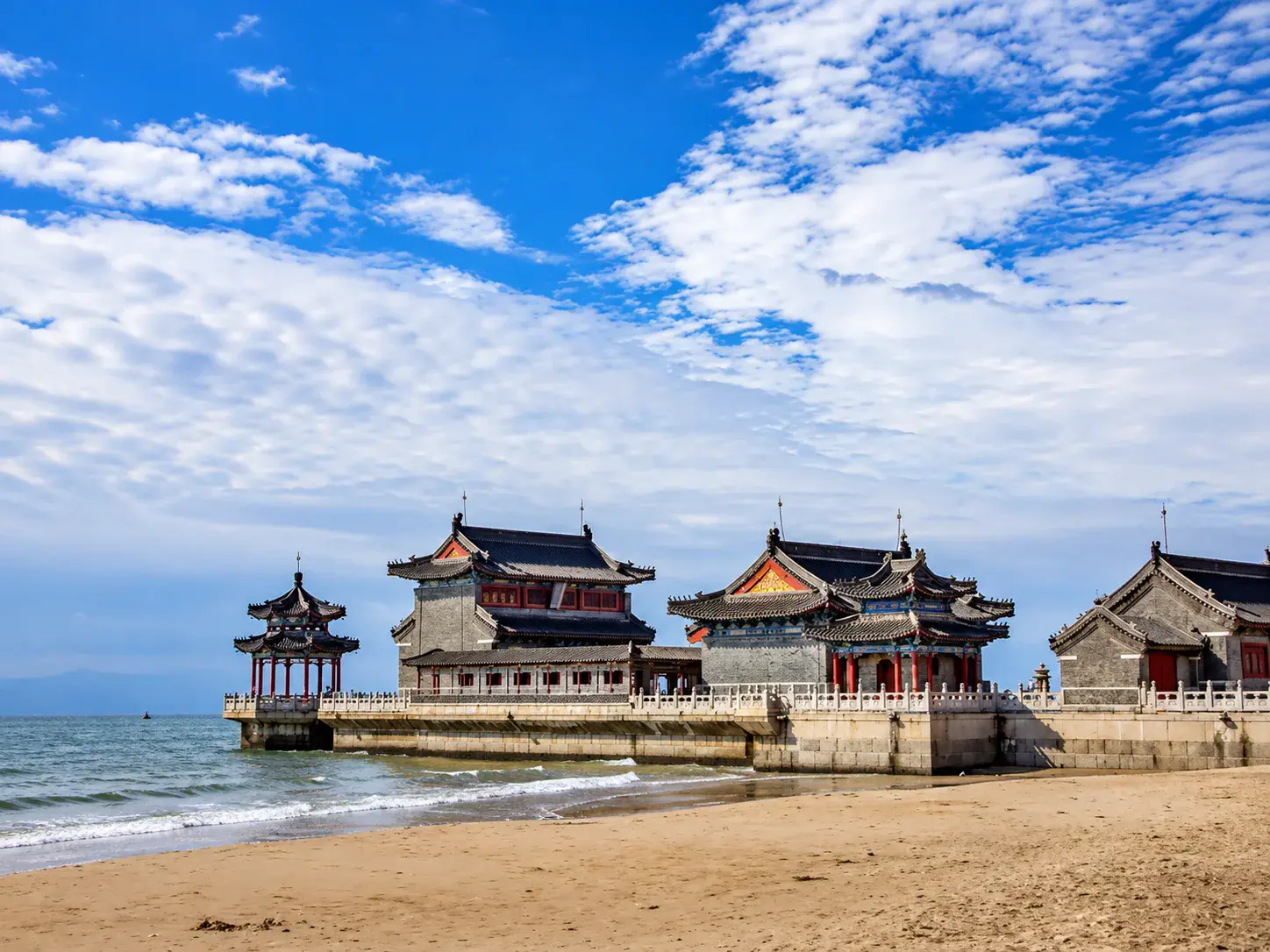
| Honesty | The pier complex is a late-20th-century rebuild |
| If energy remains | Jiaoshan stairs, often a separate ticket |
| Optional story | Mengjiangnu Temple, folklore rather than a must |
| From the beach | About half an hour by car to Beidaihe |
Shanhaiguan is the pass at the eastern end of this coast, where the Ming Great Wall meets the Bohai Sea. It is not a single gate you photograph and leave. The famous tablet, the pier in the water, and the first mountain of the Wall are three visits, often three tickets, inside one town. Treat them that way or the day collapses into a crowded doorway and a long ride home.
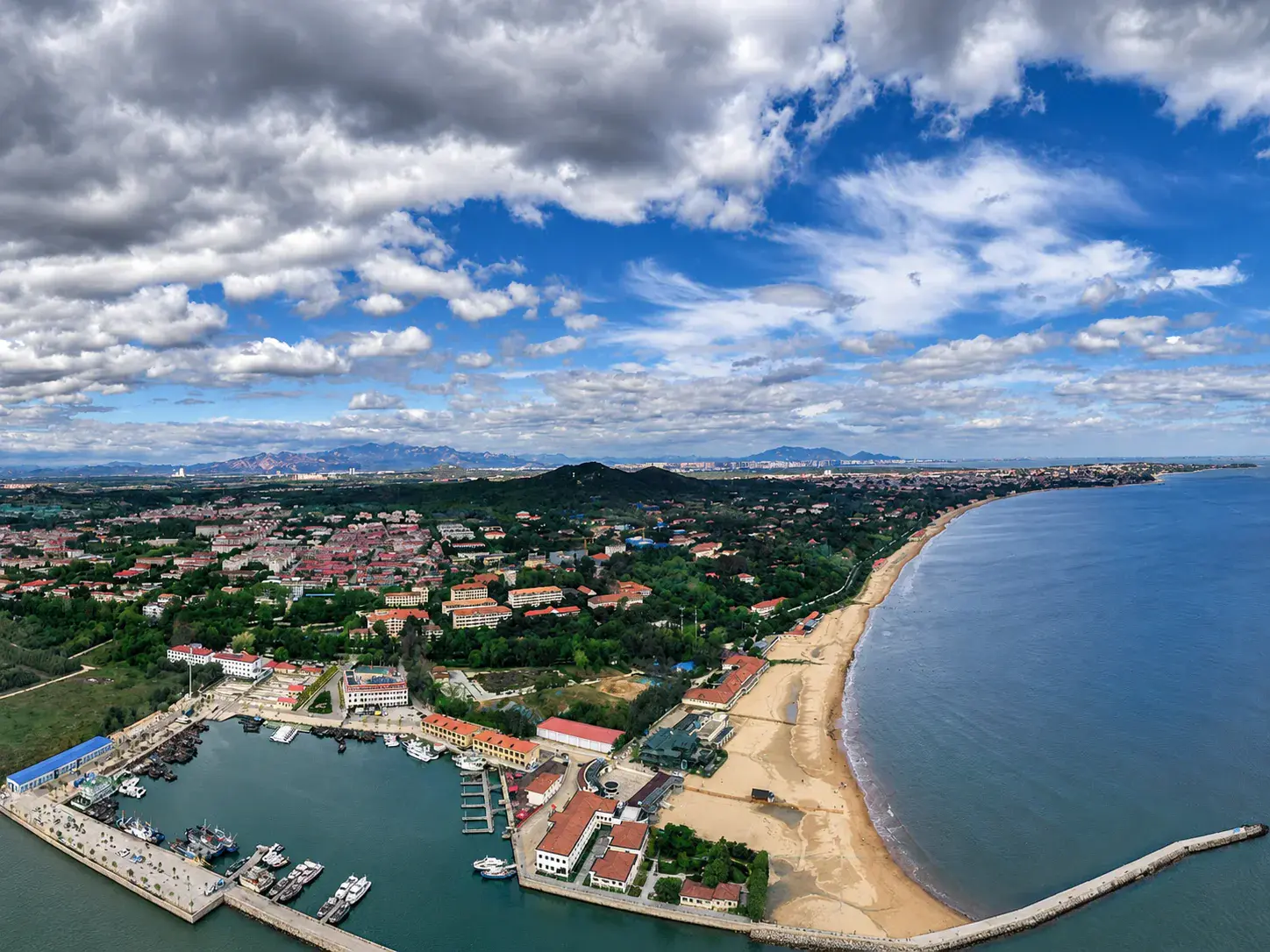
The town sits east of Beidaihe. In ordinary traffic the drive is about half an hour, which is short for a car and impossible as a walk. Qinhuangdao city, the port at Haigang, is the third name on the map and the wrong place to sleep if the morning has to start here. The Qinhuangdao guide holds those three names apart. This page is the order of the sites, how long they actually take, and when a same-day return to Beijing is enough.
Beijing is the usual start. Many direct high-speed trains take about two hours, sometimes a little less, sometimes longer when they stop more often. Not every train calls at Shanhaiguan Station. If the only stop is Qinhuangdao Station, you have added a taxi before you have seen a brick. Read the stop list. The from Beijing page is that list in full.
Three visits, not one doorway
The First Pass is the walled gate and the tablet people mean when they say the name of the town. Old Dragon's Head, Laolongtou (老龙头), is the rebuilt pier where the Wall enters the sea. Jiaoshan is the mountain immediately inland, stairs and a view back toward the pass and the coast. Mengjiangnu Temple is a folklore stop nearby. It is not a fourth equal.
They do not share one entrance in any way you should trust from a blog. Tickets are often sold separately. A combined rule can exist on a given day and vanish the next. Check what your ticket covers when you buy it, at the gate, not the night before from memory. Assuming the pier is included because you already passed the tablet is how a group splits into the people who go in and the people who wait in the lot.
You cannot walk this set from a Beidaihe hotel as if it were a neighborhood. The half-hour car is the connection. Do it in the morning, toward the pass, and do not schedule a return to the beach "for an hour" in the middle. The beach evening works after the Wall. It does not work as a sandwich.
The First Pass at opening
Start here when the photograph of the tablet matters. The gate tower is the crowded picture, and the crowd arrives with the tour buses. Opening is the kind hour. A late morning arrival can still be a real visit. It will be a visit conducted over other people's heads.
The tower is stairs. Say so before you promise the tablet to someone who cannot climb. The ground-level walls and the street outside still explain the pass: this is where the Ming line met the sea road, and the gate is the monument to that fact. The tablet is the famous object. It is not the only thing the walls are doing.
Do not spend the entire ticket on the single frame of the inscription. Walk the wall that is included, look east and west, and leave while you still have patience for the pier. People who exhaust themselves on repeated angles of the same characters then skip Old Dragon's Head have inverted the day. The gate is the name. The water is the geography.
Guides at the entrance will offer a faster story than you need. A short version is enough: the pass, the garrison town, the Wall running to the sea. You are not sitting an exam. If the group includes children, one climb to the tablet is the theater. A second climb because a ticket still had time on it is how the afternoon sours.
Old Dragon's Head, and the rebuild
Old Dragon's Head is why the pass is on a coast itinerary at all. You walk a complex built out into the Bohai, with pavilions along a pier, and you see the line of the Wall come down to the water. That meeting is the visit. Stand there long enough to understand it, then walk the pier at an ordinary pace.
The complex you are walking was heavily rebuilt in the late twentieth century. Go for the meeting of wall and water, and for that walk, not for untouched Ming fabric. The bricks under your shoes are a restoration of an idea that is historically real: the Wall did end in this sea. They are not a frozen Ming work site. Honesty makes the pier better, not worse. You stop hunting for original mortar and start seeing the gulf.
It is still not a step-free museum. The rebuilt complex is more of a walkway than Jiaoshan, and it is more forgiving than the gate tower, but thresholds, crowds, and wind are part of it. In July and August the pier is hot. In October it is jacket weather, which is often the better visit. Golden Week crowds the railings even when nobody is swimming. A red flag on a beach does not apply here in the same way. You are not here to swim. Stay on the walkway the site expects you to use.
Give Laolongtou the unhurried part of the morning. Rushing the pier to make a third ticket is the common waste. If the choice is a calm half hour on the stones over the water, or a hurried Jiaoshan so the day looks complete, keep the water.
Jiaoshan, often its own ticket
Jiaoshan (角山) is the first mountain of the Wall. The visit is stairs, then a view back toward the pass, the town, and the coast. It is a different effort from the pier. Many people do the gate and Old Dragon's Head and leave the mountain for another morning. That is why a second night exists, not because the mountain is a secret.
The ticket is often separate from the First Pass and from Laolongtou. Budget attention, not a guessed fee. Ask at the window whether this climb is included. If it is not, decide in the parking area, with the whole group present, before anyone starts up. Splitting the decision halfway up the steps is unpleasant and slow.
Skip Jiaoshan without guilt when someone cannot climb, when the heat on the pier has already spent the group, when the return train is the constraint, or when Beidaihe in the evening is the success you actually wrote down. The mountain will still be the first mountain tomorrow. It will not be improved by a sullen ascent at the end of a rail day from Beijing.
The view is the reward: the pass in one direction, the gulf in the other, the Wall leaving the flat ground. If that sentence is exciting to the people who will do the stairs, give them the time. If it is exciting only to one person, do not make it the group's surprise.
Mengjiangnu Temple
Mengjiangnu Temple is optional folklore. The story travelers hear is of a woman whose husband died on the Wall, and whose grief is said to have brought a section of it down. It is a legend people in China know the way other places know a folk song. The temple is a short stop for anyone who already cares about that story.
It should not displace Old Dragon's Head. If a driver or a desk itinerary puts the temple first and the pier "if there is time," reverse it. The pier is the geography. The temple is a commentary. A short stop after the water, when legs and trains agree, is the right size. A long stop that makes you late for Laolongtou is the wrong size.
You do not need the legend to understand the pass. If nobody in the group knows the story and nobody wants it, skip the temple and sit down. Forcing folklore at the end of a hot morning produces neither memory nor goodwill.
How long to allow
The gate and Old Dragon's Head together are a morning if you start near opening, keep lunch short, and do not add Jiaoshan. That is the length that still leaves a Beidaihe evening on an overnight trip. Add the mountain and you have spent the best of the day, which is a fair trade only when the beach is tomorrow or already happened.
All three sites, plus the rides between them, fill a Wall day. They do not fill a Wall day that also includes two high-speed legs to Beijing and a walk on the sand. Something will be a glimpse. Decide which glimpse you refuse before you buy the return ticket.
Transfers inside Shanhaiguan are real. The gate, the pier, and the mountain are not one courtyard. A car that stays with you, or a taxi you can call twice, is the practical tool. Walking between them as a single scenic path is a hopeful reading of the map. Do not plan on it with luggage, children, or a train.
The itinerary turns these lengths into one-night, two-night, and same-day shapes. Use it when the argument is about how many sleeps, and use this page when the argument is about which gate to enter first.
An order that does not collapse
Open at the First Pass. Move to Old Dragon's Head while the group is still willing to walk a pier slowly. Eat after the pier, not before, unless someone will be miserable. Hold Jiaoshan for the afternoon only if the return, or the beach, is secure. Hold Mengjiangnu for the gap that appears, and drop it the moment the gap disappears.
A different order is sane in one case: you care more about the water than the tablet, the gate is already packed, and the pier is clearer. Go to Laolongtou first, then the gate. Do not also invent a third order that starts at Jiaoshan "to beat the crowd" and then finds the pier closing its best light while you are still on the steps. The mountain is the flexible piece. The water is not.
If you slept in Beidaihe, the half-hour drive is the start of this sequence, not a scenic extra. Leave after a hotel breakfast. A promenade cafe "for a minute" is how opening becomes mid-morning and mid-morning becomes the crowd. The resort will still be there at dusk. That is the point of having slept on the coast.
If you slept nearer the pass, you can make opening without a cross-town gamble. The cost is a shorter beach, or a beach that happens late, after you have driven back west. One bed, chosen for the fragile hour, is still better than a checkout at noon between the two.
When a same-day return fits
A same-day return from Beijing fits when the only goal is this Wall and you already know you will skip the beach. That is a Wall day, not a coast holiday. The Shanhaiguan Great Wall tour is built for that narrower day: out, the pass and the sea-end, and back. It does not quietly become a Beidaihe evening. If someone adds the resort to that date, the addition is what you cut.
On your own rail ticket the same rule holds. About two hours each way sounds generous until you add station time, a taxi if the train missed Shanhaiguan Station, the gate, and the pier. Jiaoshan fits on that day only when the return is late enough to miss without sleeping in the station. The beach does not fit. A "quick" Tiger Stone stop on the way back is how people miss trains.
Not every northeast-bound train stops at every station. A same-day plan that depends on a train calling at Shanhaiguan, when the timetable only calls at Qinhuangdao Station, has hidden transfers at both ends. Those transfers are the difference between a Wall day and a day of platforms. Check the stop list before you call the day easy.
Summer heat and Golden Week both argue against a same-day trip that tries to be clever. October, with a jacket and a train that actually stops here, is the kinder version of the there-and-back. You still skip the swim. In October there is rarely a swim worth skipping.
When the night is the better tool
One night is the useful minimum if you want both the pass and the beach. Arrive from Beijing the afternoon or evening before, sleep in Beidaihe if the shore evening matters, and give the next day to this order. Leave the following morning. That is a two-day shape with one sleep. It is the length that lets the pier be slow.
Two nights is the length that adds an unhurried beach morning or a real Jiaoshan visit without borrowing time from the return train. It is also the length for children, older walkers, and anyone who dislikes a pre-dawn departure. The Qinhuangdao two-day tour is the packaged form of keeping the pass and a Beidaihe evening together. Use it when you want the order set. Use your own trains when you are happy to read the stop list yourself.
Do not bolt Chengde onto the same date. The Mountain Resort is a different direction from Beijing. A triangle drawn on a phone is not a rail itinerary. Zhangjiakou and Chongli are a ski trip. They are not a mountain you add after Jiaoshan because the word "mountain" appeared twice.
The Wall nearer Beijing is a different wall. Mutianyu or Jinshanling on the morning you return from Shanhaiguan is two Walls before lunch. Seeing the sea-end does not retire the sections in the hills, and the hills do not give you Laolongtou. Space them by a day, or pick one.
Stairs, wind, and who should skip a climb
The mobility question is the gate tower and Jiaoshan, not the flat promenade at Beidaihe. Old Dragon's Head sits between them: a walk, a rebuilt complex, wind on the pier, and still not a promise of step-free halls. If someone cannot climb, say so before the itinerary includes the mountain. They can have the pass at ground level and the pier, which is the meeting of wall and water, and that is a complete visit.
July and August put real heat on the stones. Carry water, use the earlier train or the earlier car, and do not schedule the pier for the hour when the resort beaches are also at their most glaring. September is calmer without being empty. October wants a jacket even when the platform in Beijing felt mild. Winter is a sharp wind off the gulf and a Wall visit that does not compete with swimming season, because swimming season is over.
Drones are a bad idea at the pass and over the pier. Assume they are unwelcome even without an English sign. Ask before close portraits of people who are not in your group. The tablet is a public monument. The faces around it are not a backdrop you own.
Shoes that can handle smooth rebuilt stone matter more than a second lens. A hat in summer, a shell in October, and a power bank for a crowded train are the whole special kit. Swimwear does not belong in this daypack unless the beach is genuinely later and the flag, not your optimism, will decide the water.
Food, the ride back, and the train
Eat after the main site, not in a way that steals opening. Restaurants near the gate price for people who have just finished a monument. A simple meal is enough. If you continue to Beidaihe for seafood, ask the price before the fish is cooked. A photo menu is not the whole bill. Do not try to have the "famous" meal in both towns on the same date.
The ride back west is half an hour in ordinary traffic and longer when a holiday has filled the coast road. Golden Week is that holiday. Leave a gap before any train that leaves from Qinhuangdao Station or Beidaihe Station rather than from here. Being on the Jiaoshan steps while your bags are supposed to be in a security line is the failure this page is trying to prevent.
Buy the return after you know whether Jiaoshan is in the day, or pick a train with a gap you can miss. A late afternoon departure after Old Dragon's Head can work. A departure that requires the mountain, the temple, a beach stop, and the port station does not work. Cut from the front of that list until the train is boring.
The province around this pass is sketched in the Hebei guide, and the city you are probably using as a base is Beijing. Shanhaiguan is a coast add-on to that base. It is the eastern end of a Ming line, rebuilt where it meets the water, and worth a morning you do not share with a second region. Give it the gate, the pier, and only as much mountain as the day still has.
Ways to plan the days
A same-day tour from Beijing fits when the Wall is the only goal. Add a night if Beidaihe is also required.
Wall morning
Time fit: Half day
Gate and Old Dragon's Head, Jiaoshan left for later.
- Wall morning
Why choose it: Gate and Old Dragon's Head, Jiaoshan left for later.
Wall day from Beijing
Time fit: 1 day
The Shanhaiguan day tour, no beach promise.
- Wall day from Beijing
Why choose it: The Shanhaiguan day tour, no beach promise.
Pass plus beach
Time fit: 2 days
This morning, then Beidaihe, with a night on the coast.
- Pass plus beach
Why choose it: This morning, then Beidaihe, with a night on the coast.
Want Shanhaiguan without pretending it is untouched Ming brick?
We plan the gate and the sea-end as the visit, and Jiaoshan only when the group still has stairs in them.
Keep planning the coast
Shanhaiguan questions
- The meeting of wall and sea is the point. The complex you walk was heavily rebuilt in the late twentieth century.
- Often no. Check the day's rule. Assume separate tickets until you see otherwise.
- A morning for the gate and the pier. Jiaoshan is stairs and a view, and it is why a second morning exists.
- An optional folklore stop. It is not required to understand the pass.
- Yes, if you skip the beach. That is what the Shanhaiguan day tour is for.
- No. Do not put them on one date.
Give Shanhaiguan its own morning
The First Pass and Old Dragon's Head are the visit. Jiaoshan is a second budget of energy, not a free extra.