
Macau at a glance
| Detail | Plan |
|---|---|
| Day trip | Early ferry, peninsula only |
| Comfortable first stay | 2 nights if Coloane matters |
| From Hong Kong | Ferry about 55–70 minutes, plus immigration |
| Walk | Senado, the facade, the fort, A-Ma Temple |
| Ride | Taipa, Cotai, and Coloane |
| Entry | Check Macau separately from Hong Kong and the mainland |
These are the shapes of a first cultural visit, written so you can recognise yourself in one of them before you look at dates. Both live on Macau tours. Historic Macau is two days: the peninsula and Taipa. Classic Macau is three days: the same ground, plus Coloane and a slower food evening. Neither shape is a casino tour. A week that also includes Hong Kong is arranged from the Hong Kong side, with the Hong Kong days kept intact.
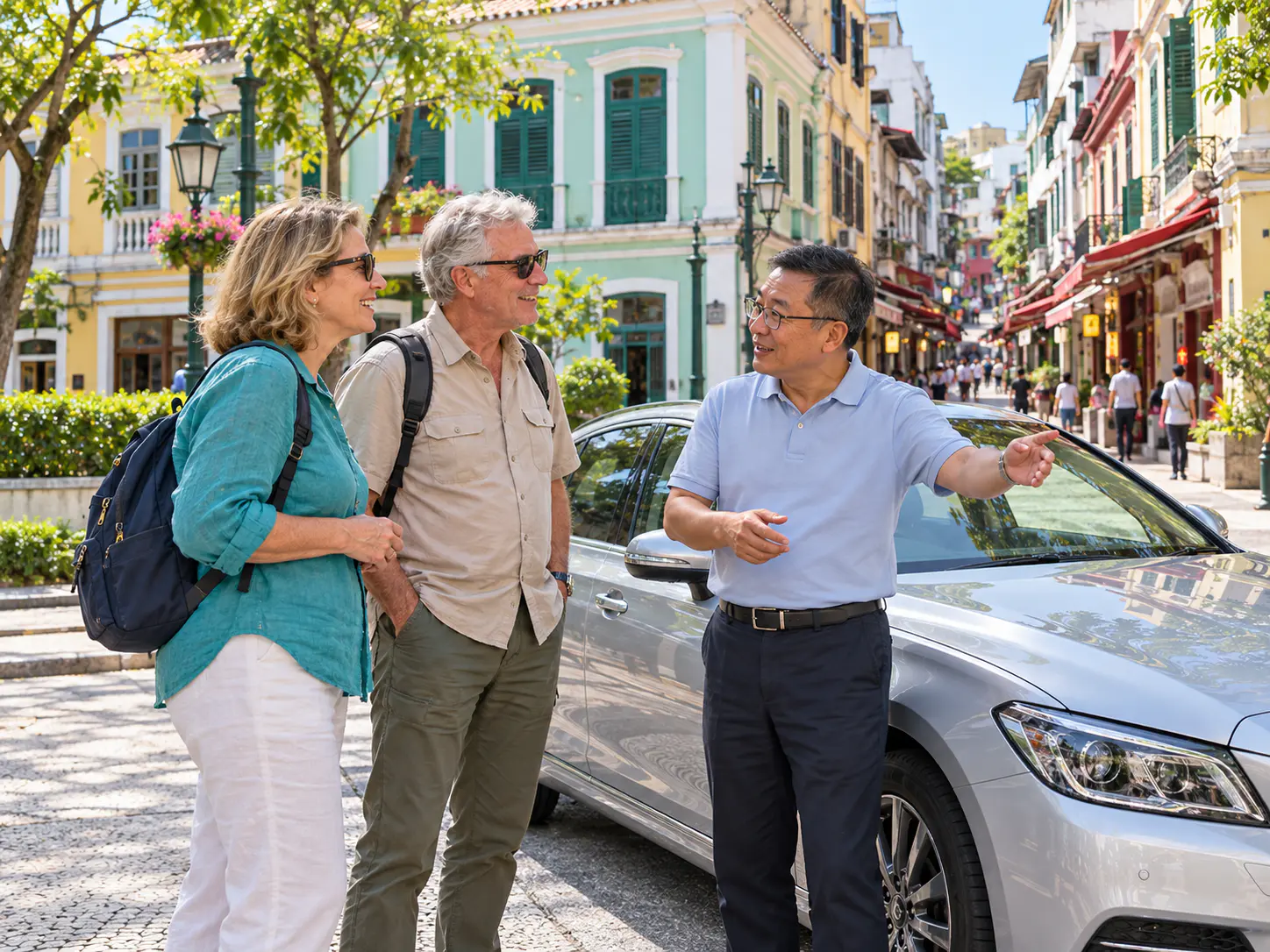
The walking order inside the days is the historic centre at a human pace, then the villages. A private sightseeing marathon is a different wish from the one these shapes were built for.
What these shapes are for
They are for a traveler who wants the UNESCO streets, a Macanese meal, and enough time that the ruins are not a photo taken on the way to somewhere else. They assume you will walk the peninsula. They assume Taipa is a place you sit down. They assume Coloane, when it appears, gets a morning rather than a wave from the road.
They are a poor fit if your main hope is the gaming floors, a pool day, or a long list of resort interiors. Cotai exists, and a single public hall can be a glance on the way to a hotel. It is not the spine of either trip. A first cultural visit can ignore the gaming floors completely and still be the full trip we mean.
They are also a poor fit for a noon arrival followed by every church and a village. The shapes start with a real first morning. If your crossing from Hong Kong cannot give you that morning, the fix is an earlier boat or an extra night, not a faster guide.
Historic Macau, across two days
Historic Macau is the two-day shape. Day one is the peninsula. Day two is Taipa. You sleep once in between, which is what lets the second day be a meal and a wander instead of a sprint back to a pier.
The peninsula day follows one direction so you do not climb the same hill twice. Senado Square, a short step to the cathedral, St. Dominic’s on the way north, the stairs and the stone facade of the Ruins of St. Paul’s, then Mount Fortress and the Macau Museum. If the morning started properly, the walk continues southwest to A-Ma Temple. Guia Fortress and the lighthouse are the high point, and they are included only when the group is fresh enough to do that hill first or by bus. They are not glued to the end of a tired afternoon and called a bonus.
Day two stays in Taipa Village: the lanes, the food street, the church hill if you want the roofs, and a meal you do not rush. African chicken, a pork chop bun, a Portuguese egg tart, serradura if the table wants something cool. We are not marching you to a single “best” restaurant. We are putting you in the village at the hour when eating is the point.
Coloane is not part of this shape. The original egg-tart bakery will still be there, and this trip does not pretend a kiosk stop is the same thing. If the bakery and the chapel are on your list, you want Classic Macau, not a squeezed extra at the end of day two.
How the peninsula day is paced
The day starts early enough that the ruin stairs are a pleasure rather than a heat drill. Summer still asks for water, a hat, and the museum as shade. October through December asks for less heroism and rewards the same early start with better light. Either way, the pace is walk, look, step inside one church, climb once, and rest on purpose.
The facade is a wall and a staircase, not a nave you tour for an hour. We say that before anyone is disappointed. The cathedral and St. Dominic’s are the complete church interiors on this morning. The museum is the indoor chapter. A-Ma is the change of tone at the end, incense and rock instead of another European front, and it is worth the walk down when the day was not already spent on a transfer.
What this pace refuses is a shopping block in the middle of the climb, a detour to a resort before A-Ma, and a last-minute Guia “because we are close.” You are not close. The square, the fort by the ruins, and the lighthouse hill are different efforts. Historic Macau would rather do the central line well than tick every pin on the peninsula.
If someone in the group cannot manage the stairs, the day shortens at the facade approach and keeps Senado, the cathedral, and St. Dominic’s. That is still the historic centre. It is not a failure of the shape. Pretending the stairs are optional for everyone, and then rushing the people who can climb, is the failure.
Taipa on the second day
The second day of Historic Macau is deliberately lighter. You have already done the stairs. Taipa Village is low lanes, a small hill with a view, and food. The point is to be there long enough to order a plate and finish it.
A pork chop bun can be the walking bite. African chicken can be the seated one. An egg tart here is a good tart and, on this shape, an honest substitute for the Coloane shop you are not visiting. Serradura closes lunch if the weather is heavy. None of this needs a ranked address. A busy room that is actually cooking beats a famous queue that blows the afternoon.
Cotai may be visible, and you may sleep near it. Walking a single public interior is allowed as scenery. It is not a second itinerary, and the gaming floor is not a scheduled stop. If a traveler wants that hour, it sits outside the walking plan with a clear meeting time, so the village meal does not shrink to accommodate a windowless room.
You return to Hong Kong, or onward, at the end of this day from the terminal that matches where you are. A Taipa-side departure is natural. A peninsula departure is fine if the hotel was there. What is not fine is a Coloane add-on invented at breakfast because the bakery came up in conversation. That is the next shape, with another night attached.
Classic Macau, across three days
Classic Macau is the three-day shape. It keeps the peninsula day and the Taipa evening, and it adds Coloane on its own morning plus enough time that the food evening is actually slow. Two nights, three days. This is the comfortable first trip when casinos are not the reason you came.
Day one can breathe. Guia Fortress, chapel, and lighthouse can open the morning when the weather is clear, because you are not saving your legs for a same-day ferry home. Then the central walk, in the same non-backtracking order, and A-Ma Temple toward the southwest while there is still light and patience. The museum fits. A long sit-down in the middle of the climb does not.
Day two is Taipa, and the evening is protected. You are not leaving Macau that night, so dinner can start at a human hour and continue past the point where a day-tripper would be in a taxi to the pier. This is the meal the shorter shape can only approximate.
Day three is Coloane and the departure. The village first. The rest of the territory does not get a farewell lap.
How to choose
| Choice | Fit | Skip when |
|---|---|---|
| Historic Macau | 2 days | The peninsula churches and squares, plus a Taipa meal. |
| Classic Macau | 3 days | Add Coloane and a slower food evening. |
| Day trip from Hong Kong | 1 day | An early ferry, the historic walk, and a realistic return. |
Coloane, without rushing the churches
Coloane Village on Classic Macau is a morning with three beats: the square, the Chapel of St. Francis Xavier, and the original Lord Stow’s bakery. The chapel is the small village church, faced onto the square, not a second St. Paul’s and not a place to spend a solemn hour. The bakery is the original shop, in the village, not a downtown kiosk and not a resort counter with the same pastry. You go there, you eat the tart warm, and you stop researching tarts.
Hac Sa can follow if the group wants to see the beach and the weather is ordinary. It is a look at the shore. It is not a swimming finale, and it is not a reason to leave the chapel early. If the morning is hot, wet, or short because of a ferry, Hac Sa is the piece that goes. The square and the bakery stay.
This morning works because the churches of the peninsula were yesterday or the day before, not an hour ago. You are not asking anyone to feel reverent about a third facade in one breathless loop. The chapel lands because the day is quiet. Rush it and Coloane becomes a suburb you drove through, which is the outcome Classic Macau exists to avoid.
The slower food evening
The slower food evening is a Taipa evening with nowhere else to be. You walk the lanes before or after, you sit, and you order the Macanese plates you care about without splitting the table into a schedule. African chicken for the people who want a plate. Buns for the people who want to keep a hand free for the street afterward. A tart if the Coloane original is still ahead of you tomorrow and you cannot wait, or skipped tonight so tomorrow’s bakery is the first one. Serradura when the air is warm.
Slow means a second drink is allowed and a taxi to Cotai is not required. It means the conversation can outlast the first course. It does not mean a crawl of many restaurants in search of a winner. One good table, chosen because it is cooking, is the evening.
If the group has eaten heavily at lunch on the peninsula, this evening can move later and stay lighter. The shape protects the time. It does not force a banquet on top of a banquet. The failure mode is skipping the sit-down entirely because a resort buffet looked easier. Easier is available every night of your life at home. Taipa’s lanes are why this day was drawn.
What these shapes leave out on purpose
They leave out a casino programme. You will see resort buildings if you sleep on Cotai or drive past the strip. You will not be walked through gaming floors, and you will not be told you missed Macau because you declined them. They leave out Hac Sa as a beach holiday. They leave out Guia on any afternoon when the group is already finished. They leave out the fantasy that a private car should shadow you through the historic lanes.
They leave out Coloane from the two-day shape, on purpose, so Historic Macau stays honest. They leave out a second peninsula climb from the Coloane morning, so Classic Macau stays calm. They leave out Zhongshan, Zhuhai sightseeing, and any mainland add-on. Those are different entries and different days.
A private car still has a job at the edges: luggage, a late ferry, or a Coloane-plus-peninsula day for people who will not ride buses. Walking remains the default inside the UNESCO streets, and buses, taxis, and hotel shuttles remain the default out to the villages. When the awkward transfer is the thing you want handled, that car is a separate product, Macau private driver, not a silent inclusion you should assume inside every walking day.
Hong Kong plus Macau lives on the Hong Kong tours
A week that joins the two cities is a Hong Kong trip with a Macau chapter, and it is kept on Hong Kong tours so you are not choosing between two versions of the same week. The Macau chapter that fits a five-day combination is the Historic Macau shape: peninsula, a night, Taipa, and the return. Classic Macau, with Coloane and the slower evening, wants more room than a five-day week can give without hollowing out Hong Kong.
Plan the Hong Kong days as Hong Kong days. Cross once, stay the Macau nights in a row, and cross back. A day trip in the middle of a Hong Kong week is available and should stay a peninsula day with an early boat, not a secret attempt to do both shapes between breakfasts. The ferry is 55–70 minutes. The immigration halls are extra. Noon arrivals still do not unlock every church and a village.
Use this page to pick the Macau size. Use the Hong Kong tours for the week that holds it, so the Hong Kong days stay written where they have room.
How to tell whether two days is enough
Two days is enough when your list is the historic centre and a Taipa meal, and you can say so without immediately adding “and the bakery, and the beach, and the lighthouse, and one resort.” Historic Macau was drawn for that list. You will walk Senado, the churches, the facade, and the fort. You will eat in Taipa. You will go home with a coherent picture.
Two days is not enough when Coloane is emotionally part of the trip, when you want Guia and A-Ma and the museum without negotiating, or when your Hong Kong arrival into Macau is late and you still want a full first day. That is Classic Macau, or it is Historic Macau plus a calmer expectation. Say which one you mean before the dates are fixed.
Age and heat matter more than pride. In summer, two days can be enough only if the peninsula morning stays early and short of extra hills. In October through December, two days feel spacious for the shorter list and slightly mean if you keep trying to bolt Coloane onto the exit. Chinese New Year and Golden Week make both shapes feel smaller. On those dates, pick the shorter list and keep the pace, rather than upgrading nights and still trying to see everything through a crowd.
Crossings, cash, and your passport
Historic Macau wants a morning arrival on the peninsula side for day one, and a departure that can leave from Taipa after day two without a cross-town panic. Classic Macau wants the same first morning, then no departure pressure on the Taipa evening, then a last-day exit that does not pull you out of Coloane before the bakery. The bridge bus from the airport side or from Zhuhai is a sensible way in when that is where you already are, and a clumsy way in when you wanted to start at Senado. Ferries are the charming default for a peninsula-first day. Terminals differ. The ticket is the authority.
Build immigration into the start and the end. The shapes assume you are through the hall before the walking clock starts. They cannot absorb a surprise document problem and still reach A-Ma.
Patacas are the local currency. Hong Kong dollars are widely taken in cash, and change often comes back in patacas. You do not need a rate from us. You need a little cash for the tart, the taxi, and the small counter that does not want a card.
Macau, Hong Kong, and mainland China are separate entry points. Booking two nights in Macau does not settle Hong Kong, and a Hong Kong week does not settle Macau. If the bridge has you touching Zhuhai, that is the mainland again. Check your passport against the current rules for each place you will actually enter. The right length of stay is a question for your passport, not a number these shapes can hand you.
When the entry is clear, choose Historic or Classic, and keep the other sights for a trip that has the nights to carry them.
Ways to plan the days
These shapes match the Macau tours page. They are starting points, not fixed departures.
Historic Macau
Time fit: 2 days
The peninsula churches and squares, plus a Taipa meal.
- Macau
- Historic Macau
Why choose it: The peninsula churches and squares, plus a Taipa meal.
Classic Macau
Time fit: 3 days
Add Coloane and a slower food evening.
- Macau
- Classic Macau
Why choose it: Add Coloane and a slower food evening.
Day trip from Hong Kong
Time fit: 1 day
An early ferry, the historic walk, and a realistic return.
- Macau
- Day trip from Hong Kong
Why choose it: An early ferry, the historic walk, and a realistic return.
Want help shaping the Macau days?
Tell us your Hong Kong hotel area and whether you want a day trip or a night in Macau. We reply with a walkable historic plan.
Keep planning
Macau

Ruins of St. Paul's is a facade. Walk Senado, the forts, and A-Ma Temple in one order so you do not backtrack in the heat.
Taipa Village, Coloane, and the Cotai resorts are three different places. A cultural trip can skip the gaming floors.
October to December is the easy walking season. Summer is hot, and typhoon days are a real reason to keep a spare night.
A day trip covers the peninsula. Two days add Taipa. Three days are what Coloane needs.
Ferries land at different terminals. Build in immigration, and do not start the historic walk after a noon departure.
Questions people ask
- Historic Macau is the two-day shape on the Macau tours. The first day walks the peninsula in one direction: Senado Square, the cathedral, St. Dominic’s, the stone facade and stairs at the Ruins of St. Paul’s, Mount Fortress and the Macau Museum, and A-Ma Temple when the morning started on time. Guia Fortress is included only if the group is fresh, not as a tired extra. The second day is Taipa Village and a real meal, not a Coloane dash. Casinos are not part of the plan. This is the right shape when the old centre and a Taipa dinner are the whole wish.
- Classic Macau is the three-day shape. It keeps the peninsula walk and adds a protected food evening in Taipa plus a Coloane morning of its own. That morning is the village square, the Chapel of St. Francis Xavier, and the original Lord Stow’s bakery, with Hac Sa only as a look at the beach if time and weather allow. Two nights make the pace comfortable. You are not trying to bolt the village onto the end of a two-day exit. Choose this when Coloane is part of the reason you are coming, not a rumour you hope to squeeze in.
- It lives on the Hong Kong tours, alongside the Hong Kong days. A five-day combination should give Macau the two-day Historic shape and leave Hong Kong enough days to feel like Hong Kong. Classic Macau, with Coloane and the slower evening, needs a longer week if Hong Kong is also supposed to be a real visit. Cross once, stay the Macau nights together, and cross back. This page helps you choose the size of the Macau piece. The week itself is written with the Hong Kong plans, where those days have room.
- No. You may see resort buildings on Cotai, and a single public lobby can be a glance, especially if you are sleeping nearby. The gaming floors are not on the Historic or Classic plan. A first cultural trip can ignore them and miss nothing these shapes promised. If one traveler wants an hour inside, it sits outside the walking schedule with a meeting time, so Taipa’s meal and the peninsula stairs stay intact. That hour is separate from the walk these days were built around.
- Two days are enough for the peninsula churches and for Taipa. They are not enough for Coloane as well, not if the square, the chapel, and the original bakery are supposed to feel calm. Historic Macau stops before that squeeze on purpose. Classic Macau adds the extra day so Coloane has a morning and the Taipa evening can run long. If your list already says Coloane, choose the three-day shape at the start. Discovering the bakery on the last morning and trying to fold it in is how both the tart and the ferry get rushed.
- Choose Historic Macau and resist the extras. Two days give you a full peninsula walk and a Taipa meal without asking you to care about Hac Sa or a resort circuit. You can still drop Guia if the stairs were enough. You do not need Classic unless the village chapel and the original bakery are calling you. Come early in the day from Hong Kong, prefer the peninsula terminal, and keep October through December in mind if you can move the dates. Summer works if the first morning stays early. The old centre rewards the shorter, disciplined shape more than a longer trip you spend in the car.
Plan a Macau visit
Share whether you are coming by ferry or the bridge, and if Coloane is the reason to stay overnight. We reply with a peninsula-first plan.