
Macau at a glance
| Detail | Plan |
|---|---|
| Day trip | Early ferry, peninsula only |
| Comfortable first stay | 2 nights if Coloane matters |
| From Hong Kong | Ferry about 55–70 minutes, plus immigration |
| Walk | Senado, the facade, the fort, A-Ma Temple |
| Ride | Taipa, Cotai, and Coloane |
| Entry | Check Macau separately from Hong Kong and the mainland |
Taipa, Coloane, and Cotai are three different places that share a map and confuse a schedule. Taipa Village is an old settlement with a food street and a small church hill. Coloane Village is a quieter square, a chapel, and the original egg-tart bakery, with a beach off to the east that most short trips only look at. Cotai is the strip of large resorts on the land reclaimed between them. None of these is a nickname for the others. A day that says “the islands” and then tries to walk from a village lane into a casino hall and out to a beach has mixed up three moods and will enjoy none of them.
Come out here when the peninsula has already had its morning, or on the second day, when you are not also racing a noon ferry. The distances are short by car and longer than they look once you are on village streets or inside a resort.
Three names, three kinds of day
Taipa was an island of villages. Coloane was the further island, greener, with a harbour edge and beaches. Cotai is the new ground poured between them, built to hold integrated resorts at a size the old streets could never take. You can cross from one to the next in a single taxi ride. You should not cross them in a single frame of mind.
A Taipa day is a meal and a wander: lanes, a few colonial houses, a view from a church terrace, and enough time to sit. A Coloane day is a village square, a bakery that is actually in the village, the chapel, and maybe the road out to Hac Sa if you want to see the shore. A Cotai hour is scale and spectacle: copied canals, a half-size landmark tower, lobbies long enough to need their own directions. Pick one as the point of the outing. Let a second one be a short add. Leave the third for another day unless you are sleeping nearby and have nothing else to prove.
People get into trouble by starting with Cotai because the hotels are famous, then “doing” Taipa Village as a ten-minute walk-through, then reaching Coloane when the bakery they wanted has become an errand. Reverse that if food and the old streets are why you left the peninsula. The resorts will still be large at sunset.
Taipa Village, for food and old streets
Taipa Village is the part of Taipa that still feels like a place people lived in before the strip existed. The lanes are low, the shops are small, and Rua do Cunha is the food street everyone ends up on, busy at lunch and busier in the evening when the tables spill and the pork chop buns move fastest. You are here to eat and to walk a few blocks, not to collect monuments.
Our Lady of Carmel sits on a small hill above the village, a pale church with a terrace that looks back over tiled roofs toward the newer towers. It is a short climb and a good breather. The Taipa Houses, a row of old residences in garden green, sit nearby as a quieter counterweight to the food street. See them if you like colonial houses. Skip them if your group is hungry and restless. The village does not fail you because you missed a museum room.
Give Taipa a meal with a start and a finish. African chicken or another Macanese plate if you want to sit. A pork chop bun if you want to keep walking. A Portuguese egg tart from a counter on the lane if you are not saving yourself for the original shop in Coloane. Serradura is the easy dessert when the weather is heavy and you want something cold. None of these requires a single champion restaurant. Choose a room that is cooking, not a room that is only photographing its own plates.
Evening is the better hour if you are staying the night. The peninsula walk should have been your morning. Taipa should be the reward, unhurried, with no one calculating the last boat in the middle of the main course. That is what an overnight is for.
What to eat, without ranking a winner
Macanese food is a port tradition. Order the plates, not a leaderboard.
The Portuguese egg tart shows up all over the territory. Eat it warm. A good one has a blistered custard top and a crust that breaks instead of bending. You will find acceptable tarts near Senado and in resort bakeries. You will find the original Lord Stow’s shop in Coloane Village, which is a different pilgrimage from grabbing a tart between churches.
African chicken is the sit-down plate to know: chicken in a sauce that commonly brings coconut, peanut, and a gentle heat. It is a Macau dish. Eat it in Taipa Village or in a plain dining room that locals are actually using. If the menu leads with a photograph and a long wait for a famous name, you are allowed to go next door.
The pork chop bun is the hand-held meal, a cutlet in a soft roll, associated with Taipa and available more widely. It is lunch between stops, not a banquet. Serradura, the sawdust pudding of cream and crushed biscuit, closes a meal when you do not want more fried food in the heat.
Eat one proper plate and one small thing. Do not try to sample every famous bite in one afternoon and still walk Coloane. The villages are small. Your appetite is not a sightseeing method.
Cotai, the resort strip
Cotai is the strip. Large resorts stand in a row on reclaimed land, each with a public face designed to be walked through: grand lobbies, indoor canals, themed streets, and air-conditioned distances that eat a surprising amount of time. The architecture is the attraction. You can learn the scale of the place from the outside and from the parts anyone can enter. You do not need a gaming floor to see it.
Use Cotai as orientation and spectacle, in a measured dose. One resort interior is enough to understand the idea. A second is optional. A third is how a cultural day disappears into escalators. The gap between front doors is larger than a village block. People look at a map, see the names clustered, and assume a stroll. Inside, you follow signs, ride people-movers, and come out on a driveway that is not the lane you pictured.
If you are staying in one of these hotels, Cotai is your neighbourhood and the shuttle is your useful habit. If you are staying on the peninsula for the historic centre, Cotai is a side trip you choose, not a default evening. The old square at night has more to do with why you came than another lobby, unless the lobby is genuinely what you want to see.
Casinos as optional scenery
Casinos are part of Cotai and part of Macau’s modern reputation. They are not the default reason for this guide. On a first cultural trip, ignore the gaming floors. See a facade, a public hall, or nothing at all, and spend the hours in Taipa Village or Coloane instead. That choice does not make the visit incomplete.
If someone you are travelling with wants to go in, treat it as their hour, with a meeting point and a time, the way you would any optional stop. Do not build the day around it, and do not turn the walk back to the bus into a debate about whether the city was wasted. The historic centre does not sit inside a casino. The chapel on the Coloane square does not either.
The issue is time. Gaming floors are windowless on purpose. They are very good at taking the afternoon you had assigned to a village.
How to choose
| Choice | Fit | Skip when |
|---|---|---|
| Make this the focus | When this page is the reason for the day | When it is only a name on a list |
| Pair it | With one nearby stop | With a second full excursion |
| Leave it | If the main stay is already full | If you have the night it needs |
Coloane Village and the original bakery
Coloane Village is the quiet one. The square is small, the traffic is lighter, and the Chapel of St. Francis Xavier is the church you came to see: a compact village chapel facing the square, pale and contained, not a hilltop monument and not a ruined facade. Step inside when it is open, walk once around the square, and let the scale reset you after either the peninsula crowds or the Cotai interiors.
The original Lord Stow’s egg-tart bakery is here, in the village, not at every downtown kiosk and not by default in a mall. Branches and counters elsewhere sell tarts, some of them from the same name. The original shop is the one people mean when they bother to come out to Coloane for it. Go to that counter, eat the tart while it is warm, and do not collect three more stops in the name of research. If you only have a peninsula day, eat a tart near Senado and leave this shop for a visit that can reach the village without a sprint.
The village also has simple places for a drink or a plate if Taipa was last night rather than this hour. Keep it light if you already ate well. Coloane’s gift is the pace, and a heavy second meal plus a beach plus a chapel is how the pace gets cancelled.
The chapel, Hac Sa, and what the shore is for
The Chapel of St. Francis Xavier is a few minutes on foot from the bakery and the square. It is the right size for the village. You are not going to spend an hour inside. You are going to see a small church in its square, which is a pleasure after the staircase on the peninsula, and then you are going to be done with churches for the day.
Hac Sa is the beach on the east side of Coloane, a long curve of dark sand and a road that feels far from Senado even though the kilometres are few. It is a beach to look at. For most short trips it is not a swimming destination. Bring a swimsuit only if you already know you want an hour on the sand and you have checked that the day is calm and that you are not about to miss a ferry. Do not promise the group a swim as the reward for a hard morning of churches. The reward in Coloane is the village, the tart, and the chapel. The water is a view from the path.
If Hac Sa is on the list, go there after the village, not before, and keep it short unless you are genuinely at leisure. A taxi or a bus covers the stretch from the square to the beach. Walking it in summer, as a connector between “sights,” is a good way to resent a perfectly nice shore.
How to move between the three
Walking the peninsula is the point of a Macau visit. Out here, the tools change. Public buses link Taipa Village, Cotai, and Coloane if you are willing to match a route in the morning and accept that holiday traffic slows everything. Taxis are the straightforward answer for a group that wants the village and then the beach without a lesson in bus stops. Hotel shuttles help when you are staying on the strip and need a ferry terminal or another resort. They are less useful as a way to explore Coloane Village, which is not a lobby on the shuttle map.
Do not plan to walk from Taipa Village to a far Cotai resort to Coloane as if they were three blocks. You can walk inside Taipa Village for as long as you like. You can walk a piece of the strip and regret the driveways. You cannot stitch all three into one pleasant footpath.
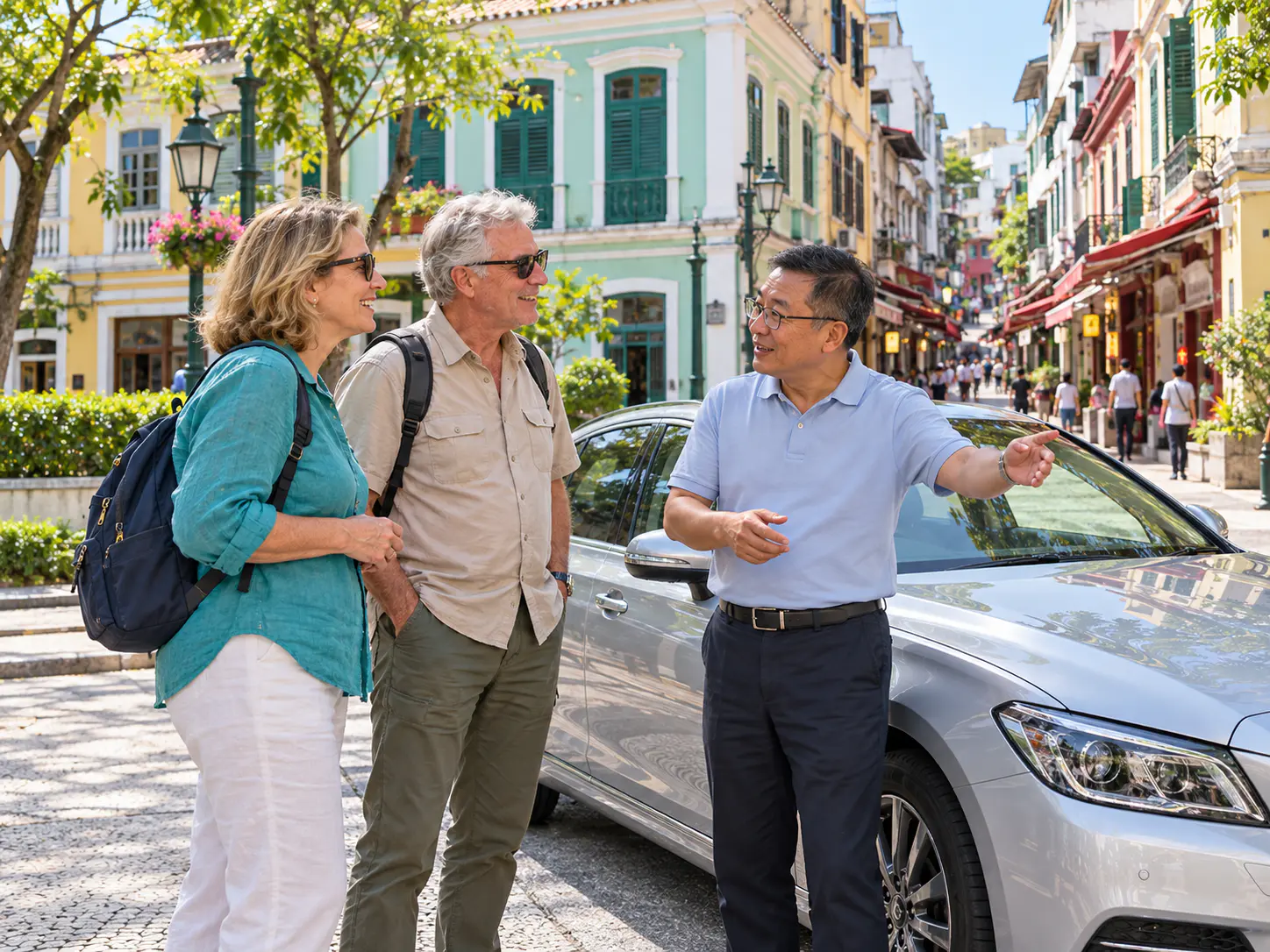
A private car earns its place on a Coloane-plus-peninsula day, especially with luggage, with people who will not ride buses, or when you are catching a late ferry and cannot absorb a missed connection. It is a separate product from the walking visit: Macau private driver. Use it for those jobs. The lanes of Taipa Village and the square in Coloane are still places you get out and walk.
What fits in a short stay
On a one-day visit that starts early, stay on the peninsula and skip this whole page. Coloane and a proper Taipa meal are what an overnight makes relaxed. If you have one night, give the first day to the historic centre and the evening to Taipa Village. Coloane the next morning works when your departure is not early and you are not also trying to tour Cotai. The moment all three are on the same half day, the chapel becomes a photo from the taxi window and the bakery becomes a queue you resent.
With two nights, the comfortable version is easy to say and pleasant to live. Peninsula on day one, including the ruins and, if energy holds, A-Ma Temple. Taipa for a slow dinner, with the church hill in the late light if you want it. Coloane on the last morning: square, chapel, original tart, and Hac Sa only if everyone still wants the shore. Cotai, if at all, is a single interior on the way back toward a hotel or the Taipa ferry, not a third full agenda.
If your ferry lands at the Taipa terminal, you are already on this side of the territory. That is a gift if the villages are today’s plan, and a delay if you meant to be at Senado first. Read the pier before you fall in love with an arrival-hour walk.
Weather and pace away from the old centre
October through December is the kind window for walking both the peninsula and these villages. Summer heat sits in the lanes with less breeze than you hope, and a typhoon signal that stops the ferries also stops the casual trip out to Hac Sa. Do not ride out to a beach lookout because the morning was merely grey. Ride out when the day is ordinary and you have hours to spare.
Chinese New Year and Golden Week fill Taipa’s food street and the resort drop-offs. Coloane stays relatively calmer and is still not empty. Book nothing that depends on a quick taxi changeover on those evenings. Eat where you are, or wait until the first wave has sat down.
Rain on the village lanes is fine. Wind on the exposed beach road is a reason to keep Hac Sa off the list and stay with the chapel and the bakery. The villages are small enough that a shortened visit still feels complete. The strip is large enough that a shortened visit is the correct visit.
Entry, even when the ride is short
Macau, Hong Kong, and mainland China are separate entry points. Coming from Hong Kong by ferry into the Taipa terminal, or by bridge bus toward this side of the territory, still means clearance. A Zhuhai crossing onto the same map is another boundary. Check your passport before you plan a village morning that depends on an early arrival. These streets are relaxed only after you are through the hall. They cannot calm a document problem, and no bakery is worth a spoiled crossing.
Ways to plan the days
These shapes match the Macau tours page. They are starting points, not fixed departures.
Historic Macau
Time fit: 2 days
The peninsula churches and squares, plus a Taipa meal.
- Macau
- Historic Macau
Why choose it: The peninsula churches and squares, plus a Taipa meal.
Classic Macau
Time fit: 3 days
Add Coloane and a slower food evening.
- Macau
- Classic Macau
Why choose it: Add Coloane and a slower food evening.
Day trip from Hong Kong
Time fit: 1 day
An early ferry, the historic walk, and a realistic return.
- Macau
- Day trip from Hong Kong
Why choose it: An early ferry, the historic walk, and a realistic return.
Want help shaping the Macau days?
Tell us your Hong Kong hotel area and whether you want a day trip or a night in Macau. We reply with a walkable historic plan.
Keep planning
Macau

Ruins of St. Paul's is a facade. Walk Senado, the forts, and A-Ma Temple in one order so you do not backtrack in the heat.
October to December is the easy walking season. Summer is hot, and typhoon days are a real reason to keep a spare night.
A day trip covers the peninsula. Two days add Taipa. Three days are what Coloane needs.
Ferries land at different terminals. Build in immigration, and do not start the historic walk after a noon departure.
Compare a 2-day historic stay, a 3-day Coloane trip, and an early day trip from Hong Kong.
Questions people ask
- They are three places that now share connected ground. Taipa Village is the old-street and food side, with lanes and a small church hill. Coloane Village is a separate, quieter settlement with a square, a chapel, and the original egg-tart bakery. Cotai is the resort strip on reclaimed land between them, built at a scale the villages never had. A taxi can link them quickly. A walking mood cannot. Choose one as the point of the day, add a second only if the clock is kind, and leave the third rather than rushing all three after a peninsula morning.
- Hac Sa is a beach on the east side of Coloane, and on most short trips it is a place to see the shore rather than a swimming destination. The visit that suits a first cultural trip is the village square, the Chapel of St. Francis Xavier, and the original bakery. Add the beach afterward if you still have unhurried time and the weather is calm. Do not trade away the chapel or a decent meal so that everyone can change into swimwear for a brief look at the water. If swimming is truly the plan, give it its own hour and do not stack it on the back of a hot church walk.
- It is in Coloane Village. That is the shop people mean when they talk about the original egg-tart bakery. Kiosks around Senado, counters in malls, and branches on the resort side can sell a Portuguese egg tart, sometimes under the same name, and a warm tart in town is still worth eating on a peninsula day. It is not the same stop as the village counter. Go to Coloane when you have an overnight or a third day, eat one tart while it is warm, and resist turning the visit into a comparison tour of every outlet on the way back to the ferry.
- No. The gaming floors are optional scenery, not the aim of a cultural visit. Cotai’s resorts are large and visually loud, and you can understand them from a lobby or a facade if you are curious. Taipa Village and Coloane Village have nothing to do with a casino floor. If one person in the group wants an hour inside, set a meeting time and keep the rest of the day on the streets you came for. You do not need to organise the whole trip around that hour. Windowless rooms are simply a poor use of a short stay.
- You can walk all you like inside Taipa Village, and you should. The food street, the church hill, and the old houses are a foot visit. Walking onward through Cotai is a sequence of driveways, indoor passages, and distances that the map shrinks. Coloane Village is a separate hop, easy by taxi or bus and a poor idea as a hot roadside march from a resort door. Use a bus, a taxi, a hotel shuttle if you are already on the strip, or a private car when the day also includes the peninsula and luggage. Then get out and walk the square.
- Usually no. A day trip that starts early can cover the historic peninsula and one meal. Coloane Village, done properly, wants the square, the chapel, and the original bakery without a sprint back to immigration. That rhythm arrives with an overnight, when Taipa can have the evening and Coloane can have the next morning. If your only visit is a single day, stay on the peninsula and eat a tart where you are. Coming out here for a blurred photo of the chapel is the version that makes the village look like it was not worth the ride.
Plan a Macau visit
Share whether you are coming by ferry or the bridge, and if Coloane is the reason to stay overnight. We reply with a peninsula-first plan.