
Macau at a glance
| Detail | Plan |
|---|---|
| Day trip | Early ferry, peninsula only |
| Comfortable first stay | 2 nights if Coloane matters |
| From Hong Kong | Ferry about 55–70 minutes, plus immigration |
| Walk | Senado, the facade, the fort, A-Ma Temple |
| Ride | Taipa, Cotai, and Coloane |
| Entry | Check Macau separately from Hong Kong and the mainland |
Hong Kong to Macau is a short ride and a real border. The water crossing takes about 55–70 minutes. The day takes whatever immigration does at both ends, plus the transfer from the pier you actually arrive at to the street you meant to walk. People lose the historic centre not on the boat but in the casual belief that “nearby” means “start whenever.”
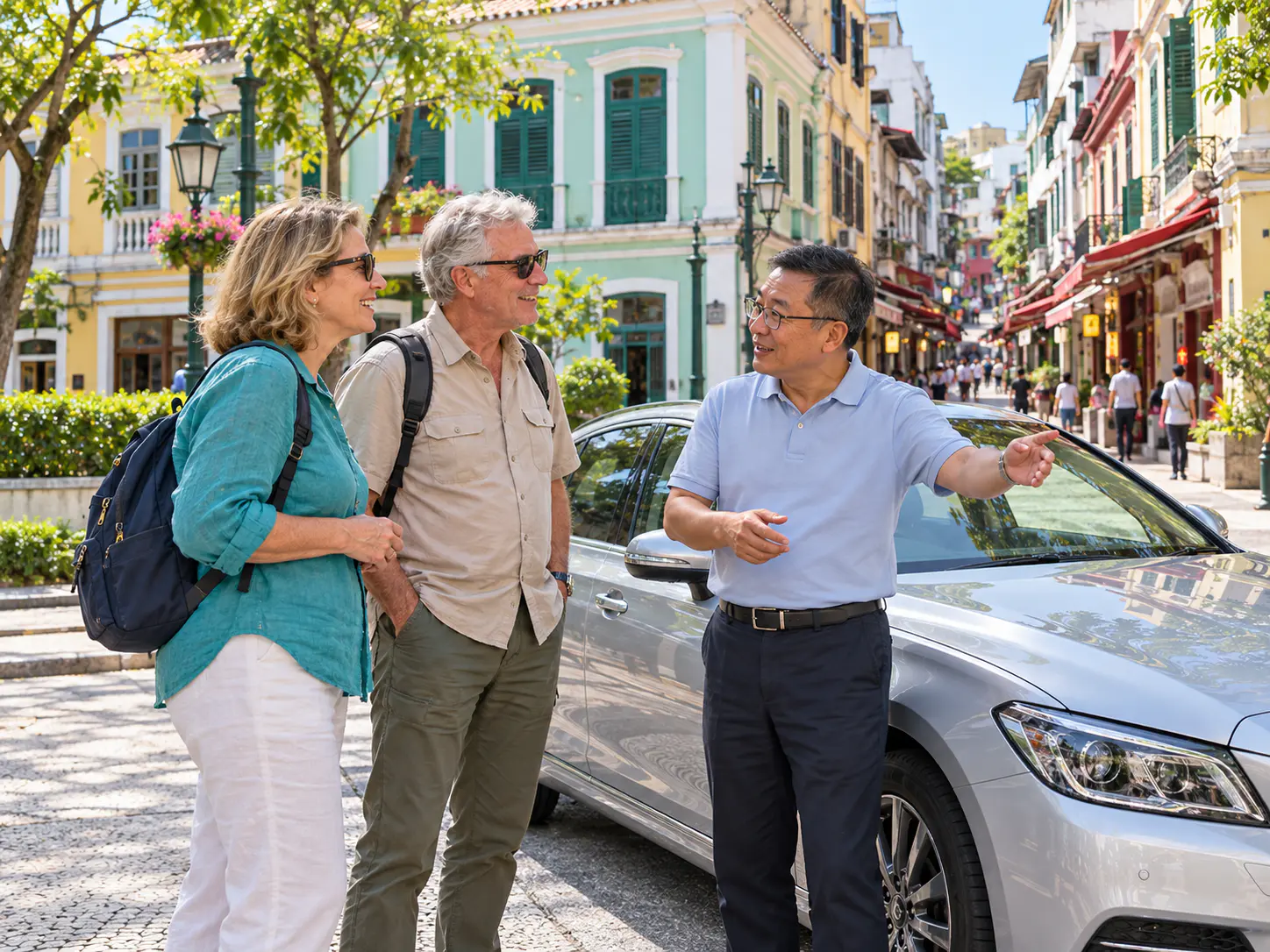
If the peninsula is the point, start early, land on the peninsula, and leave Coloane off the list. If you want a Taipa dinner and a village morning, stay the night. The Hong Kong itinerary is where the Hong Kong days belong. This page is only the crossing and what it honestly unlocks.
Two cities, one short ride
Hong Kong and Macau sit close enough for a day trip and far enough that each has its own entry, its own morning, and its own way of punishing a late start. You are not taking a tram across one harbour. You are leaving one territory and entering another. Build the day from the halls outward.
The pleasant version is simple. You are at the Hong Kong pier early, the boat is one of the first that fits your plan, you clear into Macau while Senado Square is still a good place to begin, and you walk. The unpleasant version leaves after breakfast “to avoid rushing,” meets a queue, docks at the wrong side of Macau for the churches, and spends the famous stairs in the worst heat with one eye on the return.
Decide which Macau you want before you pick the operator. A historic morning wants the peninsula terminal. A Cotai hotel or a Taipa Village start wants the Taipa terminal. The ride length is similar. The first hour on land is not.
Ferries: TurboJET and Cotai Water Jet
Two ferry companies do the ordinary work: TurboJET and Cotai Water Jet. Both are about 55–70 minutes on the water in normal conditions. Both are fast ferries, not sightseeing cruises. You will get a seat, a view of the crossing if you choose it, and then a terminal. You will not get a tour.
They do not deliver you to the same doorway. One service is the practical way onto the peninsula. The other is the practical way onto Taipa. Tickets name the pier at each end. Believe the ticket when a memory or a blog says “the ferry.” Operators adjust piers. Your walking day cannot.
Hong Kong departures are not all from one building either. Sheung Wan and Tsim Sha Tsui are the usual city piers, and some sailings serve the airport side. The pier changes how long it takes you to start, especially with luggage. Choose the Hong Kong end that is closest to where you actually slept, and choose the Macau end that is closest to the first place you want to stand. Saving ten minutes on the Hong Kong taxi and losing the peninsula arrival is a bad trade on a day trip.
Buy the return when you buy the outbound if you are not staying. Sunny weekends, Chinese New Year, and Golden Week are when “we will decide later” becomes a later boat than your legs wanted. In summer, remember that a typhoon signal can suspend sailings entirely. A booked seat does not outrank a closed harbour.
Which terminal you arrive at
The peninsula terminal, the Outer Harbour, is the right landing for a historic day. You are on the same island as Senado, the ruins, and A-Ma Temple. A taxi or a bus still sits between the pier and the square. It is a short transfer, and it is the correct short transfer. You can be walking the centre while the day is young.
The Taipa ferry terminal is the right landing for Cotai hotels, Taipa Village, and a Coloane plan. It is the wrong landing for a tight church morning, because you must cross to the peninsula before the walk even starts. That crossing is ordinary, by taxi or bus, and it is also the first thing that slips when traffic is heavy. If your hotel is on the strip and you are staying the night, Taipa is a gift. If you have six walking hours and a list of facades, it is a tax.
Check the name on the boarding pass the night before, out loud, with whoever thinks they already know. “We are going to Macau” is not a terminal. Peninsula versus Taipa is the whole question. Getting it wrong does not ruin a two-night stay. It ruins a day trip.
The bridge bus, from the airport side or Zhuhai
The bridge bus is the land route, and it is useful in two situations: you are already on the airport side of Hong Kong, or you are coming through Zhuhai and the bridge is the sensible door. It is a bus, with boundary halls, and it sets you down at a port on the edge of Macau rather than in the old streets. From there you still need a ride to Senado or to Taipa Village.
For a peninsula-first day, this is the less charming arrival. There is no harbour approach and no short hop from a downtown pier into the centre. There is a road, a port, and another vehicle. Take it when it saves a long backtrack to a ferry pier, especially with luggage and a flight on the same day. Do not take it because a map made the bridge look like a scenic shortcut into the ruins. It is not that.
Zhuhai is mainland China. Crossing from there is a different entry again from the Hong Kong crossing. If your trip touches Hong Kong, Macau, and Zhuhai, you have three separate clearances to think about, not one regional pass. The bridge makes the geography look continuous. The halls do not.
Allow the same honesty you would allow a ferry day. The bus time is only the moving part. Queues, luggage, and the onward ride into town are the day. A noon arrival by bridge compresses the historic walk just as a noon ferry does.
Immigration time on both ends
Every crossing spends time twice: leaving Hong Kong and entering Macau, then leaving Macau and entering Hong Kong if you are going back. The halls can be brief on a quiet morning and slow on a holiday, a weekend, or any day a ship has just emptied. You cannot schedule the slow version away by being annoyed.
Arrive at the Hong Kong pier early enough to clear the departure side before the sailing you chose. On the Macau side, expect a second clearance before you are in a taxi. Repeat the sequence in reverse, working backward from the boat you must not miss. A day trip that puts you on the ruin stairs twenty minutes after theoretical docking time has spent minutes you do not own.
Keep your passport where you can hold it, not at the bottom of a daypack you must unpack in the line. Small cash in patacas or Hong Kong dollars helps after you are through, for the taxi or the bun, and it does not help you in the hall. The hall wants the document. Sort that the night before.
If you are staying overnight, the return buffer still matters on the last day. A relaxed Coloane morning becomes a missed boat the moment you forget that “leave the village at noon” is not the same sentence as “be in Hong Kong at noon.”
How to choose
| Choice | Fit | Skip when |
|---|---|---|
| Make this the focus | When this page is the reason for the day | When it is only a name on a list |
| Pair it | With one nearby stop | With a second full excursion |
| Leave it | If the main stay is already full | If you have the night it needs |
What a day trip can honestly include
An early peninsula arrival can include Senado Square, the short step to the cathedral, St. Dominic’s, the stairs and stone facade of the Ruins of St. Paul’s, and Mount Fortress with a look at the Macau Museum. It can include one meal: a pork chop bun, a Portuguese egg tart, or a seated plate of African chicken. It can include A-Ma Temple toward the southwest when you started with the first sensible boat and you are willing to skip Guia.
It should not include Coloane. The original Lord Stow’s bakery is in that village, and a day trip is how people settle for a kiosk instead, which is the correct settlement. It should not include a full Taipa evening. It should not include Hac Sa, and it should not include a survey of Cotai resorts. Guia Fortress and the lighthouse are the first historic extra to drop, because that hill is not next to the square and the day trip does not have a spare hill.
Casinos are optional scenery on any length of trip. They are a particularly poor use of a day-trip afternoon. If you came for the UNESCO streets, spend the hours there. A single lobby on the way back to the Taipa pier is the most Cotai a day trip should consider, and only if you landed on that side for a reason.
When the historic walk gets compressed
The walk compresses when you start late, when you arrive on Taipa and still want every church, or when you keep a full list beside a fixed return. Noon is the cutoff we would respect. After a noon ferry, the honest visit is the square, one or two churches close to it, and the facade if the heat and the stairs are acceptable. The museum, A-Ma, Guia, Taipa, and Coloane are tomorrow’s plan or nobody’s plan.
Heat compresses the walk in summer even when the boat was early. The stairs in front of the ruins have little shade. A midday arrival in July is a different outing from a morning arrival in November. October through December is when a day trip is most likely to feel like the day you drew. Chinese New Year and Golden Week compress it again by crowd, even in cooler air. On those dates, go earlier than your usual “early,” or stay over and walk before the day-trip boats empty.
A typhoon signal compresses the walk to zero because the ferries stop. That is not a timing tweak. That is a day to remain in Hong Kong.
When to stay overnight instead
Stay overnight when any of these are true. You want Taipa Village at dinner, seated, without a return sailing in the conversation. You want Coloane’s chapel and the original bakery in the morning. You can only reach Macau around noon. You are travelling in summer and do not want two crossings in the hottest hours plus a storm risk on the return. You are with anyone who will be unhappy on a second set of stairs after the facade.
One night makes the Taipa meal relaxed and makes a short Coloane morning possible if you do not also tour the strip. Two nights is the comfortable first trip if the casinos are not why you came: a full peninsula day, a slow food evening, and Coloane without borrowing time from the exit. A day trip is the right tool only when the peninsula is truly the whole wish.
Sleeping in Macau also lets you use the kind hours. Guia first, while you are fresh, or the ruin stairs before the tour groups from the mid-morning boats. You cannot do that if you are still in a Hong Kong departure hall.
Luggage, a late boat, and a car
Walk once you are in the centre. Do not hire a car to crawl beside Senado. Do use help for the unlovely parts: luggage from the airport-side bridge port, a late ferry you cannot miss, or a single day that must join the peninsula and Coloane for people who will not take a bus.
Taxis, public buses, and hotel shuttles cover Cotai and Coloane for almost everyone else. Shuttles are a guest benefit of the big hotels, useful to the terminals, not a public tour of the villages. A private car is the separate product for the awkward gaps: Macau private driver. Match it to luggage and to a complex day, then get out and walk.
If the return boat is late and your Hong Kong hotel is on the far side of that city, say so when you plan the Macau afternoon. The ferry’s 55–70 minutes is not the end of the journey home. Kowloon and the island are different evenings. Leave a margin after the Hong Kong pier, not only before it.
A five-day shape with Hong Kong
A combined five-day trip works when Hong Kong keeps the longer share and Macau takes two days, not when both cities are promised their full list. A clean version is three days in Hong Kong, an early ferry on the fourth morning to the peninsula, a historic day, a night in Macau, Taipa on the fifth day, and the return. Coloane as its own unhurried morning does not fit that five-day shape unless you shorten Hong Kong further, which is a different trip.
Keep Macau in one block. Crossing over for a day, going back, and crossing again for Taipa means four immigration sessions for two walks. Stay the night instead.
The Hong Kong days themselves, and the way a week like this is arranged, live with the Hong Kong plans: the Hong Kong itinerary for how to spend the Hong Kong time, and Hong Kong tours for the combined five-day shape. Use this page to decide whether Macau should be a day or an overnight inside that week, then book the crossing that matches the decision.
Three entry points
Macau, Hong Kong, and mainland China are separate entry points. The ferry does not make them one region. The bridge does not either. Permission for Hong Kong is not permission for Macau, and neither is permission for the mainland if Zhuhai or another city is on your route. Check your own passport and the current rules before you buy the ticket. We will not quote a length of stay, because it is not the same answer for every traveler and it is not a fact a walking guide should pretend to settle.
Do the check first. Then pick an early peninsula boat, or pick a night in Macau and stop trying to make noon feel like morning.
Ways to plan the days
These shapes match the Macau tours page. They are starting points, not fixed departures.
Historic Macau
Time fit: 2 days
The peninsula churches and squares, plus a Taipa meal.
- Macau
- Historic Macau
Why choose it: The peninsula churches and squares, plus a Taipa meal.
Classic Macau
Time fit: 3 days
Add Coloane and a slower food evening.
- Macau
- Classic Macau
Why choose it: Add Coloane and a slower food evening.
Day trip from Hong Kong
Time fit: 1 day
An early ferry, the historic walk, and a realistic return.
- Macau
- Day trip from Hong Kong
Why choose it: An early ferry, the historic walk, and a realistic return.
Want help shaping the Macau days?
Tell us your Hong Kong hotel area and whether you want a day trip or a night in Macau. We reply with a walkable historic plan.
Keep planning
Macau

Ruins of St. Paul's is a facade. Walk Senado, the forts, and A-Ma Temple in one order so you do not backtrack in the heat.
Taipa Village, Coloane, and the Cotai resorts are three different places. A cultural trip can skip the gaming floors.
October to December is the easy walking season. Summer is hot, and typhoon days are a real reason to keep a spare night.
A day trip covers the peninsula. Two days add Taipa. Three days are what Coloane needs.
Compare a 2-day historic stay, a 3-day Coloane trip, and an early day trip from Hong Kong.
Questions people ask
- Take the ferry for a peninsula-first day or a Taipa hotel, and choose the company that lands where you want to start. TurboJET and Cotai Water Jet are both about 55–70 minutes, and they use different Macau terminals, peninsula versus Taipa. Take the bridge bus when you are already on the airport side of Hong Kong or you are coming through Zhuhai. It is a practical road arrival at a boundary port, followed by another ride into town, and it is the less charming way to begin a historic walk. Neither option removes immigration. Pick the one that matches your first stop, not the one that looks shorter on a diagram.
- The water crossing is about 55–70 minutes on TurboJET and on Cotai Water Jet in ordinary conditions. That number is the ride, not the journey from your Hong Kong hotel to Senado Square. Add the time to reach the right Hong Kong pier, the departure clearance, the arrival clearance in Macau, and the taxi or bus to the square or to Taipa Village. The same pieces apply on the way back. A day planned as “an hour there and an hour back” is the day that loses A-Ma Temple. Plan from door to door, and keep the famous 55–70 minutes as the middle of that plan rather than the whole of it.
- Choose the peninsula terminal for the historic centre, the ruins, Senado, and A-Ma Temple. Choose the Taipa terminal for a Cotai stay, Taipa Village, or Coloane. The two ferry operators land in different places, so the terminal printed on the ticket matters more than the logo. A peninsula arrival still needs a short ride to the square. A Taipa arrival needs a longer transfer before any church on the peninsula, which is a fine start to a two-day stay and a costly start to a day trip. Check the pier the night before. “Macau” is not specific enough to protect the morning.
- Allow a real buffer on both ends, outbound and back, and make it wider on weekends, Chinese New Year, and Golden Week. Quiet mornings move. Holiday halls do not. You need to be at the Hong Kong pier early enough to clear before your sailing, and you need a second clearance on arrival before you are in a taxi. Repeat that from the return boat backward. Do not schedule the ruin stairs for twenty minutes after the boat’s printed docking time. If you are staying overnight, the same buffer belongs on the exit day between Coloane or Taipa and the pier.
- An early start and a peninsula landing can cover Senado Square, the cathedral, St. Dominic’s, the Ruins of St. Paul’s, Mount Fortress, and one meal, with A-Ma Temple included when you are willing to skip Guia. That is a full and satisfying day. It does not also include Coloane Village, the original egg-tart bakery, a slow Taipa dinner, Hac Sa, and a circuit of resorts. Casinos are optional and a weak use of the few hours. If the boat is at noon, keep the square and the facade and leave the rest. The compressed walk is still worth doing. The complete list is not.
- Stay the night if you want a Taipa meal that is not rushed, a Coloane morning with the chapel and the original bakery, or a historic walk that starts before the day-trip crowds. Stay if you can only arrive around noon, or if summer heat and typhoon risk make two crossings in one day a gamble. One night covers the peninsula and Taipa, with Coloane only as a short extra. Two nights is the comfortable first cultural trip. A five-day Hong Kong and Macau week should use the two-day Macau piece and keep the Hong Kong days intact, rather than commuting back and forth and spending the week in immigration halls.
Plan a Macau visit
Share whether you are coming by ferry or the bridge, and if Coloane is the reason to stay overnight. We reply with a peninsula-first plan.