
Macau at a glance
| Detail | Plan |
|---|---|
| Day trip | Early ferry, peninsula only |
| Comfortable first stay | 2 nights if Coloane matters |
| From Hong Kong | Ferry about 55–70 minutes, plus immigration |
| Walk | Senado, the facade, the fort, A-Ma Temple |
| Ride | Taipa, Cotai, and Coloane |
| Entry | Check Macau separately from Hong Kong and the mainland |
The Historic Centre of Macau is the reason to come if churches, forts, and a temple matter more to you than a resort skyline. It sits on the peninsula, it is a UNESCO area, and it only works as a walk. You can arrive by taxi at the edge of Senado Square. After that the pavement, the stairs, and a couple of short hills do the rest. A car beside you is a nuisance, not a shortcut.
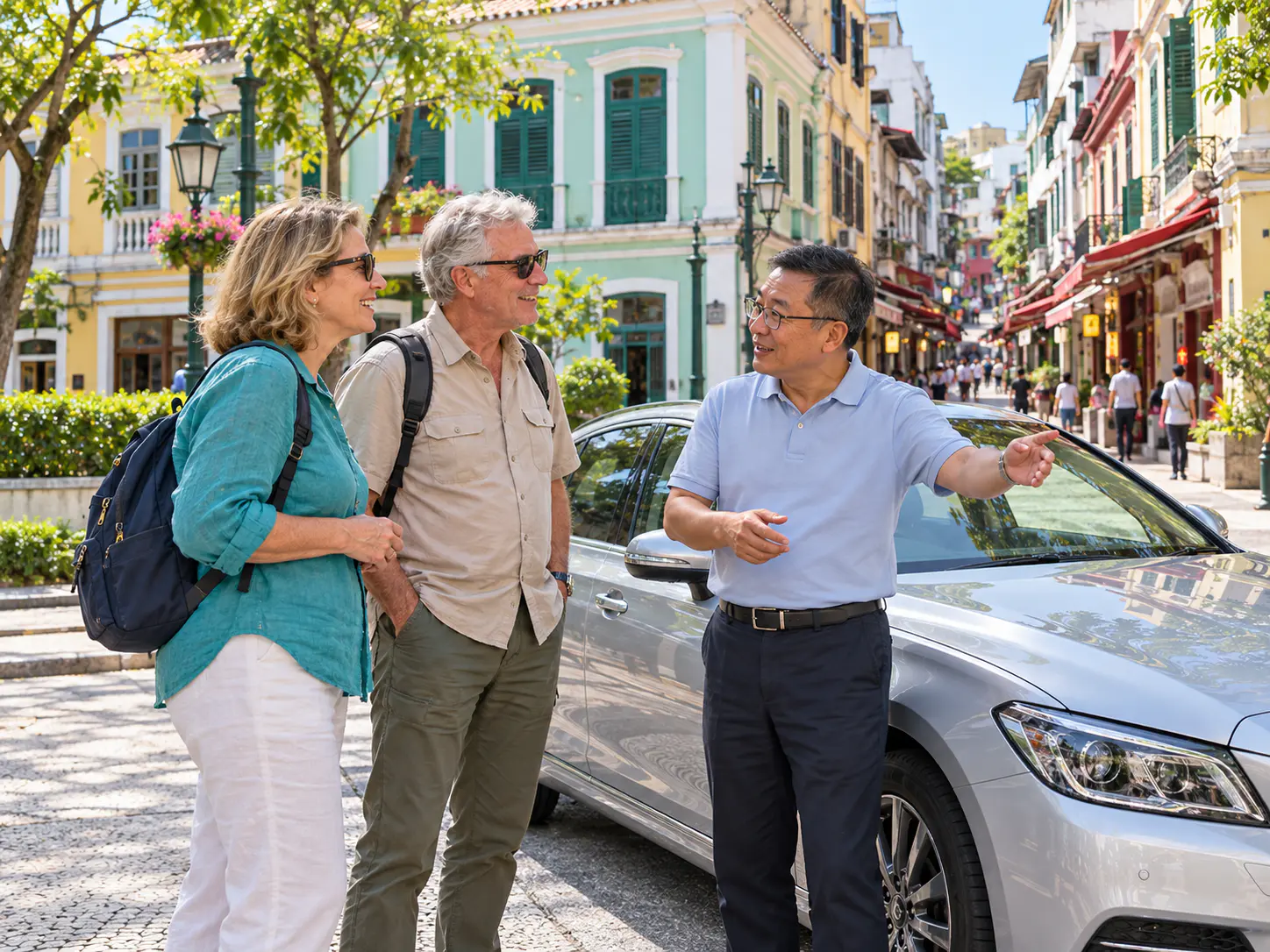
Give this district a morning when you are still willing to climb. The famous photograph is a stone facade at the top of a staircase. The better visit is everything on the way there and the temple you reach by continuing downhill instead of turning around.
What you are walking through
This is not one building. It is a chain of civic squares, religious houses, and military high ground packed into streets that predate the reclamation around them. Portuguese pavement, Chinese temple courtyards, and shop-houses share the same few hundred metres. That mix is the place. Rushing it for a single facade photo throws away the part people remember the next week.
The ground is uneven on purpose. Black-and-white calçada stones look flat in pictures and feel rounded underfoot, especially after rain. Curbs are low, steps appear in doorways, and the climb to the ruins is a real flight of stairs rather than a gentle ramp with a view. Wear shoes you can stand in for hours. Sandals with no grip are the item people regret by the time they reach the fortress.
The centre is also a living neighbourhood. People cut through Senado on the way to work, worshippers use the churches, and the lanes under the ruins sell pastries and souvenirs to whoever is climbing. You are not in a closed heritage park. Move like a guest on a busy street: leave the middle of the staircase clear when you stop for a photo, and do not block a church door for a portrait.
A walking order that does not double back
The order that wastes the least energy starts in the middle, settles the short side-step while your legs are fresh, climbs once, and then leaves the hill for good toward the southwest.
Begin at Senado Square. Before you commit to the northbound climb, walk the short rise east to the cathedral and its small largo, look inside if it is open, and come back to the square. That loop is a few minutes. Doing the cathedral after you have already climbed to the ruins means a descent and a second climb for no good reason.
From the square, walk north to St. Dominic’s. Continue up the pedestrian street and the stone stairs to the Ruins of St. Paul’s. The facade is the stop. Immediately beside and above it, go up into Mount Fortress and the Macau Museum. You are already at the high point of this cluster. See the ramparts, decide how much of the museum you want, and then walk down.
Leave toward the southwest, through the lower streets in the direction of Barra, and finish at A-Ma Temple. You will pass ordinary blocks and a busier road as the heritage core loosens. That is the correct direction. Turning around to “do Senado again” from the top only puts you back in the crowd you just left. If you want a second look at the square, take it in the evening when you are no longer carrying the rest of the route.
Guia Fortress and the lighthouse do not belong at the end of this line. They stand on a different hill, east of the centre. Put Guia first, while you are fresh, or come back to it by bus after lunch and a sit-down. Tacking it on after A-Ma, on tired legs, is how a good walk turns into a slog.
Senado Square, then the cathedral
Senado Square is the civic heart: a wavy stretch of pavement, pale civic buildings, and streets feeding in from the old main thoroughfare and from the lanes that climb toward the ruins. It is the right meeting point if your group splits up, because everyone can find it without a landmark lecture. Arrive early and you get the pattern of the stones and the facades without a tour group in every frame. Arrive at midday and you still get the architecture. You also get the heat held in the open square.
Use the square as a hinge, not as a place to finish. The useful first move is the cathedral. The Sé sits on a small rise just east of the square, quieter than the ruins, with a plain dignity that photographs do not chase as hard. Step in when a service is not underway, sit for a minute, and notice that this is a working church rather than a stage set. Then return to Senado and point yourself north. You have now done the one detour that would otherwise nag at you halfway up the hill.
If someone in the group cannot face the later stairs, Senado and the cathedral are the honest short version. Say so before you start, not at the bottom of the facade. The rest of the route only gets steeper.
St. Dominic’s on the way north
St. Dominic’s stands just north of the square, a yellow baroque front on the pedestrian street that leads toward the ruins. You would have to try to miss it. The mistake is to treat it as a facade-only glance because the famous stairs are “just ahead.” Go in if the door is open. The interior is the contrast: a complete church, used and ornamented, a few minutes before you reach a church that is only a wall.
There is often a small religious museum attached to the complex. It is skippable when the day is melting and the fortress is still ahead. It is a good pause when you want ten minutes out of the sun before the exposed staircase. Do not let a shop on this street reset your route. The souvenir trade thickens as you climb. You can buy a tart on the way down from the fort if you still want one. You cannot un-climb a hill you took in the wrong order.
Keep the group together here. The street looks straight, then it becomes steps, and people who stop to photograph the yellow front lose sight of people who have already started up. Agree that the next meeting point is the foot of the ruin staircase, not “somewhere at the top.”
The Ruins of St. Paul’s: a facade and a flight of stairs
The Ruins of St. Paul’s are the stone facade of the Church of Mater Dei, not a complete church. The timber body burned. What you came to see is the carved front: saints, symbols, and a stair of pale stone that doubles as seating for half the peninsula on a busy day. Behind the wall there is a crypt and a small museum of sacred art. There is no nave to sit in, no long interior, and no service to time your visit around. Plan for the climb and the carving. Treat the museum behind the facade as a short extra, not as the visit itself.
The stairs are the part people underestimate. They are broad, they are uneven in places, and they have very little shade. In summer the stone throws heat back at your shins. Take them slowly. If you need a rest, step to the side rather than planting a group in the walking line. The photograph everyone wants is from partway down, looking up, which means you will walk the flight more than once if you are the person holding the camera. Build that in. It is still only a staircase, not a hike, and it is enough to wind someone who has already done the square in full sun.
Morning is the kind hour. The light sits more softly on the carvings, the tour groups are fewer, and you still have the fortress above you while your patience is intact. Midday works if you have water and no one in the party is unsteady on hot stone. Late afternoon can be lovely and can also be a wall of people. Neither is a reason to skip the facade on your one historic day. It is a reason to protect this stop from being the thing you reach already exhausted.
How to choose
| Choice | Fit | Skip when |
|---|---|---|
| Make this the focus | When this page is the reason for the day | When it is only a name on a list |
| Pair it | With one nearby stop | With a second full excursion |
| Leave it | If the main stay is already full | If you have the night it needs |
Mount Fortress and the Macau Museum
Mount Fortress is the next move, not a separate expedition across town. The ramp leaves from beside the ruins and lifts you onto the old Jesuit fort: thick walls, cannons aimed over a city that has long since grown past their range, and a wide view across the peninsula toward the water and the modern fill beyond the old streets. This is the best map you will get of where you have walked and where A-Ma still sits, off to the southwest.
The Macau Museum occupies the fort. It is the right hour when you want context: how the peninsula was settled, how the churches and the Chinese city sat together, how trade and religion shaped the streets you just climbed. It is also the right hour when you want air that is not the open staircase. Give it a real visit if this is your first time, somewhere between a focused hour and a slower wander if you like exhibits. Skip the galleries, and keep the ramparts, if the morning is collapsing and A-Ma still matters to you. The view from the walls does the orientation work even when you do not read a single panel.
Do not leave the fort in the direction of Guia just because both are “high places.” Guia is another hill. From these ramparts you can see you are not next door to it. Come down toward the old streets and commit to the southwest.
A-Ma Temple at the end of the line
A-Ma Temple is the oldest famous religious site on the peninsula, set into a rocky hillside at the southwest, in the Barra area, facing the water that gave Macau its name. The sea goddess A-Ma is the figure here. The complex is a sequence of halls, incense, boulders, and short staircases, smaller in spread than the story suggests and richer up close than a drive-by allows. It is the right ending to the historic walk because it pulls you out of the church-and-square narrative and into the harbour cult that was here alongside it.
The walk from the fortress down and across to Barra is the longest leg of the route. Budget the better part of an hour at a relaxed pace, plus time inside the temple, where you will climb a little more on uneven rock. You are not going to get lost in a wilderness. You are going to pass from pedestrian heritage streets into ordinary roads. That change of texture is normal. If the heat has already won, a taxi or a bus from near the ruins to Barra is a fair rescue. Use it to save the temple, not to skip back to a hotel and call the morning finished.
At the temple, follow the flow of worshippers, keep to the side of narrow stairs, and give incense a little room. Shoulders covered and a quieter voice are the right habits even when no sign scolds you. You do not need a guide to read the place. You need twenty unhurried minutes and the willingness to look up the rock as well as at the first gate.
This is the stop a noon ferry deletes. If your boat home is early, be honest and stop at the fortress. If you have the afternoon, keep A-Ma. It is the part of the peninsula that makes the walk feel complete rather than like a circuit of the same hill.
Guia Fortress, chapel, and lighthouse
Guia Fortress, with its chapel and lighthouse, is the high point of the peninsula. The lighthouse is a working piece of coast history, the chapel is small and set inside the fort walls, and the view takes in the old city, the water, and the modern districts in one turn of the head. It is worth doing. It is not worth doing as an afterthought when Senado has already used you up.
The hill stands east of the historic core. A walk up is pleasant on a cool morning and punishing after a summer climb of the ruin stairs. Buses reach the approaches, and there are paths from the garden side of the hill for people who want the approach on foot when the weather is kind. Choose one method at the start of the day. The worst version is a tired argument at the foot of Guia about whether the group still has the climb in them.
Put Guia first if you are staying overnight and can be out early, before Senado fills. On a day trip from Hong Kong, Guia is the piece we would trade away before we trade away the facade, the fortress by the ruins, or A-Ma. You can see a lighthouse on a future visit. You cannot reconstruct the central walk from a hill that sits apart from it.
If haze or a storm signal is up, skip the ramparts. The view is the point, and an exposed hill is the wrong place to be stubborn in a gale.
How long the peninsula walk takes
Allow a full morning through mid-afternoon for the line from Senado through A-Ma, with the museum included and a sit-down somewhere along the way. A tighter pass that keeps Senado, the cathedral loop, St. Dominic’s, the facade, and the fortress view, and that skips both the museum galleries and A-Ma, is a long two to three hours if you do not shop. Adding A-Ma without the museum still asks for a half day once you include the walk down to Barra.
Guia on top of the full line is a day, not an extra half hour. Count a separate block of time: the ride or the climb, the fort, the lookout, and the return to wherever you are eating. People who “add it at the end” are usually people who then skip the temple or arrive at dinner angry at the itinerary.
These ranges assume ordinary walking, photo stops, and one pause out of the sun. They do not assume a long lunch, a shopping loop on the avenue beside Senado, or a rest in a hotel room halfway. If you need that rest, take it after the fortress and before A-Ma, and keep the temple for the cooler late afternoon. Splitting the hill from Barra is sensible. Splitting the ruins from the fortress is not. They are the same stop.
Holiday crowds stretch every range. Chinese New Year and Golden Week can turn the staircase and Senado into a slow procession. The distance does not change. Your speed does. If you are here on those dates, cut Guia and the museum before you cut the facade, and do not promise A-Ma to anyone who is already overheated at St. Dominic’s.
Heat, shade, and the stops worth dropping
Summer on this route is a heat-management problem with heritage attached. The square has some building shade at the edges and almost none in the middle. The ruin stairs are exposed. The fortress ramparts are open to the sky. Churches and the museum are the cool rooms. Use them that way: cathedral first, St. Dominic’s as a pause, museum if you need twenty minutes of not being in the sun, temple halls at the end rather than a second hour on a wall.
Carry water from the start. There are shops, and there are also moments on the stairs when you will not want to step aside into a queue for a bottle. A hat helps more than another layered shirt. If someone feels dizzy on the facade steps, sit them in shade at the side and abandon Guia without discussion. The historic centre will still have been worth the morning.
What you can skip, in order, when the day shrinks:
The museum galleries, if the rampart view has already oriented you. A second lap of the souvenir street under the ruins. Guia, whenever anyone is tired, hot, or short of time. Church interiors beyond one, if you have already been inside the cathedral or St. Dominic’s and the group is fading. A-Ma, only when the return crossing is close. The facade itself, almost never, on a first visit. Senado, never, because everything else hangs off it.
What you should not skip in the name of efficiency is the walking order. Seeing the ruins first by taxi, then doubling back to Senado, then realising the cathedral was a side step, then trying Guia because a list told you to, is more tiring than the full southwest line done once. One hill, then Barra. Guia on its own. That is the whole tactic.
A note on the border before you walk
Macau, Hong Kong, and mainland China are separate entry points. The peninsula walk is simple once you are in. The morning is not simple if your passport was not checked against the current rules before you crossed. Sort that before you pick an early ferry. A historic day that starts with a surprise in the immigration hall is the day the stairs happen at noon, which is the hour this route likes least.
Ways to plan the days
These shapes match the Macau tours page. They are starting points, not fixed departures.
Historic Macau
Time fit: 2 days
The peninsula churches and squares, plus a Taipa meal.
- Macau
- Historic Macau
Why choose it: The peninsula churches and squares, plus a Taipa meal.
Classic Macau
Time fit: 3 days
Add Coloane and a slower food evening.
- Macau
- Classic Macau
Why choose it: Add Coloane and a slower food evening.
Day trip from Hong Kong
Time fit: 1 day
An early ferry, the historic walk, and a realistic return.
- Macau
- Day trip from Hong Kong
Why choose it: An early ferry, the historic walk, and a realistic return.
Want help shaping the Macau days?
Tell us your Hong Kong hotel area and whether you want a day trip or a night in Macau. We reply with a walkable historic plan.
Keep planning
Macau

Taipa Village, Coloane, and the Cotai resorts are three different places. A cultural trip can skip the gaming floors.
October to December is the easy walking season. Summer is hot, and typhoon days are a real reason to keep a spare night.
A day trip covers the peninsula. Two days add Taipa. Three days are what Coloane needs.
Ferries land at different terminals. Build in immigration, and do not start the historic walk after a noon departure.
Compare a 2-day historic stay, a 3-day Coloane trip, and an early day trip from Hong Kong.
Questions people ask
- The central line, from Senado Square through the cathedral, St. Dominic’s, the Ruins of St. Paul’s, and Mount Fortress, takes a long morning if you include the museum and do not shop. Extending southwest to A-Ma Temple turns that into a half day or a little more, because the walk down to Barra is the longest leg and the temple has its own stairs. Adding Guia Fortress and the lighthouse makes a full day. Holiday crowds stretch all of those ranges without changing the distance. A tight photo pass of the square and the facade can be done in a couple of hours, and it leaves out the temple and the fort view that make the district feel whole.
- They are a broad public staircase, not a mountain path, and they are still the effort of the visit. The stone is uneven in places, shade is scarce, and in summer the steps radiate heat. You will often walk them more than once if you want the photograph from below. People sit on the stairs, so the walking line is narrower than the architecture looks. Take them slowly, keep to the side when you rest, and do not start them at midday if anyone in the group is unsteady in the heat. Behind the facade there is a small museum and crypt, not a church nave that lets you escape the climb.
- That is the version to avoid. Guia Fortress, the chapel, and the lighthouse sit on their own hill east of Senado, not next door to the square and not on the way down to A-Ma Temple. The climb or the walk up is pleasant when you are fresh and a poor idea when the ruin stairs have already finished you. Do Guia first on a cool morning, or take a bus to the hill after you have sat down and eaten. If the group is hot or short of time, drop Guia and keep the central walk. You can see a lighthouse another day. You only get one first pass at the facade and the fort beside it.
- Skip the museum galleries if the ramparts have already shown you the peninsula, and skip a second loop through the souvenir lanes under the ruins. Skip Guia whenever anyone is tired. Skip extra church interiors after you have been inside one. Skip A-Ma Temple only when a return ferry is close, because the walk to Barra is the piece a short day cannot honestly keep. Do not skip the facade on a first visit, and do not skip Senado Square, because the rest of the route is organised around them. Skipping stops is fine. Doing the same hill twice because the order was backwards costs more than any single sight you cut.
- You can be driven to the edge of it, and that is all a car is good for here. The UNESCO streets, the square, the church steps, and the fortress ramp are a walk. A vehicle cannot follow the order that matters, and waiting in it while the group climbs only splits the party. Walk from Senado to the ruins and the fort, then continue toward A-Ma on foot if the weather is kind. Use a taxi or a bus for the rescue leg to Barra in the heat, or for Guia if you do not want that second hill on foot. Save any private car for luggage or for a day that also includes Coloane, not for the centre itself.
- Wear shoes with grip, because the calçada pavement and the ruin stairs are polished by use and slick after rain. A hat and water matter more than a change of clothes. The open square, the facade steps, and the fortress walls are exposed, while the cathedral, St. Dominic’s, and the museum are your shade. Start early. In summer the same route that feels easy in December becomes a heat problem by late morning. Light rain is still a walking day if you slow down on the wet stones. A typhoon signal that stops the ferries is a day to stay off the ramparts entirely and wait for the official word before you go out.
Plan a Macau visit
Share whether you are coming by ferry or the bridge, and if Coloane is the reason to stay overnight. We reply with a peninsula-first plan.