
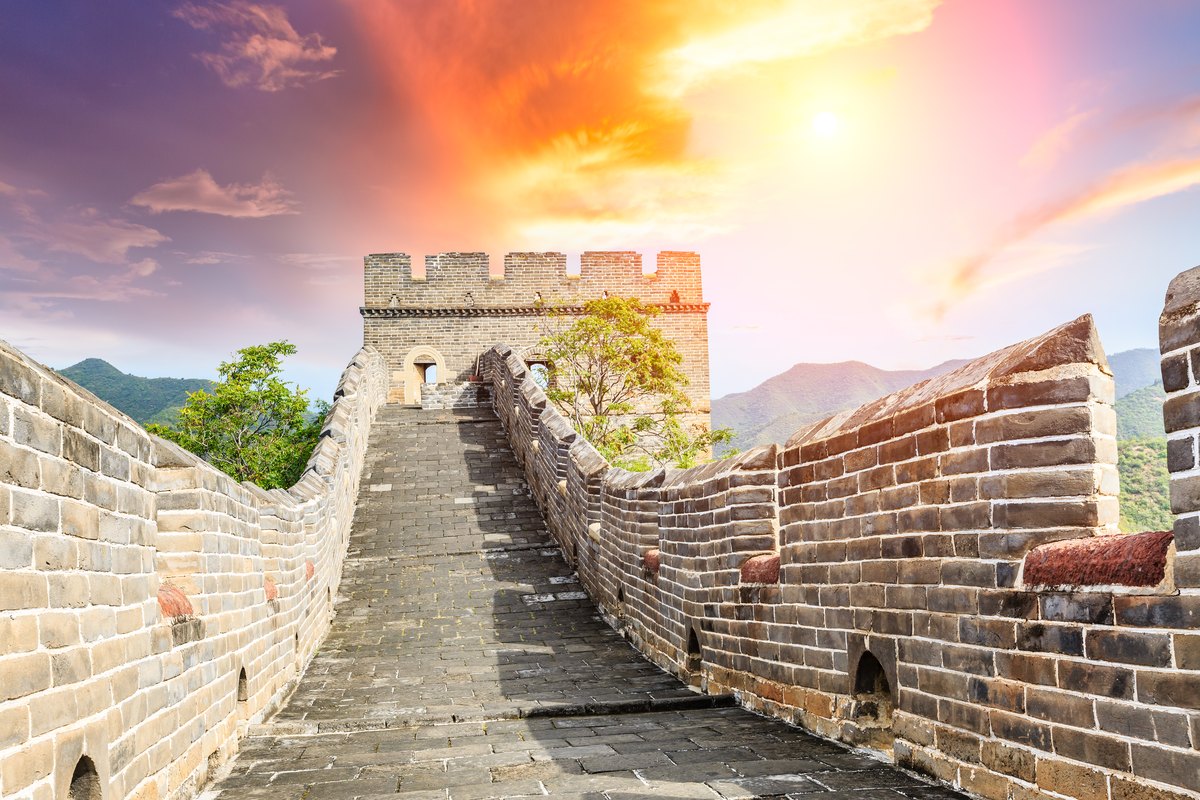
Walkable distances by section
| Section | Walkable on a day visit | Surface | Difficulty |
|---|---|---|---|
| Mutianyu | Route-dependent; current daytime visitor area is Towers 1–20 | Restored stone and brick | Easy to moderate |
| Badaling | ~2-3 km typical visitor walk | Restored stone and brick | Easy (very busy) |
| Jinshanling | ~8-10 km restored ridge | Mixed restored + worn original | Moderate |
| Jinshanling to Simatai | ~10 km where open | Restored corridors | Moderate to hard |
| Simatai | ~5 km (some closed sections) | Restored + dramatic ridges | Moderate to hard |
| Gubeikou | ~6-10 km variable | Unrestored - true wild wall | Hard, requires guide |
| Huanghuacheng | ~3-5 km on the lakeside ridge | Partially restored | Moderate |
Is it legal to walk between sections?
Often no. Open sections have ticketed boundaries; walking off the end of one onto unrestored wall typically crosses into closed or protected zones. Some restored corridors (Jinshanling to Simatai) allow connection along an authorised stretch; others (Mutianyu to Jiankou) explicitly do not.
- Jinshanling to Simatai: connection allowed on the restored corridor.
- Mutianyu to Jiankou: not legal; Jiankou is closed.
- Wild-wall hiking: legally grey at best, dangerous, and not how DragonTrail builds itineraries.
What about end-to-end attempts?
Several individuals have walked from Liaoning to Gansu over 12 to 18 months. They combined open restored sections, scrambling ruined wall, and major detours around closed zones, military land, farmland and water gaps. It is not a 'hike' in any normal sense - it is a long expedition with planning, permits and resupply.
- Typical reported time: 12-18 months.
- Daily distance: highly variable, often <15 km on rough terrain.
- Major non-wall detours: many days at a time.
What about walking 'wild wall' (unrestored sections)?
Risk goes up sharply. Unrestored wall has loose stone, collapsed staircases, narrow ridge edges, no guard rails, no rescue, and limited mobile signal. The Jiankou section is the most photographed; it is also closed and not insured. We do not build itineraries on closed wild wall. For dramatic terrain with legal access, Jinshanling and Simatai are the strongest options.
- Closed wild wall: high risk, no rescue, illegal to enter.
- Jinshanling: legal hiking with original-condition stretches.
- Simatai: legal, dramatic ridges, partial closures.
Common mistakes when planning 'walking the wall'
Assuming 'wall' means 'continuous path'
Most of the wall is broken on the ground. End-to-end is a multi-month expedition, not a hike.
Targeting Jiankou because it's photogenic
Jiankou is closed and dangerous. The famous photos sell calendar prints; they are not a legal itinerary.
Skipping the section guides
Each Beijing-area section has very different walkable distances and difficulty. Pick the section by what you want, not by name recognition.
Walking the Great Wall FAQ
- Not in one continuous line. Most of the wall is ruined, closed or no longer connected on the ground. End-to-end attempts have taken 12-18 months and required major detours.
- Realistic attempts have reported 12-18 months on foot, mixing walking restored sections, scrambling ruined ones and bypassing closed zones.
- Between 2 and 12 km depending on section. Mutianyu offers ~5-6 km of restored ridge; Jinshanling 8-10 km of hiking; Badaling 2-3 km for most visitors.
- Sometimes. Jinshanling to Simatai can be walked along an authorised corridor; Mutianyu to Jiankou cannot.
- Jinshanling for the strongest legal Great Wall hike near Beijing. Gubeikou is wilder and harder. Mutianyu is the easiest legal section.
- A small number of attempted end-to-end walkers have reported success over 12-18 months. None is a casual trip; all involved permits, resupply, and significant non-wall detours.
Pick a section to walk this trip
For a real hiking experience, Jinshanling delivers the strongest Great Wall day from Beijing - 8-10 km of legal restored ridge with far smaller crowds than Mutianyu or Badaling.
For an easier day with cable car access, Mutianyu gives 5-6 km of ridge wall with proper logistics support.
Choose a section to visitPlan a private Great Wall hiking day