
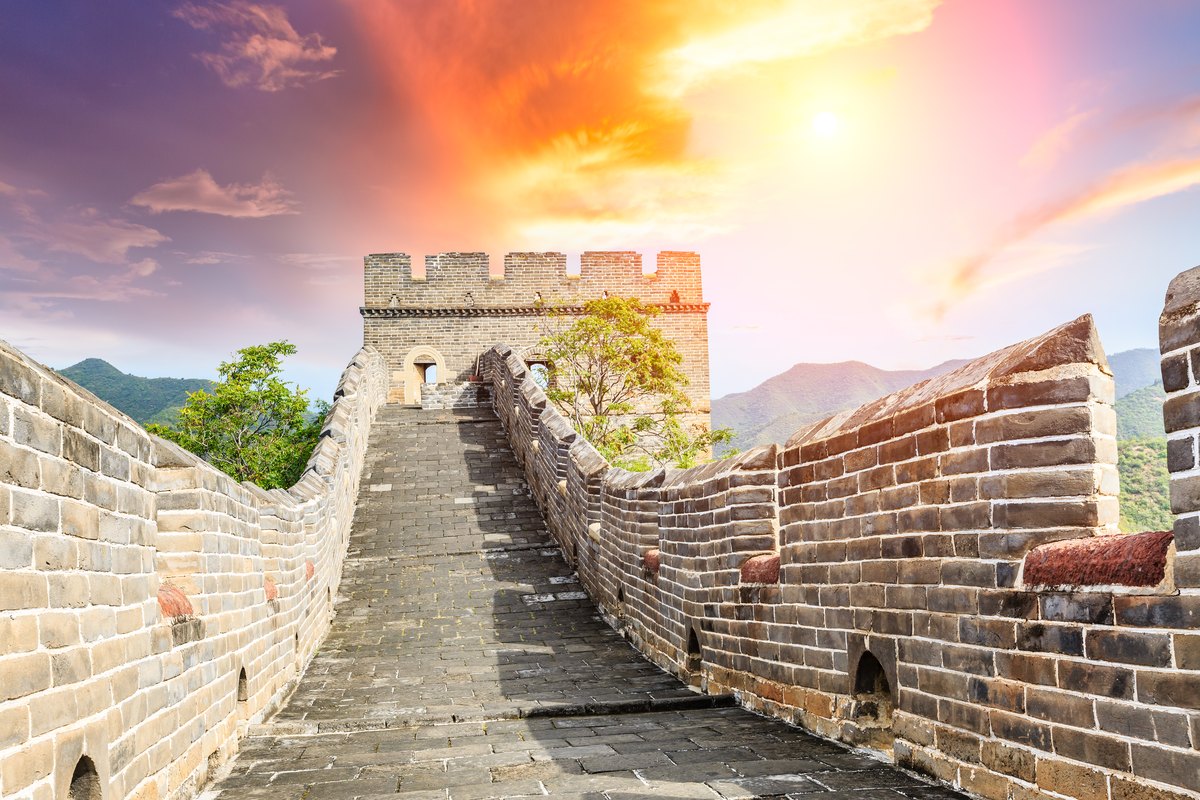
Brief history of the Great Wall
The walls visitors see today are mostly Ming dynasty (1368-1644), built and connected over two centuries to defend the northern frontier. Earlier walls were built from the 7th century BCE through the Qin, Han and other dynasties; what we call 'the Great Wall' is a network of those fragments, watchtowers and natural barriers stretched across the north.
The Great Wall on a map: from east to west
How far does it stretch?
The Ming-era continuous wall is roughly 8,851 km. Counting earlier walls and natural barriers, the total known length is about 21,196 km. The wall and its branches cross 15 provincial-level regions - from Liaoning in the east to Gansu in the west, with branches reaching as far as Heilongjiang, Qinghai, and Xinjiang.
| Endpoint or notable section | Province | Notable feature |
|---|---|---|
| Hushan (eastern end) | Liaoning | Closest to the North Korea border; partially reconstructed |
| Shanhaiguan | Hebei | Where the wall meets the Bohai Sea - 'First Pass Under Heaven' |
| Beijing-area sections | Beijing & Hebei | The most preserved, restored and visited stretch |
| Yanmenguan | Shanxi | Strategic mountain pass with long defensive history |
| Jiayuguan (western end) | Gansu | Where the Ming wall meets the Gobi Desert |
Is the Great Wall one continuous wall?
No. The Great Wall is a network of walls, watchtowers, beacon platforms and natural barriers built and rebuilt across more than 2,000 years.
- Different dynasties built different sections at different times.
- Some original walls are gone; others survive as ruins.
- What visitors see today is mostly Ming-era reconstruction.
Which city is closest to the Great Wall?
| City | Closest sections | Drive time | Best for |
|---|---|---|---|
| Beijing | Mutianyu, Badaling, Jinshanling, Simatai, Huanghuacheng, Gubeikou | 1-3 hr | Almost every visitor - the practical default |
| Tianjin | Huangyaguan | 2-2.5 hr | Travelers already in Tianjin who want a quieter section |
| Chengde (Hebei) | Jinshanling | 1.5 hr | Visitors combining Jinshanling with the Mountain Resort |
| Datong (Shanxi) | Hanging Wall / Shanxi sections | 1-2 hr | Niche routes; not the default first visit |
| Jiayuguan (Gansu) | Jiayuguan Pass | in the city | Silk Road itineraries |
Where exactly is the most-visited section?
Badaling - northwest of Beijing in Yanqing District - gets the most visitors because it is closest to the city and has direct rail access. Mutianyu - north of Beijing in Huairou District - is DragonTrail's default for international visitors because it is calmer, more scenic, and has cable car access.
- Badaling: Yanqing District, Beijing municipality.
- Mutianyu: Huairou District, Beijing municipality.
- Both are inside Beijing's administrative boundary, not in Hebei.
Common mistakes when planning around 'where is the Great Wall'
Looking for one entrance
There isn't one. Every section has its own gate, ticket and shuttle. Pick the section first; then plan the day.
Assuming the wall is in one city
The wall crosses 15 provincial regions. The version international visitors see is the Beijing-area Ming wall - not the whole story.
Trying to visit two sections in one day from Beijing
Possible only for adjacent sections like Jinshanling + Simatai with an early start. Mutianyu + Badaling is usually a long, tiring day.
Underestimating drive time
Most sections are 1.5 to 3 hours one-way from central Beijing. Return traffic is the silent budget killer; plan a buffer.
Treating 'Great Wall' and 'Badaling' as the same thing
Badaling is one section. Mutianyu, Jinshanling, Simatai, Huanghuacheng and Gubeikou are equally 'the Great Wall'.
Great Wall location FAQ
- In northern China, running across 15 provincial regions from Liaoning in the east to Gansu in the west. For visitors, the most accessible sections sit 60-150 km north of Beijing.
- China. The full Ming dynasty wall lies entirely within northern China; no part of the wall crosses into another country.
- Beijing, by a wide margin for visitors. Six well-known sections are 1-3 hours from central Beijing. Other cities (Tianjin, Chengde, Datong, Jiayuguan) have closer sections but lower visitor convenience.
- Beijing municipality contains several sections, including Badaling and Mutianyu. Jinshanling is in neighbouring Hebei province, while Simatai and Gubeikou are in Beijing's Miyun District.
- About 8,851 km for the Ming dynasty wall (the one most visitors see) and around 21,196 km when all known walls from earlier dynasties and natural barriers are included.
- Not with the naked eye - it is too narrow. With telephoto lenses from low Earth orbit it is photographable, but that's different from 'visible to the human eye'.
Plan a Great Wall visit from Beijing
If you already know which section you want, open that section guide. If not, our default for international visitors is Mutianyu - restored, cable car access, family-friendly, and the easiest balance between travel time and time on the wall.
We run private Great Wall day trips and Beijing-layover Great Wall transfers year-round, with hotel pickup and a return plan that accounts for Beijing traffic.
Plan a private Great Wall daySee all Beijing Great Wall tours