- Getting there: Usually longer than Mutianyu, so this is not a casual add-on stop
- Typical visit style: Hiking-focused half day or full day on the wall
- Difficulty: Moderate to hard depending on route
- Crowds: Usually lighter than Badaling, but holidays still matter
- Best for: Hikers; Photographers; Repeat Great Wall visitors; Travelers who want a deeper wall experience
- Less ideal for: Travelers with very limited time, low mobility, or a facilities-first preference
Jinshanling Great Wall hiking map
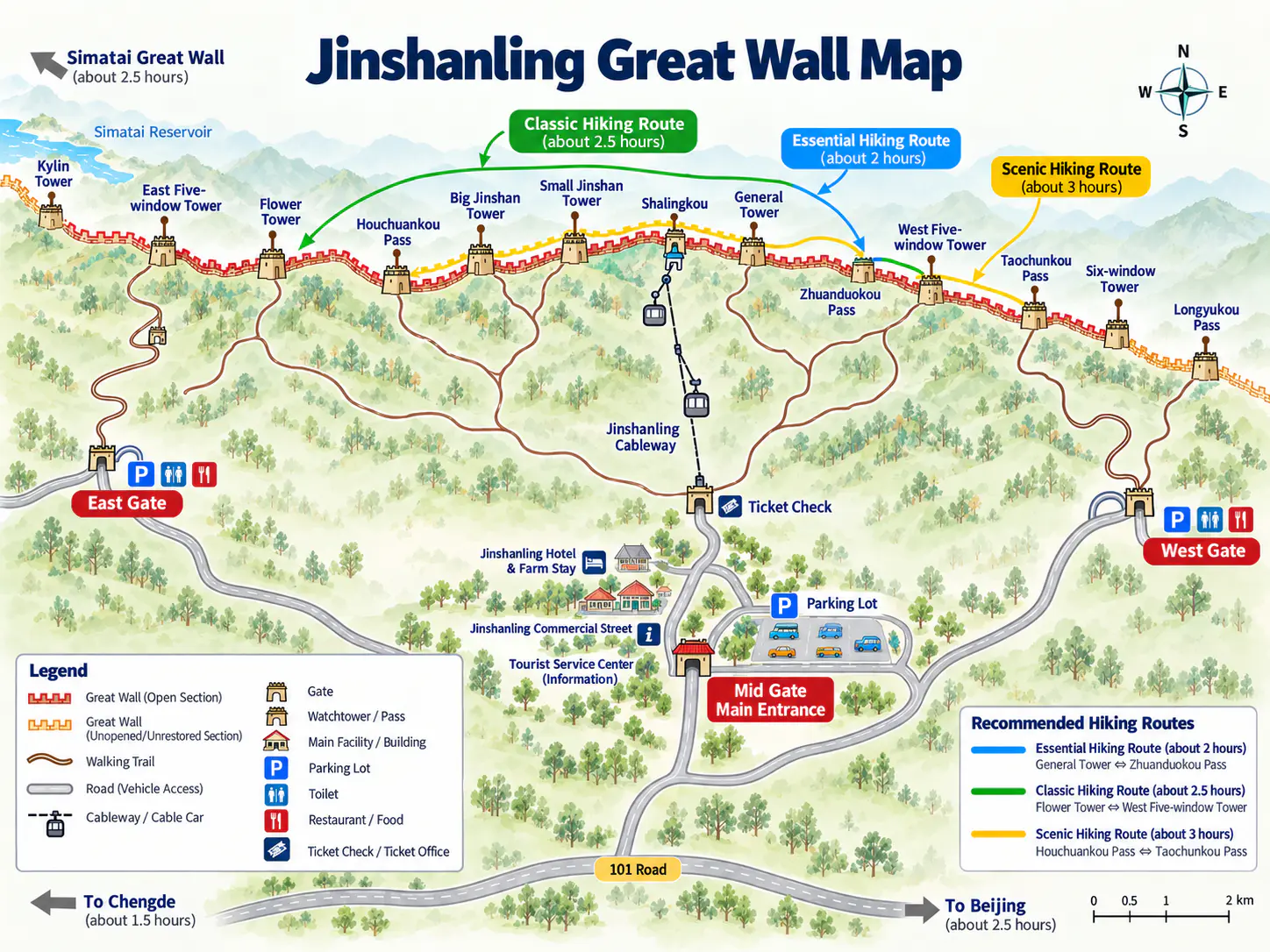 Click to enlarge
Is Jinshanling right for you?
Choose Jinshanling if you want:
- a real ridge hike rather than a short scenic visit
- a mix of restored and wilder wall sections
- longer continuous views and stronger photography potential
- a less packaged feel than more access-oriented sections
It may not be the best fit if you want:
- the shortest drive from Beijing
- easier access and gentler pacing
- cable car convenience as the center of the experience
- a quick half-day city-style outing
For many first-time visitors who want a smoother entry point, Mutianyu is often the easier choice. For travelers who want more hiking depth and are willing to trade convenience for terrain, Jinshanling is usually the stronger fit.
Route options at Jinshanling
The right route matters more here than at easier Great Wall sections. A good visit is usually defined by choosing a route that matches your time, fitness, weather, and pace.
Route A: Classic ridge sampler
- On-wall time
- about 2.5 to 3 hours
- Effort
- Moderate
- Best for
- First-time Jinshanling visitors; Balanced hikers; Photographers who want highlights without overstretching the day
This is the most balanced option for many visitors. It focuses on a representative ridge section with iconic towers, long views, and enough elevation change to feel like a real hike without turning the day into an endurance project.
Why choose it
- good introduction to Jinshanling’s character
- strong photography return for the time spent
- manageable for many reasonably active travelers
Not ideal for
- visitors who want a very short walk
- travelers expecting a low-effort sightseeing stop
Route B: Extended ridge hike
- On-wall time
- about 4 to 5 hours
- Effort
- Moderate to hard
- Best for
- Strong hikers; Repeat Great Wall visitors; Travelers who want a fuller ridge experience
This is a longer, more immersive Jinshanling day. It works best for people who actively want the wall as the main event, not just one sightseeing stop among several. Route length, exposed sections, and accumulated fatigue matter much more here.
Why choose it
- deeper hiking experience
- more variation across towers and ridgelines
- stronger sense of scale and terrain
Not ideal for
- late starts
- hot weather without preparation
- visitors unsure about their hiking stamina
Route C: Focused short segment
- On-wall time
- about 1.5 to 2 hours
- Effort
- Moderate
- Best for
- Time-limited visitors; Conservative pacing; Travelers who want Jinshanling without committing to a long traverse
This option is useful when you want the scenery and atmosphere of Jinshanling but need tighter control over the day. It is better to do a focused, well-chosen segment than rush a longer ridge and end up fatigued or pressed for time.
Why choose it
- better fit for a shorter overall day
- lower fatigue exposure
- easier to manage in uncertain weather
Not ideal for
- travelers who specifically want a full ridge feeling
- visitors expecting a full-day hiking outcome in limited time
How to choose the right route
A useful way to choose is not by ambition, but by constraints.
- Choose the focused short segment if your main constraint is time.
- Choose the classic ridge sampler if you want the best balance of scenery, effort, and day structure.
- Choose the extended ridge hike only if the wall itself is the priority and you are comfortable building the whole day around it.
In practice, many weak Jinshanling experiences come from one mistake: choosing the longest route because it sounds like the “best” one, even when the day, weather, or fitness level does not support it.
Example day structure from Beijing
Jinshanling works best as a deliberately planned day trip, not a loose outing.
Focused half-day structure
- Morning departure from Beijing
- Drive to Jinshanling
- 1.5 to 2.5 hours on the wall
- Short rest or meal break
- Return to Beijing
This can work well for a tighter day, but the drive still needs to be respected. Even a shorter on-wall route does not make Jinshanling a casual city-side excursion.
Full-day structure
- Early departure from Beijing
- Arrival with time to start before the strongest heat or late-day pressure
- 3 to 5 hours on the wall depending on route
- Rest, recovery, and flexible return timing
- Return to Beijing with buffer
For many visitors, this is the better match. It allows enough time for the wall itself without turning the return leg into a rushed or fatigued finish.
How we manage a Jinshanling hiking day
Jinshanling is where route discipline matters. The value of a transfer-plus-guide setup is not only transport or explanation. It is the ability to keep the day controlled as conditions change.
Pacing control
A Jinshanling day should not be paced like a city attraction. The terrain, stairs, and exposed sections change how people move. We adjust pace based on fitness, weather, and how energy holds up after the first part of the hike. Short breaks are built around terrain and rhythm, not treated as fixed tourist stops.
Route control
The route is selected based on how much wall you actually want to experience, not simply on what looks longest on paper. This matters because backtracking, overcommitting, or choosing the wrong segment can reduce the quality of the day quickly. The route can also be shortened or kept tighter if conditions on-site suggest that the original plan would push the day too far.
Time buffer control
A strong Jinshanling day needs a return buffer. This is not only about the drive back to Beijing. It is also about deciding in advance what the turnaround point is, how long the wall section should take, and when it is no longer worth extending. That protects the day from turning into a late, tired return caused by small time overruns earlier on the ridge.
Exit strategy
Good planning at Jinshanling includes knowing when to stop, not just where to go. If fatigue sets in earlier than expected, if the weather turns, or if pace falls below plan, the route should shift toward a controlled exit rather than a forced completion. That is often the difference between a satisfying hike and a stressful one.
Getting there from Beijing
For most visitors, the sensible options are either a private driver (DragonTrail from ¥1,200 sedan / ¥1,600 MPV) or a guided hiking setup.
Private driver
Complexity: Low
Best for: Visitors who want predictable pickup, direct transport, and control over departure and return timing
DragonTrail rates from ¥1,200 (standard sedan) / ¥1,600 (7-seat MPV) for Jinshanling/Simatai. Often the most practical option for independent visitors who want the day to run on a clear schedule.
Guided hiking day
Complexity: Low in execution
Best for: Visitors who want route help, pacing judgment, and more confidence on a longer wall day
This is the better fit when the hiking experience itself is the point, especially for first-time Jinshanling visitors or travelers who do not want to self-manage route decisions on-site.
Public transport and transfer combinations
Complexity: Higher
Best for: Flexible travelers comfortable with transfers, variable timing, and extra planning
This can work, but for many visitors it adds friction at exactly the point where Jinshanling already requires more structure than other sections.
Jinshanling vs Mutianyu vs Gubeikou
A simple rule:
Jinshanling
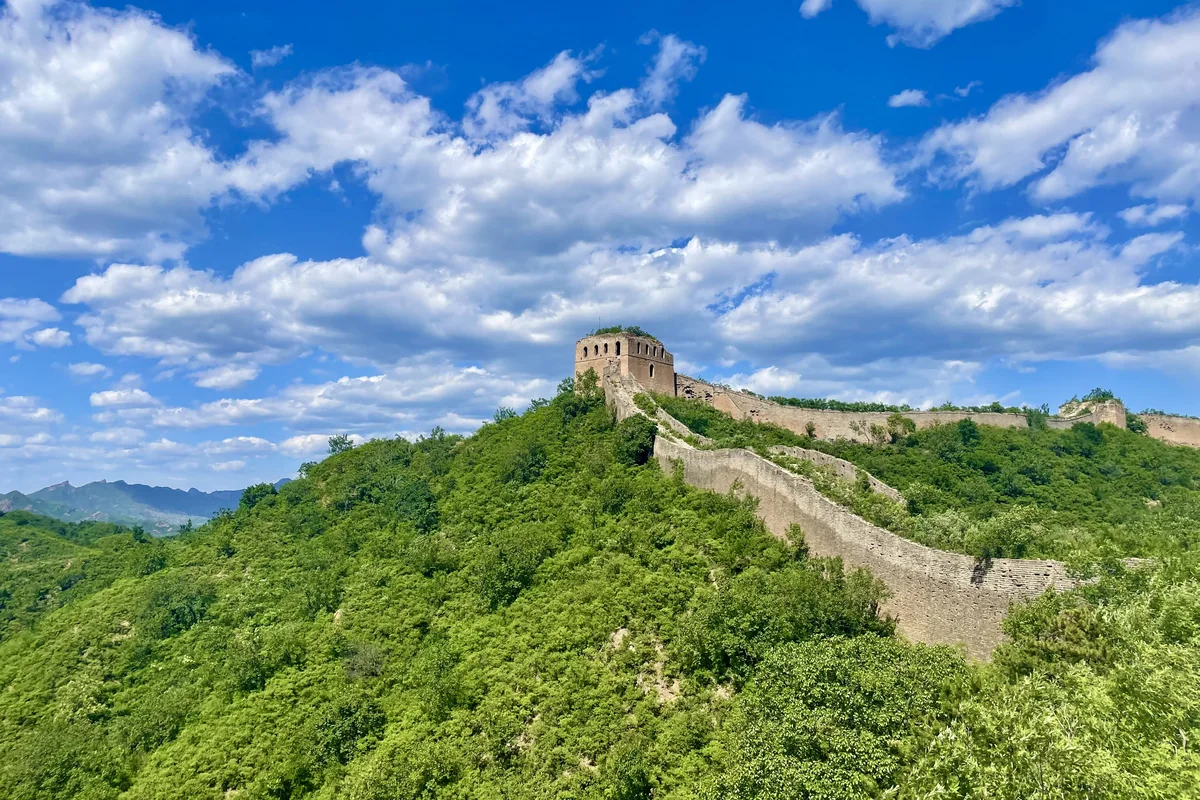
Best when hiking depth is the priority. Strong ridge views, longer walking logic, and a mix of restored and wilder wall.
Mutianyu
Best when you want easier logistics, gentler access, and a more facilities-supported experience. Often the better first Great Wall visit for mixed-age groups or travelers who want less friction.
Gubeikou
Best for travelers specifically seeking a wilder and more rugged wall experience. Usually less suitable for casual visitors and requires stronger tolerance for rougher conditions.
- choose Mutianyu for easier access and smoother logistics
- choose Jinshanling for a fuller hike with broad visual payoff
- choose Gubeikou only when ruggedness itself is part of the goal
| Jinshanling | Mutianyu | Gubeikou | |
|---|---|---|---|
| Effort | Higher hiking load; ridge logic matters | Moderate; uplift options reduce climbing | High / rugged; wild wall |
| Access | Longer drive; plan as a wall day | Smoother visitor logistics | Rougher access; strongest self-selection |
| Style | Hiking depth + big views | Facilities-first friendly | Wilderness-forward; least forgiving |
Common mistakes at Jinshanling
Treating it like a quick city outing
Jinshanling is not a short urban attraction. The drive and the hike add up. Underestimating either one usually weakens the entire day.
Choosing the longest route by default
Longer is not always better. A controlled 2.5 to 3 hour ridge hike is often more satisfying than pushing into a 5 hour route that leaves you exhausted or pressed for return time.
Wearing the wrong shoes
Grip matters. Uneven steps, worn surfaces, and occasional loose ground make ordinary casual shoes a poor choice.
Ignoring exposure
Wind, sun, and seasonal temperature swings are real here. Jinshanling can feel much harsher than city conditions suggest, especially on exposed ridges.
Tickets, weather & gear
Tickets / access: Admission ticket ¥65. Published packages: ¥65 tickets only; ¥85 with shuttle RT; ¥105 with cable one-way; ¥125 with cable RT (or VIP shuttle combo); ¥145 with shuttle RT + cable RT. Private driver from Beijing: from ¥1,200 sedan / ¥1,600 MPV.
Weather: Assume more exposure than city conditions suggest; check wind and temperature swings.
What to bring
- proper walking shoes with grip
- water
- sun protection in warmer months
- layers for wind or seasonal temperature shifts
- realistic expectations about route length and pace
FAQ
- It can range from moderate to fairly strenuous depending on the route. The route choice matters as much as the wall itself. For many visitors, the issue is not whether Jinshanling is “hard” in theory, but whether the chosen route matches their day and energy level.
- It is generally a longer drive than closer sections like Mutianyu. That is why Jinshanling works best when treated as a dedicated hiking day rather than a short side visit.
- It can be, but only if you actually want a hiking-oriented wall experience. If your priority is comfort, access, or easier pacing, Mutianyu is often the better first choice.
- A focused segment can work, but the drive still makes the day longer than people often expect. In many cases, a full day is the better structure.
Plan a Jinshanling hiking day
If you already know you want a hiking-focused Great Wall day from Beijing, Jinshanling is one of the strongest choices.
If you are still comparing sections, start here: