
Quick Orientation
| Topic | Orientation |
|---|---|
| Goal | One simple, intact decorative cut |
| Starter tools | Thin paper, scissors, pencil, cutting mat |
| Key idea | Leave connecting bridges |
| Next step | Practice a second design or try a hosted session |
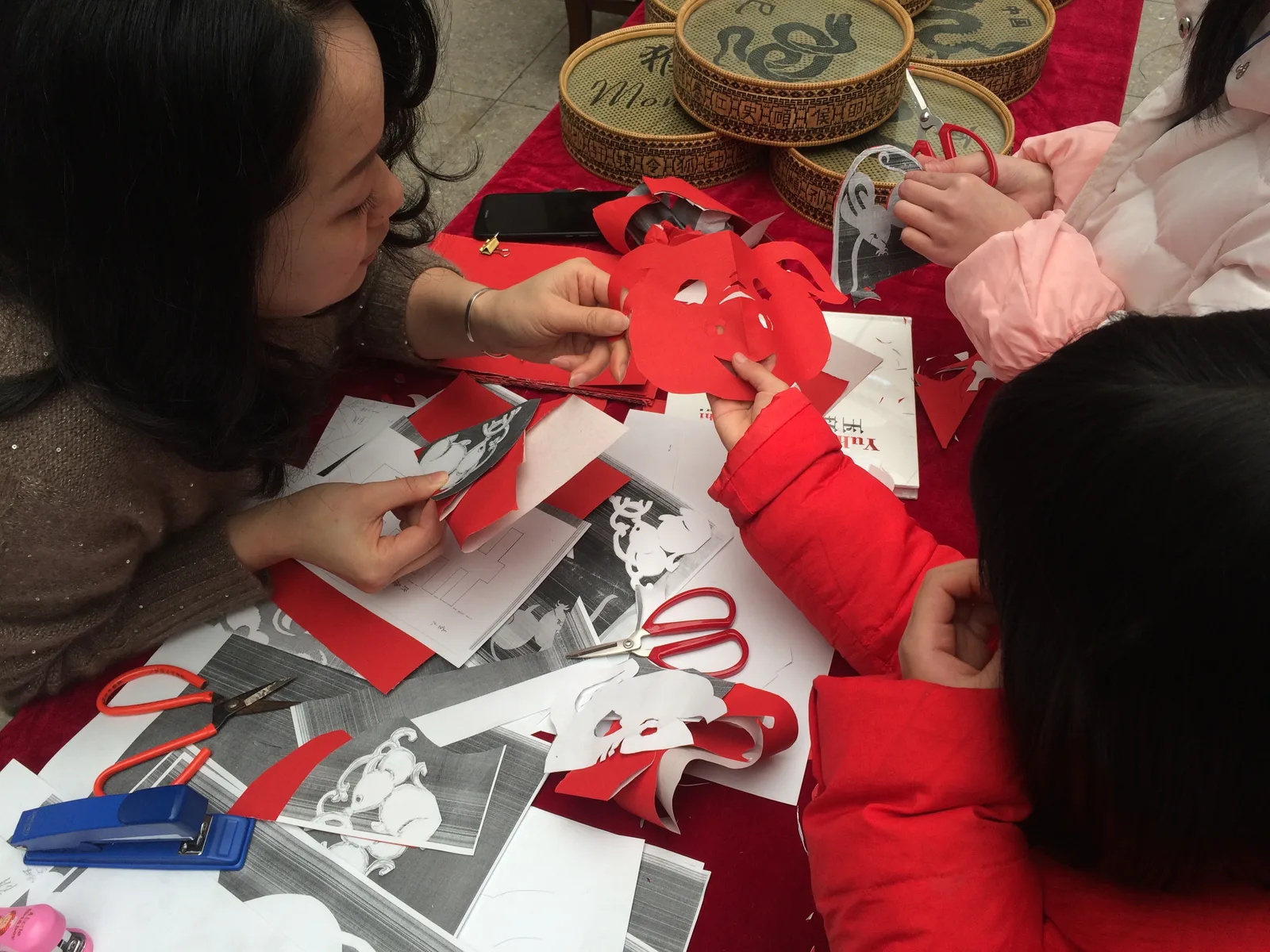
*People cutting red paper with scissors in a Yuhuan paper-cutting activity. Photograph: Rowingbohe, Wikimedia Commons, CC BY-SA 4.0. Representative cultural activity; not a DragonTrail session.*
Tools and Materials
Beginner-friendly kit:
- Thin coloured paper (festive red is common for practice that looks “New Year”)
- Small sharp scissors
- Pencil for transferring a simple outline
- Cutting mat or scrap cardboard
- Optional: craft knife for straight interior cuts—only with a mat and care
Traditional workshop contexts may add specialized knives for fine openwork. You do not need them for a first folded snowflake-like window flower or simple character practice.
Positive Space, Openwork and Bridges
Every cut removes paper. If you remove too much without leaving connections, the design falls into scraps. Bridges are the narrow paper links that hold motifs together. Looking at finished jianzhi, notice how outer frames and inner connectors keep animals or characters intact.
Positive shapes (paper kept) and negative spaces (holes) should both be intentional.
Beginner Sequence: A Simple Folded Cut
This sequence teaches control; it is not “the only authentic method.”
- Choose thin paper larger than your final display size.
- Fold once or twice for bilateral symmetry if you want a mirrored window flower. Skip folding for an asymmetric outline.
- Draw a simple design on the front, keeping thick connectors. Avoid hairline details on the first try.
- Cut slowly, removing small shapes rather than long risky tunnels.
- Unfold carefully and flatten under a book if needed.
- Display on a window or card to see how light reads the openwork.
Character cuts (for example a chunky 春) need even more attention to interior counters—the closed holes inside strokes.
Scissors Versus Knife Techniques
Scissors suit household and classroom settings. Knife or engraving approaches can achieve finer pierced textures in some regional and studio traditions. Beginners should master scissors control before chasing knife detail.
Easy Designs Versus Advanced Jianzhi
Beginner designs usually use high-contrast forms with relatively few narrow bridges. Advanced jianzhi may involve intricate lattices, multi-layer colour and freehand cutting from memory. Respect the gap: a successful beginner cut is still real craft practice, just not museum virtuosity.
Cultural framing: Jianzhi Folk Art. Motif ideas: Symbols & Motifs.
Common Beginner Mistakes
- Cutting away the outer frame so the piece has no border
- Making bridges thinner than the scissors can preserve
- Using thick cardstock that fights small scissors
- Expecting one fold to produce a complex figurative animal
- Tracing tiny internet templates without simplifying
Learning With a Host or Class
A short demonstration or hosted session helps with posture, scissors control and design choice. In China, availability is local and seasonal—see Where to Experience.
DragonTrail’s Beijing hutong experience is built around calligraphy, dumplings and lunch. You may request a short paper-cutting activity in your inquiry; it is included only if confirmed before payment: hutong cultural experience.
Frequently Asked Questions
What paper is best for beginners?
Thin coloured craft paper that scissors can turn easily. Very thick paper fights detail; extremely fragile tissue tears too soon.
Do I need special Chinese paper-cutting scissors?
Purpose-made scissors help, but sharp small craft scissors are enough to start.
Is folding required?
Only for symmetrical folded designs. Many traditional works are not folded snowflake patterns.
How long does a first project take?
A simple first cut may take anywhere from a few minutes to much longer depending on size, complexity and experience.
Can children try Chinese paper cutting?
Often, with supervision and simplified designs. Avoid craft knives for young children.
Practicing Character Cuts Safely
Chinese characters with enclosed spaces need planned counters. Sketch the character larger than you think you need, thicken every stroke, then cut interior holes before refining outer edges. If a stroke is too thin, the character collapses when lifted.
Pair character practice with the symbols page so you understand why 福 and 春 dominate festive teaching sets.
Clean-Up and Display
Brush scraps away before unfolding fully. For window display, a light mist of water can help paper relax flat—test on scrap first. Avoid heavy glue that stains thin paper.
When to Stop and Take a Class
If your bridges keep tearing or you want knife techniques, a short hosted session is more efficient than forcing advanced cuts alone. Plan that through local cultural programs or an optional confirmed add-on—not by assuming inclusion in an unrelated activity list.
Mini Project Ideas
| Project | Why it teaches well |
|---|---|
| Symmetric window flower | Forces bridge planning on a fold |
| Chunky 春 or 福 | Teaches counters inside characters |
| Simple zodiac silhouette | Practices curves without lace density |
| Layered two-colour stack | Shows alignment without complex piercing |
Complete one intact piece before chasing density. Intact and simple beats shredded and ambitious.
Safety Notes
Keep fingers clear of blade paths; cut away from your body; park knives when not cutting. Supervise children. Dispose of sharp scraps so they are not mistaken for confetti in a shared kitchen—relevant if you practice before a dumpling session on a cultural day.
Sources & Further Reading
- UNESCO — Chinese paper-cut (2009, Representative List of the Intangible Cultural Heritage of Humanity)
- Smithsonian Folklife Festival — Paper Cuttings, Shaanxi Province
- Smithsonian National Museum of Asian Art — Paper Cutting educator material
Technique guidance is practical traveler instruction aligned with folklife teaching descriptions of scissors-based paper cutting. The hero photograph is a Yuhuan activity context, not Beijing.
Continue Exploring
Hub · New Year designs · Where to experience · Arts and Crafts