
China Snow Town at a glance
| Detail | Plan |
|---|---|
| Where | Xuexiang, Hailin, Heilongjiang |
| From Harbin | About 5–6 hours on the winter road |
| Minimum stay | Two nights |
| Why overnight | Dawn and blue hour, not a dark arrival |
| Not the same as | Yabuli skiing or the Ice Festival |
| Crowds | Weekends and Chinese New Year |
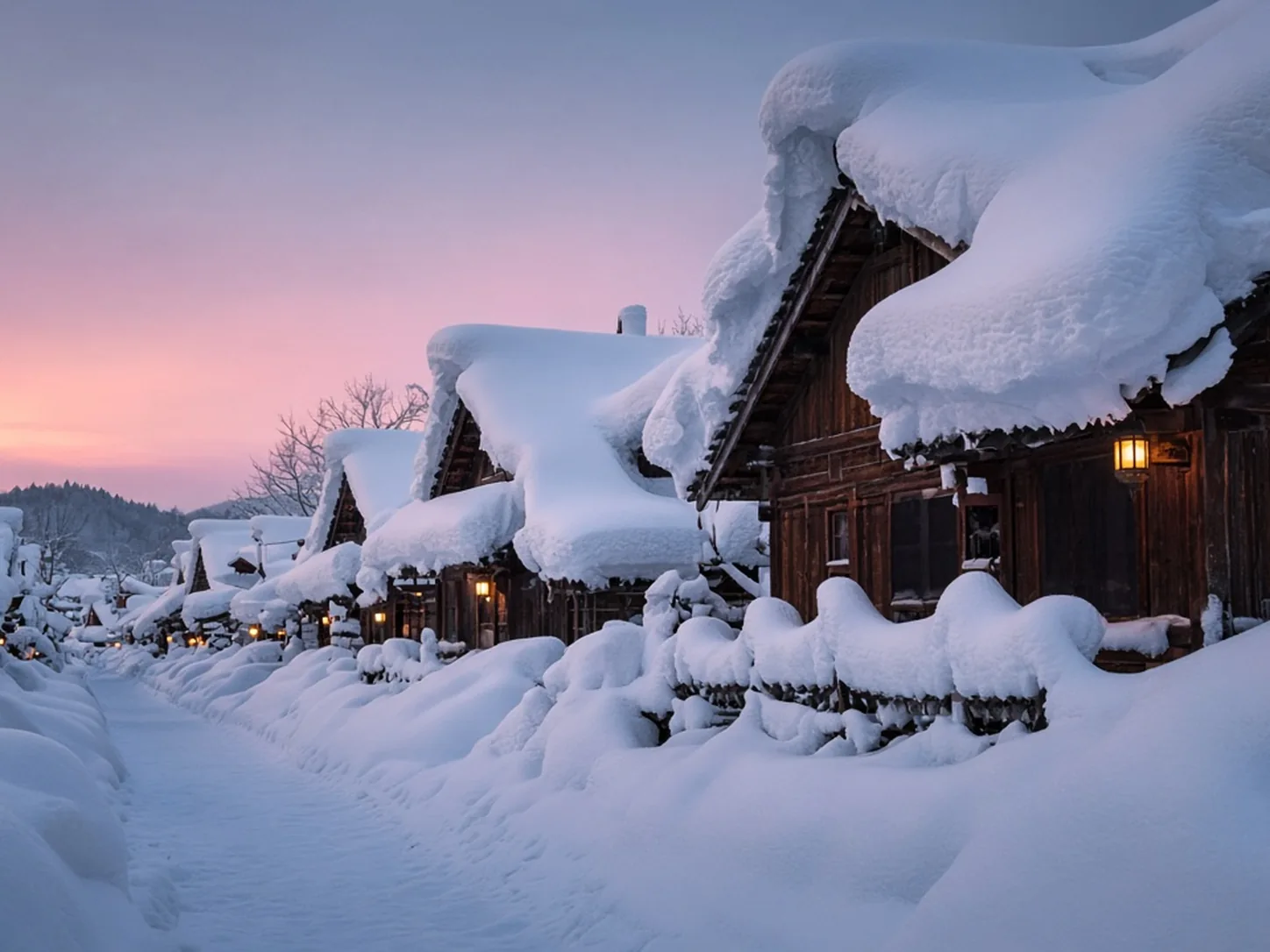
Where you sleep in China Snow Town decides the photograph more than the coat you packed. Xuexiang, in Hailin, is a scenic village of snow-loaded wooden roofs and icy lanes. A bed inside or truly at the edge lets you walk out for dawn. A bed beyond the gate makes you a passenger on the first shuttle, and the first shuttle is often later than blue hour.
Inside the Scenic Area or Beyond the Gate
The scenic area is the village people mean: the lanes, the roof caps, the managed paths, and the lodgings that sit among them or immediately beside them. Sleeping there, or at the edge where you can walk to the lane before the crowds, is the arrangement that matches the reason for the trip. You dress, you step onto the ice, and you are in the picture while the light is still low and the walking line is still yours.
Sleeping outside the gate is a different stay. You are depending on the internal shuttle to begin your day, and on the last shuttle to end it. That can be a reasonable night if you do not care about dawn and you have confirmed every running time. It is a poor way to spend the only mornings of a short stay. The shuttle is part of the scenic operation. It is separate from your Harbin hotel, and it is separate from scenic-area entry. Both entry and the shuttle need to be in the plan even when the room is already held.
Ask a plain question before you accept an outside room: what time is the first shuttle on my dates, and does that put me in the lane before sunrise? If the answer is vague, assume you will miss blue hour. The Harbin travel guide is where city nights belong, before and after the mountain. It is not a substitute address for the dawn you came to Hailin to see. Harbin’s Snow Town chapter talks about the overnight from the festival side. The bed, on this page, is a village decision.
Two nights is the minimum useful stay, and both of those nights should be in the place that can reach the lane. Splitting them — one inside, one back toward the station to “save a transfer” — usually saves the wrong thing. You give away a morning so the departure logistics look neat.
Dawn Is a Hotel Decision
Blue hour and the first light on the roofs are the hours the lane is quiet enough to see. They happen before breakfast service feels relevant and before most shuttle schedules feel generous. If your door is on the village side of that problem, you can be outside, fully dressed, at the time the snow actually looks like the photographs. If your door is on the far side, you will watch that light from a window or miss it entirely while you wait in a line of coats.
This is why “we will go early” is not a plan when the room is outside. Early is defined by the shuttle, the gate, and the road from a distant lodge, not by your alarm. An alarm at a heroic hour still loses to a vehicle that has not started. Confirm the first departure against the sunrise of your month. December through February all have late sunrises and mid-afternoon sunsets. The window is short enough that a half-hour delay is the whole effect.
On a two-night stay you may get two dawns if you are inside, and the arrival day may not include one at all. That is acceptable. On a one-night stay you often arrive in the dark and leave after breakfast, so the bed’s location is the only chance you had, and an outside room deletes it. Three nights, the longer stay, give you spare dawns. They do not repair a room that cannot reach the lane. Location first, then the extra night.
Weekends and Chinese New Year change the morning even when you are well placed. More people set the same alarm. The lane clogs earlier. Being inside still matters, because you can be there before that clog, but it does not give you a private village. Midweek in January, after fresh snow, is when a well-placed room and a quiet lane overlap. Choose the bed as if that morning is the point, because it is.
What a Snow-House Photo Is Selling
Listings lean on the roof. Snow piled on wood, a warm window, a path disappearing into white. That image is the exterior of Xuexiang in a good winter. It is a fair picture of what you will walk past. It is an unreliable picture of the night indoors. “Snow house,” “snow cottage,” and similar phrases describe a look and a location claim. They do not rank the building, and they do not identify a single property you should book. There is no one right name on this page. There is a right kind of place: inside or at the edge, heated, reachable on foot at dawn, honest about the walk.
Judge a room by four practical facts. Can you walk to the main lane before the shuttle would have mattered? Is the room heated, and is the heat something you can ask about in plain language? What is the walking surface between the door and the lane — steps, a slope, polished ice? How many other guests share the corridor on a weekend? A poetic title that fails those questions is a photograph of somebody else’s morning.
Be wary of a pin dropped “near Snow Town” that is actually a town on the station side of the mountain. Near, in winter, can mean a shuttle you have not confirmed. Ask which gate, which shuttle, and how long the walk is on ice with luggage. If the host describes a scenic shuttle as “easy,” ask for the first departure again. Easy in the afternoon is not the same as possible at blue hour.
China Snow Town tours is where a village stay of three days and two nights, or four days and three nights, gets its nights matched to this standard. Adding the village to a Harbin winter still means those nights, not a city hotel with a long day trip attached. Festival nights remain a Harbin tours decision.
Heat Indoors, Ice at the Door
Expect the room to be heated. Also expect that heat to vary. Some buildings run very warm, enough that you will want to sleep in light clothes and will feel overdressed the moment you come inside from a loop. Others are warm near the source and cool in the corners, or warm in the evening and less so by the pre-dawn hour when you are pulling boots on. Ask how the room is heated and whether guests can adjust it. Pack sleep clothes for a warm room and a layer you can add if the corner by the window is the cold one.
The photograph of snow on the roof does not mean you are sleeping in an unheated cabin, and it does not mean the outdoors has been domesticated. The transition is abrupt. You are warm, then you open a door, and the air is about −20°C to −30°C, often with wind if your door faces a gap between buildings. Dress completely inside. Hat, face cover, gloves, and boots before the handle. A “quick look” in indoor clothes ends in a retreat and a fogged pair of glasses, and it blocks the doorway for everyone else.
Cotton against the skin is the wrong base for that transition. You will sweat while you overdress indoors, then cool fast when you stop on the lane to look at a roof. Wool or synthetic fabric next to the skin, then insulation, then a wind shell. The ridge above the houses is windier than the lane. The doorway is already enough wind to respect.
Give wet gear a place to thaw overnight, away from a blast of heat that can cook a boot or a glove. Wet gloves in the morning are a missed dawn. A spare pair of gloves and spare socks in the bag are more useful than another lens. Boots with grip stay by the door, not buried under a coat where you will trip over them in the dark.
How to choose
| Choice | Fit | Skip when |
|---|---|---|
| Make this the focus | When this page is the reason for the day | When it is only a name on a list |
| Pair it | With one nearby stop | With a second full excursion |
| Leave it | If the main stay is already full | If you have the night it needs |
Noise, Thin Walls, and Early Doors
A scenic village in peak season sounds like one. Wooden or wood-clad buildings carry footsteps, luggage wheels, corridor talk, and doors. On weekends the sound goes late, because people return from the lit lane in a stream, and it starts early, because photographers and groups set alarms for the same blue hour. Chinese New Year is louder still. Earplugs are a reasonable piece of kit, not a criticism of the place.
You will be part of the noise if you are doing the trip properly. A pre-dawn departure means boots in a corridor. Keep voices down, pack the camera bag at night, and avoid a shouted reunion in the hallway. Other guests are trying to sleep or trying to leave. Residents who work in the village are on the same schedule of early doors. The lane is their workplace and their street.
Meal rooms and lobbies fill at the moments everyone gets cold together: after the first loop, and again at dinner. That bustle is part of being warm. It is also a reason to eat slightly early if you want a table before a night walk, and a reason not to expect a silent retreat at 7 a.m. on a Saturday in January. Midweek eases both the lane and the building. If silence is essential to you, midweek is the lever that works. A demand for a private hush on a holiday weekend will not be met by any ordinary snow-house room.
If someone in the group sleeps lightly or is traveling with a small child, say so when you hold the room and ask for a quieter corner if one exists. Do not expect a guarantee. Expect that you asked while there was still a choice. Three nights can be kinder than two for this reason alone: one noisy night does not define the stay, and a person can skip one dawn without skipping the only dawn.
Walking on Ice between the Door and the Lane
The path from a village room to the famous frames is often short and still technical enough to matter. Packed snow turns to ice where everyone steps in the same places. There are steps, slight slopes, and boards or stones hidden under a white surface. The fall people remember is usually here, half awake, carrying a camera, not on a dramatic ridge. Take shorter steps. Keep hands out of pockets until you know the surface. Use a small light on the way out and shield it from other people’s faces and lenses.
Insulated boots with a real tread are the right tool. Smooth fashion boots are how a pretty coat ends up on the ground. Removable ice grips can help people who already know they are unsteady, with the caution that grips change how you walk on indoor floors — take them off before you step onto tile and slide in the other direction. A pole is optional and often awkward in a crowd. It is not required for a village lane the way it would be on a mountain route. This is not a mountaineering problem. It is a slippery street in deep cold.
Leave the main walking line clear when you stop to look up at a roof. Two people abreast on the only polished track force everyone else onto worse snow. That is how collisions happen in puffy coats with no peripheral vision. Step aside, make the picture, and move. Deep snow at the edge can hide a ditch or a drop beside a path. The cleaner angle is not worth a leg.
Luggage uses the same surface on arrival day, when you are tired from five to six hours on the road and the light may already be gone. This is the argument for a smaller overnight bag. A large spinner suitcase on village ice is a hazard to you and to the people behind you. If the city hotel in Harbin can hold the bags you do not need, use that. The Harbin travel guide covers the city base those bags return to.
The Edge of the Scenic Area
“At the edge” is a useful category and a slippery phrase. The edge that works is a place you can leave on foot, in the dark, and reach the lane before sunrise, without waiting for a shuttle and without a road walk along vehicle traffic. The edge that does not work is a lodge that uses the word because the pin looks close, while the practical start of the day is still a shuttle queue after breakfast.
Ask for the walking time on ice, with snow, in the morning, not the summer distance in meters. Ask whether that walk is permitted and lit before the scenic area’s main rush. Ask whether luggage is walked the same way or delivered somehow else. A ten-minute walk in daylight boots can be twenty minutes in the dark with a camera and a careful pace. That can still be the right room. An unconfirmed “very close” cannot.
Edge rooms can be quieter than the buildings in the middle of the lane, which is a real advantage on weekends, provided the walk does not take the light. They can also be more exposed to wind. Look at whether the door faces an open gap. A windy threshold at −25°C changes how long you will stand there organizing gloves. Organize inside.
If the only rooms left are beyond that definition, consider different dates before you consider a heroic shuttle plan. Midweek January inventory is the usual reason an inside or edge room still exists. Chinese New Year and peak weekends are the usual reason it does not. Harbin’s Snow Town chapter is frank about peak demand from the festival-trip side. The same pressure applies when the village is your whole trip. Hold the room, then draw the rest of the week around it.
Weekends, the Holiday, and Holding a Room
Rooms inside the scenic area go first on January weekends and through Chinese New Year, when domestic travel floods Hailin. If those dates are fixed, start with lodging and accept that you may be choosing among what remains, including outside rooms that compromise dawn. If the dates can move, move them. A midweek stay with the right bed beats a holiday stay with a long shuttle and a lane you cannot walk.
Do not assume you can arrive and sort a room at the gate. Peak winter is when that hope fails. The rest of a Harbin itinerary should flex around the village nights you actually hold, especially when Xuexiang is the point. When the festival is the point, the reverse can be true — city nights first — and you should only add the village if a real room and real nights still fit. That judgment is what Harbin tours and the Harbin chapter are for. This page’s standard does not loosen because the festival was booked earlier.
Holding a room is not the same as understanding check-in after a winter delay. Tell the property you are coming by road or by train plus a local transfer, and that five to six hours from Harbin can run long. A late gate arrival needs a person who will still receive you. Get the arrival instructions in Chinese and in English if you can, including what to do if the shuttle you expected has stopped for the night.
Groups larger than a couple should ask whether the rooms are near each other. Scattered buildings on icy paths turn every regroup into a project. A family with a grandparent should prefer fewer steps even if the view from the window is slightly less theatrical. The theatrical view is available outdoors, at dawn, if the walk to it is kind.
Who Can Sleep Farther Out
Sleep farther out only with a clear reason and a clear shuttle. You do not care about blue hour, you have confirmed the first and last runs, and you are happy to spend the scenic middle of the day in the lane with everyone else. Some travelers genuinely want that and would rather have a quieter night away from corridor doors. It is a valid preference when it is chosen, and a disappointment when it is discovered.
Do not sleep farther out because a listing looked more like a hotel you recognize. The village’s charm and its inconvenience are the same fact: you are in a mountain scenic area, not in Harbin. Familiar lobbies sit back in the city, on the nights before and after, and they are the wrong tool for the morning this place is known for. Yabuli’s ski hotels are a different mismatch. The Yabuli guide is for a ski stay in Shangzhi, about three hours from Harbin. A night on a ski mountain does not put you in Xuexiang’s lane at dawn, and the drive between them is not a casual morning transfer.
People who cannot walk on ice, or who cannot be outside at these temperatures even for short loops, will not be saved by a well-located room. The point of the location is the walk. If the walk is the part of the trip they need to avoid, the better winter is the city festival, shaped with Harbin tours, where warming halls and a different kind of evening exist. The village can still be beautiful from a window. It is a thin use of a long road.
For everyone else, the order is simple. Choose inside or the true edge. Confirm heat, the icy walk, and the noise you are willing to accept. Hold it for two nights at minimum, three if you want a spare dawn. Then make the road from Harbin match that bed, through China Snow Town tours if you want the stay handled as one piece. The roof in the photograph is the outside. The right room is the one that lets you meet it before the lane fills.
Ways to plan the days
These shapes match the China Snow Town tours page. They are starting points, not fixed departures.
Snow Town stay
Time fit: 3 days
The winter road, two nights, and one real dawn.
- China Snow Town
- Snow Town stay
Why choose it: The winter road, two nights, and one real dawn.
Longer snow stay
Time fit: 4 days
A second morning when the first dawn was cloudy or crowded.
- China Snow Town
- Longer snow stay
Why choose it: A second morning when the first dawn was cloudy or crowded.
Add to a Harbin winter
Time fit: Add-on
Village nights beside a festival plan quoted on the Harbin page.
- China Snow Town
- Add to a Harbin winter
Why choose it: Village nights beside a festival plan quoted on the Harbin page.
Want help shaping the China Snow Town days?
Tell us your Harbin arrival and whether the Ice Festival is also in the trip. The village nights are planned here; festival days stay with Harbin.
Keep planning
China Snow Town
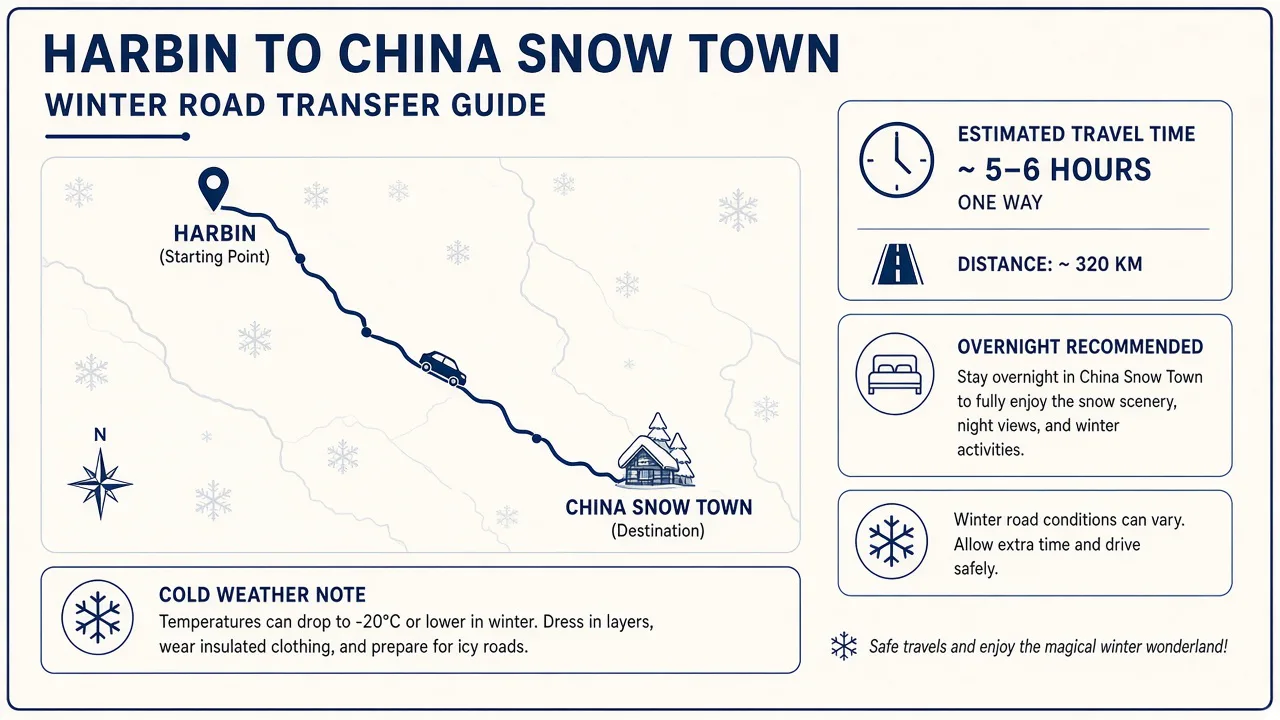
The winter road from Harbin is about 5–6 hours. Rail plus a shuttle is the alternative, and both need daylight at the far end.
December to February is the season. Midweek January after fresh snow beats a holiday weekend.
Two nights for one dawn, three nights if you want a spare morning. A Harbin day trip does not work.
Blue hour and the hour after sunrise are the quiet windows. Cold drains camera batteries and patience.
Compare a 3-day village stay, a 4-day longer stay, and adding the village to a Harbin winter.
Questions people ask
- Stay inside the scenic area, or at the edge where you can walk to the lane before sunrise, if dawn and blue hour are why you came. An outside hotel ties the morning to the internal shuttle. When the first shuttle is later than the light you wanted, the room has already failed, however attractive the listing. Entry and that shuttle are separate from any Harbin hotel and need to be confirmed for your dates. Outside can make sense if you truly do not care about the early hour and you have the shuttle times in writing. For a two-night stay built around photographs, choose the door you can open onto the village while the lane is still quiet.
- The famous picture is the exterior: snow on wooden roofs and a path of ice. Indoors, expect heating, and also expect it to be uneven. Some rooms run hot enough to sleep in light clothes. Others are warm near the source and cool at the window by the time you dress for dawn. Ask how the room is heated and whether you can adjust it. The doorway is the shock. Temperatures of about −20°C to −30°C wait outside, so put on hat, face cover, gloves, and boots before you open the door. Cotton against the skin stays damp and chills you when you stop walking. Wool or synthetic layers handle that swing better. Dry gloves and spare socks overnight so the morning starts ready.
- Yes, especially on weekends and through Chinese New Year. Wooden buildings carry boots, doors, luggage, and corridor talk, and a village full of people chasing dawn all sets alarms together. Midweek in January is quieter in the building and in the lane. Earplugs help. Pack the night before so you are not rattling a bag at blue hour, and keep your own voices down — you are part of the sound. A lighter sleeper, or a family with a small child, should ask for a calmer corner when they hold the room and should prefer three nights so one noisy night is not the whole stay. Silence is not something a snow-house listing can promise in peak season.
- Often short, and still icy. Packed snow polishes where everyone steps, and steps or a slight slope are common between the door and the frames you want. The fall usually happens here, half awake, not on a ridge. Use boots with grip, take shorter steps, and keep your hands free until you trust the surface. A small light helps before sunrise if you shield it from other people. Leave the only clear walking line open when you stop for a picture. A large suitcase on that surface, after five or six hours on the road, is a good reason to bring a smaller overnight bag and leave extra luggage in Harbin. Deep snow off the path can hide a ditch. Stay on the walked line, just not in the middle of it when you pause.
- It means you can leave on foot, in the dark, and reach the village lane before sunrise without waiting for a shuttle or walking along vehicle traffic. It does not mean the pin looks close on a map, and it does not mean the host called the shuttle easy. Ask for the walking time on winter ice, whether that walk is allowed before the main rush, and how luggage arrives. A careful ten or twenty minutes can still be the right room. An unconfirmed “very close” on the station side of the mountain is an outside hotel with extra words. If no true edge or inside room remains, change the date before you invent an earlier shuttle than the one that runs.
- Hold the village room before you decorate the rest of the week, once Xuexiang is the point of the trip. Inside and edge rooms go first on January weekends and over Chinese New Year. Midweek nights after a snowfall are the better bet for both inventory and a lane you can walk. Do not plan on sorting a bed at the gate after a long winter road. Tell the property you may arrive late if the Harbin drive runs long, and keep the arrival note in Chinese. If your real goal is the Ice Festival, settle that with Harbin tours and add the village only if a proper room and real nights still fit. A ski hotel at Yabuli will not solve either problem.
Plan a China Snow Town visit
Share your Harbin dates and whether you can sleep two nights in the village. We reply with a road plan that protects the dawn.