
China Snow Town at a glance
| Detail | Plan |
|---|---|
| Where | Xuexiang, Hailin, Heilongjiang |
| From Harbin | About 5–6 hours on the winter road |
| Minimum stay | Two nights |
| Why overnight | Dawn and blue hour, not a dark arrival |
| Not the same as | Yabuli skiing or the Ice Festival |
| Crowds | Weekends and Chinese New Year |
China Snow Town is a deep-winter village. Xuexiang, in Hailin, Heilongjiang, is worth the road from December through February, when the wooden roofs carry snow and the lanes stay frozen. The month chooses the light and the likely depth of that snow. The day of the week chooses the crowd. The night’s weather chooses whether rime appears. No calendar can promise the third.
December through February
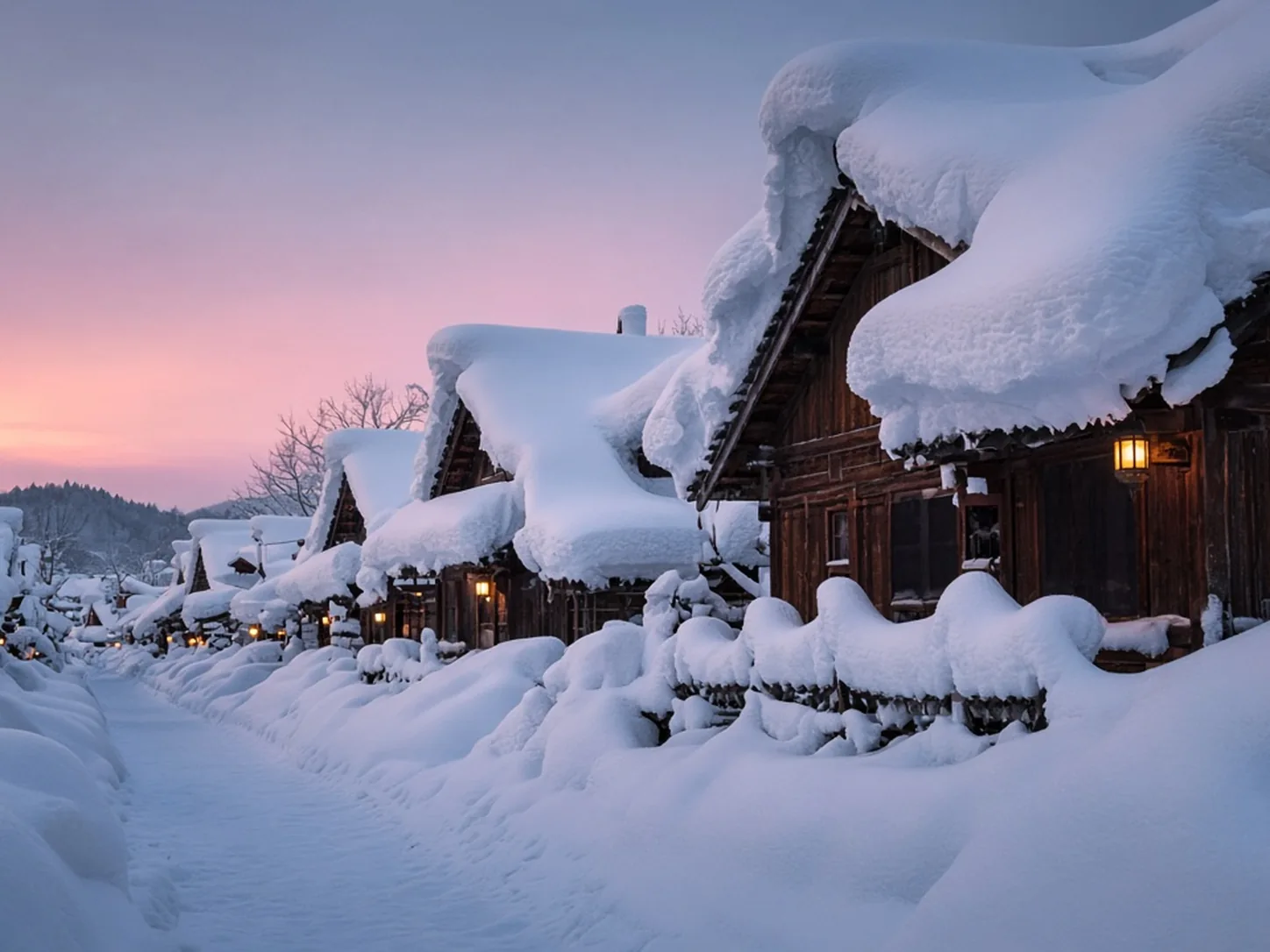
Plan the visit inside December, January, and February. That is the season when the village looks like the place people mean by China Snow Town: heavy snow on wood, a walking lane of packed ice, and cold that sits around −20°C to −30°C often enough that you should dress for it every day. Outside that window the trip changes character. Earlier weeks can still be building their snow load. Later weeks can soften at the edges. If the roofs and the frozen lanes are the reason to leave Harbin, stay inside the three months.
The winter road from Harbin remains typically about five to six hours throughout the season. A same-day return is a poor plan in December and still a poor plan in February. Two nights is the minimum useful stay in every one of these months, because the daylight is short and one night often means arriving in the dark and leaving after breakfast. Three nights is the stay that gives you a spare morning when the first dawn is a whiteout.
Harbin’s Ice Festival runs on its own city calendar in the same broad winter. That overlap is why people try to do both. The festival decision stays in the city. The Harbin travel guide and Harbin tours are where those dates belong. Harbin’s Snow Town chapter explains how a village overnight can sit beside a festival trip. This page is only about when Xuexiang itself is at its best. The village does not become a better or worse idea because an ice park opened downtown.
How December Behaves
December is the start of the reliable season and the month with the least patience for assumptions. Snow is usually established in the mountains of Hailin by the heart of the month, and the roofs can already look fully loaded. Early December is the part to treat more carefully. Some years the caps are already thick. Some years the scene is still filling in, with more wood showing and a lane that has not yet settled into deep winter. If your dates are the first days of the month, ask someone who is there what the roofs look like that week, and be willing to slide later if the report is thin.
The days are near their shortest. Sunset is a mid-afternoon event, and a late breakfast erases the quiet hour. Cold is already serious. Wind on the ridges is already the limiter. Crowds are present on weekends and lighter than the January holiday crush if you avoid the days when domestic travel spikes. Midweek December can be a calm, serious village, which photographers often prefer to a famous week that they cannot walk.
December is a good month when you want the season without betting the entire trip on a holiday. It is a weaker month when you need a guarantee of maximum snow depth, because the early weeks do not always provide it. Come for a village in winter, not for a single expected thickness. Two nights still apply. The short daylight makes a day trip from Harbin even less sensible than the driving time alone suggests.
January, Midweek, after Snow
January is the center of the season. The cold is dependable, the snow cover on a normal year is the reason the photographs exist, and the village is fully in its winter work. It is also when weekends fill and when rooms inside the scenic area disappear first. The better bet, if you can move your dates, is a midweek stay after fresh snow.
Fresh snow is a visual event and a practical one. The roof caps look soft and complete, tracks in the lane are fewer on the first morning, and the whole settlement reads as one white shape. The next day the lane is polished by feet, which is still beautiful and is harder to walk. “After fresh snow” means you want to be on site the morning after a fall, not driving toward Hailin while it is still coming down and arriving too late to see it. That is another argument for two or three nights. A storm on your travel day becomes a gift on the morning you already planned to be there.
Midweek matters because the audience changes. Weekends pull cars and groups from Harbin and farther cities. The main lane clogs late in the morning and stays full. Tuesday, Wednesday, and Thursday are when a dawn still belongs to people who woke up for it, at least until the scenic shuttle delivers the first wave. Even midweek is not empty in January. It is merely the version of the village you can walk.
China Snow Town tours fits this month cleanly: a three-day, two-night stay when one full day is enough, or a four-day, three-night stay when you want a second dawn in case the first is wind or flat cloud. Adding the village to a Harbin winter still means those nights in January, not a weekend dash.
February and the Lengthening Light
February is still the season. The roofs can remain heavily loaded, the cold can still reach the same band, and the lanes still demand boots with grip. The days lengthen a little compared with the turn of the year, which you will feel as a slightly kinder afternoon rather than as a long evening. Sunset remains early by the standard of a mild city. Do not start treating February like a shoulder season you can do in a day from Harbin.
The lunar new year often falls in February, and sometimes in late January. When it does, the month splits in two. The holiday and the days pressed against it are the most crowded version of Xuexiang. The midweek days clearly outside that rush can be excellent, with snow still in place and fewer people than a January Saturday. A warm spell, if one arrives late in the month, rounds the edges of the roof caps and makes the ice less predictable. Watch the forecast for a thaw, and do not confuse “February” with “always perfect.” It is in season. It is also the month when the holiday can erase the advantage.
If your only February dates sit inside the holiday, either accept the crowds with open eyes or move the trip. A longer stay of three nights helps you use the early hours and hide indoors during the worst of the lane. It does not empty the village. Yabuli, the ski area in Shangzhi about three hours from Harbin, has its own February logic for people who came to ski. The Yabuli guide is that decision. It is not a quieter Snow Town.
Weekends Fill the Lane
A weekend in season is a different village from a Wednesday, even when the snow is identical. Visitors leave Harbin and other cities on Friday or early Saturday, reach Hailin in the afternoon or at night, and concentrate in the main lane from late morning through the lit evening. The internal shuttle runs full. Doorways that make the classic roof picture become standing rooms. The walk from your door to the lane is still icy, and it is now icy with an audience that stops without warning.
If you are inside the scenic area you can still be out at blue hour before that density arrives. That is the weekend tactic that works: one early loop, a long warm break, and a second outing only if you are willing to share every frame. If you are outside the gate, the first shuttle may deliver you into the crowd rather than ahead of it. Confirm it, and assume the worse reading on Saturdays.
Return traffic toward Harbin on Sunday afternoon is part of the weekend, not a footnote. The five-to-six-hour center can run longer. A group that must be in the city for a festival evening on Sunday should leave the village earlier than the photographs suggest, or should stop pretending Sunday can hold both a dawn and an ice park. Harbin tours should own that city evening. The mountain morning should be allowed to end in a calm drive.
Midweek is the better bet whenever the rest of your life allows it. Say so to the people you are traveling with before everyone falls in love with a Saturday on a calendar. The Saturday looks convenient because it matches days off. It is the day the lane stops being a lane.
How to choose
| Choice | Fit | Skip when |
|---|---|---|
| Best walking weather | Spring and autumn, or Oct–Dec in the south | Holiday weeks |
| Hot or storm season | Go, with a flex day | A packed outdoor checklist |
| Quiet season | Fewer people, different scenery | Anyone chasing peak bloom or peak snow |
Chinese New Year
Chinese New Year is the busiest period in the scenic area. The official holiday moves with the lunar calendar, landing in late January or in February, and the travel rush is wider than the official dates. The weekend before, the holiday itself, and the weekend after are when rooms inside the village are hardest to hold and the main lane is hardest to walk. People come from across the country for this exact picture. You will not have it to yourself.
Go during the holiday only if those dates are truly fixed and you have accepted the bargain. You may still see extraordinary snow. You will see it with a crowd, a noisier building, and a slower shuttle. Book the room early, stay inside or at the true edge so dawn is still possible, and prefer three nights so you can use the earliest hour and give the middle of one day back to the throng. Eat earlier than you think. The moments everyone comes in from the cold are the moments the tables disappear.
Do not combine the holiday with a same-day return, a tight train connection, or a flight the evening you leave the mountain. Every leg runs hotter: the Harbin road, the station, the gate, the shuttle. Slack is the only comfort available. Harbin’s Snow Town chapter is worth reading if the holiday is also your only window for the Ice Festival, because the city will be crowded for the same reason. Doing both at their peak is a large, tiring winter. It can be a good one when the nights are real. It is a poor one when each place is given a fragment.
If you can move off the holiday by even a few days into a midweek, do that before you upgrade anything else about the trip. Dates beat gear.
Rime Is the Night You Got
Rime is the feathery ice that can coat branches, rails, and the edges of roofs after a cold, clear, relatively still night. It is the detail that makes some mornings look embroidered. It forms when the air and the cold cooperate. A night of wind, a night of heavy falling snow, or a night that never gets clear enough can leave you with bare twigs over beautiful roofs. The next dawn can bring rime after a dull day, or can strip yesterday’s rime before you finish breakfast.
Nothing in the season schedule produces it on demand. January is colder and therefore a more plausible month than a mild thaw, and a clear forecast is more interesting than a storm forecast if rime is your hope. Interesting is not the same as promised. People who book a single sunrise and call it the rime morning are arranging a disappointment in advance. People who book two or three nights are arranging a chance, and they still need a reason to be happy if every morning is simply a snow-loaded village. That reason exists. The roofs and the lanes are the trip. Rime is a bonus the weather might add.
When it is there, it is fragile. Wind on the ridge knocks it off. Warm breath and a long stop under a loaded branch are a poor combination. Touching it, brushing it for a cleaner frame, or shaking a small tree is how a shared morning gets ruined for the people behind you. Look, and leave it.
Storm days have their own beauty: falling snow softens the lane and hides the previous day’s tracks. They are poor days to decide the trip has failed because the branches are not feathered. They are good days to walk a shorter loop, dry your gloves, and be in position the next morning. That tactic requires an extra night. Build it in January if this detail matters to you. Leave it off the list of things a guide can confirm before you travel.
How Short the Daylight Is
At this latitude in deep winter the sun rises late and sets in the mid-afternoon. The useful outdoor day is a morning plus an early afternoon, not a long golden evening of the kind warmer cities advertise. Blue hour begins before you feel ready to leave a warm room. If the room is outside the gate, the shuttle may begin after that hour has passed. The season does not care that you would have preferred a 9 a.m. start.
Work the day in that order. Be outside for the first light if photographs or a quiet lane matter. Eat after that loop, not before, unless you are the sort of person who cannot function without food — in which case eat something small in the room and save the long breakfast. Use the middle of the day, which is the least cruel hour, for a slower walk or a rest. Go out again while the sun is low, and be indoors or finished before you are negotiating ice in full dark with cold hands, unless a night walk is a deliberate choice with a light and a known path back.
December is the strictest of these clocks. Late February is slightly more forgiving and still not a summer evening. A plan that puts the village walk “after we arrive and have lunch” fails in every month of the season. Arrive the day before the walk. That is the whole best-time argument hidden inside the clock: the right month still needs the right structure, which is two nights at minimum.
The Harbin travel guide describes city daylight for festival planning. The city and the village share the short day and do not share the morning. A Harbin hotel breakfast and a Xuexiang dawn are different dates.
Cold, Wind, and What to Wear for This Season
Temperatures of about −20°C to −30°C are common from December through February. A milder day can sit above that band, and a bitter dawn can feel worse because of wind. The ridge above the roofs is the exposed place. The lane can be strangely still while the viewpoint is already too much. Let the wind shorten the ridge loop. Do not let a forecast that says “only” −18°C convince you to bring a city coat.
Wear a non-cotton layer against the skin, wool or synthetic, because you will sweat while dressing in a warm room and then stand still in the lane. Add insulation and a shell that stops wind. Cover the ears, the neck, and the bridge of the nose. Boots should be insulated and grippy. Put spare camera batteries and a thin glove in an inner pocket. The season is long enough that you may see several dawns; your battery habit has to survive more than one morning.
This is village clothing, not a mountaineering kit. You are walking maintained paths for short periods and going back inside. You are not crossing a glacier. The failures are ordinary: cotton, smooth soles, a battery in an outside bag, a face left bare on the ridge, a single pair of gloves that got wet on day one. Fix those and the season is manageable in loops. Ignore them and every month feels the same kind of awful.
Sunglasses belong in the bag in January as much as in a brighter month. Snow glare and wind-blown crystals do not wait for March. Glasses will fog when you enter a heated building. That fog is a season-long fact. Stand aside while they clear.
When This Season Is the Wrong Winter
Skip Xuexiang, even in a perfect January week, if the group cannot walk on ice or be outside in this cold for repeated short loops. The village is the outdoors. A window is a thin return on five or six hours of road. The Ice Festival in Harbin is the winter that offers more time under shelter between spectacles, and it should be planned with Harbin tours rather than forced into a scenic lane.
Skip it if you only have a weekend you refuse to leave, and you also refuse crowds, and you also want rime. Those three demands do not coexist. Move the date, accept the people, or drop the frost from the requirements. Skip it if the only way the dates work is a same-day return. The season is real and the structure is still wrong.
Choose Yabuli instead, and read the Yabuli guide, when the group wants to ski. The ski season and the village season overlap on a calendar and diverge on a mountain. Shangzhi is closer to Harbin. It is still a different day. Do not spend a rare clear January morning on the road between them because both places are in season at once.
When the season and the structure agree — midweek, inside December through February, two or three nights, room at the lane, festival either skipped or given its own city days — the village is as straightforward as deep winter gets. China Snow Town tours is how that stay is held together. The weather on the morning itself remains the weather. Show up for the snow. Let rime be extra if the night was kind.
Ways to plan the days
These shapes match the China Snow Town tours page. They are starting points, not fixed departures.
Snow Town stay
Time fit: 3 days
The winter road, two nights, and one real dawn.
- China Snow Town
- Snow Town stay
Why choose it: The winter road, two nights, and one real dawn.
Longer snow stay
Time fit: 4 days
A second morning when the first dawn was cloudy or crowded.
- China Snow Town
- Longer snow stay
Why choose it: A second morning when the first dawn was cloudy or crowded.
Add to a Harbin winter
Time fit: Add-on
Village nights beside a festival plan quoted on the Harbin page.
- China Snow Town
- Add to a Harbin winter
Why choose it: Village nights beside a festival plan quoted on the Harbin page.
Want help shaping the China Snow Town days?
Tell us your Harbin arrival and whether the Ice Festival is also in the trip. The village nights are planned here; festival days stay with Harbin.
Keep planning
China Snow Town
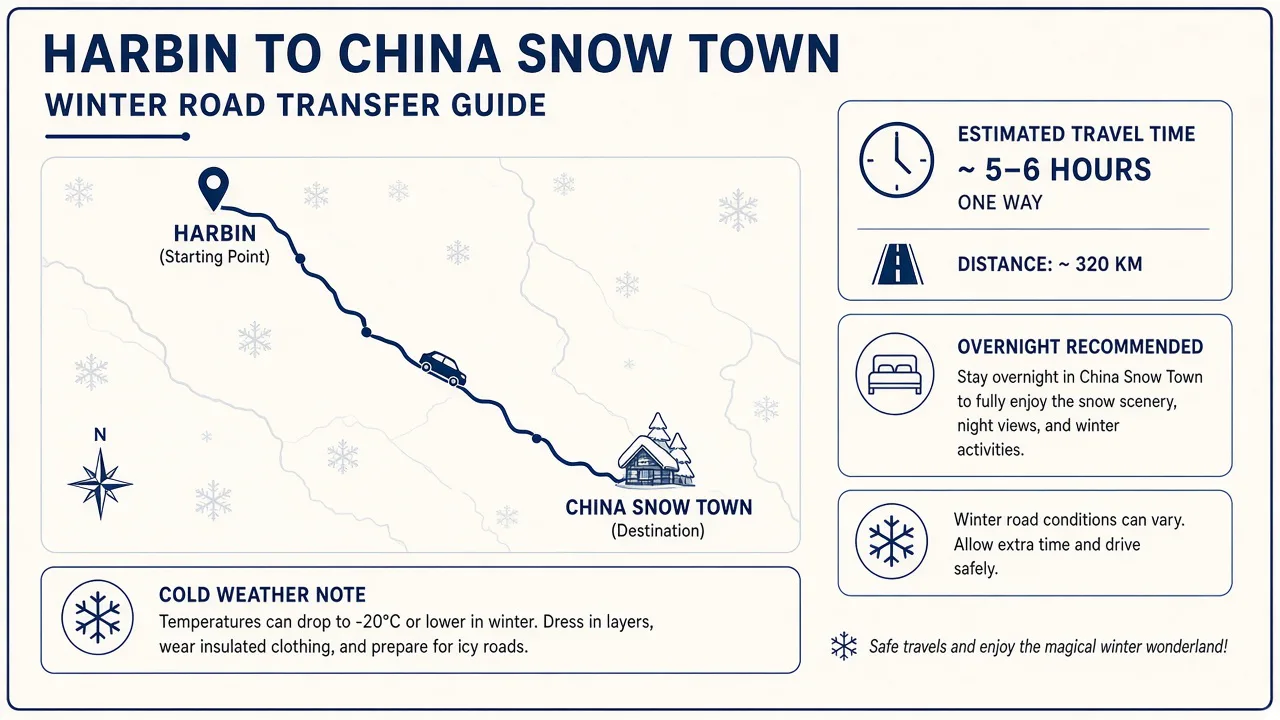
The winter road from Harbin is about 5–6 hours. Rail plus a shuttle is the alternative, and both need daylight at the far end.
Sleep inside or at the edge of the scenic area if the dawn photographs are why you came.
Two nights for one dawn, three nights if you want a spare morning. A Harbin day trip does not work.
Blue hour and the hour after sunrise are the quiet windows. Cold drains camera batteries and patience.
Compare a 3-day village stay, a 4-day longer stay, and adding the village to a Harbin winter.
Questions people ask
- January is the center of the season, with dependable cold and, in a normal winter, the snow-loaded roofs people come to Xuexiang to see. A midweek date after fresh snow is the better bet: the caps look complete, the tracks are fewer on the first morning, and the lane is calmer than on a Saturday. December can be excellent once the snow has settled, and cautious early in the month if the roofs are still filling in. February stays in season and often contains Chinese New Year, which changes the crowd completely. All three months still need two nights. The right month does not fix a same-day return from Harbin or a hotel beyond the shuttle.
- Avoid it if you want a walkable lane and a quieter building. The holiday falls in late January or February, and the rush runs wider than the official dates, including the weekends on either side. Rooms inside the scenic area go first, the main lane fills, and the road back to Harbin runs long. Come during the holiday only when your dates cannot move and you have already accepted the people, the noise, and the need to be outside at blue hour if you want any quiet. Three nights help you use the early morning and surrender one crowded midday. Moving even a few days into a midweek does more for the trip than any other change. The snow can be wonderful and still be hard to see.
- You can improve your chances and you cannot book the result. Rime can form after a cold, clear, relatively still night and can be absent, or gone by breakfast, if the wind rises or the air stays wrong. January and a clear forecast are more interesting than a thaw or a travel day spent inside a snowstorm. Interesting is not a promise. Stay two nights at minimum, three if this detail matters, so one dull dawn is not the whole story. The reason to be there remains the wooden roofs and the lanes. If those would disappoint you without feathered branches, this is the wrong village to stake a winter on. Do not touch the ice if you are lucky enough to see it. The next person is looking at the same branch.
- Weekends are a crowded time, which is a different statement. The snow does not know it is Saturday. The shuttle, the lane, and the doorways do. Groups from Harbin and beyond arrive Friday and Saturday, and the main walking line clogs from late morning onward. A room inside the scenic area still lets you walk at blue hour before that wave. A room outside may deliver you into it. Sunday returns toward the city often run slower than the usual five to six hours. Midweek is the better bet when you can choose. When you cannot, keep the dawn, eat early, and do not also demand an empty frame at noon. Read Harbin’s Snow Town chapter if that weekend is also your only festival window.
- Short enough to redesign the visit. Sunrise is late, sunset arrives in the mid-afternoon, and blue hour starts while a warm room still feels like the sensible place to be. The useful outdoor time is a morning and an early afternoon, not a long evening stroll. Eat a small bite if you must, then get outside, and save the long breakfast for after the first loop. A scenic shuttle that starts late will miss that hour entirely, which is why the bed has to be inside or at the edge. December is the strictest clock. Late February is only slightly kinder. Arrive the day before the day you hope to walk. A plan that tours the village “after lunch” is a plan for headlights.
- Both sit inside the season if your dates are in the month rather than clinging to the scraps at the ends. Early December sometimes still shows more wood and less roof-load, so ask for a current report and slide later in the month if the scene is thin. The heart of December is a serious, often calmer village. February can keep deep snow and serious cold, with a little more afternoon light, and it can also host the lunar new year or a thaw that softens the caps. Treat a holiday week in February as peak crowd, and treat a mild forecast as a reason to watch the roofs, not as a reason to switch the whole trip to a day visit. When in doubt, aim at midweek January and keep two or three nights in Hailin.
Plan a China Snow Town visit
Share your Harbin dates and whether you can sleep two nights in the village. We reply with a road plan that protects the dawn.