
China Snow Town at a glance
| Detail | Plan |
|---|---|
| Where | Xuexiang, Hailin, Heilongjiang |
| From Harbin | About 5–6 hours on the winter road |
| Minimum stay | Two nights |
| Why overnight | Dawn and blue hour, not a dark arrival |
| Not the same as | Yabuli skiing or the Ice Festival |
| Crowds | Weekends and Chinese New Year |
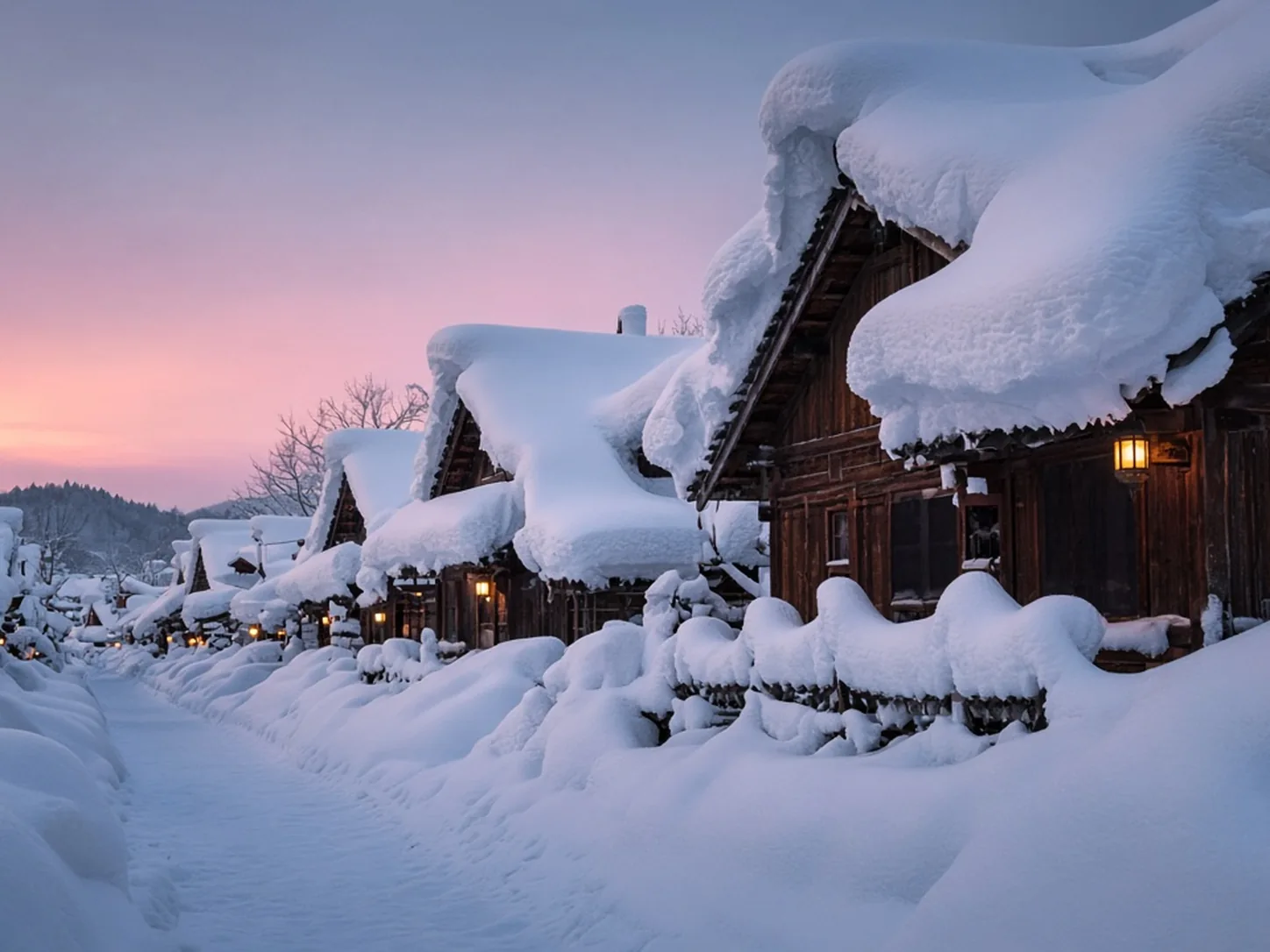
The winter journey to China Snow Town is the first decision of the trip, not a transfer you tuck under a city morning. Xuexiang lies in the mountains of Hailin, Heilongjiang. From Harbin the road is typically about five to six hours, and the light at the far end decides whether you see the village or only the gate.
The Winter Road from Harbin
Harbin is where most visitors start, because that is where the flights land and where the Ice Festival keeps its own calendar. The village is southeast of the city, in Hailin, inside the wider Mudanjiang region. The drive begins by covering distance across relatively open country, then slows as the road climbs into the mountains toward the scenic area. Winter changes the second half more than the first. Packed snow, a plow ahead, trucks, and short visibility in a squall are ordinary parts of the day, not rare emergencies.
Treat five to six hours as the planning center in winter. A clear day with light traffic can run a little easier. A snowfall, an incident, or a slow mountain section can add time you will feel in your legs and in the remaining daylight. Build the plan around the longer reading. If the road runs fast, you gain a calm arrival. If you planned the fast reading and the road runs long, you arrive in the dark with no slack.
The Harbin travel guide is the right place to understand the city you are leaving and the city you will return to. Harbin’s Snow Town chapter describes this same road from the point of view of a festival itinerary. Use that chapter when the village is a piece of a Harbin winter. Use this page when you are trying to arrive in Hailin with enough day left to matter. The hours do not shrink because the trip was purchased as a city add-on.
A private car, a train plus a local transfer, or some mix of the two can all be honest ways to cover the distance. None of them turns Xuexiang into a suburb. The scenic-area gate is not a Harbin hotel door, and the internal shuttle is a further step after you arrive in the area.
What Those Hours Feel Like
The first stretch is fatigue of a familiar kind: a warm vehicle, a long straight run, a stop for food or a toilet if you have planned one. People talk, doze, and watch the snow thicken on the fields. The later stretch is the one that changes the mood. The road narrows in feel if not always in width, curves arrive, oncoming headlights matter in the afternoon gloom, and the speed that looked reasonable on a map becomes a number the driver cannot keep.
Daylight in January is short. Sunset comes in the mid-afternoon. If you leave Harbin in the morning, you have a chance of reaching the gate while the lane still holds some light, which on a two-night stay is a bonus rather than the main event. If you leave Harbin late in the morning or after lunch, expect the village to appear as lamps, steam from doorways, and a dark path. That can be a fine first night when another morning is already booked. It is a failed visit when it is the only arrival you have.
Children, older travelers, and anyone who sleeps poorly in a moving car need the hours described in advance. Surprising a group at the hotel door with “it is a bit of a drive” produces a miserable mountain section and a wasted first evening. Say five to six hours, say the last part is slower, and say the scenic area still has its own entry and shuttle after the car stops.
Eating belongs in that description. A heavy meal just before the mountain curves is a common way to feel awful. A light meal and a planned stop work better. The stop is also how you reset cold feet and quarrelsome moods before the gate, where queues and luggage do not reward people who are already finished for the day.
Why a Same-Day Return Fails
A same-day return looks plausible only if you ignore the clock. Five to six hours out and five to six hours back is ten to twelve hours of winter road before the scenic area adds entry and the internal shuttle. Whatever remains in the middle is a rushed walk in whatever light is left, often very little, followed by a turnaround while everyone is cold. You do not get blue hour. You do not get a full daylight loop. You get a fragment of the lane between two long drives.
We treat that pattern as a poor plan, including when the car is comfortable and the road is clear. Comfort changes how the hours feel. It does not create extra daylight, and it does not move Hailin closer to Harbin. Visitors who have one free day in the city should spend it in Harbin. The Ice Festival, the streets, and a proper evening are a real day. A forced mountain dash is a long sit that happens to include a postcard.
Harbin tours is where a city day of that kind belongs. China Snow Town tours assumes the road is paired with nights, because that is the only way the drive earns the hours. One night still often collapses into a dark arrival and a breakfast departure. Two nights is the minimum useful stay: you may arrive late on the first day, you have a full day in the village, and you drive back on the third day. The getting-there question and the how-long-to-stay question are the same question.
If someone offers the village as a day tour from a Harbin hotel, ask what time the car leaves, what time it must leave the mountain, and how much of that gap is walking rather than queueing. The arithmetic usually ends the conversation. A group that still wants to go should move the dates until two nights fit, or drop the mountain and keep the city.
A Private Road Transfer
A private vehicle is the comfortable way to do the winter road when the group has luggage, mixed ages, or a flight to protect. You leave from the Harbin hotel, you can stop when someone needs to stop, and the cabin stays warm. That matters at these temperatures more than it matters in a mild city. It also matters for motion sickness, because a private driver can pause on the mountain section and a tight public connection cannot.
The car ends at the current scenic-area drop point. Scenic-area entry is separate. The internal shuttle is separate. Both need to be in the plan even when the Harbin hotel and the driver are already arranged. Confirm, before departure day, where the car is allowed to stop this season and where it will wait on the return. Those points change with scenic rules. Discovering the gap while holding suitcases on ice is the failure mode.
A private car does not compress five to six hours into a sightseeing errand, and it does not entitle the driver to enter the village lanes as if they were a hotel driveway. Agree the return meeting time in language everyone understands, and carry the hotel name and the meeting point in Chinese on paper. Phones fade in the cold, and a dead screen at dusk is a poor moment to remember a pin.
Self-drive is a reasonable choice only for people who already handle northeast mountain roads in winter, in the dark, with the right tires and a calm tolerance for slow trucks. It is a poor default for visitors on a first Heilongjiang trip. The scenery will not improve because you were also the person watching the ditch. If you do drive, you still need entry, the shuttle rules, and a legal place to leave the car. The village core is a walking place.
When the village is being added to a Harbin winter, the road transfer is part of the village block, together with the nights. Festival days stay on Harbin tours. The shape of that join is on China Snow Town tours. Harbin’s Snow Town chapter remains the festival-side explanation of why the drive should not be casual.
The Train toward Hailin or Mudanjiang
The rail alternative is a train from Harbin toward Hailin or farther on toward Mudanjiang, then a local road transfer into the scenic area. Faster trains run on this corridor. Schedules and stopping patterns change, so the live timetable is the one that counts. We will not name a departure to memorize. A number copied from an old article is how people miss a train they were never on.
Harbin has more than one station. The first confirmation is which station your train actually uses, and how long it takes to reach that station from your hotel in winter traffic with luggage. A correct ticket and the wrong station is a cold mistake made entirely of lost time. Arrive at the station with a buffer you would accept in any unfamiliar city, plus a little more because coats, ice, and queues slow every step.
Hailin and Mudanjiang are not the village. Hailin is the closer city on the way into this mountain country. Mudanjiang is the larger hub farther along the line. Either can be the right place to meet a local transfer, depending on the season’s roads and on where your shuttle connection is actually staged. Confirm the current station with the person who will meet you before you buy a ticket that looks clever on a map. A station that is “near” Xuexiang on a country map can still leave you a mountain drive short of the gate.
Buy the connection with slack. Winter trains can be punctual and can also slip. A plan that requires your train, the local car, scenic-area entry, and the last shuttle to mesh within a few minutes is not a plan. It is a hope. If the numbers only work when every leg is perfect, choose an earlier train or a private road car from Harbin and remove one of the handoffs.
How to choose
| Choice | Fit | Skip when |
|---|---|---|
| Make this the focus | When this page is the reason for the day | When it is only a name on a list |
| Pair it | With one nearby stop | With a second full excursion |
| Leave it | If the main stay is already full | If you have the night it needs |
After the Station, the Shuttle
The local transfer from the station to the scenic gate is its own winter drive. Plan it as a mountain leg with weather and curves, not as a short hop across town. Ask the person meeting you how long that leg takes in current snow, where they can stop, and what happens if your train is late. Then ask the scenic-area question separately: entry, and the internal shuttle from the gate to the lanes. Those are not included in a Harbin hotel booking, and they are not included merely because you hold a train ticket.
The internal shuttle is what makes an outside hotel dangerous for dawn. If you sleep beyond the gate, your morning begins when the shuttle begins. Confirm the first run before you accept that room. A station arrival that lands after the last practical shuttle of the day is a night spent in the wrong town, looking at a dark gate. Build the rail day so you clear entry while staff and shuttles are still running, with margin.
Luggage is the detail that makes this chain feel longer than the map. A large suitcase is awkward on station stairs, worse on ice, and worse again if you must board a shuttle with a crowd. Take an overnight bag into the village when you can, and leave the rest of the trip’s luggage in Harbin if your city hotel will hold it. The Harbin travel guide is the context for those city nights before and after. The mountain day should carry what you can walk with in boots.
Write down the shuttle meeting point and the lodge name in Chinese. Groups get separated when one person stops for a toilet and another follows a crowd toward the wrong vehicle. A private road transfer avoids some of those handoffs. Rail can still be the right choice for travelers who prefer the train and have confirmed every link. The mistake is assuming the train’s arrival time is the village’s arrival time.
Arrive While There Is Still Light
Daylight is the scarce resource, not distance. In December, January, and February the sun sets in the mid-afternoon and rises late enough that a leisurely breakfast can take the blue hour. The road has to be judged against that window. A morning departure from Harbin is what gives a two-night stay any chance of a first afternoon in the lanes. An afternoon departure gives you a night arrival, which is acceptable only because the next dawn exists.
Work backward from the gate. You want to finish entry and the shuttle, reach the room, and still have a short walk if the sky cooperates. That means the car or the local transfer must reach the area while the scenic operation is fully awake, not in its last minutes. If your chosen departure cannot do that, shift to the night-arrival pattern and protect the following morning, or shift the whole stay so you are not traveling on the only day you meant to be outside.
The same arithmetic runs in reverse. Leaving the village after a long dawn session pushes the Harbin arrival into the evening. Leaving after breakfast can still mean the city in the afternoon or later if the road is slow. Do not describe the return as “back by lunch” unless a specific departure and a clear road have both been confirmed for that date, and even then keep a private doubt. Winter roads are allowed to be slower than the story you told yourself in the hotel.
China Snow Town tours builds the stay so this arrival logic is the structure, not an apology. Three days and two nights, or four days and three nights, both assume the travel days are travel days. Adding the village to a Harbin winter means those same road hours and the nights, with festival time left in the city. The drive is never the hidden half-day beside an ice park.
Carsickness and Winter Roads
The mountain section is where people who were fine on the expressway start to feel ill. Curves, a warm cabin, a phone held in the lap, and a heavy lunch are the usual combination. Winter adds blowing snow, flat grey light, and oncoming headlights in the early dark, which tire the eyes even when the stomach is calm. Name this before you assign seats. Pride in the back row is how a photographer loses the first evening.
Sit toward the front if you are the person who gets sick. Look at the horizon rather than at a screen. Eat something small and plain before the curves, and keep the cabin from becoming a sauna. If you already use a motion-sickness remedy at home, take it on your usual schedule before the mountain section, not after you feel unwell. A private car can stop. Use that freedom early. Waiting until someone is unwell makes the rest of the car unwell too, and it steals the slack you needed at the gate.
Children need the same honesty. A tablet can help for a while and then become the cause. Build a stop into the mountain half even if everyone claims they will sleep. They may not sleep. The road is not a failure if you pause. It is a failure if you arrive too late because you refused to pause and then had to stop anyway.
Drivers, whether private or local, are managing ice and visibility on your behalf. Do not push for a reckless pace so a shuttle might still be caught. A missed shuttle is an inconvenience. A slide on a mountain road is a different category of problem. If the weather is actively worsening, the right call can be a later entry or a delayed departure from Harbin. Two nights of slack, or three, are what make that call possible. A same-day return has no slack at all.
Yabuli sits on a related southeast corridor, about three hours from Harbin in Shangzhi, and it is still the wrong detour. The Yabuli guide explains the ski day. Adding that mountain to the Snow Town road because you are “already driving southeast” lengthens a journey that is already long and drops you at the village after the light. Ski on a different day, or skip it.
Buffers before a Flight
The return to Harbin is a winter road with the same five-to-six-hour center and the same chance of delay. An international flight on the evening you leave the village is a poor match. Snow, a slow plow, or a late shuttle off the mountain can consume the margin that looked generous in a booking app. Sleep in Harbin the night before you fly, or leave Xuexiang the previous day and give the city night to packing and rest.
Domestic connections deserve the same suspicion when the ticket is the last flight and the mountain morning is non-negotiable. If the dawn photographs matter, they have to be allowed to run long, which means the flight has to be on a later day. If the flight is fixed and tight, leave the village earlier than the photographer in you prefers, and do that knowingly on a stay that already had a full day. Do not try to keep both the last possible frame and the last possible plane.
Weather can close the pleasant version of the road without closing the province. Blowing snow and poor visibility are reasons to move a departure earlier in the day, not reasons to start later and “make it up” on the highway. Ask the driver in the morning what the road is doing. Believe a cautious answer. The Harbin travel guide side of the trip should include one uncommitted city block near the flight, precisely so the mountain is allowed to be slow.
Rail returns need the same buffer at the station you confirmed on the way in. A local transfer that must hit a specific train, which must hit a specific Harbin airport run, is three winter legs in a chain. Break the chain with a night in Harbin. The village is memorable when the ending is boring and on time.
Confirm the Links before You Buy the Tight One
Before you pay for a train, a car, or a room, write down four facts for your actual dates. Which Harbin station or which hotel door. Which Hailin or Mudanjiang station, if you are on the train, and who meets you there. Where the scenic drop-off is, and how entry plus the internal shuttle work that week. What time the first shuttle runs if your room is outside the gate. If any line is “we will see,” you do not yet have a connection. You have a direction.
Ask those questions in daylight planning, not from the back seat. Scenic operations adjust shuttle running and car access. A blog’s map of the gate can be a year out of date. The person who will carry your luggage is a better source than a pin dropped on a village photo. Harbin’s Snow Town chapter is worth reading beside those answers if a festival evening is also in the week, because the city clock and the mountain clock collide in specific ways. The chapter is not obsolete. It is the other half of a combined trip.
Leave Yabuli off this confirmation list unless you have a separate empty day. The ski area’s three-hour drive from Harbin is a different outing, described in the Yabuli guide. Keep the Snow Town list boring and local: road or rail, station, shuttle, dawn, return buffer.
When you want that list handled as one village stay, the shapes on China Snow Town tours already assume the hours on this page. Three days and two nights, four days and three nights, or the road and the nights added to a Harbin winter. Festival days, if you still want them, stay on Harbin tours. The lane is worth the journey when the journey is allowed to take the time it takes.
Ways to plan the days
These shapes match the China Snow Town tours page. They are starting points, not fixed departures.
Snow Town stay
Time fit: 3 days
The winter road, two nights, and one real dawn.
- China Snow Town
- Snow Town stay
Why choose it: The winter road, two nights, and one real dawn.
Longer snow stay
Time fit: 4 days
A second morning when the first dawn was cloudy or crowded.
- China Snow Town
- Longer snow stay
Why choose it: A second morning when the first dawn was cloudy or crowded.
Add to a Harbin winter
Time fit: Add-on
Village nights beside a festival plan quoted on the Harbin page.
- China Snow Town
- Add to a Harbin winter
Why choose it: Village nights beside a festival plan quoted on the Harbin page.
Want help shaping the China Snow Town days?
Tell us your Harbin arrival and whether the Ice Festival is also in the trip. The village nights are planned here; festival days stay with Harbin.
Keep planning
China Snow Town
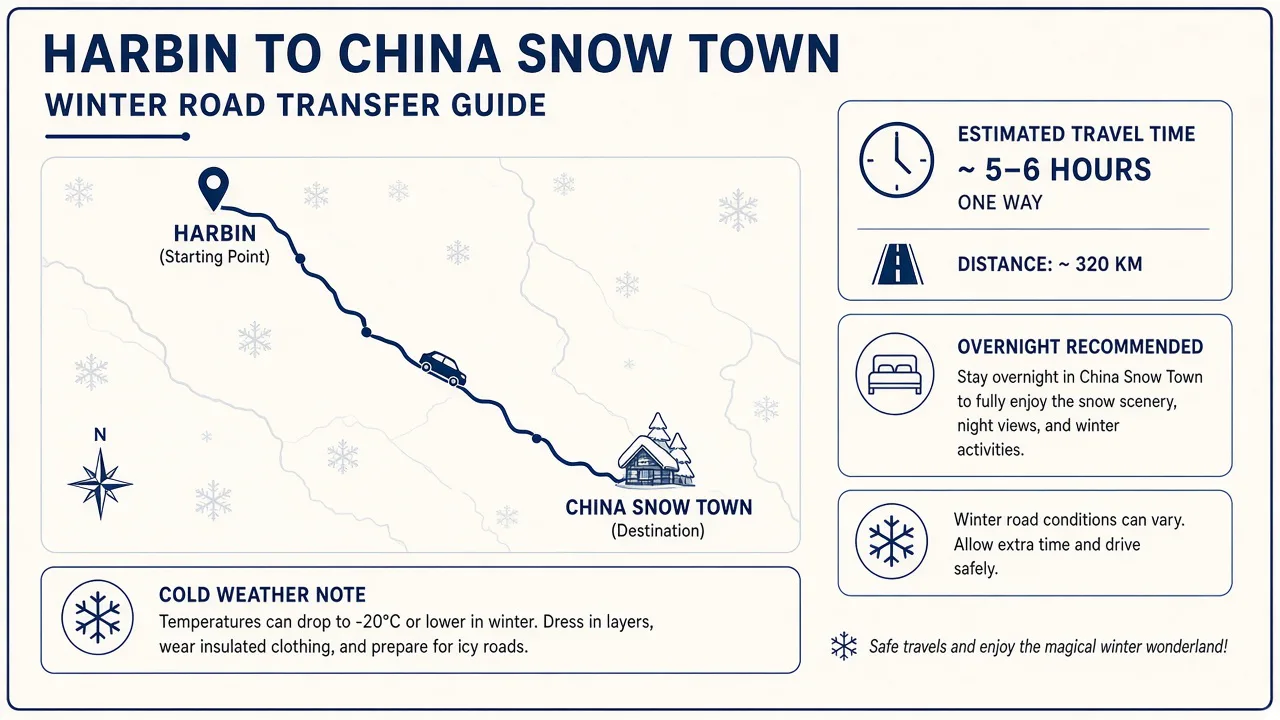
Sleep inside or at the edge of the scenic area if the dawn photographs are why you came.
December to February is the season. Midweek January after fresh snow beats a holiday weekend.
Two nights for one dawn, three nights if you want a spare morning. A Harbin day trip does not work.
Blue hour and the hour after sunrise are the quiet windows. Cold drains camera batteries and patience.
Compare a 3-day village stay, a 4-day longer stay, and adding the village to a Harbin winter.
Questions people ask
- In winter, plan on about five to six hours from Harbin to the Xuexiang scenic area in Hailin. That is a center, not a promise. Snow, traffic, and the slower mountain section can add time, and a clear day can run a little easier. The count ends at the area, not at your photograph. Scenic-area entry and the internal shuttle still sit between the car and the lanes, and both are separate from your Harbin hotel. A same-day return is therefore most of a day in the vehicle for a short walk. Leave in the morning if you want any chance of daylight on arrival, and give the village two nights so a slow road does not erase the trip.
- The train toward Hailin or Mudanjiang is a real alternative to a private road transfer, especially if you prefer rail for the long leg. It is not a train to the lane. You still need a local mountain transfer from the station you actually chose, then scenic-area entry and the shuttle. Confirm the current station and the shuttle schedule before you buy a tight ticket. Harbin has more than one station, and a clever connection with no slack fails when a train slips or the last shuttle has gone. A private car simplifies the handoffs and can stop if someone feels ill. It does not make the trip short. Choose rail when the links are confirmed. Choose the car when luggage, children, or a fixed flight need fewer surprises.
- A same-day return from Harbin is a poor plan. Five to six hours each way, plus entry and the shuttle, leaves a fragment of the village in the middle and none of the dawn that makes the roofs worth seeing. You ride in the dark, stand in the cold, and ride back tired. One night often becomes the same disappointment in a milder form: arrival after sunset, departure after breakfast. Two nights is the minimum useful stay, so a full day sits between the drives. If you only have a single free day, keep it in the city with Harbin tours. The mountain will not compress because the group is eager.
- In December, January, and February the sun sets in the mid-afternoon, so a departure after late morning usually becomes a night arrival. Leave Harbin in the morning if the first day needs any usable light at the gate, and still treat that light as a bonus on a two-night stay. Work backward from entry and the shuttle, not from the moment the car parks. An afternoon departure is acceptable when you already have the next dawn protected and you are sleeping inside or at the edge of the scenic area. It is a failure when that dark arrival is the only time you will be there. The return has the same shape: a slow road can put you in Harbin in the evening even after a breakfast departure.
- The later, curving section is the one that matters, especially in a hot car with a phone in your lap. Sit forward, watch the horizon, eat lightly, and plan a stop before anyone feels awful. If you use a motion-sickness remedy at home, take it on your usual schedule before the mountain stretch. A private driver can pause. A chain of trains and last shuttles cannot. Tell the group this before seats are chosen, including teenagers who expect to watch videos the whole way. Winter glare and oncoming lights add fatigue even for people whose stomachs are calm. Do not ask a driver to make up lost time on ice. Two or three nights at the village are what give you permission to travel slowly.
- Do not fly out of Harbin on the evening you leave Xuexiang. The return is another winter road of about five to six hours, and snow or a late shuttle can consume a margin that looked wide on a booking screen. Sleep in the city the night before an international flight, or leave the village the previous day. A dawn photo session and a same-evening long flight ask for two kinds of punctuality the weather may not allow. Rail plus a local transfer plus an airport run is three legs. Break that chain with a Harbin night. Read the city side in the Harbin travel guide, and keep festival evenings off the mountain-return day.
Plan a China Snow Town visit
Share your Harbin dates and whether you can sleep two nights in the village. We reply with a road plan that protects the dawn.