
China Snow Town at a glance
| Detail | Plan |
|---|---|
| Where | Xuexiang, Hailin, Heilongjiang |
| From Harbin | About 5–6 hours on the winter road |
| Minimum stay | Two nights |
| Why overnight | Dawn and blue hour, not a dark arrival |
| Not the same as | Yabuli skiing or the Ice Festival |
| Crowds | Weekends and Chinese New Year |
China Snow Town is Xuexiang, a scenic village in Hailin, Heilongjiang. People come for wooden houses under a heavy snow load, the lanes between them, and the chance of rime after a cold, clear night. Harbin is the usual city where the journey starts. The village is a mountain stay with its own gate, its own shuttle, and a clock that does not match a city afternoon.
The Village People Mean by Snow Town
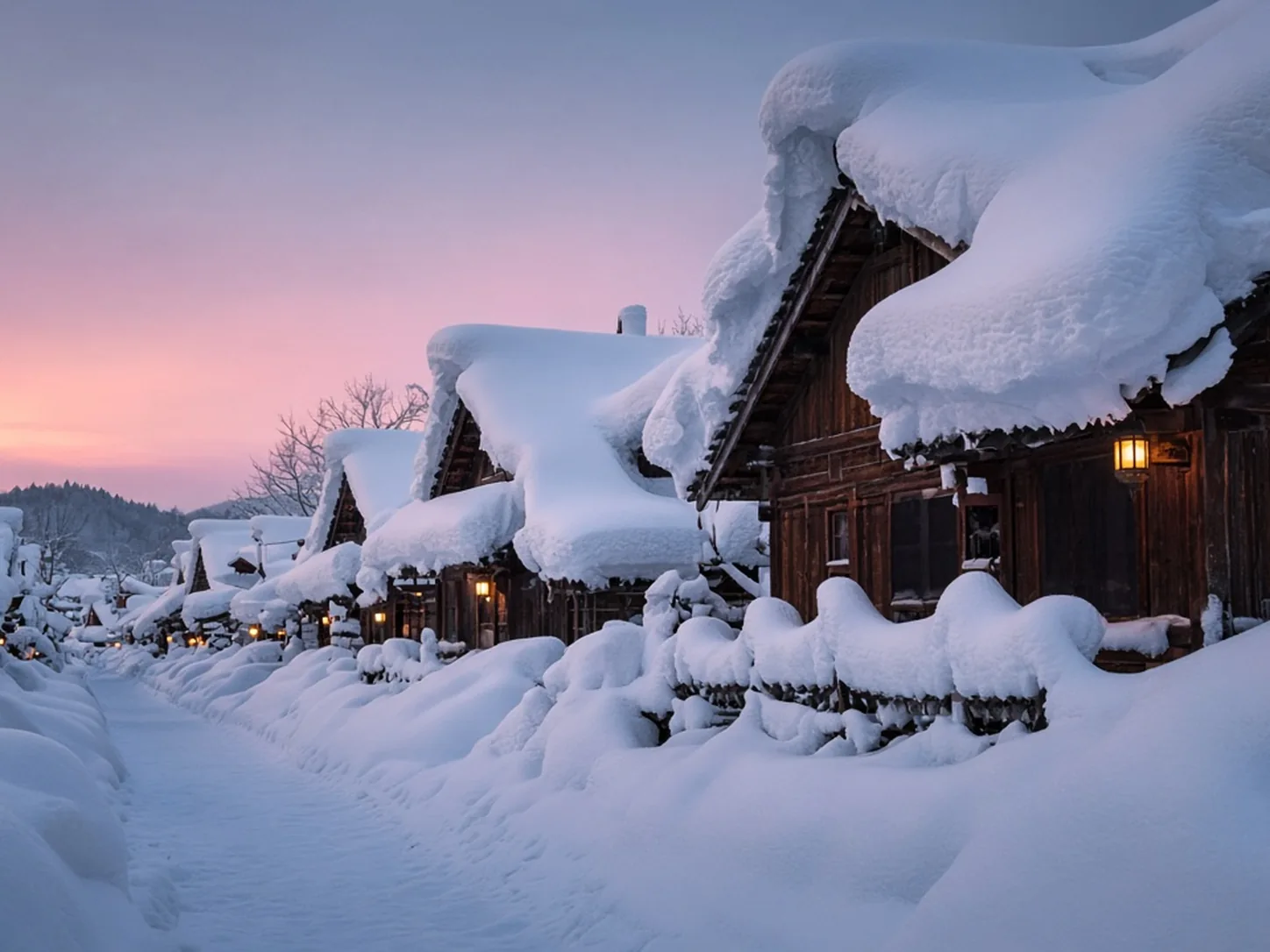
Xuexiang sits in the mountains of Hailin, in the southeast of Heilongjiang, within the wider Mudanjiang region. English-language plans call it China Snow Town. In a normal winter the wooden roofs carry thick caps of snow, the lanes shrink to a walking track of packed snow and ice, and the settlement reads as one white mass until you are close enough to see doors, wood, and the tracks of whoever walked at dawn. That scene is the reason to travel. You walk it, warm up, and walk it again when the light has changed.
Rime is the feathery ice that can coat branches and eaves after a cold, clear, relatively still night. It is the fine detail in many famous frames, and it is also the detail nobody can put on a booking. A night that is cold enough and quiet enough in the wind may leave it on the trees by morning. Falling snow, fog that never settles, or a hard wind on the ridge produces a different village, often still worth the road. Plan for the roofs and the lanes. Treat rime as weather you might be given.
The settlement is a lived scenic village with rooms, meals, and managed entry. People who work here use the same icy lanes visitors are trying to frame. Leaving a clear walking line, staying off unstable snow at the edge of a path, and keeping dawn voices low are part of seeing the place properly, not a courtesy appendix.
Many travelers meet the name first while planning Harbin. The Harbin travel guide is the right place for the city, the riverfront, and the Ice Festival. Harbin’s Snow Town chapter explains how this village can sit inside that city trip. Keep both pages. This guide stays with Xuexiang: what the mountain rewards, and why the stay has to be built around the lanes.
What You Walk Once You Are In
A day in the village is a series of short outdoor loops. You dress completely, step onto ice, walk while the roofs are in low light, go inside when your hands stop cooperating, then go out again for the next change in the sky. The scenic area includes the main lane and higher viewpoints that look down on the roof caps. The lane is where people concentrate once groups arrive. The ridge is where the wind decides how long you stay. Both are walks in winter boots with real grip, on snow that polishes into ice wherever feet repeat the same line.
Nothing about that day is organized like a ski resort. There is no lift map to follow and no run to ski. The purpose is the wooden village under snow. Visitors who want skis on their feet are looking at a different mountain. Yabuli, covered in the Yabuli guide, is a ski area in Shangzhi, about three hours from Harbin, on a related southeast corridor. It asks for its own day and its own reason to leave the city. Sharing a compass bearing with Xuexiang does not make a ski morning a convenient stop on the way to Hailin. The hours you would spend in ski boots are the hours the village gate needed.
The Ice Festival is a third decision, and it stays in Harbin. Illuminated ice, a municipal night schedule, and the festival parks do not resemble lamps on wooden houses. Travelers whose winter is Ice and Snow World should shape that trip with Harbin tours. Travelers whose winter is the roofs should shape the nights with China Snow Town tours.
Why Two Nights Is the Minimum That Works
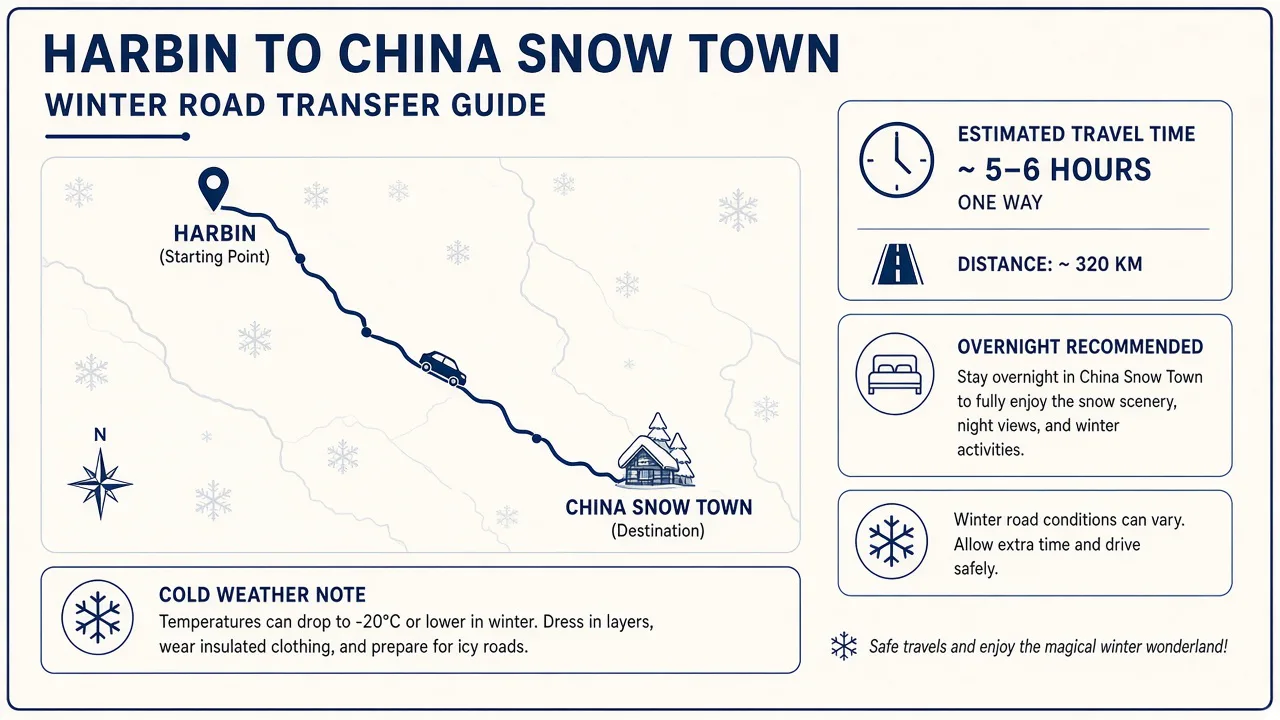
The winter road from Harbin is typically about five to six hours. Treat that as a planning center. Snow, a plow in front of you, and the slower mountain section can stretch it, and a clear fast day can run a little kinder. A same-day return still means something like ten to twelve hours of driving, plus scenic-area entry and the internal shuttle, for a short stand in the lane. You leave Harbin in the early cold, arrive late, and turn around before the village has shown you the hour it is actually good. A same-day return from Harbin is a poor plan.
One night is the pattern that looks tidy on a festival itinerary and then shrinks on the ground. The car or the train connection gets you in after the light has gone. You sleep. You leave after breakfast so the return does not collide with a city plan. The dawn you wanted becomes a few minutes beside the luggage. Harbin’s Snow Town chapter describes that single overnight from the festival side, where city days are the spine and the village is a hard extra. Read it if that is truly your trip. If the wooden roofs are why you came, two nights is the minimum useful stay. One night often means arriving in the dark and leaving after breakfast.
Two nights produce an arrival day, a full day between the drives, and a departure day. The arrival is allowed to be dusk. The middle day holds dawn, a hot meal, a second walk, and a night outing if energy remains. The departure can follow that dawn or follow breakfast, and the village day has already happened. Three nights add a spare full day, which is how a whiteout morning or a ridge too windy to stand on fails to ruin the journey.
Count nights in the village, or truly at its edge. A room in Harbin does not put anyone on the lane at blue hour, however early the car is ordered.
Where the City Ends
Harbin is the transport city. Flights land there, festival nights happen there, and many winter routes begin and end there. Xuexiang is a long winter drive southeast into Hailin, then up to a scenic gate. The city and the village share a province and a season. They do not share a morning, a ticket, or a hotel logic.
Use Harbin for the things it does well. The Harbin travel guide keeps the urban winter coherent: festival timing, city distances, and how many days the ice actually needs. Harbin tours is where those festival days are arranged. This village guide does not retire either one. A traveler who wants ice sculptures at night and snow-loaded roofs at dawn is planning two stays that happen to fall in the same months. The workable join is the road plus real nights at the village, with the festival left on the Harbin side.
Time of departure is the hinge. Leave Harbin early and the first village afternoon can still hold fading light, which is a pleasant extra on night one of a longer stay. Leave after late morning and the first hours in Xuexiang are headlights, a gate, and a dark lane. That arrival is acceptable when another morning is already in hand. It is the entire visit when it is not.
Scenic-area entry and the internal shuttle sit apart from the Harbin hotel you use before and after. A car from the city hotel can deliver you to the current drop point. It does not replace the entry, and it does not replace the shuttle that links the gate to the lanes. Both need to be in the plan before anyone is standing in the wind with bags, asking which queue is theirs.
Yabuli on Its Own Day
Yabuli and Xuexiang get bundled because both are white, both are southeast of Harbin, and both appear in northeast winter searches. The similarity is the direction out of the city. Yabuli is a ski area in Shangzhi, about three hours from Harbin. China Snow Town is the village in Hailin, typically five to six hours by winter road. One day is built around skiing. The other is built around walking a settlement under snow.
Attaching one to the other as a casual add-on spends the dawn in a vehicle. The drive between a ski mountain and this scenic village is its own winter transfer, with its own fatigue, and it delivers you to the second place after the light you wanted. If the group wants to ski, give that desire a real day and read the Yabuli guide before the week is drawn. If the group wants the roofs, protect the village nights and leave the skis for a day that is actually empty, or for another trip.
A longer Heilongjiang winter can hold both in sequence, with recovery between them. That is a larger plan than a village stay. It is not something to clip onto three days in Xuexiang because the two places feel like neighbors on a small map. They are related by corridor and separated by purpose.
How to choose
| Choice | Fit | Skip when |
|---|---|---|
| Snow Town stay | 3 days | The winter road, two nights, and one real dawn. |
| Longer snow stay | 4 days | A second morning when the first dawn was cloudy or crowded. |
| Add to a Harbin winter | Add-on | Village nights beside a festival plan quoted on the Harbin page. |
Cold, Wind, and the Length of a Loop
Temperatures of about −20°C to −30°C are common through the season. The forecast number matters less than the wind on the ridges above the roofs. In a still lane, a properly dressed person can walk, look, and talk. On the exposed ridge, the same morning ends early because the face hurts and the fingers quit. Short outdoor blocks, with a warm interior between them, match the place. The village favors people who go out more than once. It punishes the plan of staying outside until misery becomes the memory.
Dress for deep winter in the ordinary sense. Wool or a synthetic layer goes against the skin. Cotton does not, because it holds sweat and then draws heat off you when you stop to look at a roofline. Insulation comes next, then a shell that stops wind. Cover ears, neck, and the bridge of the nose. Carry gloves thick enough for the walk, and a thinner pair in an inner pocket for the minute a camera dial or a phone matters. Spare camera batteries live in that inner pocket as well. A battery left in an outside bag fades in this cold, and the metal of a camera on bare skin becomes painful very quickly.
Boots need insulation and a sole that holds on ice. The usual fall is on a polished track by a doorway or on a slight slope, not on dramatic ground. Shorter steps and hands free to balance are the whole technique required. Stay on the maintained lane and the scenic paths. Deep snow off the edge can hide a drop or a ditch, and it is a poor trade for a slightly cleaner angle. Sunglasses help with glare and with crystals blown off the roofs. Glasses fog the moment you step into a heated room. Choose the warm stop before you need it, and avoid lingering in a doorway that other people are trying to use.
Entry, the Shuttle, and the Bed
The scenic area is managed. Entry follows the current gate arrangements, and an internal shuttle links the gate with the village lanes. Where you sleep decides whether dawn is a walk or a wish. A room inside the scenic area, or truly at its edge, lets you reach the lane while the light is still blue. A room outside the gate ties you to the first shuttle. If that shuttle starts after the hour you came for, the listing was the wrong listing, however well the roof photographed in someone else’s frame.
A “snow house” photograph shows the exterior. It does not promise a particular heating system, a silent night, or a door that opens onto cleared pavement. Expect a heated room, and also expect the heat to be uneven from one building to the next. Wooden walls carry corridor noise, luggage, and the pre-dawn doors of other guests. The walk from your own door to the famous lane is on ice, often with steps. You dress before you go out. Checking the light in indoor clothes is how people turn a five-minute look into a miserable retreat.
Weekends and Chinese New Year are extremely crowded, in the lane and in the buildings beside it. Midweek in January, after fresh snow, is the better bet when your dates can move. Rooms inside the scenic area are the ones that disappear first on those peak nights. When the village is the point of the winter, hold the village room first and arrange the Harbin nights around it.
Who the Village Rewards
The village rewards a specific appetite. You want this look, you can give it two nights, you can be outside in deep cold for short repeated loops, and you can walk on ice without treating that as a surprise. A quiet lane at dawn is worth a long road to you. You also understand that rime may be absent and that the snow-loaded roofs are still the sight you came to stand in front of.
Harbin is the better winter if your pictures are Ice and Snow World, festival nights, and city streets. That trip is complete on its own, and Harbin tours is where it is shaped. A village-only stay will not turn the ice park on. It will put the group in Hailin while the festival happens in the city. Read the Harbin travel guide and stay with that plan when the city is the real desire.
Yabuli is the better mountain if the group wants to ski. The Yabuli guide is the page for that day. A regional week that truly wants both skiing and the village needs separate days and an honest count of the driving. It does not need a slogan that treats them as one outing.
The village stays themselves are straightforward. A Snow Town stay is three days and two nights: arrival, one full day, departure. A longer stay is four days and three nights: arrival, two full days, departure. Adding the village to a Harbin winter means the road and the nights here, while festival days remain on the Harbin tours page. Those three shapes live on China Snow Town tours.
When You Want the City and the Village
A combined winter has an order that respects how cold and how long the road feels. Land in Harbin and sleep before anyone is asked to ride five or six hours into the mountains on the day they stepped off a flight. Give Xuexiang its nights. Return to the city with a buffer before you fly out. Put the festival evening on a Harbin day that is not also the mountain-return day. The drive back already uses the daylight and most of the group’s patience. Ice and Snow World on top of that return asks for a second wind that −25°C rarely supplies.
Harbin’s Snow Town chapter is the place to decide whether the village belongs in a festival itinerary at all. It is the Harbin-side account of the overnight, the road, and the reasons a short city break should often skip the mountain. Use that chapter to judge the fit. Use this guide to judge the nights if the fit is real. When the chapter shows that your dates are too short, stay in the city. The roofs will still be in Hailin in a later winter.
When the village wins the argument, keep the confirmation list short. You need the pickup point or the station you are actually using, scenic-area entry, the internal shuttle relative to dawn, and a room that can reach the lane before sunrise. Midweek dates, wind-aware clothing, and a spare dawn if you can afford the extra night sit around that list. Rime stays off the list. It is a result of the night you happen to be there, not a line you can confirm in advance.
Settle the Trip Before the Month
Name the trip before you name the hotel. A village trip needs two or three nights in or at the edge of the scenic area, a road or rail arrival that still leaves a full day in the middle, and clothing that works at about −20°C to −30°C once the wind is included. A festival trip needs Harbin, and it should take on the village only when those nights are real rather than decorative. A ski trip needs Yabuli and should stop borrowing the wooden lanes as if they were a resort.
Then place the trip inside December through February. January on a midweek date, after snow has refreshed the roofs, is the overlap of solid cover and a lane you can still walk. Weekends change the feel of the same village. Chinese New Year changes it again and makes rooms harder to hold. Any of those mornings can bring rime, and any of them can bring bare branches under beautiful snow. The date selects the crowd and the likelihood of deep cover. It does not select the frost on the trees.
If the logistics should be handled as a village stay, match the number of dawns you need to a shape on China Snow Town tours. If the festival is the winter you actually want, begin with Harbin tours and only then decide whether the road and the nights belong beside it. The Harbin travel guide keeps the city side readable while you choose. Standing in the lane early, already dressed, with the shuttle question answered, is the moment all of that planning was for.
Ways to plan the days
These shapes match the China Snow Town tours page. They are starting points, not fixed departures.
Snow Town stay
Time fit: 3 days
The winter road, two nights, and one real dawn.
- China Snow Town
- Snow Town stay
Why choose it: The winter road, two nights, and one real dawn.
Longer snow stay
Time fit: 4 days
A second morning when the first dawn was cloudy or crowded.
- China Snow Town
- Longer snow stay
Why choose it: A second morning when the first dawn was cloudy or crowded.
Add to a Harbin winter
Time fit: Add-on
Village nights beside a festival plan quoted on the Harbin page.
- China Snow Town
- Add to a Harbin winter
Why choose it: Village nights beside a festival plan quoted on the Harbin page.
Want help shaping the China Snow Town days?
Tell us your Harbin arrival and whether the Ice Festival is also in the trip. The village nights are planned here; festival days stay with Harbin.
Keep planning
The winter road from Harbin is about 5–6 hours. Rail plus a shuttle is the alternative, and both need daylight at the far end.
Sleep inside or at the edge of the scenic area if the dawn photographs are why you came.
December to February is the season. Midweek January after fresh snow beats a holiday weekend.
Two nights for one dawn, three nights if you want a spare morning. A Harbin day trip does not work.
Blue hour and the hour after sunrise are the quiet windows. Cold drains camera batteries and patience.
Compare a 3-day village stay, a 4-day longer stay, and adding the village to a Harbin winter.
Questions people ask
- China Snow Town is Xuexiang, a scenic village in Hailin, Heilongjiang, in the mountains southeast of Harbin. The winter road between them is typically about five to six hours, before you add scenic-area entry and the shuttle into the lanes. Harbin is the city where flights, the Ice Festival, and many hotel nights sit. Xuexiang is a separate stay with its own gate and its own morning. The Harbin travel guide remains the right page for the city, and Harbin’s Snow Town chapter explains how the village can fit a festival trip. This guide is the village itself. A Harbin hotel does not put you on the lane at dawn, and a same-day return spends the visit in the car.
- Yabuli is a ski area in Shangzhi, about three hours from Harbin, on a related southeast corridor. China Snow Town is farther, in Hailin, and the point of going is the wooden village under snow. The Yabuli guide is where a ski day should be planned. Putting the two places on one casual day spends the light you needed in a second winter transfer. A longer Heilongjiang trip can hold both only when each has its own day and the driving is counted honestly. A three-day village stay does not have that spare day. Choose the roofs or the ski runs as the reason for the departure, and give the other mountain a date that is actually empty.
- One night often means arriving in the dark and leaving after breakfast, especially when the winter road runs five to six hours and the return has to meet a Harbin plan. You can see lamps on snow and a brief morning, and you miss a full daylight day in the lanes. Two nights is the minimum useful stay when the village is the reason for the trip: one arrival, one complete day, one departure. Festival itineraries sometimes use a single overnight because the city is the spine. That tradeoff is described in Harbin’s Snow Town chapter. If the roofs are the point, book the second night. Three nights adds a spare dawn if weather matters to you.
- January is deep in the December-through-February season, and midweek days after fresh snow are the better bet for cover and for a lane that is still walkable. Rime is a different question. It can form after a cold, clear, relatively still night, and it can be gone or absent the next morning if the wind picks up or the air never cooperates. No date on the calendar is a promise of feathered branches. Go for the snow-loaded roofs and the village lanes, which are the reliable subject of a normal winter visit. If a particular dawn is grey or windy, a two-night or three-night stay gives you another morning. A single sunrise scheduled as “the rime morning” is how people leave disappointed in a beautiful place.
- The village stands on its own. Snow-loaded roofs, the lanes, and a possible rime morning do not require an ice park in Harbin. Travelers who want only Xuexiang can plan a Snow Town stay of three days and two nights, or a longer stay of four days and three nights, through China Snow Town tours. Travelers who want the festival as well should keep those city days on Harbin tours and treat the village as the road plus the nights. The Harbin travel guide is still the page for Ice and Snow World. Skipping the festival is reasonable. Skipping the village nights, and hoping a city evening will resemble Hailin, is the mismatch to avoid.
- Expect about −20°C to −30°C, and expect wind on the ridges to feel colder than the lane. Wear wool or synthetic fabric against the skin, not cotton, then an insulating layer and a windproof shell. Cover your face, ears, and neck. Use insulated boots with a sole that grips ice, and keep spare camera batteries and a thinner pair of gloves in an inner pocket so the cold does not kill them in an outside bag. Plan short loops with a warm interior between them. Stay on the maintained paths. The visit is a village walk in deep winter, so dress for repeated exposure and for ice underfoot, then go back inside before your hands stop working.
Plan a China Snow Town visit
Share your Harbin dates and whether you can sleep two nights in the village. We reply with a road plan that protects the dawn.