
China Snow Town at a glance
| Detail | Plan |
|---|---|
| Where | Xuexiang, Hailin, Heilongjiang |
| From Harbin | About 5–6 hours on the winter road |
| Minimum stay | Two nights |
| Why overnight | Dawn and blue hour, not a dark arrival |
| Not the same as | Yabuli skiing or the Ice Festival |
| Crowds | Weekends and Chinese New Year |
The photographs of China Snow Town are made in a narrow band of time, in a lane that belongs to other people as well as to you. Xuexiang, in Hailin, rewards the visitor who is outside before the shuttle crowds arrive, and who can still enjoy the roofs when the famous frame is full of coats.
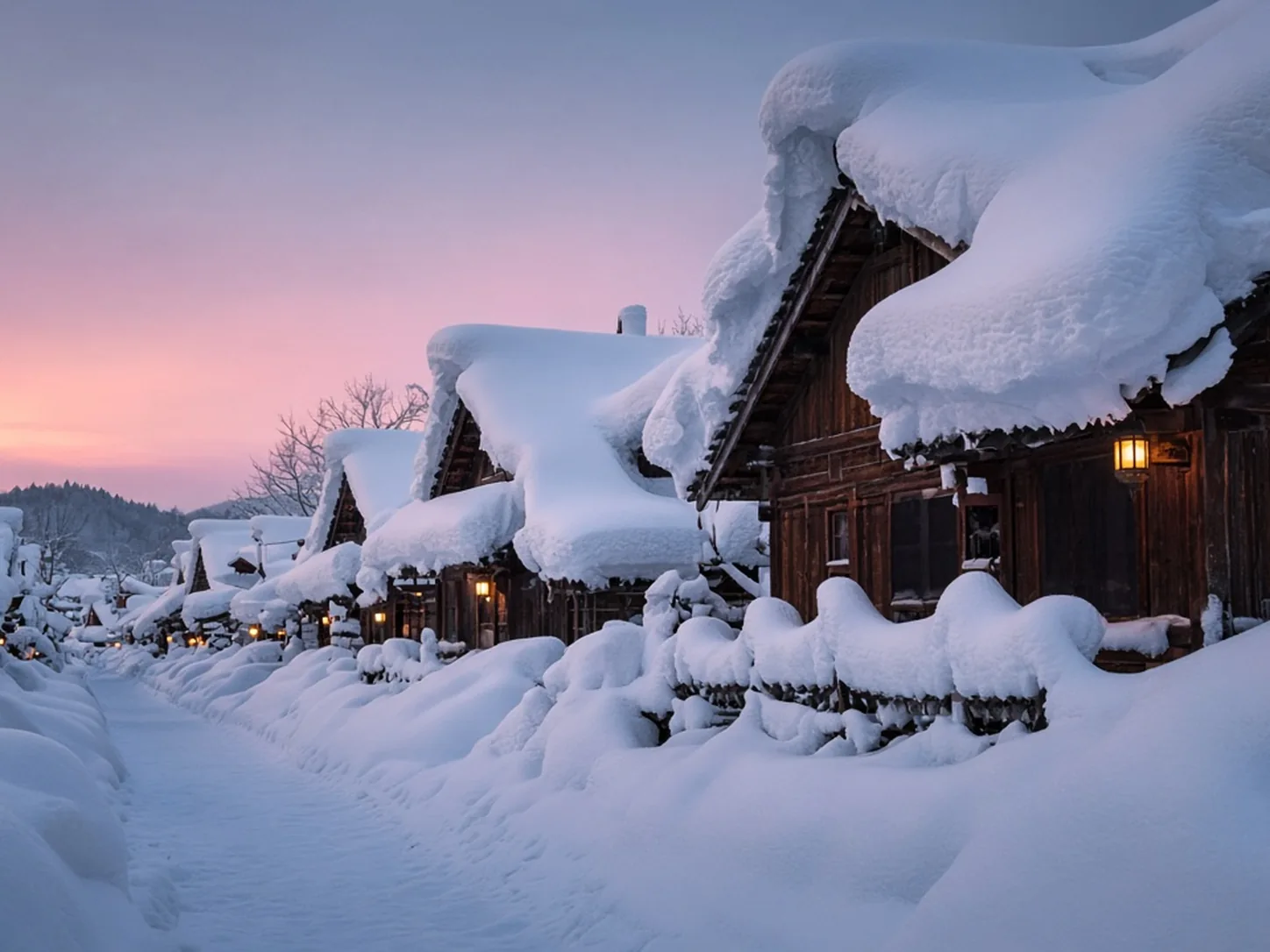
The Hour the Lane Belongs to You
That hour is the end of the night and the start of the day. Blue hour and the first light reach the snow-loaded roofs while most groups are still indoors or still on the road from Harbin. The lane is icy, the air is often around −20°C to −30°C, and the wind on any rise above the houses is the thing that will end your loop. For a short while the walking line is wide enough to stop, look up, and step aside without a negotiation.
You only get this hour if you slept inside the scenic area or truly at its edge. An outside room waits on the internal shuttle, and the first shuttle is frequently later than the light. No alarm fixes a vehicle that has not started. Confirm the room against the dawn before you worry about lenses. Two nights is the minimum useful stay, so this hour is not also your departure. Three nights give you a second try when the first morning is wind or flat cloud.
Arrive dressed. Hat, face cover, boots with grip, gloves, and the camera already set with a battery that spent the night in an inner pocket. A “quick check” in indoor clothes fogs your glasses in the doorway and blocks everyone behind you. The Harbin travel guide can wait. This morning cannot.
Midweek in January, the morning after fresh snow, is when this hour is at its best. The caps look complete, yesterday’s tracks are softened, and fewer people had the same idea. Weekends and Chinese New Year do not cancel the hour. They shorten it. The same doorway that was empty at first light is a crowd by late morning. Be there for the empty version.
Blue Hour, Then the Rush
Blue hour here is not a gentle city twilight you can wander into after coffee. It is early, cold, and brief. The snow reads blue, a few windows are lit, and the roof caps separate from the sky just enough to see. Then the sun, such as it is in December through February, comes up late and the mood changes. You still have good light. You have less privacy. By late morning on a weekend the main lane has changed jobs. It is now a corridor for groups, sticks, and people stopping in the only polished track.
Plan the morning as two beats, not one heroic stand. First beat: the quiet frames, made quickly, with a path back to warmth already chosen. Second beat: after you have been inside, eaten, and put a warm battery back in the camera, a walk in ordinary daylight when you are willing to share the lane. If you try to shoot continuously from blue hour until noon, your hands quit and your temper follows. The village looks better in person when you are not shaking.
Sunset is a mid-afternoon event. There is a second short window of low light, warmer in color than the morning, and it is worth a smaller outing if the morning already happened. It is not worth skipping dawn for. People who sleep through the early hour and “do photos at sunset” discover how fast the sun leaves Hailin, and how full the lane already is. Night lights are a third picture, useful and different, described below. They do not refund the morning.
Harbin’s Snow Town chapter talks about this timing from the point of view of a festival itinerary, where one night often deletes the blue hour entirely. If you are on that pattern, know it. If you came to photograph the village, you are on the two-night or three-night pattern, and the alarm is the point of the second night.
Where the Main Lane Clogs
The clog is specific. It gathers in the central walking line between the most photographed houses, and it thickens at the doorways and bends where the roof caps stack into a single frame. Everyone has seen the same picture. Everyone stops in the same two meters of ice. On a Saturday in January, or any day of Chinese New Year, that stop becomes a knot: tripods, phones, people stepping backward without looking, and a polished surface that does not forgive a sudden shift of weight.
You will feel it first as a change in pace. The lane, which let you walk, now lets you shuffle. Elbows in thick coats have no sensation. A person who steps off the polished line to escape the knot can step into deeper snow that hides a ditch or a drop at the path’s edge. Stay on the maintained surface. Leave the knot by turning around and finding another stretch, not by climbing a snowbank that is somebody’s roof-load or an unstable edge.
Weekday late mornings clog too, only later and less completely. Do not imagine a Wednesday is empty. Imagine it is usable if you already did your work at dawn and you do not need the noon frame. The shuttle delivers waves. When a wave arrives, the doorway you liked becomes their doorway. Let them have it. You were there earlier, or you will be there tomorrow if you have the extra night.
Residents and staff use this lane to work, not to pose. A cart, a child, a person carrying supplies has the right to the walking line. Step aside before you are asked. The photograph of an empty lane is partly a photograph of good timing and partly a photograph of courtesy that kept you from planting yourself in the last clear gap.
Tripods, Elbows, and Courtesy
A tripod in the middle of an icy lane is a barrier. It catches boots, it blocks the only safe line, and it claims a public path for a picture that could have been made from the side. If you need the tripod for a low-light frame, set it at the edge, stay with it, and collapse it the moment you move. Do not leave it “just for a second” while you back up into the crowd. Seconds are when other people fall.
Many of the roof pictures do not need a tripod at all in the growing light. A higher ISO and a steady stance against a wall, off the walking line, are kinder and often sharper than a tripod you are too cold to level. At blue hour a support can help. Use it where people are not trying to pass, and keep the legs in so the footprint is small. On the ridge, wind will move a tall tripod more than it moves you. Shorten it, or accept a faster shutter and a little more noise in the file.
Courtesy with people is simpler than courtesy with gear. Do not block a doorway. Do not direct strangers into your frame and then get angry when they walk. Do not climb onto private steps or onto the snow piled against a house. Ask before you photograph someone at work, and accept a refusal. A resident in a heavy coat is not a prop because the wood behind them is picturesque. Children in the lane are not a theme. Point the camera at the roofs and the snow if you do not have a clear yes.
Drones are a separate question the scenic area answers, and the answer can be no. Do not arrive assuming the sky is yours. Check the current rule before you pack the aircraft, and do not fly “just once” over a crowd on ice. A falling machine and a startled group on a polished path are a bad combination. The roofs look extraordinary from the ground at the right hour. That hour is the legal, available picture.
Your own group is the crowd you can actually control. Agree that you will not walk abreast, that you will not stop in a bunch, and that one person watching the path behind is worth more than one more angle. China Snow Town tours does not change the physics of the lane. Two nights or three, the ice is the same width.
How to choose
| Choice | Fit | Skip when |
|---|---|---|
| Make this the focus | When this page is the reason for the day | When it is only a name on a list |
| Pair it | With one nearby stop | With a second full excursion |
| Leave it | If the main stay is already full | If you have the night it needs |
Batteries, Screens, and Cold Metal
Lithium batteries sag in this cold. A camera that was full at breakfast can fade in the lane, then recover a little once the battery sits against your body. The working method is rotation. Carry two spares in an inner pocket, not in the bag on your hip where the wind reaches them. Swap before the camera dies, and put the cold battery in the pocket to warm. Number them with a bit of tape if you cannot feel which one you just used.
Limit the rear screen. Reviewing every frame with the display on spends the battery and spends your attention while you stand still, which is the fastest way to get cold. Make the picture, glance once, pocket the camera against your body between bursts. Metal bodies and metal tripod legs bite bare skin in under a minute at these temperatures. Touch them with gloves. A thin glove in the inner pocket is for the dials. A thick glove is for the walk. Switching is clumsy and still better than skin on metal.
Phones fail the same way and are worse to lose because they hold the meeting point. Keep the phone warm and keep the hotel name, the car meeting point, and the shuttle note on paper in Chinese. A dead screen at dusk, in a crowd, is not the moment to discover you memorized nothing. Condensation is the other silent failure. When you go indoors, bag the camera before the warm wet air hits it, and let it come up to temperature slowly. Open the bag too soon and you have moisture on a cold body, then a useless camera for the afternoon window. The patience is the whole trick.
Bring more power than a city day suggests, especially on a three-night stay with two dawns. A single battery and a hopeful pocket is a one-morning plan. Hand warmers help the pockets and should not sit directly on skin. They will not save a battery you left in the snow while you changed lenses. Change lenses inside, or accept that you will not change them. Cold fingers drop lens caps, and lens caps on ice become other people’s falls.
Rime, When the Night Cooperates
Rime is the feathery ice that can outline branches and eaves after a cold, clear, relatively still night. It is the detail in some of the frames you have seen, and it is not a schedule. You can do everything right — January, midweek, on site before dawn — and find bare twigs over perfect roofs. You can also step out after an ordinary forecast and find the lane embroidered. Wind strips it. A later sunrise does not hold it for you. Touching it, brushing snow onto it, or shaking a sapling to “improve” the frame removes it for everyone else.
If it is there, photograph it first, before the ridge wind or the crowd reaches it, and do it from the path. The best rime pictures are usually the quiet ones: a branch against a roof, not a heroic viewpoint in a gale. If it is absent, do not spend the precious hour hiking around in search of a rumor. The snow-loaded roofs are the subject that justified the road from Harbin. Shoot them while the lane is yours. On a three-night stay you may get another morning. On a two-night stay this is the morning. Either way, a village under snow is not a failed rime hunt.
Falling snow is a different gift. It softens tracks and fills the air, and it hides fine rime even as it makes the roofs look heavier. Expose for the snow, not for the bright sky gap, and keep the camera covered when you are walking. Wet flakes on a warm lens, brought from indoors, melt and smear. Let the camera cool in the bag, then work. These are village techniques, not a mountaineering manual. You are a few minutes from a door. Use the door.
The Yabuli guide is not where you go for a closer version of this picture. Yabuli is a ski area in Shangzhi, about three hours from Harbin, and its visual logic is runs and lifts. A detour there on a clear rime morning would be a remarkable way to miss the only embroidered dawn of your stay.
Night Lights Are a Different Photograph
After dark the village turns on lamps. Snow picks up the color, windows punctuate the roofs, and the lane reads as a night scene rather than as a blue-morning one. It is worth doing once, on purpose, with a path you already walked in daylight so the ice is not a surprise. It is a poor substitute for the dawn you skipped. Festival travelers sometimes see only this version, because one night in the village ends at breakfast. Harbin’s Snow Town chapter is frank about that. If night lights are all you will have, enjoy them and do not tell yourself you photographed the morning village.
Weekends at night are crowded. The same doorway knot returns, now with less depth perception. Use a small light to walk, shield it, and avoid a headlamp on the bright setting pointed at people’s faces or into their frames. Flash from a phone does the same damage at close range. If you need light for safety, point it at the ground ahead of your own feet. The lamps on the houses are the light in the picture.
Decide in advance whether this outing is allowed to steal the next dawn. On a two-night stay, the dawn wins. A short night walk, then sleep, is the compromise. On a three-night stay you can give one evening to the lamps and protect the other morning with an early night. Cold batteries still apply. A spare in the inner pocket, a body kept under the coat between frames, and an exit before your hands are too numb to work the door.
The Ice Festival’s night pictures are a different craft in a different place. Illuminated ice in Harbin is planned on Harbin tours. Do not light this lane as if it were that park, and do not skip this lane because you already shot ice blocks. Wood, snow, and a lamp are the palette here.
Standing Still without Taking the Lane
The useful skill is to stop without becoming an obstacle. Choose the side, put your back near a wall or a bank that is clearly part of the path, and leave a body-width of the polished track clear. Make the frame. Move. If someone is coming with a load or a child, the frame can wait ten seconds. Ten seconds of manners is faster than a collision and an apology on ice.
Look up before you step back. Roof caps shed snow and ice, especially on a milder afternoon or in wind. The pretty overhang is also the place you should not linger. Look down before you step sideways. The edge of the walked line is where the surface changes from polished to deep, and deep is where people post a leg through. Look at your group before you lead them into a knot “because the picture is there.” The picture will be there from a worse angle that everyone survives.
Aperture and longing can wait until you are warm. The mistakes that ruin files here are motion from shivering, a fogged eyepiece you did not notice, and a battery death at the moment the light peaked. The mistakes that ruin the morning for other people are the tripod, the backward step, and the drone. You can be proud of a small number of frames made at the right hour from the side of the lane. You do not need every platform listed in a caption.
If the cold is winning, leave. A warm room and a second outing produce better pictures than a heroic stand that ends with dropped gear and a numb face. The ridge is optional. The lane at first light is not. Wind is the judge of the ridge, not your itinerary. When the judge says no, come down while you can still feel your boots.
A Day Built for Pictures and for Cold
A practical shooting day matches the two-night or three-night stay. Morning: blue hour and first light, short loop, indoors, food, batteries into the pocket. Late morning: stay out of the worst knot, or walk a less famous stretch if it is still pleasant. Early afternoon: one lower-light pass, then gloves off and dried. Evening: optional lamps, only if tomorrow’s alarm is safe. Repeat if you have another night. Do not insert Yabuli, a Harbin evening, or a long transfer into this day and still call it a photo day.
Gear that earns its place is dull. Spare batteries, spare gloves, a plastic bag for condensation, a cloth for fogged glasses, paper with the lodge name, boots you already trust on ice, a strap that does not swing into other people. Gear that often stays home: a drawer of lenses you will not change in the wind, a drone you have not confirmed, a tripod you are unwilling to collapse every time you move. Cotton against the skin stays home as well. It keeps the sweat from the warm room and gives it back when you stand still to focus.
China Snow Town tours is the three-day or four-day way to put this day in the middle of the road time, or to add those nights to a Harbin winter while festival days stay in the city. The Harbin travel guide remains the city reference. Neither page can stand in the lane for you at blue hour. You do that, off to the side, battery warm, letting other people pass.
Ways to plan the days
These shapes match the China Snow Town tours page. They are starting points, not fixed departures.
Snow Town stay
Time fit: 3 days
The winter road, two nights, and one real dawn.
- China Snow Town
- Snow Town stay
Why choose it: The winter road, two nights, and one real dawn.
Longer snow stay
Time fit: 4 days
A second morning when the first dawn was cloudy or crowded.
- China Snow Town
- Longer snow stay
Why choose it: A second morning when the first dawn was cloudy or crowded.
Add to a Harbin winter
Time fit: Add-on
Village nights beside a festival plan quoted on the Harbin page.
- China Snow Town
- Add to a Harbin winter
Why choose it: Village nights beside a festival plan quoted on the Harbin page.
Want help shaping the China Snow Town days?
Tell us your Harbin arrival and whether the Ice Festival is also in the trip. The village nights are planned here; festival days stay with Harbin.
Keep planning
China Snow Town
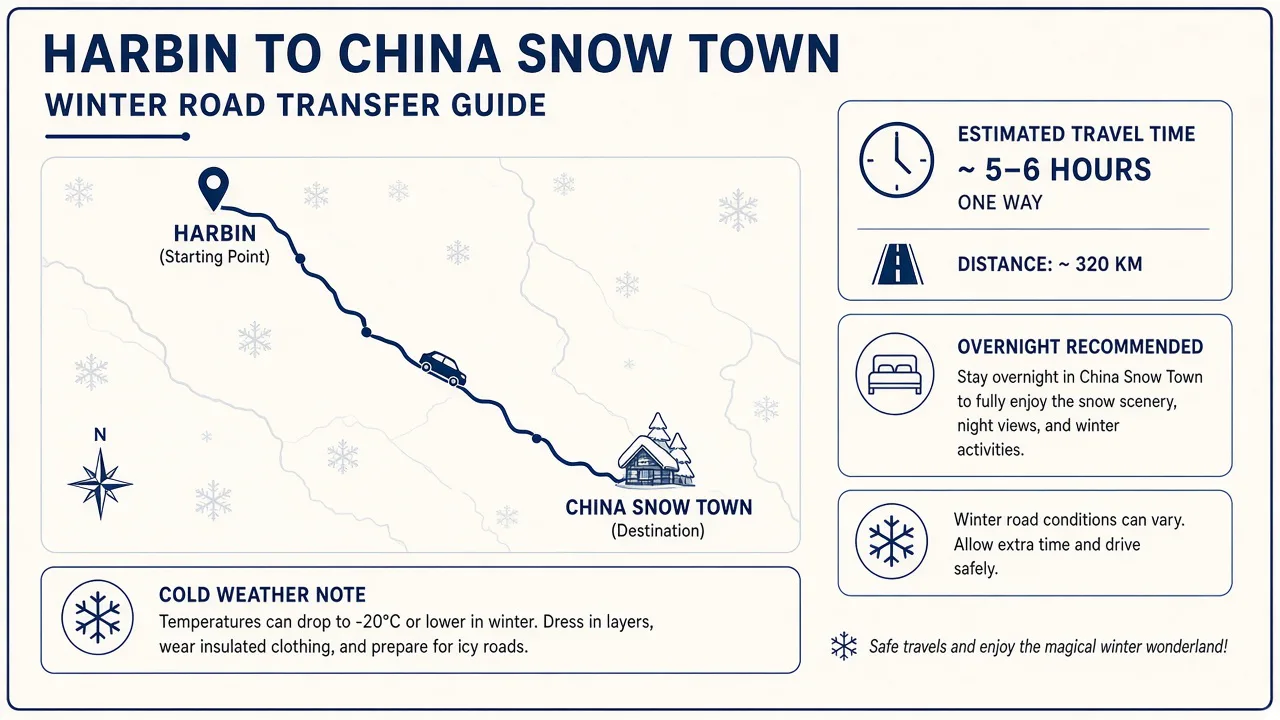
The winter road from Harbin is about 5–6 hours. Rail plus a shuttle is the alternative, and both need daylight at the far end.
Sleep inside or at the edge of the scenic area if the dawn photographs are why you came.
December to February is the season. Midweek January after fresh snow beats a holiday weekend.
Two nights for one dawn, three nights if you want a spare morning. A Harbin day trip does not work.
Compare a 3-day village stay, a 4-day longer stay, and adding the village to a Harbin winter.
Questions people ask
- Be in the lane for blue hour and the first daylight, which means dressing in the room and walking out before breakfast. That is the quiet hour, and it is also the coldest. You only reach it on foot if you slept inside the scenic area or at the true edge. A shuttle from an outside hotel often starts after the blue has gone. Come inside when your hands fade, eat, and go out again for the short low-light window in the mid-afternoon. Sunset is early from December through February. Night lamps are a separate picture, worth one deliberate walk, and they do not replace the morning. On a two-night stay this dawn is the priority. On a three-night stay you can repeat it if the first try is windy or grey.
- In the main lane, at the bends and doorways where the snow-loaded roofs stack into the familiar frame. Late morning is when it thickens, earlier on weekends and through Chinese New Year, later on a midweek day in January. People stop in the same two meters of polished ice, often with a tripod, and the walking line becomes a knot. Do not escape by climbing a snowbank or stepping into deep snow at the edge. Turn around and use another stretch, or be satisfied with the frames you made at dawn. Residents still need the lane for work. Give way to anyone carrying a load or walking a child. The empty picture is mostly a picture of having arrived earlier.
- Assume the path is the constraint, not a signed debate. A tripod set in the middle of an icy lane blocks the only safe line and catches people’s boots. If the light truly needs support, place it at the edge, stay with it, keep the legs short, and collapse it as soon as you move. Many roof pictures after first light do not need it. A faster shutter and a stance off the walking line are safer when your fingers are too cold to level a head. On the ridge the wind shakes a tall stand more than it shakes you. Never leave the tripod unattended in a crowd. And do not fly a drone unless the scenic area’s current rule says you may. The ground at blue hour is the picture that is actually available.
- Keep spares in an inner pocket, not in an outside bag, and rotate them before the camera dies. A cold battery often recovers some charge once it warms against your body, so pocket the one you just removed. Limit the rear screen. Standing still to review frames spends power and chills you faster than walking. Wear a thin glove for dials and a thick one for the walk. Metal against bare skin hurts within a minute around −20°C to −30°C. When you go indoors, seal the camera in a bag first and let it warm slowly, or condensation will take the next outing away. Bring more than one morning’s power if you have two dawns. Change lenses inside, if you change them at all.
- Photograph the village you have. Snow-loaded wooden roofs and the lane are the reason to come to Xuexiang. Rime can appear after a cold, clear, still night and can be missing the next morning if the wind picks up. It is not a failed trip when the branches are bare. Shoot the roofs while the lane is still quiet, stay off the ice with your hands, and do not shake snow or rime off a tree for a cleaner frame. Falling snow is its own kind of picture. A three-night stay gives you another dawn. A two-night stay gives you this one. Neither is improved by leaving for Yabuli, which is a ski area and a different day. Touching the frost, when it does exist, only removes it.
- Poorly, if you pretend you can do both fully on the same night. The dawn is colder and more important. On a two-night stay, take a short lamp-lit walk if you still have energy, shield any personal light toward the ground, and then sleep. On a three-night stay, give one evening to the night scene and protect the other morning with an early night. Weekend nights clog the same doorways as weekend mornings, with worse footing. Skip the outing if your hands are already done. Harbin’s ice park is a different night, on Harbin tours, and it should not be stacked on the evening you return from Hailin. One deliberate night in the village is plenty.
Plan a China Snow Town visit
Share your Harbin dates and whether you can sleep two nights in the village. We reply with a road plan that protects the dawn.