Symbols decoded
| Symbol | Meaning | Where to see |
|---|---|---|
| Number 9 | Imperial number, max | Circular Mound Altar 9-stone rings; balustrade posts |
| Number 28 (4+12+12) | Chinese calendar in architecture | Hall of Prayer interior columns |
| Number 3 | Sacred number | Triple-tier plinths, triple-eaved roof, 3 axis structures |
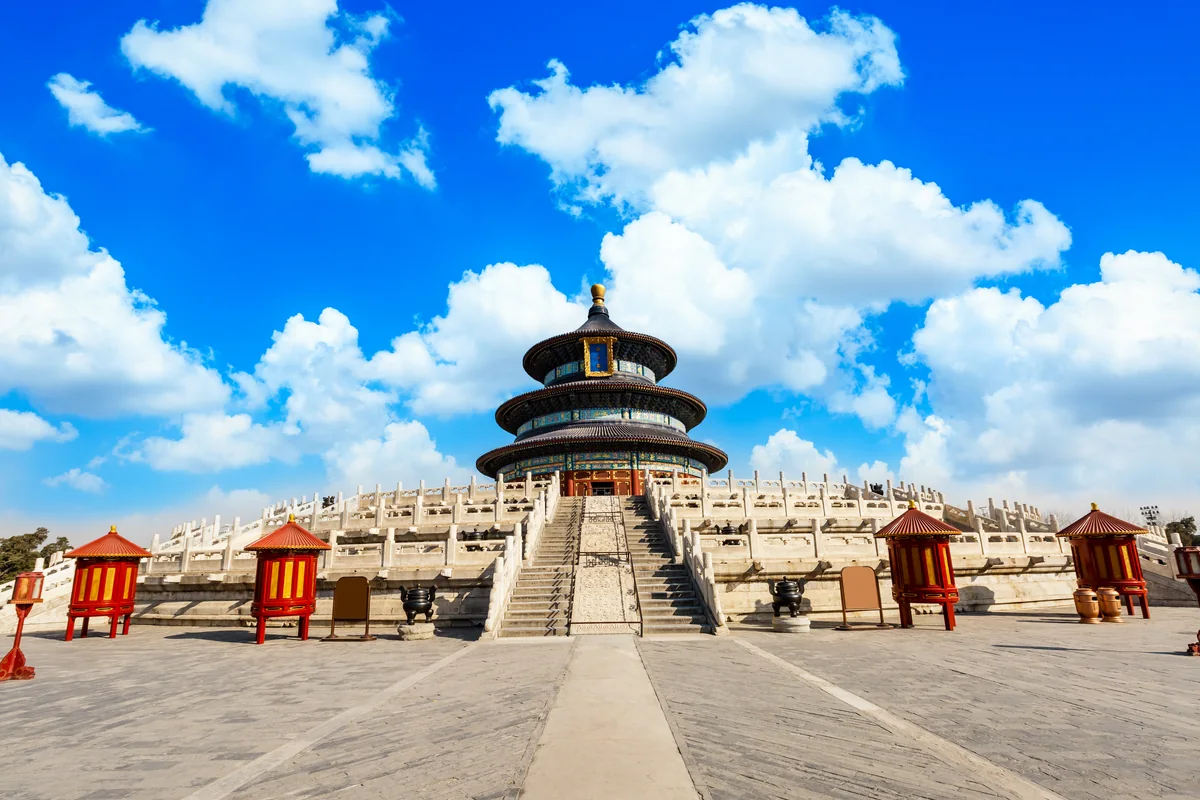
| Blue glazed tiles | Sky / heaven | Hall of Prayer, Imperial Vault roofs |
| White marble | Purity + imperial rank | All structure plinths and balustrades |
| Round form | Heaven (Tian) | All three signature structures |
| Square form | Earth (Di) | Walls around structures, plinth bases |
| South-to-north axis | Imperial procession path to Heaven | Entire site layout |
| Heavenly Centre Stone | Literal centre of heaven | Top of Circular Mound Altar |
The number 9 - imperial maximum
9 is the highest single digit in Chinese numerology and traditionally represents imperial authority at its maximum. Throughout the Temple of Heaven, 9 and multiples of 9 are everywhere: Circular Mound Altar has 3 tiers x 9 concentric rings of stones each, ring counts in multiples of 9 (top ring 9, second 18, third 27, etc. up to 81 stones in the 9th ring of each tier). Balustrade posts: 9 per outer ring, 9 per inner. Steps to each tier: 9. The number 9 is the cosmological signature of the temple's imperial-only function - no other building in Beijing uses 9 as densely as the Temple of Heaven. Same imperial-number signature as the 9 ridge animals on the Forbidden City's Hall of Supreme Harmony.
- 9 = imperial number, max.
- Circular Mound Altar: 3 tiers x 9 rings.
- Ring counts in multiples of 9.
- Top ring 9 stones; ninth ring 81 stones.
- Same signature as Forbidden City's 9 ridge animals.
The number 28 - the calendar
The Hall of Prayer for Good Harvests' interior column count of 28 (4 + 12 + 12) is the Chinese calendar in architectural form. (1) 4 inner columns near the central altar = the 4 seasons (spring, summer, autumn, winter). (2) 12 middle columns surrounding them = the 12 months of the year. (3) 12 outer columns at the perimeter = the 12 two-hour periods of the Chinese day (each 'shichen' = 2 modern hours). Total 28 = the 28 lunar mansions in traditional Chinese astronomy (the constellations through which the moon passes each lunar month). The architecture is a literal calendar / astronomy diagram. A guide makes this visible by counting the column ranks; without context, the columns look like ordinary structural posts.
- 28 = 4 seasons + 12 months + 12 two-hour periods.
- Also 28 lunar mansions in Chinese astronomy.
- Hall of Prayer interior columns by rank.
- Calendar / astronomy diagram in architecture.
- Guide makes it visible.
Blue glazed tiles + white marble
Two key colours. (1) Blue glazed roof tiles represent sky and heaven - the colour of the firmament where Tian (Heaven) manifests. Used throughout the temple's signature structure roofs (Hall of Prayer triple-eaved, Imperial Vault, Circular Mound Altar surrounding pavilions). Distinct from the Forbidden City's yellow imperial-earth tiles. (2) White marble represents purity and imperial rank - used for all plinths, balustrades, the Heavenly Centre Stone, the 3-tier Circular Mound Altar, and the triple-tier Hall of Prayer plinth. Together blue + white marble + the surrounding red walls (celebration / protection) form the temple's signature colour palette.
- Blue = sky / heaven (roof tiles).
- White marble = purity + imperial rank.
- Red walls = celebration / protection.
- Distinct from Forbidden City's yellow (imperial earth).
South-to-north axis orientation
The imperial procession axis runs south-to-north from the South Gate area through Circular Mound Altar (south), Imperial Vault (mid), Hall of Prayer (north). The orientation has cosmological meaning. (1) South-facing = yang energy = where Heaven manifests in classical Chinese cosmology. The emperor on his throne in the Forbidden City faced south; the Temple of Heaven sits south of the Forbidden City, in the direction the emperor faced. (2) South-to-north walk = procession toward Heaven (since the temple's structures progress in scale and ceremonial importance from south to north). (3) The temple's axis continues the Forbidden City's axis southward, making imperial Beijing one giant cosmological line from the Drum and Bell Towers in the north through the Forbidden City through Tiananmen Square through the Temple of Heaven to Yongding Gate in the south.
- South-to-north imperial procession axis.
- South = yang = where heaven manifests.
- Emperor on Forbidden City throne faces south.
- Procession toward heaven (south to north).
- Beijing's cosmological line: north (Drum/Bell) to south (Yongding).
Common symbolism mistakes
Missing the number coding
Without counting, the numbers are invisible. Count one ring of Circular Mound Altar stones or one column rank of Hall of Prayer to make it tangible.
Treating blue tiles as 'just colour'
Blue = heaven; yellow = earth. The colour choice is cosmological, not aesthetic.
Skipping the Heavenly Centre Stone test
Stand on it and clap - the surround sound is the symbolism made experiential.
Walking the axis north-to-south by accident
Reverse processional order. Walk south-to-north for the conceptually correct experience.
Temple of Heaven symbolism FAQ
- Five layers: numbers (9 imperial, 28 calendar, 3 sacred), colours (blue sky, white purity, red celebration), shapes (round heaven, square earth), orientation (south-to-north imperial axis), materials (marble, granite, timber).
- 9 is the highest single digit in Chinese numerology and represents imperial authority at its maximum. The Circular Mound Altar uses 9-multiples throughout: 9 concentric rings per tier, ring counts in multiples of 9, balustrade posts 9, steps 9.
- Hall of Prayer interior columns: 4 inner (4 seasons) + 12 middle (12 months) + 12 outer (12 two-hour periods of the Chinese day) = total 28 (28 lunar mansions). Chinese calendar / astronomy in architecture.
- Blue = sky / heaven; yellow = imperial earth (the Forbidden City). The Temple of Heaven uses blue because it's a heaven-sacrifice site.
- 'Round heaven, square earth' Chinese cosmology. Round altars on square bases or surrounded by square walls = literal architectural expression.
- Circular marble stone at the exact centre of the top tier of the Circular Mound Altar. The emperor stood here during the winter solstice ceremony - the literal centre of heaven in Chinese cosmology.
Walk with the symbolism decoder
Our private Temple of Heaven day pairs the symbolism decoder with the route - counting the 9-stone rings, naming the 28-column calendar, standing on the Heavenly Centre Stone for the acoustic test.
For the broader cosmology context, the Chinese cosmology page covers Tian, Di, yin-yang, and five elements.
Plan a guided symbolism-focused Temple of Heaven dayChinese cosmology