Five concepts of Chinese cosmology
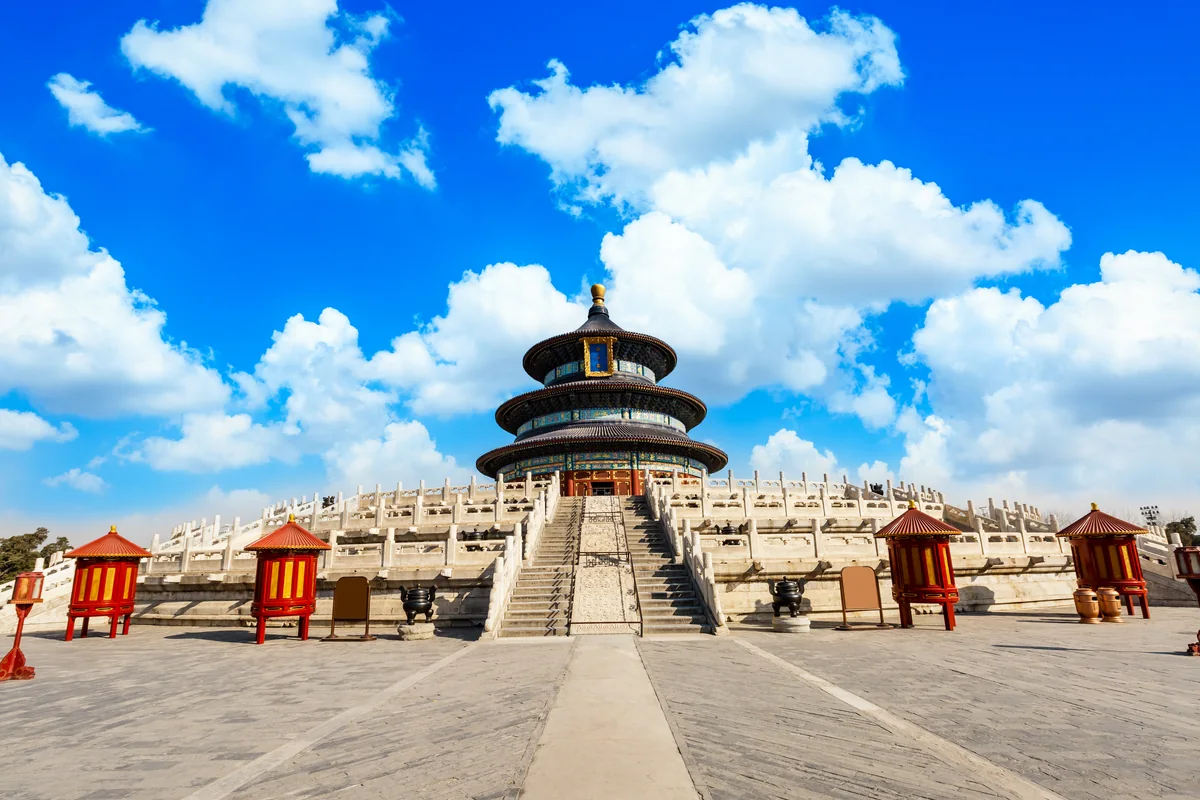
Chinese cosmology rests on five core concepts, all expressed at the Temple of Heaven. (1) Tian (Heaven): the cosmic principle of the heavens, the source of order and authority. Symbolised by round forms, blue tiles, the Heavenly Centre Stone. (2) Di (Earth): the cosmic principle of the ground, the support that bears life. Symbolised by square forms, base plinths, the south of the temple. (3) Yin-Yang: complementary opposites (dark-light, cold-warm, female-male, earth-heaven). The temple's south-to-north axis runs from yin (south, earth) to yang (north, heaven). (4) Five Elements (Wuxing): wood, fire, earth, metal, water - the five processes through which Tian and Di interact. Visible in the temple's seasonal sacrifice timing. (5) Mandate of Heaven (Tianming): Heaven's grant of authority to the emperor as Tianzi (Son of Heaven). The temple is the architectural infrastructure where this mandate is publicly renewed. Together these five concepts form the worldview the temple was built to express.
- From central Beijing: Central Beijing — about 20–45 minutes by subway or taxi
- Reading time: 7-8 min
- Guide type: Cultural background
- Best for: Cosmology / philosophy-curious visitors; Architecture lovers wanting deeper context
- Less ideal for: Practical-planning visitors
Five concepts and where they appear at the temple
| Concept | Mandarin term | Where to see at the temple |
|---|---|---|
| Tian (Heaven) | Tian | Round forms, blue tiles, Heavenly Centre Stone |
| Di (Earth) | Di | Square forms, base plinths, south of temple |
| Yin-Yang | Yinyang | South-to-north axis runs yin (south) to yang (north) |
| Five Elements (wood, fire, earth, metal, water) | Wuxing | Seasonal sacrifice timing (winter solstice = water peak) |
| Mandate of Heaven | Tianming | The emperor's right to perform the ritual |
| Son of Heaven | Tianzi | The emperor's title; demonstrated on Heavenly Centre Stone |
Tian (Heaven)
Tian is the supreme cosmic principle in Chinese cosmology - the heavens as the source of order, authority, and life. Not a personal god (like the Judeo-Christian God) but an impersonal cosmic principle. The Temple of Heaven's central act, the winter solstice sacrifice, is addressed to Tian. The architectural expression: round forms (the dome of heaven), blue glazed roof tiles (the sky), the Heavenly Centre Stone (the literal centre of heaven) at the top of the Circular Mound Altar. Walking the temple is walking through the architecture of Tian. The word 'Tianzi' (Son of Heaven, the emperor's title) means literally 'child of Tian' - the emperor is Heaven's chosen representative.
- Tian = supreme cosmic principle.
- Not personal god; impersonal principle.
- Round forms + blue tiles + Heavenly Centre Stone.
- Tianzi = Son of Heaven = child of Tian.
Di (Earth)
Di is the cosmic principle of the ground - the support that bears life. The complement to Tian. In Chinese cosmology Di is square (vs Tian's round), south-facing (vs Tian's north), receptive (vs Tian's active), and feminine (vs Tian's masculine - though both are cosmic, not personal). At the Temple of Heaven, Di is expressed through square forms (the bases under round structures, the square wall around the Circular Mound Altar), through the south position (the temple is south of the Forbidden City, in the direction of earth's manifestation), and through the support function of plinths (earth supports heaven). The complementary site, the Temple of Earth (Ditan, north of Beijing), is specifically for sacrifice to Di on the summer solstice.
- Di = cosmic principle of earth.
- Square forms, south position, receptive.
- Complement to Tian.
- Temple of Earth (Ditan): separate site for Di sacrifice.
Yin-Yang
The most famous concept of Chinese cosmology - yin and yang as complementary opposites that together make up the universe. Yin: dark, cold, female, earth, south (where the sun is at winter solstice), receptive, water. Yang: light, warm, male, heaven, north (where the pole star is), active, fire. The pair is not opposition but complement - each contains a seed of the other (the famous taijitu yin-yang diagram). At the Temple of Heaven, the south-to-north axis runs from yin (south, earth, where winter solstice begins) toward yang (north, heaven, where the renewed yang returns). The winter solstice ceremony itself is the cosmic moment of yin peak and yang return; the ritual catches this transition.
- Yin = dark, cold, female, earth, south, water.
- Yang = light, warm, male, heaven, north, fire.
- Complementary, not opposed.
- Each contains seed of the other (taijitu).
- Temple of Heaven south-to-north = yin to yang.
- Winter solstice = yin peak + yang return.
Five Elements (Wuxing)
The five processes through which Tian and Di interact: wood (spring), fire (summer), earth (late summer, transition), metal (autumn), water (winter). Each element has associated season, direction, colour, emotion, organ. At the Temple of Heaven, the seasonal rituals align with element timing: winter solstice (water peak) = main sacrifice; spring (wood) = harvest blessing at Hall of Prayer. Each element generates and overcomes specific others (the generating and overcoming cycles), making the five elements a dynamic system rather than static categories. The temple's ritual calendar is built on this system - the emperor's annual ritual cycle moves through the elements.
- Five elements: wood, fire, earth, metal, water.
- Each with season, direction, colour, emotion.
- Winter (water) = main sacrifice.
- Spring (wood) = harvest blessing.
- Dynamic system: generating + overcoming cycles.
Mandate of Heaven (Tianming)
The political-cosmological doctrine that Tian (Heaven) grants the right to rule to a worthy ruler - the Tianming (Mandate of Heaven). The mandate can be withdrawn if the ruler is unworthy (which justified dynastic changes throughout Chinese history - failed dynasties had 'lost the mandate'). The emperor maintains the mandate by performing the imperial rituals correctly, especially the winter solstice Sacrifice to Heaven at the Temple of Heaven. Skipping the ritual or performing it incorrectly would suggest the mandate had been lost. Earthquakes, famines, and rebellions during a reign were often interpreted as signs of fading mandate. The Temple of Heaven is the architectural infrastructure of the Mandate of Heaven doctrine - 500 years of dynastic legitimacy ran through the temple.
- Tianming = Mandate of Heaven.
- Right to rule granted by Heaven to worthy ruler.
- Can be withdrawn (justifies dynastic change).
- Maintained by correct ritual performance.
- Disasters as signs of fading mandate.
- 500 years of dynastic legitimacy ran through the temple.
Common cosmology misunderstandings
Reading Tian as 'God' in Western sense
Tian is an impersonal cosmic principle, not a personal deity. Different category from Christian or Islamic theology.
Reading yin-yang as opposition
Complementary, not opposed. Each contains a seed of the other.
Treating cosmology as 'ancient superstition'
It's a coherent worldview, codified over 2000+ years. The temple is built on rigorous philosophical foundations.
Missing the political dimension
Mandate of Heaven was political doctrine, not just religious belief. 500 years of dynastic legitimacy ran on it.
Chinese cosmology FAQ
- The classical Chinese understanding of how the universe works - centred on Tian (Heaven), Di (Earth), yin-yang, five elements (wood, fire, earth, metal, water), and the Mandate of Heaven (Tianming). Codified over 2000+ years from pre-Qin texts through Han, Tang, and Song refinements.
- The supreme cosmic principle in Chinese cosmology - the heavens as the source of order and authority. Not a personal god but an impersonal principle. The Temple of Heaven is dedicated to Tian.
- Complementary opposites that together make the universe. Yin: dark, cold, female, earth, south. Yang: light, warm, male, heaven, north. Each contains a seed of the other.
- Wood, fire, earth, metal, water - the five processes through which Tian and Di interact. Each has associated season, direction, colour, emotion. The temple's ritual calendar aligns with this system.
- Tian's grant of authority to a worthy ruler. Can be withdrawn if the ruler is unworthy (justifying dynastic change). Maintained by correct imperial ritual performance, especially at the Temple of Heaven.
- Different category - it's a cosmology + political doctrine + ritual practice, codified philosophically over 2000+ years. Not religion in the Western sense (worship of a god) but not just philosophy either.
Walk the cosmology with a guide
Our private Temple of Heaven day with a cosmology-focused guide names the five concepts as you walk - Tian at the round forms, Di at the square plinths, yin-yang at the south-to-north axis, five elements in the ritual calendar, Mandate of Heaven in the emperor's role.
For the simpler round-and-square decoding, the round and square symbolism page is the entry-level companion.
Plan a guided cosmology-focused Temple of Heaven dayRound and square symbolism