
Comparação lado a lado
| Palácio de Verão | Templo do Céu | |
|---|---|---|
| Melhor tempo permitido | Cerca de 3–4 horas | Cerca de 1,5–2,5 horas |
| Localização | Noroeste de Pequim | Sul do centro histórico da cidade |
| Experiência principal | Jardim imperial, lago, colinas e arquitetura | Ritual imperial, simbolismo e arquitetura cerimonial |
| Caminhada | Geralmente mais; a escolha da rota importa | Moderado para uma rota focada nos principais pontos turísticos |
| Passo | Melhor quando sem pressa | Mais fácil de encaixar em um dia estruturado de turismo |
| Ideal para | Paisagem, jardins, fotografia e uma metade de dia mais lenta | História, arquitetura, ritual imperial e agendas mais apertadas |
| Fácil de combinar com atrações centrais | Menos conveniente | Sim |
| Bom como um meio dia independente | Sim | Normalmente mais curto, a menos que explore o parque mais amplo |
| Consideração de segunda-feira | Parque aberto; várias atrações internas normalmente fechadas | Parque aberto; grandes complexos históricos normalmente fechados |
| Escolha típica para a primeira visita | Escolha quando a paisagem é a prioridade | Escolha quando o turismo na cidade e a história imperial são a prioridade |
Nenhum dos locais é simplesmente uma versão menor do outro. Eles representam diferentes funções do Pequim imperial e devem ser escolhidos de acordo.
What the two sites actually offer
Summer Palace: imperial landscape
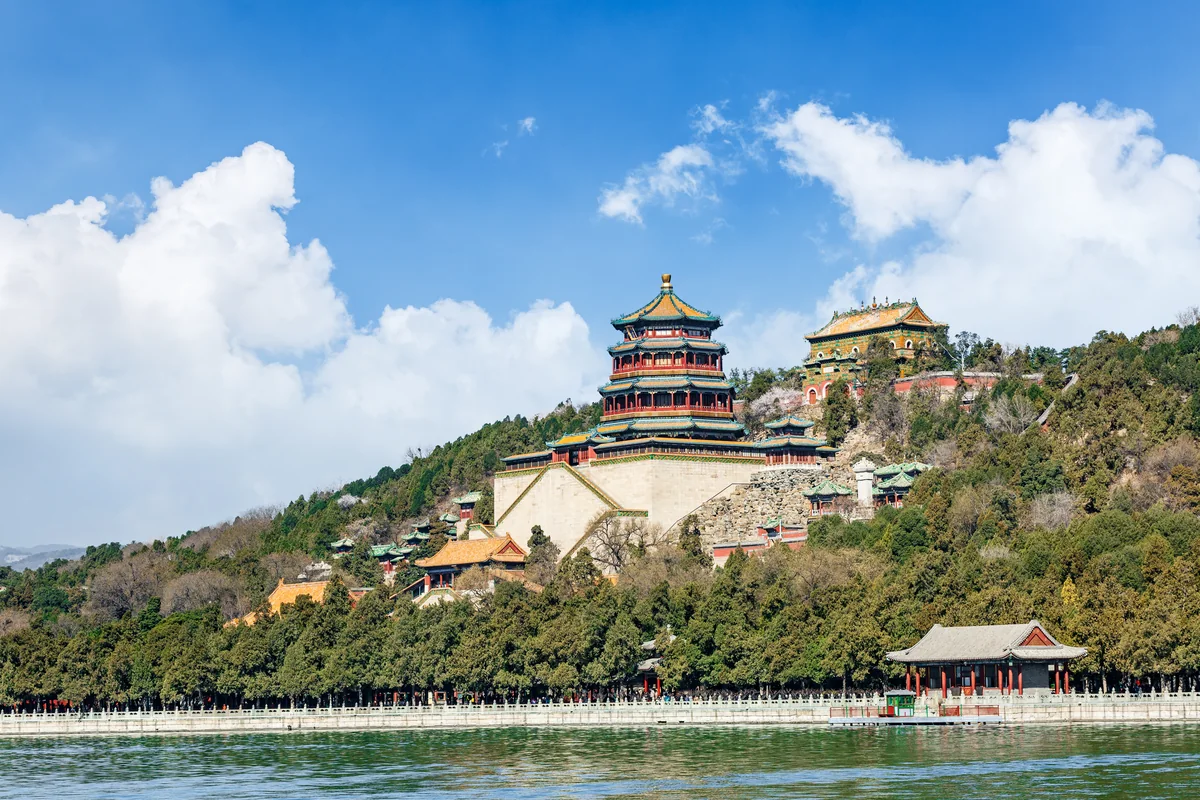
The Summer Palace is not primarily a palace building.
It is a large imperial garden structured around Kunming Lake and Longevity Hill, with pavilions, halls, temples, bridges, covered corridors and carefully composed views.
That distinction matters.
At the Forbidden City, the experience is largely architectural and axial. At the Summer Palace, much of the experience comes from moving through the landscape and seeing how architecture, hills and water are arranged together.
For a first visit, the main elements usually include:
* Kunming Lake * Longevity Hill * the Long Corridor * the main palace area near the eastern side * views toward the Tower of Buddhist Incense * optional additional walking around the lake or hill
You do not need to cover the entire park.
Trying to do so is one of the easiest ways to turn an enjoyable half day into unnecessary walking.
A good Summer Palace visit chooses a route and leaves enough time to stop.
Temple of Heaven: imperial ritual
The Temple of Heaven is not simply a temple in the ordinary sense.
It was a major imperial ceremonial complex where emperors of the Ming and Qing dynasties performed rituals connected with heaven and agricultural prosperity.
The main visitor route connects several distinct ceremonial spaces.
The most important are:
* Hall of Prayer for Good Harvests * Imperial Vault of Heaven * Echo Wall area * Circular Mound Altar * the raised ceremonial route linking the principal complexes
The architecture becomes more meaningful when you understand why the buildings are arranged as they are.
The Temple of Heaven is therefore particularly strong for travelers interested in symbolism, urban planning, imperial ceremony and architectural design.
Its visual identity is concentrated around several famous structures, but the site is larger than the Hall of Prayer for Good Harvests alone.
Do not enter, photograph the blue-roofed hall and assume you have seen the entire complex.
Choose based on your itinerary
If you are visiting the Forbidden City on the same day
Choose Temple of Heaven.
The two sites create a strong historical contrast.
The Forbidden City shows the emperor's political and residential world. The Temple of Heaven shows another part of imperial power: ritual and the emperor's ceremonial relationship with heaven.
They are also much easier to combine geographically than the Forbidden City and Summer Palace.
A typical full city day can therefore follow:
Forbidden City → Jingshan → lunch → Temple of Heaven
This creates a coherent day without crossing all the way to northwest Beijing.
If you have already seen several palaces and temples
Choose Summer Palace.
The landscape changes the rhythm of the trip.
Instead of moving through another sequence of courtyards and ceremonial halls, you spend more time beside water, walking through gardens and looking across a larger landscape.
This is particularly useful after one or two architecture-heavy sightseeing days.
If you only have two hours
Choose Temple of Heaven.
A focused visit can cover the principal ceremonial sequence in around 1.5–2 hours if your transport and entry are already organized.
The Summer Palace can technically be visited quickly, but that usually misses the quality that makes the site worth visiting.
If you have four hours
Choose based on experience rather than efficiency.
For landscape and a slower walk, choose Summer Palace.
For history, symbolism and easier onward routing, choose Temple of Heaven and use the remaining time elsewhere in central Beijing.
If you are traveling with older family members or children
Do not decide from the attraction name alone.
The Summer Palace can be very comfortable if you choose a short lakeside route, but it can also become a long walking day if you climb Longevity Hill and try to cover too much of the park.
The Temple of Heaven also involves substantial walking if you explore the full grounds, although a focused route between the principal ceremonial buildings is easier to control.
For either site, the important variable is the route, not simply the total size of the park.
Walking, time and physical effort
Summer Palace
For most first-time visitors, allow around 3–4 hours.
You can make the visit shorter, but the Summer Palace rewards time.
The park covers a large area and different entrances create very different routes. A lakeside-focused visit can be relatively relaxed. Adding Longevity Hill, internal attractions and longer sections around Kunming Lake increases the walking significantly.
Do not measure the visit only by kilometers.
Steps, slopes, crowds, photography stops and deciding which paths to take all affect the pace.
A useful approach is to decide in advance whether you want:
a scenic lakeside route, a hill + architecture route, or a longer mixed route.
Temple of Heaven
For the main ceremonial sights, allow around 1.5–2.5 hours.
That does not mean the Temple of Heaven is a small park. The overall grounds are extensive.
What makes it easier to schedule is that the major historic structures form a clearer sequence and you can complete a focused visit without exploring every section of the surrounding park.
This makes Temple of Heaven easier to combine with another central Beijing attraction.
If you want to spend time watching everyday park life, exploring side areas or walking extensively through the grounds, allow longer.
Can you visit both in one day?
Yes.
But the important question is whether combining them creates the day you actually want.
The sites are on different sides of Beijing:
Temple of Heaven: south of the historic centre
Summer Palace: northwest Beijing
Travel between them therefore creates a meaningful cross-city transfer.
A practical full-day structure is:
Morning — Temple of Heaven
Start with the main ceremonial route before the middle of the day.
Allow around 1.5–2 hours for the principal sights.
Midday — Lunch + cross-city transfer
Do not treat this as a twenty-minute gap.
Allow proper time for leaving the park, reaching your transport, lunch and traveling to northwest Beijing.
Afternoon — Summer Palace
Give the Summer Palace the larger block.
Around 3 hours allows a good first visit without trying to cover every corner of the park.
This combination works well if these are your two priorities.
It works less well if you are also trying to add the Forbidden City, Tiananmen Square or several other major attractions.
In that case, divide the sights across different days.
Two well-visited sites are usually better than four rushed ones.
Tickets, opening hours and Mondays
Opening hours and access arrangements can change, especially around holidays and temporary operating periods, so check the current official information before visiting.
Summer Palace
The main park currently has separate peak and off-season pricing.
Peak season: April 1–October 31
Park ticket: 30 RMB
Combination ticket: 60 RMB
Off season: November 1–March 31
Park ticket: 20 RMB
Combination ticket: 50 RMB
The combination ticket adds several separately ticketed attractions within the park.
During peak season, the park currently opens at 06:00 and closes at 20:00, with last park entry at 19:00.
During the off season, it opens at 06:30 and closes at 19:00, with last park entry at 18:00.
Several internal attractions have shorter hours than the park itself.
Summer Palace on Monday
The main park remains open.
However, several internal attractions normally close on Mondays except major public holidays, including:
* Tower of Buddhist Incense * Garden of Virtue and Harmony * Summer Palace Museum * Suzhou Street
Other individual courtyards can also follow Monday closure rules.
A Monday Summer Palace visit can therefore still be worthwhile for the lake, landscape and general park, but it is not equivalent to a normal full-access day.
Temple of Heaven
The Temple of Heaven also uses peak and off-season pricing.
Peak season: April 1–October 31
Park admission: 15 RMB
Combined ticket: 34 RMB
Off season: November 1–March 31
Park admission: 10 RMB
Combined ticket: 28 RMB
For a first visit focused on the famous ceremonial buildings, the combined ticket is the relevant comparison because basic park admission does not cover all the principal historic compounds.
The park itself opens earlier and remains open later than the historic compounds.
The main historical sights normally open at 08:00.
During peak season they currently close at 18:00, with entry ending earlier.
During the off season they currently close at 17:00.
Temple of Heaven on Monday
The park itself remains open.
However, major historic compounds normally close on Mondays except statutory holidays and occasional special seasonal arrangements.
These include the:
* Hall of Prayer for Good Harvests * Echo Wall area * Circular Mound Altar * Hall of Abstinence
If these buildings are the main reason for your visit, Monday is therefore a poor day to choose unless a special opening arrangement is in effect.
Common planning mistakes
Treating Summer Palace as another palace building
The name is misleading if you imagine something similar in scale to a single European palace.
The Summer Palace is an extensive garden landscape.
Plan a route through it rather than simply planning an arrival time.
Assuming Temple of Heaven means one famous blue building
The Hall of Prayer for Good Harvests is the icon, but it is only one part of the ceremonial complex.
Continue through the site if you want the visit to make historical sense.
Choosing only by walking distance
The Summer Palace generally requires more time, but either site can involve considerable walking.
Route design matters more than the headline size of the attraction.
Combining both without accounting for geography
Temple of Heaven and Summer Palace are not neighboring attractions.
The transfer between southern/central Beijing and the northwest of the city is part of the itinerary.
Treat it as real time.
Arriving too late for the internal attractions
The outer park gates can remain open after individual historic buildings have stopped admitting visitors.
Do not use the park's closing time as the arrival deadline for the main sights.
Ignoring Monday closures
Both parks can still have accessible areas on Mondays, but important internal attractions normally close.
Always distinguish between the park being open and the buildings you came to see being open.
Do you need a guide?
You can visit both sites independently.
Whether a guide adds value depends on what you want from the visit.
Temple of Heaven
A guide can add more value here if your interest is historical.
Much of the site's significance is conceptual rather than immediately visible.
Understanding why the structures are circular or square, how the ceremonial route worked, and what the emperor was doing at the different altars changes the experience substantially.
If you mainly want to see the architecture, photograph the buildings and walk through the park, self-guiding is straightforward.
Summer Palace
A guide is less necessary simply for understanding where you are.
The main practical challenge is choosing a route through a very large site.
A guide becomes useful when you want deeper historical context, efficient routing, or explanation of how the landscape and imperial buildings fit together.
For independent visitors, deciding the entrance, exit and approximate route before arriving solves much of the logistical problem.
What about a private driver?
A driver adds relatively little if Temple of Heaven is your only destination and you are already staying in central Beijing.
It becomes more useful when:
* Summer Palace is part of a multi-stop day * you are combining Summer Palace and Temple of Heaven * you are connecting these sites with the Great Wall * you are traveling with children or older family members * you want to avoid losing time finding transport between distant parts of Beijing
The value is primarily in simplifying the day between attractions.
Próximos passos
Use esta regra simples:
Escolha o Templo do Céu se você tiver pouco tempo, quiser história e simbolismo imperial, ou precisar de um ponto turístico que combine eficientemente com o centro de Pequim.
Escolha o Palácio de Verão se você tiver meio dia, preferir jardins e paisagens, ou quiser uma experiência mais lenta construída em torno da paisagem em vez de arquitetura cerimonial.
Visite ambos se eles forem realmente duas das suas prioridades e você puder dedicar a eles a maior parte de um dia inteiro.
Se ainda está a decidir porque está a tentar encaixar vários pontos turísticos de Pequim num só dia, o próximo passo melhor é planear toda a rota em vez de avaliar cada atração separadamente.
Planeamento relacionado