
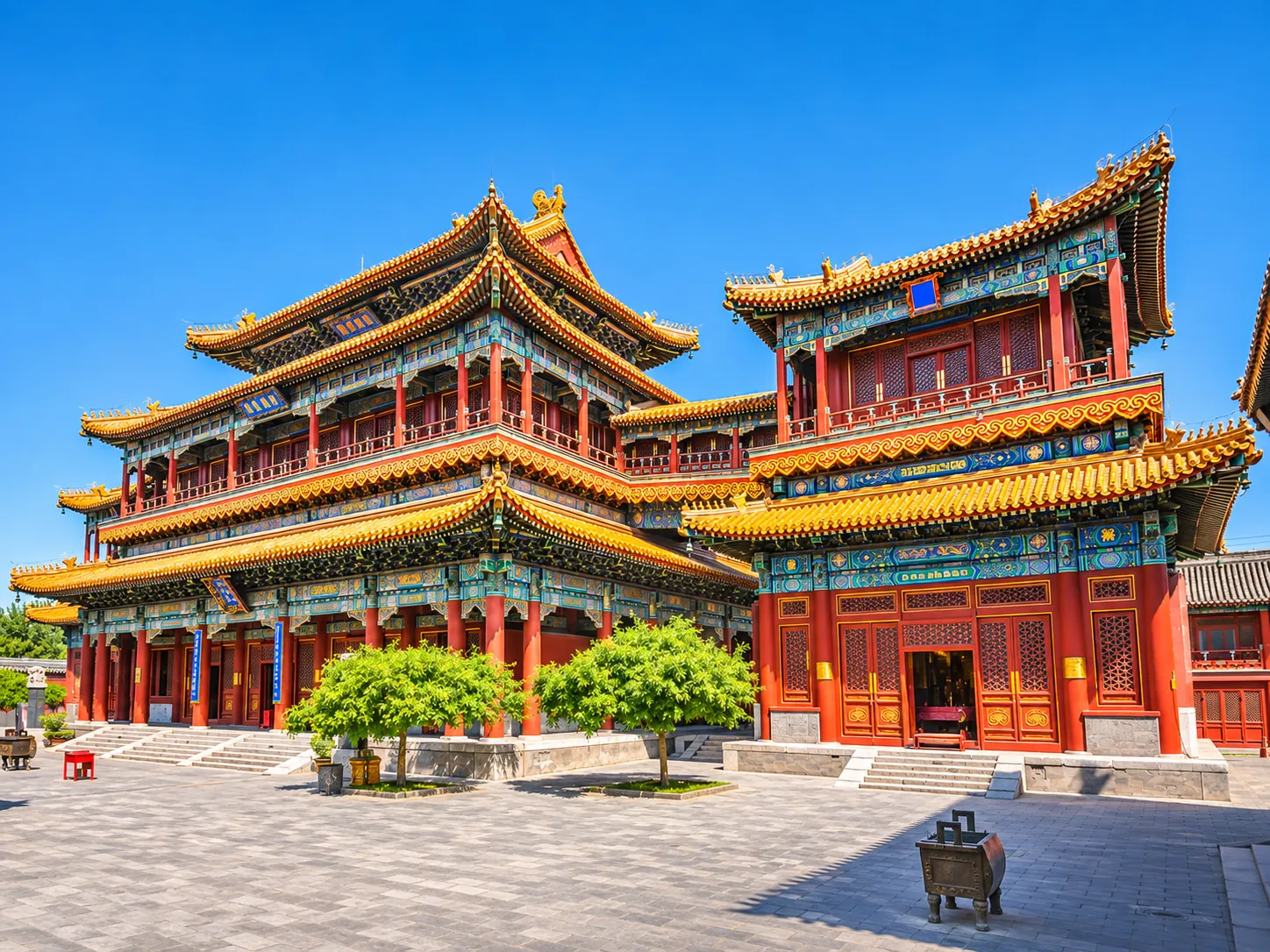
A Palace That Became a Temple
- Location: 12 Yonghegong Street, Dongcheng District, Beijing
- Chinese name: 雍和宫 (Yōnghé Gōng)
- Admission: RMB 25 per adult
- Suggested visit: 1.5–2 hours
- Best for: History, Buddhist art, Qing-dynasty architecture, religious culture, and traditional Beijing neighborhoods
In northeastern Beijing, behind red walls and beneath magnificent golden roofs, stands one of the city's most extraordinary historic complexes.
Yonghegong (雍和宫), commonly known as the Lama Temple, is both a former imperial residence and an active Tibetan Buddhist monastery.
Its story begins in the Qing dynasty, when the site served as the residence of a prince who would later become emperor. Over time, the palace was transformed into a major religious institution, combining the architectural grandeur of the imperial court with the sacred traditions of Tibetan Buddhism.
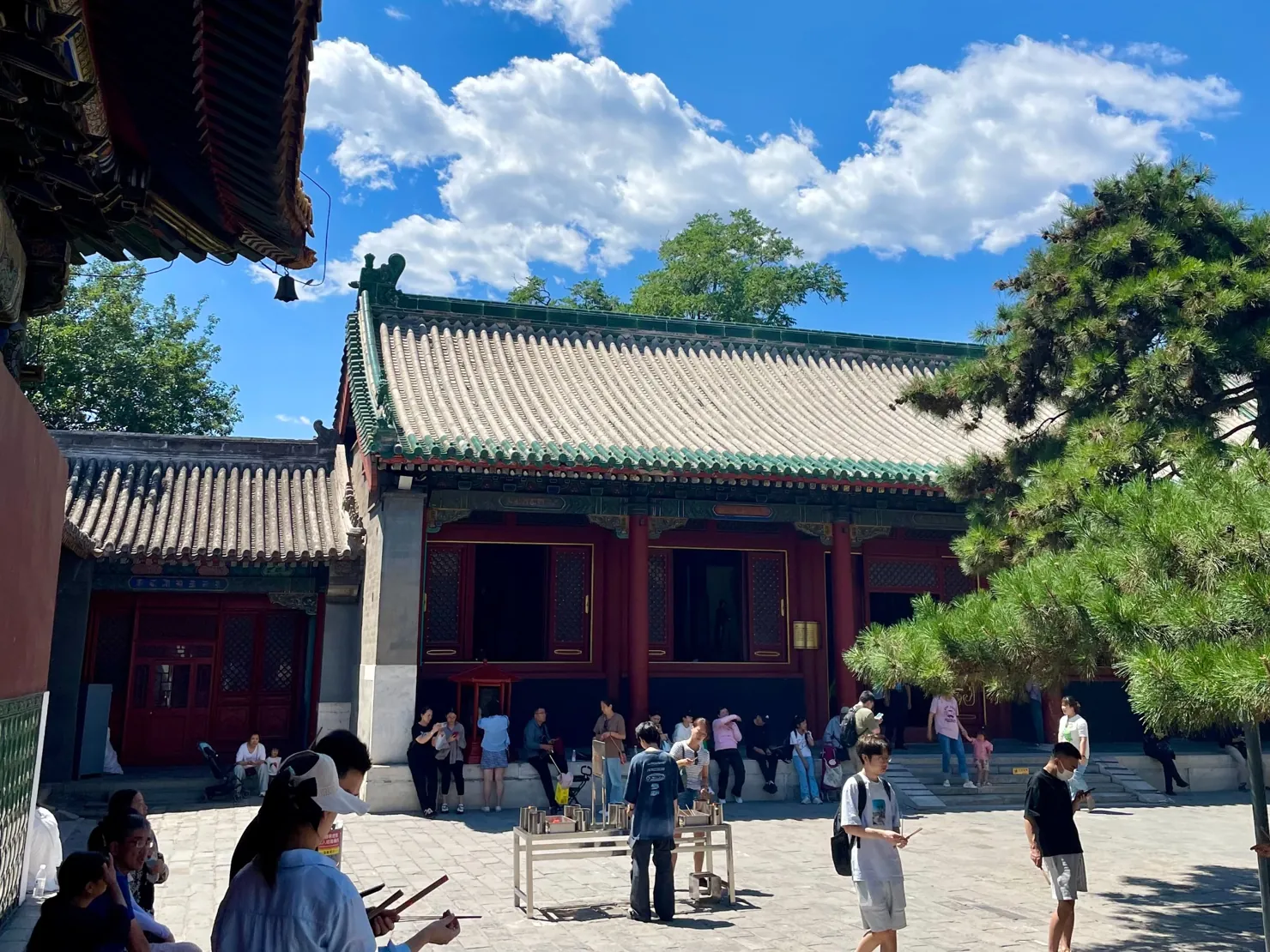
Today, visitors pass through a sequence of ceremonial gates, incense-filled courtyards, and richly decorated halls containing Buddhist sculptures, paintings, and ritual objects.
At the northern end of the complex stands its most celebrated treasure: a towering statue of Maitreya Buddha carved from a single white sandalwood trunk.
Unlike many historic monuments in Beijing, the Lama Temple is not simply a preserved architectural site. It remains a place of worship.
Monks continue religious activities, worshippers offer incense, and visitors encounter a living tradition that connects Beijing with the wider Buddhist world.
For travelers interested in Chinese history, religion, architecture, or art, Yonghegong offers an experience quite different from the Forbidden City or the Temple of Heaven.
1. From Prince's Residence to Imperial Monastery
The Origins of Yonghegong
The complex was established in 1694 during the reign of the Kangxi Emperor.
It originally served as a residence for Yinzhen, the imperial prince who later became the Yongzheng Emperor.
The residence was subsequently known as Yonghe Palace, or the Palace of Harmony and Peace.
When Yongzheng ascended the throne in 1722, the site's imperial importance increased.
His successor, the Qianlong Emperor, was also born here, giving the complex a particularly close connection with the Qing imperial family.
The Transformation of 1744
In 1744, during Qianlong's reign, the complex was formally converted into a Tibetan Buddhist monastery.
This transformation was both religious and political.
The Qing emperors maintained close relationships with Tibetan Buddhist institutions, particularly the Gelug tradition.
Imperial patronage of Tibetan Buddhism formed part of a wider system of religious, cultural, and political relationships linking the Qing court with Tibet, Mongolia, and other Inner Asian regions.
Yonghegong became an important expression of these connections within the imperial capital.
Why the Architecture Looks Imperial
Unlike many temples built specifically for religious use, Yonghegong inherited the layout and architectural vocabulary of a princely residence.
Its buildings are arranged along a formal north–south axis, with successive gates, courtyards, and halls.
Yellow-glazed roof tiles, elaborate painted beams, ceremonial spaces, and carefully organized architectural proportions reflect its imperial origins.
The resulting complex combines palace architecture with Buddhist religious functions.
That combination is one of the principal reasons Yonghegong is architecturally distinctive.
 Click to enlarge
2. Understanding Tibetan Buddhism at Yonghegong
The Lama Temple is associated with the Gelug school of Tibetan Buddhism, one of the major traditions of Tibetan Buddhist practice.
Tibetan Buddhism developed through centuries of interaction between Indian Buddhist teachings, Tibetan religious traditions, monastic institutions, and regional cultures.
Its religious art includes elaborate sculptures, painted images known as *thangkas*, ritual objects, and representations of Buddhas, bodhisattvas, teachers, and protective deities.
At Yonghegong, these traditions are expressed within an architectural setting strongly influenced by the Qing imperial court.
A Meeting of Cultural Traditions
The temple illustrates the close historical relationship between Tibetan Buddhist institutions and the Qing dynasty.
Its architecture and artworks reflect multiple cultural influences, including Han Chinese, Tibetan, Mongolian, and Manchu traditions.
These influences can be seen in religious imagery, inscriptions, decorative motifs, and the arrangement of ceremonial spaces.
For visitors, the temple offers an opportunity to understand a side of Qing history that extends beyond the familiar story of emperors and palaces.
A Living Religious Institution
Yonghegong continues to function as a Buddhist monastery.
Visitors may encounter monks, worshippers, religious ceremonies, and incense offerings.
The atmosphere differs from that of a conventional museum.
Some visitors come primarily for the architecture and art. Others come to pray.
Both activities take place within the same historic environment.
Respecting that shared use is an essential part of visiting the temple.
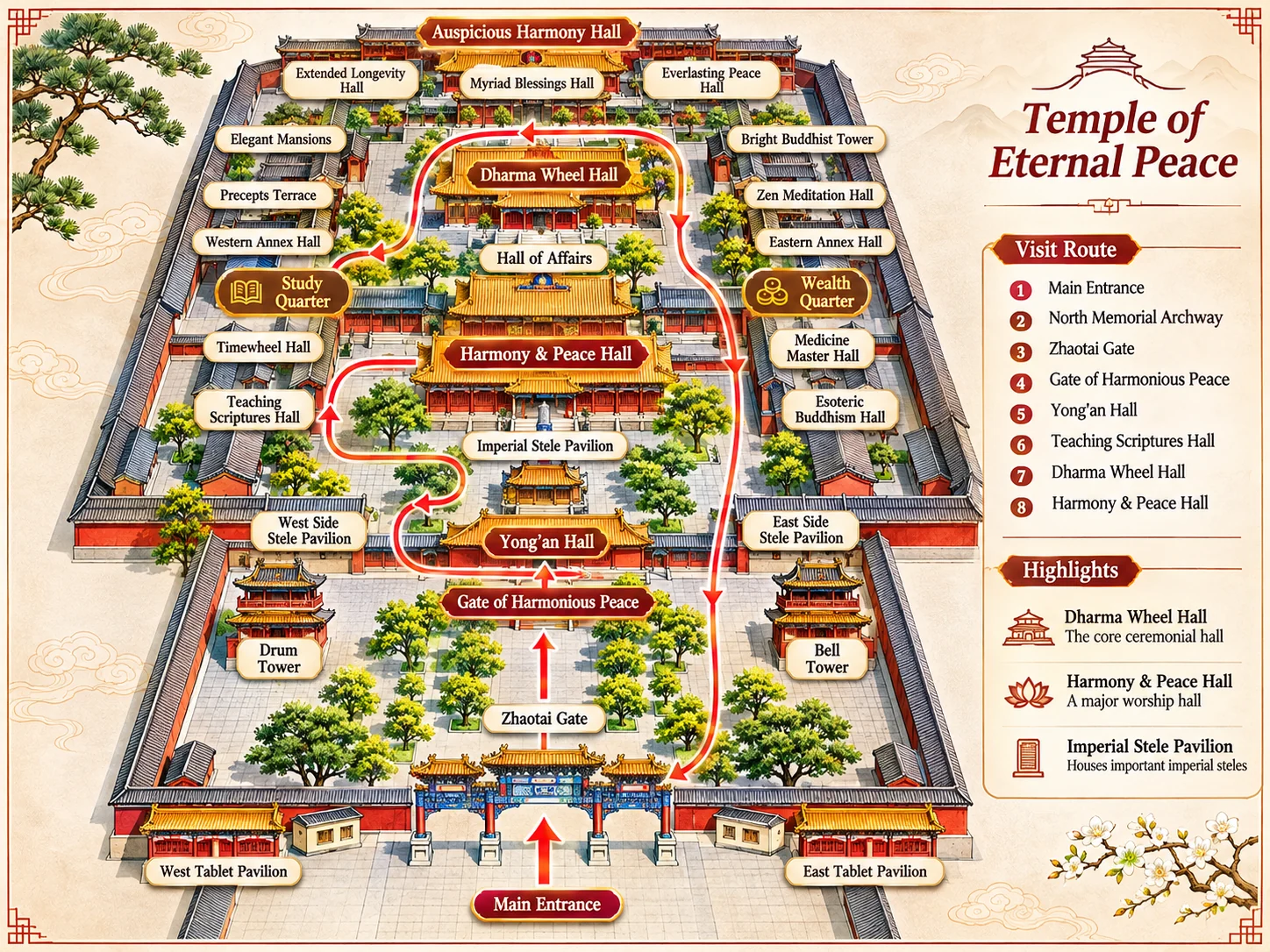
3. The Main Halls: A Walk Through Yonghegong
The Lama Temple is organized along a central north–south axis.
Visitors generally enter from the south and progress through a series of courtyards and increasingly significant religious halls.
Rather than rushing directly to the giant Buddha, allow time to appreciate the architectural progression.
Each hall contributes to the experience.
 Click to enlarge
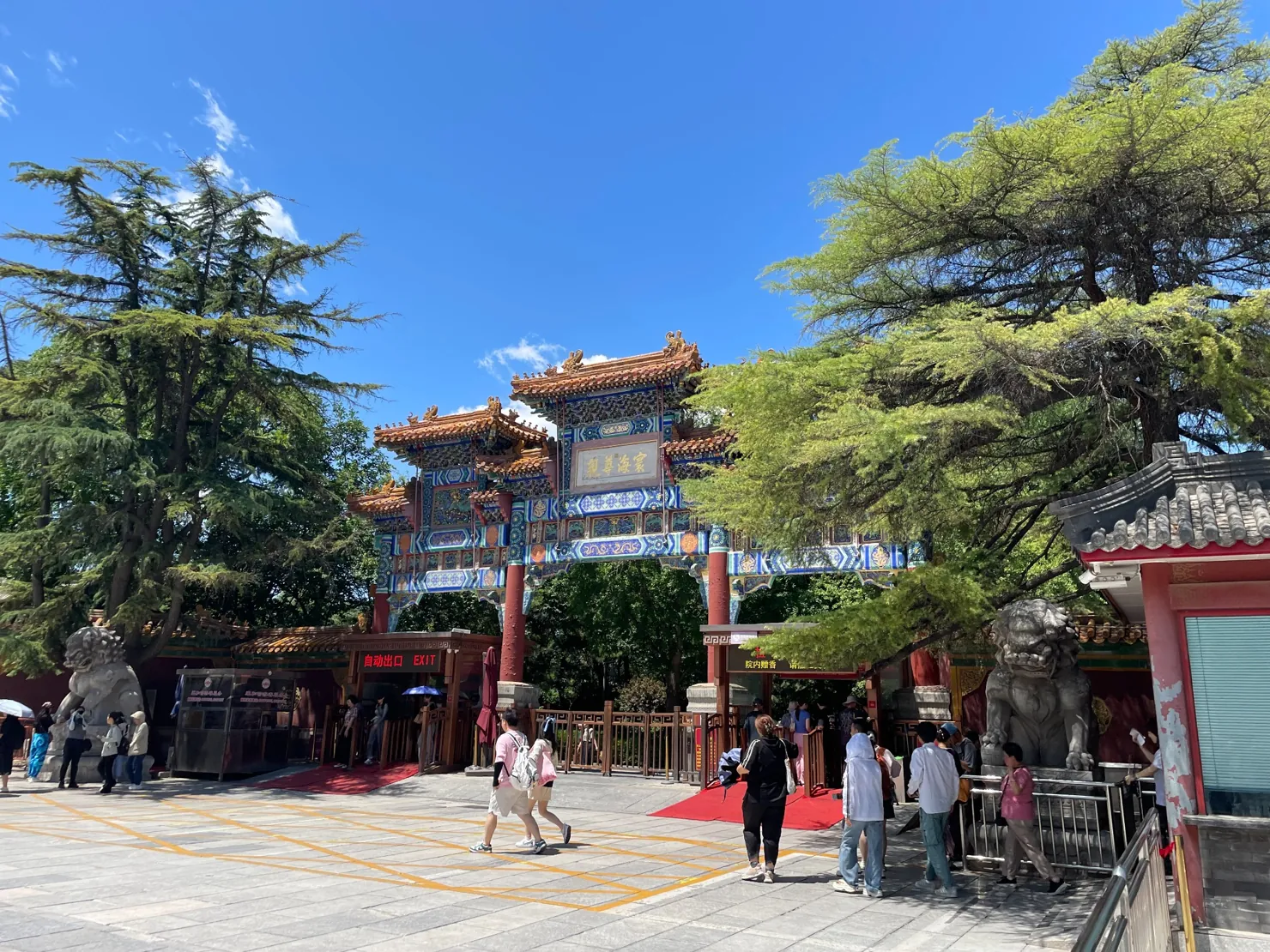
Yonghe Gate Hall
Yonghe Gate Hall (雍和门) introduces visitors to the main religious precinct.
Its traditional timber architecture, decorative roof, and Buddhist imagery establish the character of the complex.
The hall marks the transition from the entrance courtyards into the principal sequence of sacred spaces.
 Click to enlarge
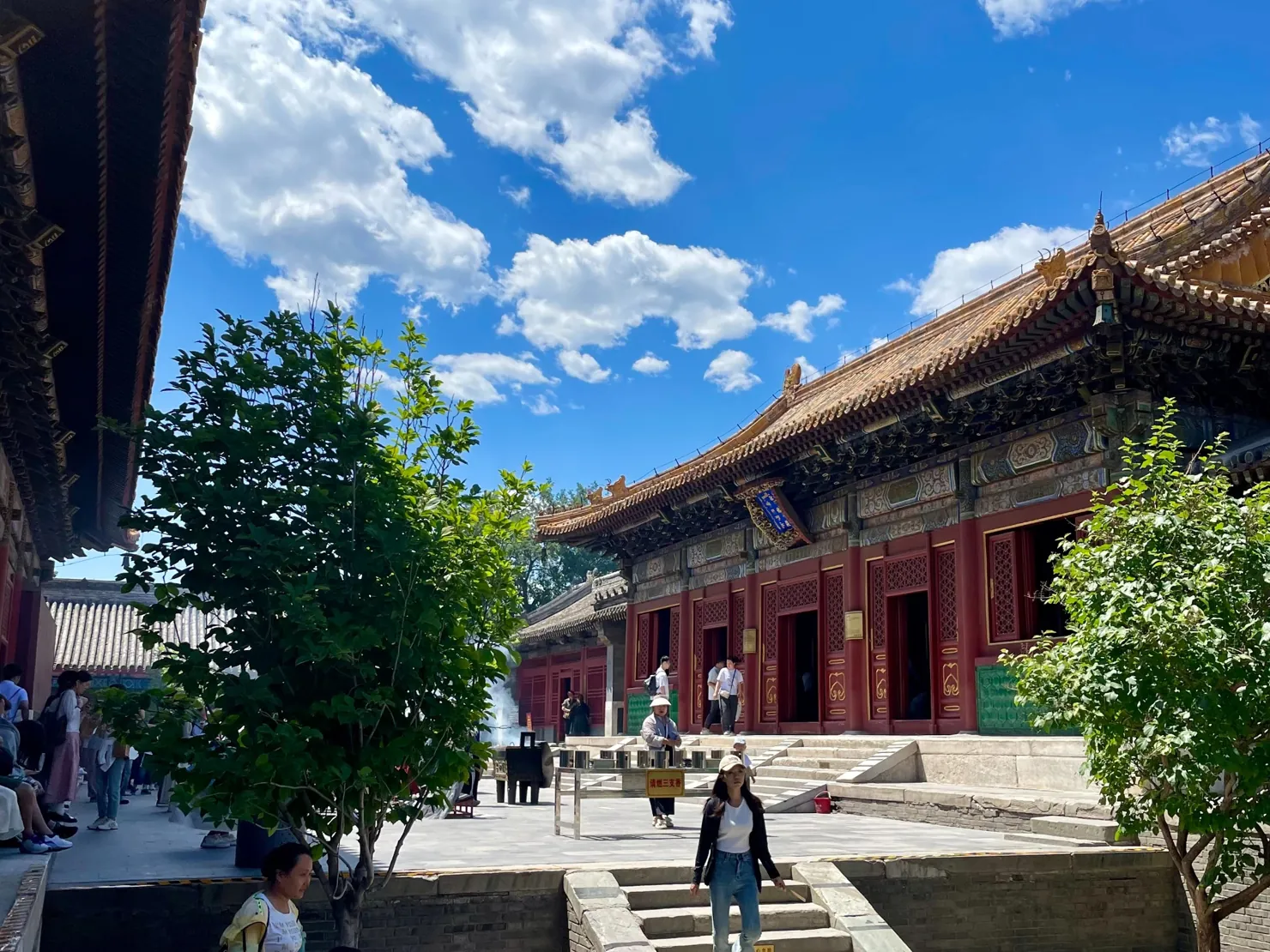
Yonghe Hall
Yonghe Hall (雍和宫大殿) is one of the principal ceremonial buildings.
Its architecture reflects the formal grandeur inherited from the site's imperial past.
Inside, important Buddhist sculptures and religious furnishings occupy the central space.
The hall is particularly valuable for understanding the combination of Qing palace architecture and Tibetan Buddhist worship.
 Click to enlarge
Yongyou Hall
Yongyou Hall (永佑殿) continues the central sequence.
Its name reflects the imperial associations of the complex, while its present religious function illustrates the transformation of the former residence into a monastery.
The hall contains Buddhist images and decorative details that reward careful observation.
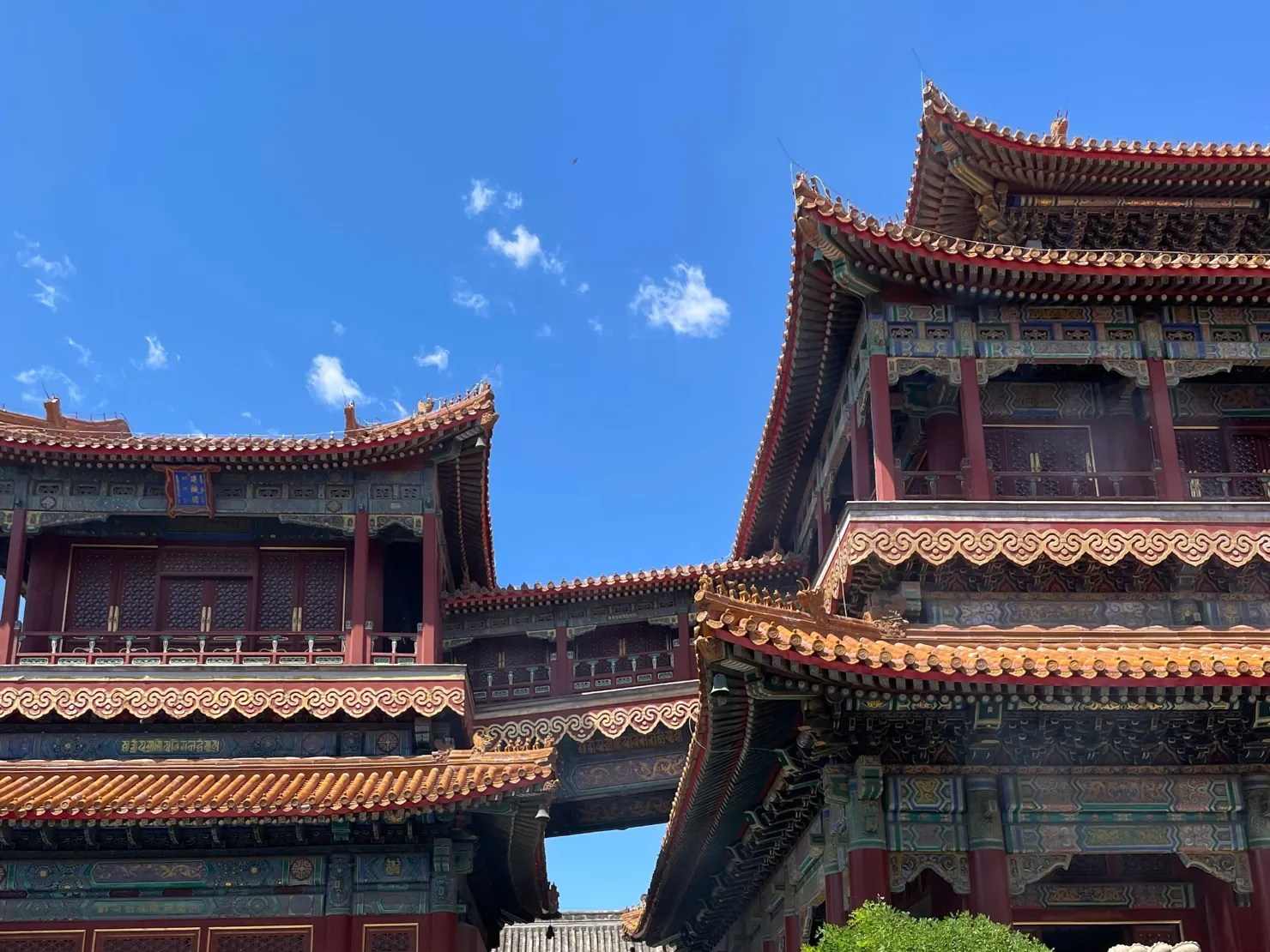
Falun Hall
Falun Hall (法轮殿), or the Hall of the Wheel of Dharma, is among the most distinctive buildings in the complex.
Its architecture incorporates features associated with Tibetan Buddhist religious traditions.
The hall houses an important image of Tsongkhapa, the influential Tibetan Buddhist teacher associated with the founding of the Gelug school.
This makes Falun Hall particularly significant for understanding Yonghegong's religious identity.
 Click to enlarge
Wanfuge: The Pavilion of Ten Thousand Happinesses
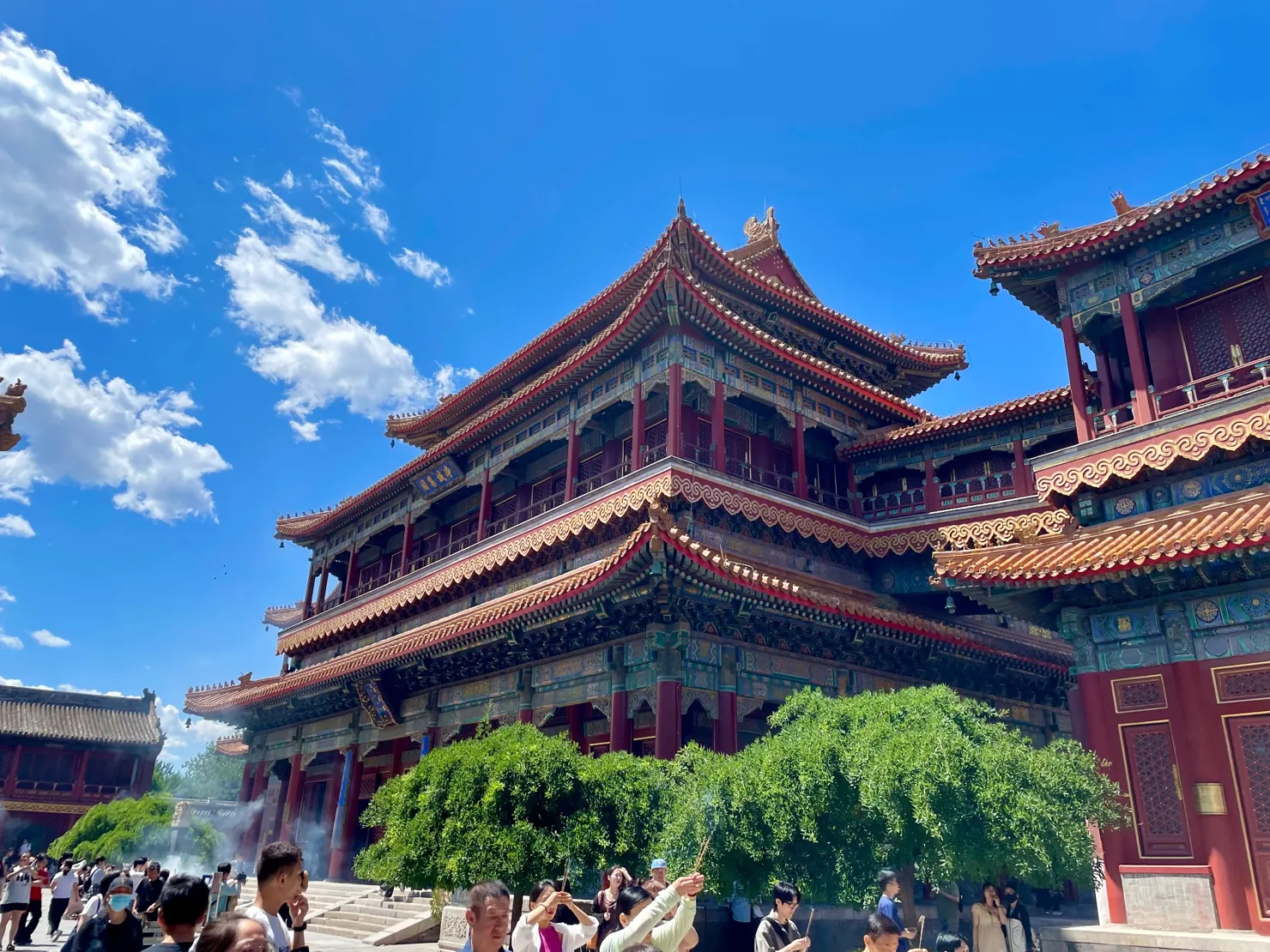
At the northern end of the main axis stands Wanfuge (万福阁), the Pavilion of Ten Thousand Happinesses.
This imposing multi-story structure houses the temple's most famous sculpture: the giant Maitreya Buddha.
The pavilion provides a dramatic architectural conclusion to the sequence of courtyards and halls.
The contrast between the height of the building and the immense sculpture inside creates one of the most memorable interiors in Beijing.
 Click to enlarge
4. The Giant Sandalwood Maitreya Buddha
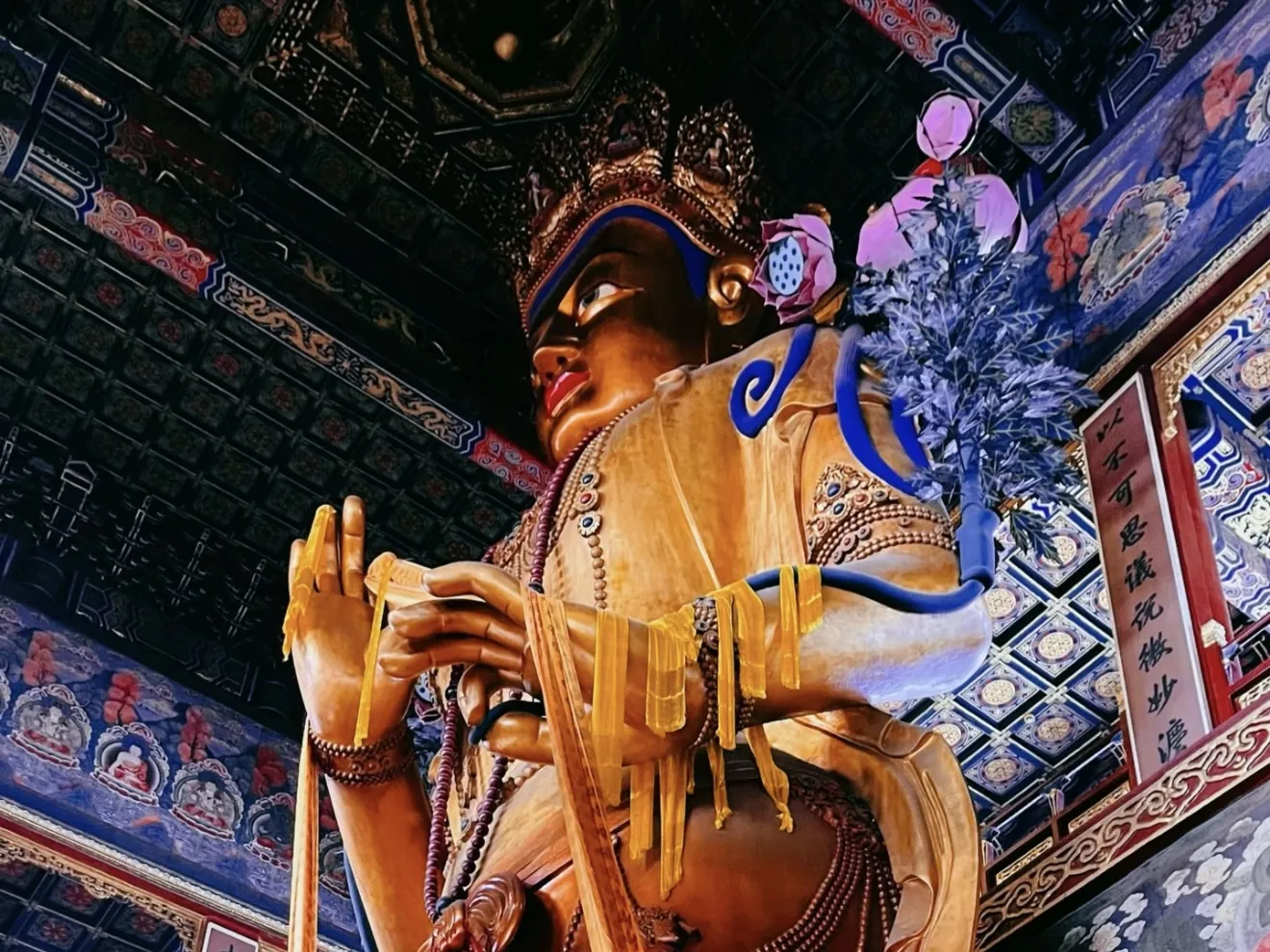
The most celebrated artwork at Yonghegong is the monumental Maitreya Buddha housed inside Wanfuge.
Maitreya is traditionally understood in Buddhism as the future Buddha, associated with a future age in which Buddhist teachings will be renewed.
The statue is carved from a single white sandalwood trunk.
It rises approximately 18 meters above ground, with an additional 8 meters extending below ground, giving a total height of approximately 26 meters.
This distinction is important because visitor guides sometimes give different heights without explaining the difference.
An Extraordinary Feat of Woodcarving
The statue's scale is remarkable.
Carving such a monumental figure from a single trunk required exceptional materials, craftsmanship, and planning.
Its construction also reflects the resources available through imperial patronage and the religious significance attached to the project.
The sculpture is recognized as one of Yonghegong's greatest artistic treasures.
How to Appreciate the Statue
The interior space is designed to emphasize the sculpture's immense vertical scale.
Visitors look upward toward the figure, whose height extends through the pavilion's multi-story interior.
The experience is particularly striking after walking through the lower halls and courtyards of the complex.
Photography inside the religious halls is prohibited, so visitors should appreciate the sculpture without attempting to photograph it.
 Click to enlarge
5. The Three Masterpieces of Woodcarving
Yonghegong is especially celebrated for three major works of Buddhist woodcarving.
The Maitreya Buddha
The monumental white sandalwood Maitreya statue in Wanfuge is the best-known of the three.
Its immense scale and single-trunk construction make it an exceptional example of religious sculpture.
The Five Hundred Arhat Mountain
The Five Hundred Arhat Mountain (五百罗汉山) is a finely carved work made from red sandalwood.
It depicts numerous Buddhist figures arranged within a complex miniature landscape.
The sculpture rewards attention to its extraordinary detail, including individual figures, architectural elements, and layered spatial composition.
The Phoebe Zhennan Buddha Niche
The third masterpiece is an elaborate Buddhist niche carved from *Phoebe zhennan* wood.
Its intricate ornamentation demonstrates the technical refinement of traditional Chinese woodcarving.
Together, these three works illustrate the artistic ambition and religious patronage associated with Yonghegong.
They also provide a useful framework for visitors interested in craftsmanship rather than simply the temple's most famous statue.
6. Incense, Prayer, and Temple Etiquette
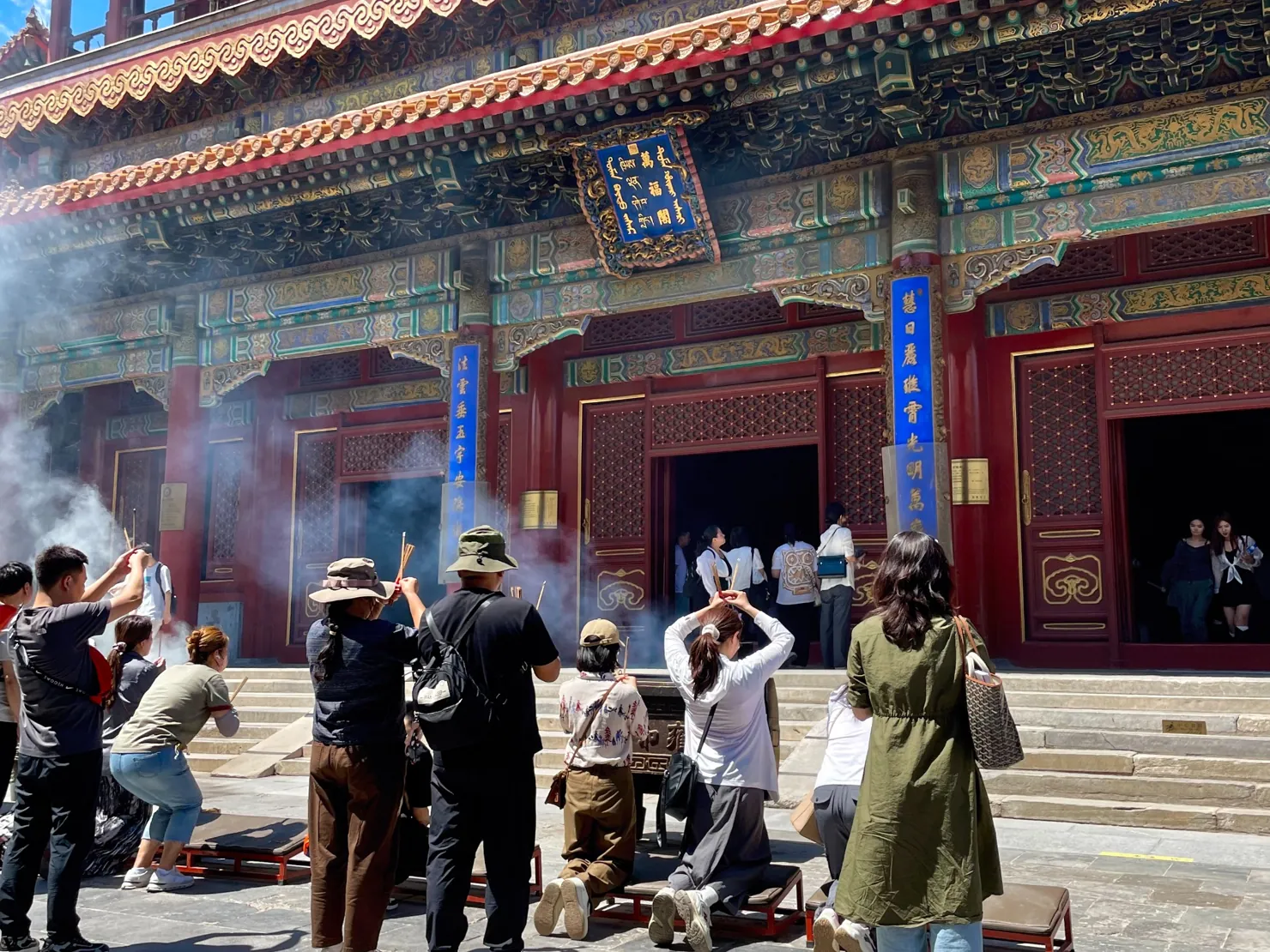
One of the most memorable aspects of visiting the Lama Temple is the atmosphere of its courtyards.
Incense rises from designated burners, worshippers bow before the halls, and the sound of religious activity occasionally carries through the complex.
Because Yonghegong remains an active monastery, visitors should approach it with the same respect they would show at any functioning religious site.
Can Visitors Offer Incense?
Yes. Visitors may participate in permitted incense offerings if they wish.
The temple provides incense for worshippers and visitors, subject to its current arrangements.
There is no requirement to participate.
If you prefer to observe rather than pray, you are welcome to appreciate the architecture and atmosphere respectfully.
Basic Visiting Etiquette
- Speak quietly, especially near people praying.
- Do not photograph or film inside the religious halls.
- Burn incense only in designated outdoor areas.
- Do not touch Buddhist sculptures, paintings, or ritual objects.
- Avoid obstructing worshippers or religious activities.
- Follow posted instructions and staff directions.
- Dress respectfully and move carefully over raised thresholds.
Incense burning may be restricted during strong winds or other safety conditions.
Is Photography Allowed?
Photography is generally possible in permitted outdoor courtyards.
Photography and filming inside the religious halls are prohibited.
Visitors should also avoid photographing worshippers without permission.
The most suitable architectural photographs are usually taken from the open courtyards, where the temple's golden roofs, painted beams, and ceremonial layout can be appreciated without disturbing religious activity.
 Click to enlarge
7. Tickets, Opening Hours, and Reservations
Yonghegong is a ticketed religious and cultural attraction.
The following information reflects the standard arrangements published by Beijing's official tourism authorities in November 2026.
Admission Prices
Adult ticket: RMB 25
Discounted ticket: RMB 12 for eligible visitors
Discount eligibility depends on the visitor category and supporting documents.
Opening Hours
April 1 – October 31
09:00–17:00 Ticket sales and admission end at 16:30.
November 1 – March 31
09:00–16:30 Ticket sales and admission end at 16:00.
Opening arrangements may change during religious festivals, public holidays, severe weather, or special events.
How to Buy Tickets
The temple provides official ticket-purchasing channels.
Visitors can use the temple's authorized on-site ticket facilities or its official WeChat service account, 雍和宫游客信众服务.
The temple states that third-party businesses and individuals are not authorized to resell its admission tickets.
Foreign passport holders should check the current official instructions and bring their passports or other required original identification.
For visitors who do not use WeChat, the staffed ticket facilities may be the simplest option, subject to availability.
A private driver or tour guide does not replace the temple's admission requirements.
See Beijing’s official Lama Temple visitor information for admission prices and seasonal hours.
How Much Time Should You Allow?
Most visitors should allow approximately 1.5–2 hours.
Architecture and Buddhist art enthusiasts may wish to spend longer.
Allow additional time during weekends, holidays, and important religious observances.
8. How to Get to the Lama Temple
The Lama Temple is located at 12 Yonghegong Street in Dongcheng District, northeastern central Beijing.
By Subway
The easiest public transportation option is Yonghegong (Lama Temple) Station, served by Beijing Subway Lines 2 and 5.
Follow signs toward the temple and confirm the pedestrian entrance.
The station is within a short walk of the complex.
By Taxi or DiDi
Use the destination:
Yonghegong / Lama Temple — 雍和宫
The address is:
12 Yonghegong Street, Dongcheng District, Beijing
Vehicles may need to stop at a permitted roadside location rather than directly outside the temple entrance.
By Private Vehicle
A private vehicle is useful when combining the Lama Temple with other Beijing attractions.
However, the temple and its immediate surroundings are best explored on foot.
For a half-day visit focused only on Yonghegong, Guozijian, and Wudaoying, the subway and walking are often sufficient.
9. Best Time to Visit
The Lama Temple is open throughout much of the year, and each season offers a different atmosphere.
Spring
Spring brings comfortable walking conditions and fresh greenery to the courtyards.
It is a good time to combine the temple with nearby historic streets.
Summer
Summer can be hot and busy.
Arriving early helps avoid the warmest part of the day and some of the larger visitor crowds.
Autumn
Autumn is especially attractive for architectural photography.
The golden roofs, red walls, and changing foliage create a distinctive seasonal landscape.
Winter
Winter offers a quieter atmosphere outside major holidays and religious observances.
The contrast between cold air, incense smoke, and the temple's richly colored architecture can be particularly striking.
When Is It Most Crowded?
Weekends, public holidays, Chinese New Year, and important Buddhist observances can attract substantial numbers of worshippers and visitors.
The first and fifteenth days of the lunar month are often particularly popular for prayer.
For a more relaxed architectural visit, a weekday morning is generally preferable.
10. Beyond the Lama Temple: Guozijian, Confucius Temple, and Wudaoying
One of the strongest reasons to visit Yonghegong is its location within a fascinating historic neighborhood.
Several important cultural attractions lie within walking distance.
Together, they provide an unusually concentrated introduction to Beijing's religious, educational, and residential history.
Confucius Temple
The Beijing Confucius Temple (孔庙) was established during the Yuan dynasty.
It became an important site for ceremonies honoring Confucius and the Confucian scholarly tradition.
Its architecture includes traditional ceremonial halls, courtyards, and historic stone inscriptions.
Visiting it after Yonghegong provides a valuable contrast between Buddhist religious institutions and the Confucian traditions associated with imperial education and state ritual.
Imperial College
The Imperial College, or Guozijian (国子监), was the highest state educational institution in imperial China.
Its Beijing complex preserves buildings and ceremonial spaces associated with the education of officials and scholars.
The nearby Confucius Temple and Imperial College are commonly visited together.
Guozijian Street
Guozijian Street (国子监街) is one of Beijing's most attractive historic streets.
Traditional archways, courtyard walls, old trees, and scholarly associations give it a distinctive character.
The street provides a pleasant transition between the major historic sites.
Wudaoying Hutong
Wudaoying Hutong (五道营胡同) is a traditional lane known today for its mixture of residential architecture, cafés, small restaurants, and independent shops.
Unlike the ceremonial architecture of Yonghegong and Guozijian, Wudaoying reveals a more intimate neighborhood environment.
It is an ideal place to finish a cultural walk with tea, coffee, or lunch.
The street's appeal lies in the combination of historic urban fabric and contemporary everyday life.
11. A Half-Day Lama Temple Walking Route
Duration: Approximately 3.5–4.5 hours Walking style: Self-guided cultural exploration Starting point: Lama Temple Finishing point: Wudaoying Hutong
9:00 AM — Lama Temple
Begin when the temple opens.
Spend approximately 90 minutes to two hours exploring its main courtyards, religious halls, and monumental sculptures.
Follow the south-to-north sequence and allow time to appreciate the architecture.
11:00 AM — Confucius Temple and Imperial College
Continue to the nearby Confucius Temple and Imperial College.
Allow approximately 60–90 minutes to explore the ceremonial buildings, historical exhibits, and educational heritage.
Check the museums' current opening schedule before visiting.
12:15 PM — Guozijian Street
Walk along Guozijian Street.
Observe the traditional archways, historic buildings, and quieter residential surroundings.
12:45 PM — Wudaoying Hutong
Finish with a walk through Wudaoying Hutong.
Explore its shops and cafés, or stop for lunch.
This route combines religious history, imperial education, architecture, and contemporary neighborhood life without requiring long transfers.
12. Combining the Lama Temple With Other Beijing Attractions
Lama Temple and the Drum and Bell Towers
The Drum and Bell Towers are another important part of Beijing's historic urban landscape.
Combining them with Yonghegong provides an opportunity to explore the city's religious architecture, traditional timekeeping system, and nearby hutong neighborhoods.
Lama Temple and Nanluoguxiang
Nanluoguxiang is one of Beijing's best-known historic hutong streets.
The surrounding lanes retain elements of the traditional residential street network.
This combination is suitable for visitors interested in both monumental architecture and everyday neighborhood life.
Lama Temple and Shichahai
Shichahai is a historic lakeside district known for Houhai, Qianhai, Silver Ingot Bridge, and traditional hutongs.
Combining the temple with Shichahai creates a longer cultural itinerary connecting Buddhist heritage with Beijing's historic residential and waterfront landscapes.
Lama Temple and the Temple of Heaven
Both are major religious and ceremonial landmarks, but they served very different purposes.
The Lama Temple is an active Tibetan Buddhist monastery with Qing imperial connections.
The Temple of Heaven was a ceremonial complex where emperors performed rituals associated with heaven and the agricultural calendar.
Together, they illustrate the diversity of religious and ceremonial traditions in imperial Beijing.
13. Why the Lama Temple Matters
Yonghegong tells a story that extends beyond any single building or sculpture.
Its origins as a princely residence connect it with the Qing imperial family.
Its conversion into a Tibetan Buddhist monastery reveals the religious and political relationships that shaped the Qing empire.
Its architecture combines imperial Chinese building traditions with Buddhist religious functions.
Its sculptures demonstrate extraordinary craftsmanship and the artistic resources available through imperial patronage.
And its continued use as a monastery preserves a living connection with centuries of religious practice.
For visitors, this combination makes the Lama Temple especially meaningful.
It is neither simply a palace nor simply a museum.
It is a place where imperial history, Buddhist art, architecture, and contemporary religious life remain closely connected.
14. Explore Beijing's Cultural Heritage With DragonTrail
The Lama Temple is easy to visit independently, especially when combined with the nearby Confucius Temple, Imperial College, and Wudaoying Hutong.
For travelers planning a wider Beijing itinerary, DragonTrail can help arrange private sightseeing days that include Yonghegong alongside other historic and cultural landmarks.
A private day might combine the Lama Temple with the Drum and Bell Towers, Shichahai, or other selected neighborhoods.
For longer stays, Yonghegong can form part of a two- to five-day Beijing itinerary covering the Forbidden City, Temple of Heaven, Summer Palace, Great Wall, and traditional hutongs.
Explore: Private Beijing Day Tours and Multi-Day Itineraries https://dragontrail.cc/tours/beijing/private-tour-quote
Planning a journey across several Chinese cities? https://dragontrail.cc/tours/private-china-tours
Frequently Asked Questions
- The Lama Temple is famous for its Qing imperial origins, Tibetan Buddhist architecture, active religious traditions, and monumental Maitreya Buddha carved from a single white sandalwood trunk.
- Yes. It is particularly rewarding for visitors interested in Qing history, Buddhist art, religious culture, and traditional architecture. Its location also makes it easy to combine with several nearby historic attractions.
- Standard adult admission is RMB 25. Eligible discounted admission is RMB 12, subject to the temple's current rules and documentation requirements.
- From April through October, the standard hours are 09:00–17:00, with admission ending at 16:30. From November through March, the standard hours are 09:00–16:30, with admission ending at 16:00.
- The temple provides official online and on-site ticket channels. Check the current arrangements before visiting, especially during holidays or important religious observances.
- Yes. International visitors can visit the temple, subject to normal admission procedures. Bring your passport and follow the current official ticket instructions.
- Yes. Yonghegong remains an active Tibetan Buddhist monastery, and religious activities continue alongside public visiting.
- Yes, in designated areas and according to the temple's rules. Participation is optional, and incense burning may be restricted under certain weather or safety conditions.
- Photography is generally permitted in designated outdoor areas, but photography and filming inside the religious halls are prohibited.
- The Maitreya Buddha rises approximately 18 meters above ground, with another 8 meters below ground, giving a total height of approximately 26 meters.
- Most visitors should allow 1.5–2 hours. A half-day itinerary can include the Confucius Temple, Imperial College, and Wudaoying Hutong.
- Yonghegong (Lama Temple) Station, served by Lines 2 and 5, is the most convenient station.
- Nearby attractions include the Beijing Confucius Temple, Imperial College, Guozijian Street, Wudaoying Hutong, Drum and Bell Towers, and Nanluoguxiang.
- No. The Lama Temple is a Tibetan Buddhist monastery with Qing imperial origins. The Temple of Heaven is an imperial ceremonial complex historically used for rituals associated with heaven and agricultural prosperity.