
Suzhou at a glance
| Detail | Plan |
|---|---|
| Good first stay | 2 nights for gardens and Pingjiang |
| Add one excursion | A third night for Tongli or the west side |
| From Shanghai | About 25–35 minutes to Suzhou Station |
| On to Hangzhou | About 1.5–2 hours to Hangzhou East |
| Walk | North gardens, south gardens, and Pingjiang |
| Take a car | Water towns, Tiger Hill, and luggage |
Tongli, Zhouzhuang, and Luzhi sit outside Suzhou’s old city wall. Each is a canal town in its own right, with bridges, white houses, and a visitor route through lanes that used to be ordinary streets. None of them is a neighborhood you wander into after Humble Administrator’s Garden. The old city already has canals. Pingjiang Road is the canal walk inside the walls. A water town is a separate journey, and it deserves a day that does not also try to be a garden morning.

Choose one town. Tongli is the calmer choice for a half day or a night. Zhouzhuang, in Kunshan, is the famous one and the crowded one. Luzhi is smaller. The ride out and the ride back are the long transfer of that day. Everything else on the list waits.
What these towns are, and what they are not
A water town visit is a walk through a preserved settlement: stone bridges, houses built to the water, a few larger residences and gardens open to visitors, and a commercial lane that grows louder as you approach the most photographed corner. You are not touring a single monument with a gate and a sequence of halls. You are circulating. The skill is knowing when you have seen the idea and when you are only repeating it in a denser crowd.
This is why the towns feel related to Suzhou and still distinct from it. Suzhou’s classical gardens are designed sequences, tight and authored. Pingjiang is one strong lane inside a living city, with the modern streets a block away. A water town is a whole small world of lanes, which is the pleasure and the risk. The pleasure is immersion. The risk is sameness, especially if you try to collect two towns as if they were two gardens with different names.
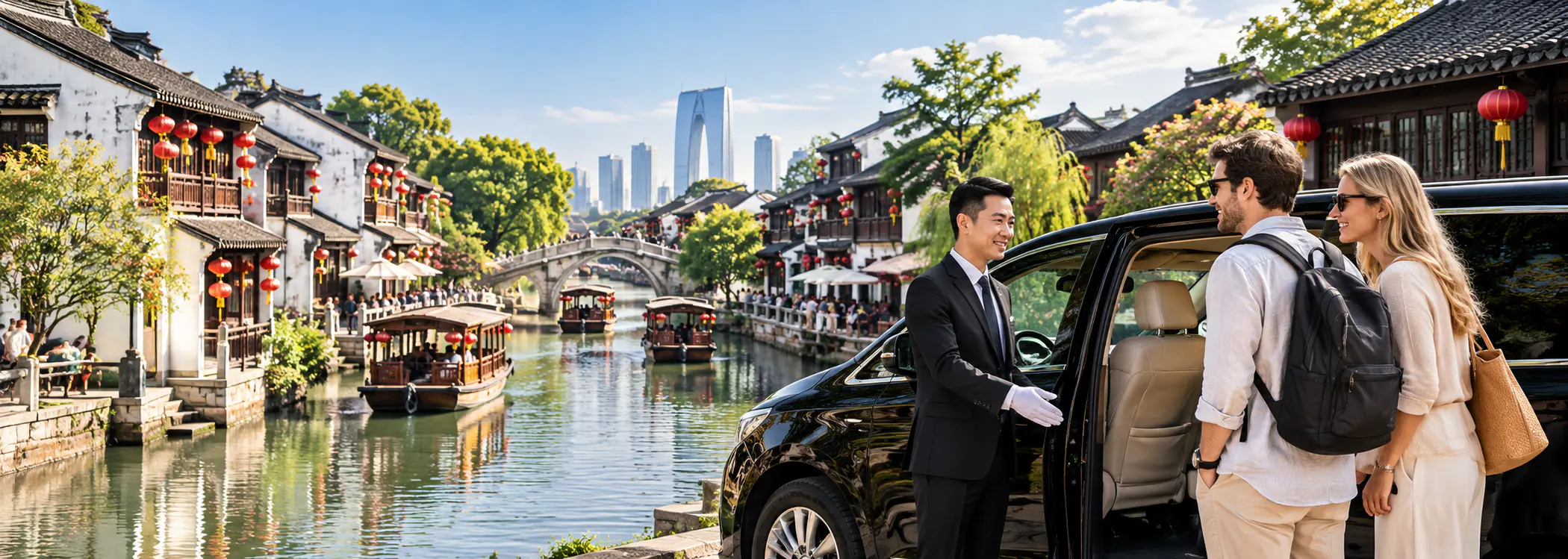
None of the three sits inside the moat. You will not reach them by strolling from the Master of the Nets, and the metro, useful inside Suzhou, does not replace the ride. A car is the straightforward way to do a half day and still be back for dinner, because the vehicle waits and the return is a decision rather than a search. Taxis out and back can work for confident travelers. Tour buses work for people who are happy with a fixed window. However you go, leave after breakfast, arrive late morning, and protect the return.
The towns are also not a substitute for the gardens. Someone who skips Humble Administrator’s Garden in order to spend the only day in Zhouzhuang has chosen a famous canal scene and missed the thing Suzhou does better than almost anywhere. Someone who skips every town in order to stay with the gardens has missed nothing essential to the classical city. The town is an extra with a strong character. It is optional in a way the north-central garden morning is not.
Tongli, for a half day or a night
Tongli is the town we suggest first when someone wants canals beyond the old city and would rather not spend the visit inside a crowd. It is still a visitor town, with shops and boats and a route that funnels people toward the prettier bridges. On a weekday outside the big holidays it has room to walk. On a Saturday in October it is busy and still usually kinder than Zhouzhuang at the same hour. Come expecting a walked village, not a secret.
A half day is the standard shape. Leave the old-city hotel after breakfast. The ride is often on the order of forty minutes to a little over an hour, depending on where you slept and on traffic, and weekends stretch it. Arrive late morning, before you are hungry and after the earliest rush has sorted itself. Walk the main canals, then deliberately step toward an edge. The edge is where Tongli remembers it is a town. Sit down for lunch rather than grazing the whole way, or you will finish the lanes and still feel you never stopped.
Retreat & Reflection belongs in the middle of this visit, not as a separate expedition and not as a glimpse. It is a classical garden in Tongli, not inside Suzhou’s old walls, and it is one of the best reasons to choose this town over a vaguer canal stroll. Plan on forty-five to seventy-five minutes. The garden is smaller and more domestic than Humble Administrator’s, with water close by, and it resets the day from shopping lanes to composed views. See it when you still have attention. Then walk a little more and leave.
If you stay the night, the town changes after the day visitors go. The lanes darken, the selling slows, and the morning before you depart is the quiet version of the place. That night is worth it on a trip of three days or more, when you can spare an old-city evening. It is a poor trade on a two-day first visit, because you would be giving up Pingjiang in Suzhou for a second canal atmosphere. Sleep in Tongli when the quiet is the point. Sleep in Suzhou when the gardens are.
Zhouzhuang, famous and crowded
Zhouzhuang is the name people recognize, and the recognition is the problem as well as the draw. The town is in Kunshan, east of Suzhou’s old city, and the ride is commonly longer than the hop to Tongli, often around an hour to an hour and a half, again depending on traffic and the exact start. You come for the classic double-bridge views and the dense canal scenery that has been in pictures for years. Those views exist. They exist in company.
Arrive as early as the day allows. The central bridges and the main lane are the congestion points, and they get harder as tour groups settle in. See the famous corner first, while you can still stand still, then walk outward. Zhouzhuang has edges, and the edges are how a crowded town becomes a place again. If you only circulate in the core, you will remember shoulders and snacks. If you give it a full unhurried day and accept the fame, you can still have a good visit. What you cannot do is arrive at two in the afternoon after a garden in Suzhou and expect the picture you were sold.
Boats are part of the offer. A short ride shows you the waterline of the houses and removes you from the lane for a few minutes. Take it if the group wants to sit, and skip it if the queue is the main feature. Check what is running rather than assuming a particular route, and do not let the boat become the reason you never walk the quieter streets. The town is a walking town that happens to have boats.
Zhouzhuang is the right choice for someone who wants the most famous water town and does not mind a crowd, or for someone revisiting the region who has a specific reason to see this one. It is the wrong choice for someone who chose Suzhou in search of quiet courtyards and then added the town because a list said to. That traveler will be happier in Tongli, or happier with no town at all and a third morning in a garden. On National Day, Labor Day, and Qingming, the advice tilts further. If the holiday is fixed and the town is optional, keep the old city.
Luzhi, the smaller visit
Luzhi is the town people skip because they have not seen it in a headline, which is part of its appeal and part of its limit. It is smaller. A half day is enough, and a full day can feel like you are waiting for a monument that is not coming. The ride from many old-city hotels is usually the shortest of the three, though traffic still deserves a margin. You walk canals, bridges, and a compact set of lanes, and then you are done. Done, here, is a success.
Choose Luzhi if the group wants a water town at a modest scale, if Zhouzhuang’s fame sounds like a warning, or if someone has already done the famous town on another trip and wants a different walk rather than a repeat. Choose it if mobility is a concern and a shorter outing is the humane excursion. Do not choose it as the thing you “might as well add” after Tongli. The towns are too alike to be a pair in one day, and Luzhi’s smallness is not a coupon for a second stop.
Luzhi also does not contain Retreat & Reflection. If the classical garden inside a water town is the reason you are leaving Suzhou, you want Tongli. If a pagoda and a hill are the reason, you want the west side of Suzhou, not a canal town at all. Luzhi is for the lanes themselves. Judge it by that standard and it is a pleasant half day. Judge it by Zhouzhuang’s reputation and it will seem to be missing a climax. It is not missing one. It is a different size.
Shops and snacks are present and less relentless than in the famous core of Zhouzhuang. Eat a simple lunch and go back. There is no prize for staying until the light fails. An early return gives you an old-city evening, which on a three-day trip may be the second night on Pingjiang, a better use of dusk than a gift shop at the edge of a small town.
How to choose
| Choice | Fit | Skip when |
|---|---|---|
| Make this the focus | When this page is the reason for the day | When it is only a name on a list |
| Pair it | With one nearby stop | With a second full excursion |
| Leave it | If the main stay is already full | If you have the night it needs |
Retreat & Reflection, kept inside Tongli
Retreat & Reflection, Tuisi Yuan, is the garden that confuses the geography. It belongs to the family of classical gardens associated with Suzhou, and it stands in Tongli. Visitors who try to fold it into a morning that started at Suzhou Museum create a day of riding. Visitors who enter it as a chapter of a Tongli walk understand it immediately. The garden is close to water, residential in scale, and best seen when you can be unhurried.
Give it a real slot in the middle of the town visit. Forty-five minutes is a look. Seventy-five is a visit. You do not need the two-hour span you gave Humble Administrator’s Garden, and you do need more than a photograph of the first pond. Check the current opening arrangement when you plan the day, so the town walk and the garden hour agree. If the garden’s hours are shorter than you hoped, see it first and take the lanes after, rather than discovering the gate at the end of a long lunch.
Do not come to Tongli only for ten minutes in the garden and a turnaround. The garden is better because of the town around it, and the town is better because the garden gives the day a composed center. That combination is the argument for Tongli over a vaguer “canals nearby” plan. Zhouzhuang has its own houses and museums and does not need this garden to justify a visit. Luzhi does not offer this garden as a consolation prize. The pairing is specific: Tongli plus Retreat & Reflection, one day, then home.
On a second trip to the region, this garden can be the reason you return to Tongli even if you feel you have “done” water towns. Seen in a quieter month, or early, it carries the same ideas as the old-city gardens at a scale that a half day can hold. Seen as the fourth gate after two Suzhou gardens and a rushed arrival, it is just another ticket. Spare it that.
A half day, a full day, or the night
The half day is the default, and it has a clock. Breakfast in Suzhou, on the road by about nine, in the town late morning, walking and sitting through the middle of the day, on the road back by mid-afternoon, in the old city for a normal dinner. Tongli and Luzhi fit this clock easily. Zhouzhuang fits it if you accept a slightly longer ride and a more focused walk, and it is happier as a full day when the crowd means you need the early start and the outward loop.
A full day in one town means a slower lunch, a second walk on a different edge, and a return that still gets you to dinner without a heroic timeline. It does not mean a second town in the remaining hours. The full day is how Zhouzhuang becomes tolerable, and how Tongli becomes luxurious. It is also how a three-day Suzhou trip spends its extra day completely. When you return, the evening is light. You have already done the excursion. A garden at dusk is not required to justify the sofa.
The night is a different product. You arrive in the afternoon, walk while the day visitors are still there, eat after they leave, and walk again when the lanes are mostly residents and overnight guests. The next morning is the best hour, and then you return to Suzhou or continue toward your next city. This is worth packing a small bag for. It is not worth dragging the whole party’s luggage through a pedestrian lane if the hotel transfer is awkward. Ask where the car can stop, and walk the last stretch with only what you need.
In summer, bias toward the earlier arrival and the longer sit. In winter, a half day is usually enough, and the pleasure is emptiness rather than foliage. In the holiday weeks, either go very early or save the town for another year. Rain shortens the walk and does not cancel it. Wet stone on a bridge is a reason to slow down, not a reason to add a second destination while you are already out.
Why two towns in one day does not work
Two water towns in one day look efficient on a map and feel repetitive on the ground. You spend the first town watching the clock, eat badly or not at all, ride to the second town, and arrive for its most crowded hours with the least patience. The bridges start to blur. The group starts to negotiate. By the time you are back in Suzhou, you have used the long transfer twice and enjoyed neither walk.
The likeness is the deeper reason. Tongli, Zhouzhuang, and Luzhi are variations on canals, white walls, stone bridges, and visitor lanes. A classical garden and a canal town are different kinds of attention, which is why a trip can hold both on different days. Two canal towns are the same kind of attention, and the second one has to be extraordinary to justify the fatigue. On an ordinary day it is not. It is a second set of bridges.
There is a version of the region, spread over many days, in which a person sees more than one town and is glad of the comparison. That version has a night between them, or a full day each, and it is a water-town journey rather than a Suzhou garden journey with a side trip. If that is your trip, say so, and build it honestly. If your trip is Suzhou for two or three days, one town is the whole allowance. The itinerary keeps the third day singular for this reason.
People still ask for Zhouzhuang plus Tongli because both names are famous and the car is already hired. The car can wait at one town as easily as it can rush between two. Use the waiting. Sit longer. Walk the edge you would otherwise skip. Return in daylight, or in a calm early evening, and keep Pingjiang for a different night so the canals do not become the only Suzhou you remember.
How the town sits beside the gardens
Put the gardens on their own mornings. The north-central walk, Humble Administrator’s Garden and the museum and perhaps Lion Grove, is a day with Pingjiang afterward. The south gardens are another morning. The water town replaces one of those patterns for a single date. It does not attach to them. A west day of Lingering Garden and Tiger Hill is the rival extra, not a companion. Choose the town or the west side when you have three days. Choose the gardens and Pingjiang when you have two. The classical gardens page will still be there if the town is what you postpone.
A practical three-day order is north and Pingjiang, then south, then Tongli. Another is north and Pingjiang, then Tongli, then south, if the weather forecast begs you to take the outdoor town day while the sky is clear. The west side can replace Tongli and should not join it. A one-day visitor from Shanghai should not add a town at all. The sampler is the garden and the lane, and the town would delete one of them.
If someone in the group has already decided that Zhouzhuang is the emotional point of the journey, believe them and give it the day, early, with the gardens arranged around it rather than against it. A morning in Suzhou the day before and a morning in Suzhou the day after will hold the classical city. The town day stays whole. That is a happier compromise than a little of everything on all three dates.
Luggage and hotel nights follow the same singular logic. Most people should keep one hotel in the old city and make the town a day trip. Overnight in Tongli is the exception, chosen on purpose. A different hotel every night, old city then town then Hangzhou, is a lot of bags for a short trip. Do it when the night in Tongli is truly wanted. Otherwise return, sleep where your next morning garden is an easy hop, and let the town be a day you remember as a day.
The right town is the one you can describe without reference to the one you are skipping. Tongli for calm and for Retreat & Reflection. Zhouzhuang for the famous picture, with eyes open about the crowd. Luzhi for a smaller half day. One of those sentences is enough to build the date. The other towns can wait for a later year, which is a better fate than a blurred afternoon.
Ways to plan the days
These shapes match the Suzhou tours page. They are starting points, not fixed departures.
Suzhou Essence
Time fit: 2 days
Gardens and Pingjiang, with a night in the old city.
- Suzhou
- Suzhou Essence
Why choose it: Gardens and Pingjiang, with a night in the old city.
Classical Suzhou
Time fit: 3 days
Gardens, Pingjiang, and one water town.
- Suzhou
- Classical Suzhou
Why choose it: Gardens, Pingjiang, and one water town.
Suzhou and Hangzhou
Time fit: 4–5 days
Two nights in each city, with the train kept to one day.
- Suzhou
- Suzhou and Hangzhou
Why choose it: Two nights in each city, with the train kept to one day.
Want help shaping the Suzhou days?
Tell us your dates and whether Tongli or Hangzhou belongs in the same trip. We reply with a garden-and-canal plan, with a car only on the days that leave the old city.
Keep planning
Suzhou
How to pair Humble Administrator’s Garden, the museum, Lion Grove, and the south gardens without rushing the west side.
Walk Pingjiang for the canal lane, and treat Shantang as the longer, more rebuilt street — not the same hour.
Late spring and autumn suit the gardens. Summer is humid, winter is quiet, and holiday weeks fill the famous gates.
A one-day sampler from Shanghai, a two-day garden stay, and a three-day plan that adds one water town or the west side.
Compare a 2-day garden stay, a 3-day water-town add-on, and a 4–5 day Suzhou and Hangzhou trip.
Questions people ask
- Choose Tongli if you want the calmer half day or a quiet night, and if you want Retreat & Reflection as part of the walk. Choose Zhouzhuang, in Kunshan, if the famous canal scenery is the point and you are willing to go early and accept crowds at the central bridges. Choose Luzhi if you want the smallest scale and a shorter visit that still feels like a canal town. All three sit outside the old city wall. None of them replaces Pingjiang Road, which is the canal lane inside Suzhou. On a first trip of two or three days, one town is plenty. If crowds bother you more than missing a famous name, Tongli is the one to book, on a weekday if your dates allow.
- You can reach two, and the day will feel like a transfer with walks attached. Tongli, Zhouzhuang, and Luzhi resemble one another: bridges, white walls, visitor lanes, and a busier core. Seeing both means watching the clock in the first and arriving tired at the second, often at its most crowded hour. The ride between them spends the energy the lanes were meant to use. Give one town the late morning through the mid-afternoon, eat there, and return to Suzhou. If you are genuinely traveling for water towns over several days, give each town its own date. Inside a Suzhou garden trip, a second town is the first thing to delete.
- Tongli is outside the old city walls, a ride rather than a stroll from Humble Administrator’s Garden or Pingjiang Road. Plan on something like forty minutes to a little over an hour from an old-city hotel, with extra time on weekends and in bad traffic. Zhouzhuang is farther out in Kunshan, commonly around an hour to an hour and a half. Luzhi is usually the shorter hop of the three. None of these is a metro stop at the edge of a garden cluster. Go after breakfast, walk the town as the main event, and come back for dinner, or stay the night in Tongli if that quiet evening is a choice you made in advance. A “quick look” on the way to another sight is how the town disappears.
- It is crowded in the center, and it is still enjoyable if you treat the crowd as part of the plan. Go early, see the famous bridges before the lanes lock up, and then walk toward the edges, where the town feels less like a queue. Weekend days in spring and autumn, and any day during Qingming, Labor Day, or National Day, are the heavy versions. A short boat ride is optional and sometimes slower than the walk. If your reason for leaving Suzhou was quiet, switch the day to Tongli or stay with the gardens. If your reason was to see Zhouzhuang itself, keep it, give it the whole day, and do not bolt a second town or a major garden onto the same date.
- Stay overnight in Tongli when the trip is three days or longer and a quiet canal evening matters more than another night on Pingjiang Road. The town is calmer after day visitors leave, and the next morning is the best walking hour. Skip the overnight on a two-day first visit to Suzhou, because you would be trading away the old-city evening that makes the gardens feel settled. Zhouzhuang can be an overnight as well, though many people are ready to leave once the famous lanes are done. Keep the luggage simple, confirm where a car can actually stop, and walk the last part. Most garden-focused trips are happier with one old-city hotel and the town as a day trip.
- A car is the easy way to do a water-town day, because the ride is the long transfer and the return time matters. The driver waits while you walk. Taxis can cover a simple out-and-back if you are sure of the pickup. What the car should not do is add Tiger Hill, Hanshan Temple, or Lingering Garden to the same date. Those western sights are already a full morning of their own. Pair the town with a free evening in the old city, not with another excursion. Leave after breakfast, arrive late morning, and be content with one place. Check the current opening arrangement for Retreat & Reflection if Tongli’s garden is on your list, so the walk and the gate agree.
Plan a Suzhou visit
Share your dates, whether you arrive at Suzhou Station or Suzhou North, and if a water town matters. We reply with a practical Suzhou plan.