Can you leave Guangzhou Airport during a layover?
Two different questions get mixed together. First: are you eligible to enter mainland China on your passport / transit rules for this itinerary? Second: even if entry is allowed, is the connection long enough after real airport processes? This page focuses on practical timing. For visa or 240-hour transit eligibility, use DragonTrail’s China transit / visa guidance rather than treating any layover tip as a legal guarantee.
| Best for | Connections with clear entry permission and honest buffers |
|---|---|
| Time needed | Usable city time often far below headline layover length |
| Transport | Metro if light/confident; road if luggage or tight return |
| Location | CAN is north of the city — every loop pays a travel tax |
| When to avoid leaving | Immigration uncertainty, baggage risk, exhausted family |
How to calculate usable Guangzhou layover time
Calculate sightseeing time from the flight schedule, not the headline layover length:
Usable city time = total connection − airport exit procedures − journey into the city − return journey − airport arrival buffer − extra contingency.
Airport exit may include immigration, checked-bag collection and the walk to the pickup point. On the return, use the airline’s recommended airport arrival time rather than its final check-in cutoff. A terminal change, separate tickets or bags that must be checked again can increase the time required.
Check permission to enter mainland China separately from this timing calculation. A long connection does not itself establish eligibility. Use the China visa-free transit guide and current official immigration guidance for your passport and itinerary.
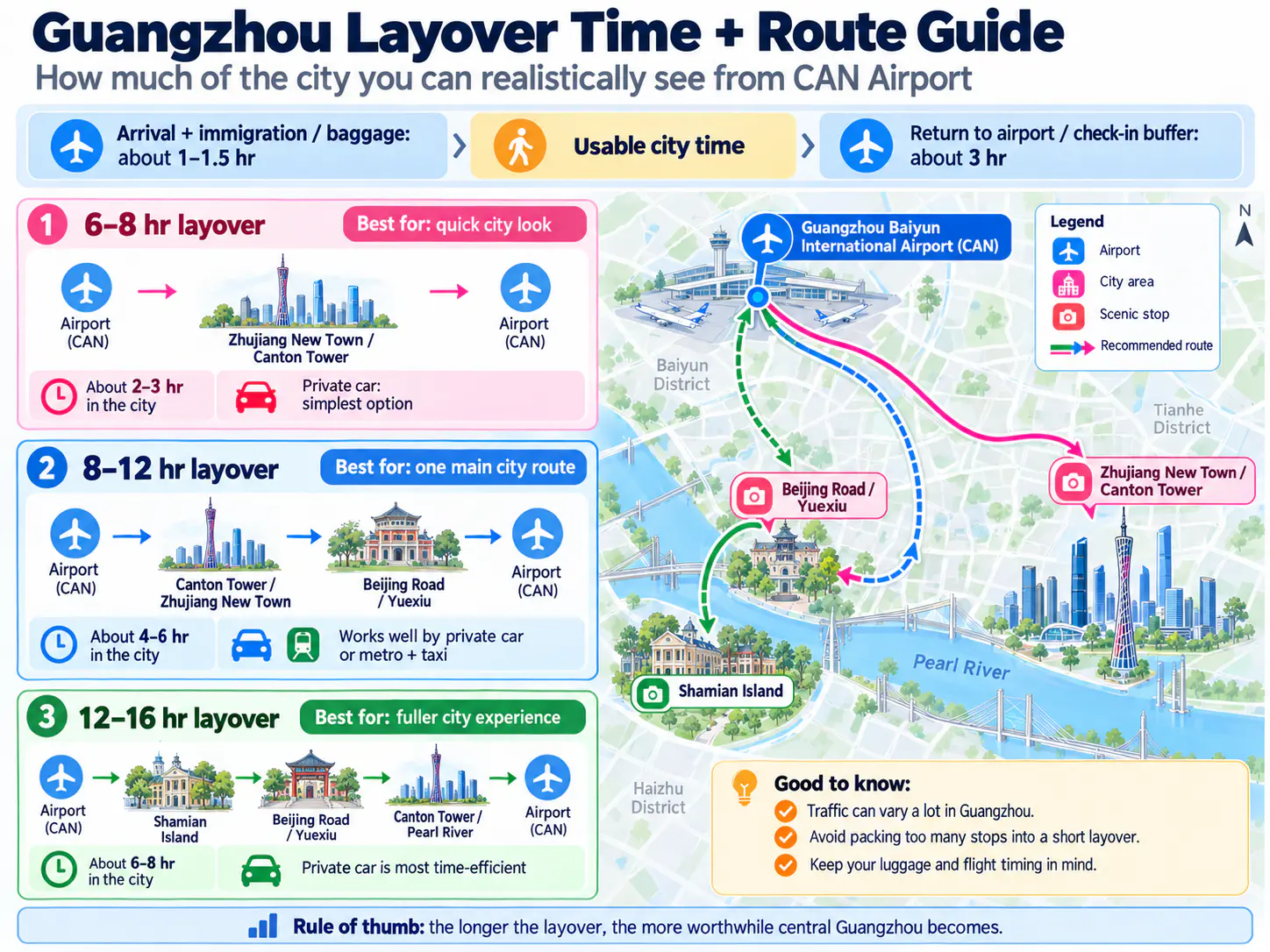
What can you realistically do with 6–8 hours?
A six-hour connection is generally a poor starting point for a central Guangzhou sightseeing plan. Airport procedures, two transfers and a proper return buffer can use most or all of it. At around eight hours, one compact city stop may be possible if entry, luggage and traffic conditions cooperate; decide using the time left after you actually clear the airport.
Do not buy timed attraction tickets on the assumption that landing time equals pickup time. If the arrival is delayed or immigration takes longer than expected, shorten or drop the outing. Staying at the airport can be the more useful choice when the remaining window is small.
8–12 hours: route patterns
With enough usable time, choose one compact theme. For older Guangzhou, use one Liwan area with a meal. For the modern city, use Zhujiang New Town and north-bank river views. These routes remain easier to shorten than an itinerary with several timed admissions.
A Canton Tower observation ticket adds entry procedures, queues and a trip to the tower’s side of the river. If seeing the tower is enough, the opposite-bank view may meet the goal with fewer moving parts. See the riverfront guide.
12–16 hours
Longer connections can support a more comfortable loop with a sit-down meal and less rushing — for example Shamian or Yuexiu earlier, then Zhujiang New Town / Canton Tower toward dusk if weather and queues cooperate. Still leave a deliberate rest margin; a 14-hour layover can become a stressful 5-hour city window if both airport processes run long.
Overnight Guangzhou layover
Overnight changes the problem from “sprint sightseeing” to “hotel logistics.” A city hotel near metro makes sense when you arrive early enough to clear immigration and still want a normal dinner. An airport-area hotel makes sense when you land late, depart early, or do not want another CAN round-trip in the morning. Do not schedule a full Gulong-style day trip on an overnight that is really just a sleep stop.
Where should luggage go?
Decision logic first: if you cannot reliably store or transfer bags, shrink the city plan. Options travelers commonly evaluate include keeping bags with a booked vehicle, using airline through-check when tickets allow, or airport/city luggage storage where available. Do not assume a specific CAN storage counter exists for your terminal and date — verify on the day or design a plan that does not depend on it.
Metro vs taxi vs private vehicle for a layover
The key variable is predictability + transfer count + luggage, not luxury. Metro is fine when you are light, confident with Line 3, and buffers are fat. Taxi/DiDi reduces walking. A layover-oriented private vehicle is about controlling the return clock when the cost of missing a flight dwarfs the hire fee.
Mode context: Getting Around Guangzhou. Terminal pickup detail: airport transfer guide. Optional timed product: Guangzhou layover tour.
When should you stay at the airport?
Staying airside or landside at CAN is a rational plan, not a failed trip. Strong reasons to stay:
- Immigration or transit eligibility is uncertain
- Connection is short once honest buffers are applied
- Overnight with poor late-metro timing and an early departure
- Separate tickets / baggage that may not transfer cleanly
- Child or family exhaustion after a long inbound flight
- Significant inbound delay that has already eaten the city window
Sample timing calculation
This example shows the arithmetic for an 11-hour connection, arriving at 09:00 and departing at 20:00. The durations are planning assumptions, not a promise about a particular flight or traffic condition.
| Step | Assumption | Result |
|---|---|---|
| Land at CAN | 09:00 arrival | Start the 11-hour connection. |
| Clear arrival procedures and meet transport | 1.5 hours | Ready around 10:30. |
| Travel to one city area | 1 hour | Sightseeing starts around 11:30. |
| Return to CAN | Plan airport arrival 3 hours before departure | Target airport arrival 17:00. |
| Travel back | 1 hour, plus 30 minutes of contingency | Leave the city by 15:30. |
| City visit, including lunch | 11:30–15:30 | Around 4 hours. |
The same result is 11 − 1.5 − 1 − 1 − 3 − 0.5 = 4 hours. If the airline requires an earlier return, or either transfer needs longer, reduce the city visit. Never extend the outing to recover sightseeing time lost to a late arrival.
FAQ
- Possibly one compact city stop after arrival procedures and a conservative return calculation. Eight hours is a total connection, not eight sightseeing hours. Decide from your actual airport exit time and protect the onward flight.
- Yes when bags are light and timing is generous. Choose road options when luggage, kids or a hard return clock dominate.
- Only after you share real flight times. A tour helps when you want one English-speaking contact for the return clock; it does not create usable time that the schedule does not have.
- Sometimes on longer daytime or early-evening windows with healthy buffers. Confirm return time before buying timed tickets — see Canton Tower & Pearl River.