
Legalism at a Glance
| Topic | Orientation |
|---|---|
| Key figures | Shang Yang; Shen Buhai; Shen Dao; Han Fei |
| Key ideas | *fa*, *shu*, *shi* |
| Political context | Warring States → Qin unification |
| Contrast | Virtue-ritual focus of Confucianism |
| Related | Chinese Philosophy, Xi’an/Qin heritage for historical setting |
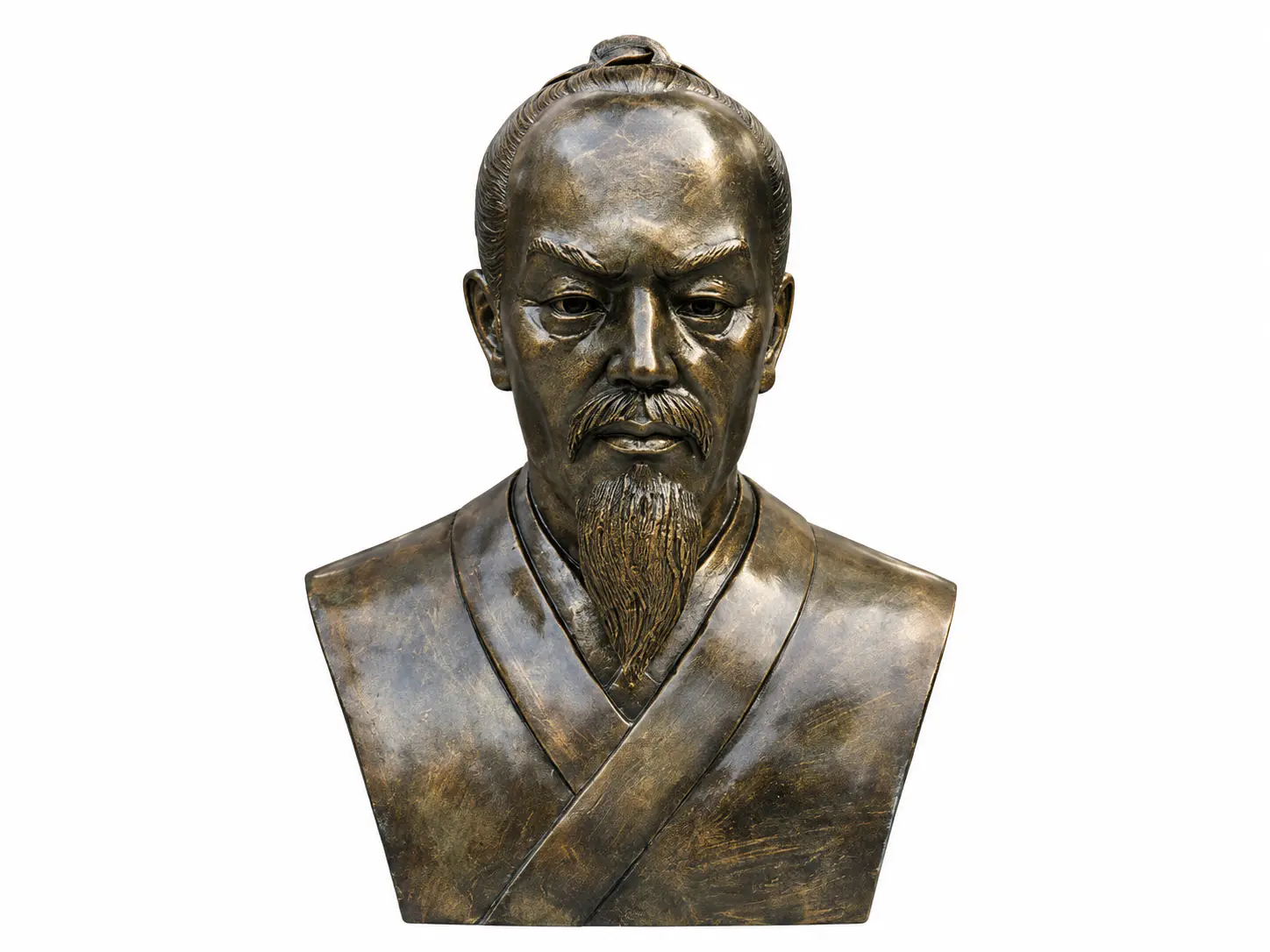
*Statue of Han Fei. Photo via Wikimedia Commons — CC BY-SA 4.0. Cropped/resized; non-generative. Modern commemorative statue, not a contemporary likeness.*
Historical Setting
Multi-state warfare rewarded administrative centralization, military discipline and predictable incentives. Legalist programs promised enrichment and strengthening of the state.
Shang Yang
Reforms in Qin associated with agricultural incentives, harsh but public standards, and weakening of aristocratic privilege—foundational Legalist practice narratives.
Shen Buhai and Shen Dao
Administrative technique (*shu*) and related themes of positional authority appear in the wider Legalist conversation; details vary by source tradition.
Han Fei
The *Han Feizi* synthesizes standards, methods and power into advice for rulers wary of ministerial manipulation. See also philosophers.
Fa, Shu, Shi
- Fa (法): standards/laws publicly knowable
- Shu (术/術): administrative/political technique
- Shi (势/勢): situational advantage / authority of position
Nuance matters: these are classical analytic terms, not a modern legal code table of contents.
Qin State and Unification
Qin institutional successes made Legalist tools historically consequential. Terracotta and Qin capital heritage near Xi’an illustrate imperial aftermath—not a proof-text that statues “are Legalism.” Use as historical setting only.
Han-Era Legacy and Synthesis
Han and later political traditions drew selectively from Confucian public ideology and bureaucratic techniques with Legalist ancestry—among other currents.
Comparison with Confucianism
Confucians prioritized virtue and ritual cultivation; Legalists prioritized enforceable standards and control of incentives. See Confucianism vs Daoism vs Legalism.
Why Legalism ≠ Modern Rule of Law
Modern rule-of-law ideals constrain rulers via rights and separation of powers. Classical Legalism often arms the ruler with tools to control subjects and officials—so the shared English word “law” should not be treated as the same concept.
Common Misconceptions
- Legalism ≠ “Chinese culture is cruel.”
- Not the opposite of all Confucianism in later practice—synthesis happened.
- Not identical to contemporary Chinese statutes.
Legalism FAQ
What is Legalism in Chinese philosophy?
A classical statecraft tradition centered on standards, technique and positional power.
Who was Han Fei?
Late Warring States thinker whose text synthesizes Legalist themes.
Did Qin use Legalism?
Qin reforms and institutions are closely associated with Legalist programs; history is still debated in detail by scholars.
Is Legalism the same as rule of law?
No. Classical Legalism is not modern constitutional rule of law.
Related Pages
Sources
- Stanford Encyclopedia of Philosophy — Legalism in Chinese Philosophy.
- *Han Feizi* scholarship and Qin institutional history for classical statecraft context.