Three motives
| Motive | Evidence |
|---|---|
| Imperial sacrifice ritual | Dedicated venue for winter solstice prayer; 22 emperors used it 1420-1914 |
| Son-of-Heaven legitimacy | Emperor stood on Heavenly Centre Stone at cosmological centre; public demonstration of Tianzi role |
| Cosmological architecture as power demonstration | Round heaven + square earth in stone; 9-count imperial numerology; blue tiles for sky |
Imperial sacrifice ritual - the central act
The winter solstice (around December 21-22) was the most important date in the Chinese imperial religious calendar - the longest night of the year, when yin energy peaks and yang begins to return. The emperor performed the Sacrifice to Heaven (Sitian Da Dian) on this date: a complex multi-day ritual including animal sacrifice (cattle, goats), grain offering, music, dance, prayers, and the emperor's ascent to the Heavenly Centre Stone on the Circular Mound Altar. The ritual was the central religious act of Chinese imperial power - if the emperor performed it correctly, the empire would have good harvests; if he did not, drought and famine would follow. The temple was built to provide the architectural stage.
- Winter solstice (Dec 21-22) - most important imperial date.
- Yin peaks, yang begins to return.
- Sacrifice to Heaven (Sitian Da Dian): multi-day ritual.
- Animal sacrifice, grain, music, dance, prayers.
- Empire's good harvests depended on correct performance.
Son-of-Heaven legitimacy
The emperor's traditional title was 'Tianzi' - Son of Heaven. The title meant the emperor was Heaven's chosen representative on earth, with divine mandate to rule the empire. But the title required public demonstration - the emperor needed to be seen performing the rituals that connected him to Heaven. The Temple of Heaven was the architectural infrastructure of this demonstration: the emperor processed south from the Forbidden City to the temple, walked the south-to-north axis, ascended the Circular Mound Altar, stood on the Heavenly Centre Stone, and prayed to Heaven on behalf of the empire. The annual ritual reaffirmed his legitimacy as Son of Heaven. Skipping the ritual was politically inconceivable - it would suggest the emperor had lost the mandate.
- Tianzi = Son of Heaven (imperial title).
- Mandate of Heaven to rule.
- Required public ritual demonstration.
- Temple of Heaven = architectural infrastructure.
- Annual ritual reaffirmed legitimacy.
- Skipping the ritual: politically inconceivable.
Cosmological architecture as power demonstration
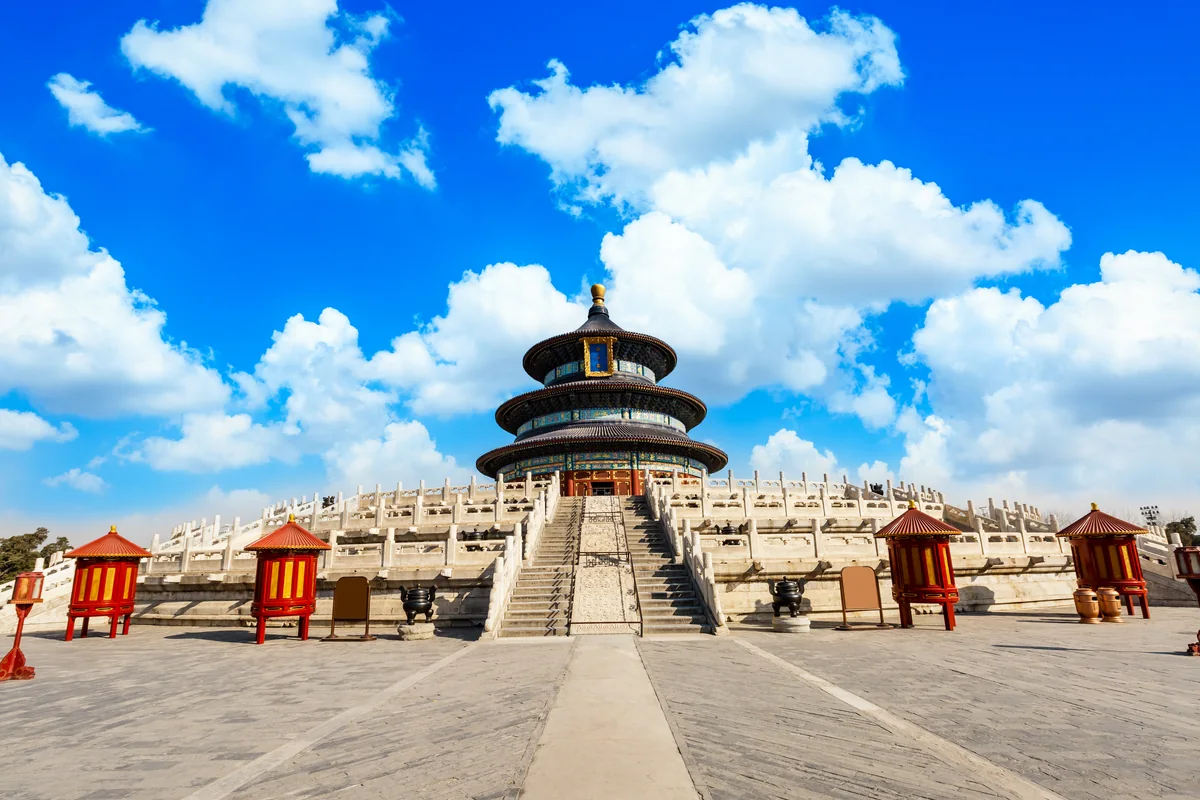
The temple's three signature structures encode Chinese cosmology in stone and timber. Round altars on square bases = round heaven, square earth. Blue glazed roofs = sky. The 9-count stone rings on the Circular Mound Altar = imperial number 9 (maximum cosmological power). The 4 + 12 + 12 column counts in the Hall of Prayer = 4 seasons + 12 months + 12 two-hour periods (the Chinese calendar in architectural form). The central north-south axis = the imperial procession path. The whole 273-hectare complex is a 3D cosmological diagram visible to anyone in Beijing - projecting the imperial worldview at urban scale. This is power demonstration through architecture, not religion in the modern sense.
- Round altars + square bases.
- Blue tiles = sky.
- 9-count stone rings = imperial number.
- 4 + 12 + 12 columns = Chinese calendar.
- Central axis = imperial procession path.
- 273 hectares of cosmological diagram.
- Power demonstration through architecture.
Why southeast Beijing position
The Temple of Heaven sits south of the Forbidden City and southeast of Tiananmen Square. The position is cosmologically calibrated: south = yang = heaven (in classical Chinese cosmology, the south-facing emperor on his throne in the Forbidden City looks toward the south where Heaven manifests). The temple's south-to-north axis continues the Forbidden City's axis. The emperor's annual procession from Forbidden City to Temple of Heaven for the winter solstice was a literal walk south along the imperial cosmological line. Today the geography is preserved: the Forbidden City sits at the centre of historic Beijing; the Temple of Heaven sits south, exactly where Ming-Qing cosmology placed it.
- Southeast Beijing - cosmologically calibrated.
- South = yang = heaven.
- Emperor's throne faces south.
- Temple of Heaven south-to-north axis continues Forbidden City's.
- Annual procession from Forbidden City to Temple of Heaven along cosmological line.
- Geography preserved today.
Common 'why built' misunderstandings
Treating it as a 'religious temple' in the modern sense
It's not Buddhist or Daoist religion - it's the architecture of imperial legitimacy. Different category.
Skipping the cosmological context
Without context, the architecture looks like 'just round buildings'. The cosmology makes it meaningful.
Forgetting the Son-of-Heaven title
Central to understanding why emperors maintained the ritual for 500 years.
Comparing to Western cathedrals
Different category - not worship of a god but performance of imperial cosmology.
Why was the Temple of Heaven built FAQ
- Three reasons. Imperial sacrifice ritual: the emperor needed a dedicated venue for the winter solstice prayer. Son-of-Heaven legitimacy: the ritual reaffirmed the emperor's mandate to rule. Cosmological architecture as power demonstration: the buildings encode 'round heaven, square earth' cosmology in stone.
- Tianzi - the traditional Chinese imperial title meaning Heaven's chosen representative on earth. Required public ritual demonstration; the Temple of Heaven was the venue.
- The Sitian Da Dian - the most important imperial religious act of the year, performed at winter solstice (December 21-22). Multi-day ritual including animal sacrifice, grain offering, music, dance, and the emperor's ascent to the Heavenly Centre Stone.
- No - different category. The Temple of Heaven is the architectural infrastructure of Chinese imperial cosmology and legitimacy, not religion in the modern Western sense.
- Cosmologically calibrated: south = yang = heaven. The emperor's throne in the Forbidden City faces south; the temple sits south where Heaven manifests in classical Chinese cosmology.
- It reaffirmed the emperor's Mandate of Heaven. Skipping it would suggest he had lost the mandate - politically inconceivable for 500 years.
Walk the cosmological infrastructure
Our private Temple of Heaven day with a history-focused guide explains the Son-of-Heaven role, the winter solstice ritual, and the cosmological architecture as you walk the south-to-north axis.
For the broader cosmology context, the Chinese cosmology page covers Tian, Di, yin-yang, and five elements at the temple.