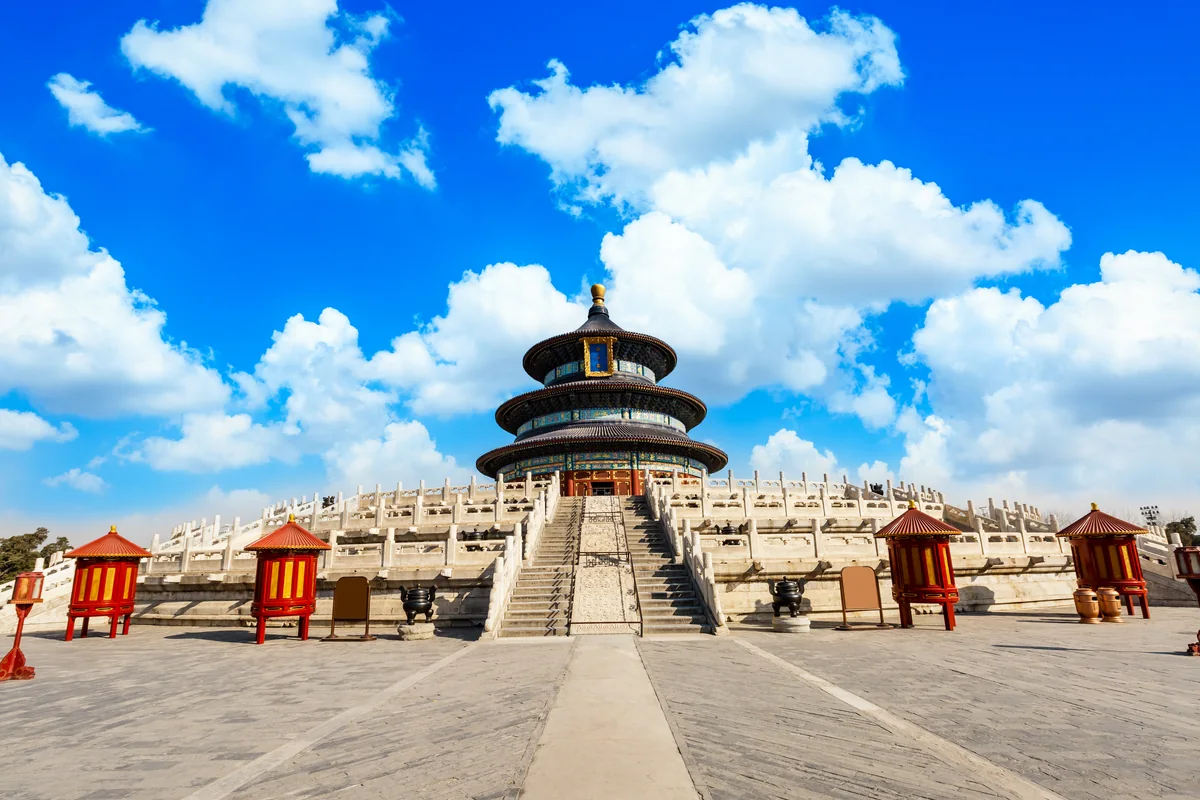
Round heaven, square earth - the cosmological rule
Classical Chinese cosmology models the universe as 'round heaven (Tian), square earth (Di)' - heaven is the dome of sky overhead, conceptually circular; earth is the flat ground below, conceptually square. The Temple of Heaven expresses this cosmology architecturally. Every signature structure is round (representing heaven) sitting on a square base or surrounded by a square wall (representing earth). The Circular Mound Altar is a round 3-tier altar within a square outer wall within a round encircling wall. The Imperial Vault of Heaven is a round single-roofed hall on a square base, surrounded by the round Echo Wall. The Hall of Prayer for Good Harvests is a round triple-eaved hall on a square triple-tier marble plinth. The whole temple is the round-heaven-square-earth cosmology made into walkable architecture.
- From central Beijing: Central Beijing — about 20–45 minutes by subway or taxi
- Reading time: 5-6 min
- Guide type: Cultural background
- Best for: Cosmology / philosophy-curious visitors; Architecture lovers wanting deeper context; Travellers wanting the single most important Temple of Heaven concept
- Less ideal for: Practical-planning visitors
Round + square throughout the temple
| Structure | Round element (heaven) | Square element (earth) |
|---|---|---|
| Circular Mound Altar | Round 3-tier altar | Inner square wall + outer round wall (heaven contains earth contains heaven) |
| Imperial Vault of Heaven | Round single-roofed hall + round Echo Wall | Square plinth base |
| Hall of Prayer for Good Harvests | Round triple-eaved hall | Square triple-tier marble plinth |
| Temple boundary | Northern boundary curves | Southern boundary is straight (round north, square south = heaven north, earth south) |
| Temple layout | Northern half wider (heaven expands) | Southern half narrower (earth concentrates) |
The core cosmological principle
Classical Chinese cosmology (codified during the Han dynasty, refined through the Tang and Song) models the universe as 'round heaven (Tianyuan Difang), square earth' - heaven is the dome of sky overhead, conceptually round; earth is the flat ground below, conceptually square. The principle predates the Temple of Heaven by 1000+ years - it appears in classical texts like the Lvshi Chunqiu (3rd century BCE). The temple is the maximal architectural expression of this principle. Walking the temple makes the cosmology tangible: stand at the centre of the Circular Mound Altar and look outward - the round altar (heaven) sits within a square wall (earth) sits within a round wall (heaven again, as the cosmic container). The architecture is the cosmology made visible.
- Round heaven, square earth (Tianyuan Difang).
- Codified Han dynasty; classical principle.
- Appears in Lvshi Chunqiu (3rd century BCE).
- Temple of Heaven is maximal architectural expression.
- Walking makes cosmology tangible.
The Circular Mound Altar's nested cosmology
The Circular Mound Altar's surrounding walls are a particularly elegant cosmological diagram. From the centre outward: (1) Round 3-tier marble altar - heaven. (2) Inner square wall - earth boundary. (3) Outer round wall - the cosmic container (heaven again, as 'the whole'). So the model reads: heaven (altar) inside earth (square boundary) inside the heavens (round container). The emperor at the centre stands at the focal point of nested cosmological levels. This is more sophisticated than simple round-on-square - it expresses heaven manifesting through earth back into the universal heaven, which is the deeper meaning of the Son-of-Heaven ritual.
- Round altar (heaven) at centre.
- Inner square wall (earth boundary).
- Outer round wall (cosmic heaven container).
- Nested model: heaven in earth in heaven.
- Emperor at focal point of nested levels.
Hall of Prayer - round on square plinth
The Hall of Prayer for Good Harvests sits on a square triple-tier white marble plinth. The hall itself is round (38m diameter, triple-eaved blue roof) - heaven. The plinth is square (each tier square but stepped back) - earth. The cosmology reads vertically: earth (square plinth) supports heaven (round hall) above. The blue roof tiles add another layer - sky above heaven. So the building reads bottom-to-top: earth -> heaven -> sky. The vertical layering plus the round-on-square horizontal expression makes the Hall of Prayer the maximal cosmological structure in China. Standing at the foot of the plinth and looking up, the cosmology is literally above you.
- Round hall on square plinth.
- Hall = heaven; plinth = earth.
- Blue roof = sky.
- Bottom-to-top: earth -> heaven -> sky.
- Maximal cosmological structure in China.
Temple boundary shape
Even the temple's outer boundary expresses cosmology. The northern half of the boundary curves (round = heaven); the southern half is straight (square = earth). This makes the temple as a whole shaped like a half-rounded rectangle - heaven in the north, earth in the south. The orientation matches the cosmological logic: the south-to-north imperial procession axis runs from earth (south) toward heaven (north). The Hall of Prayer at the north end is conceptually 'in heaven'; the Circular Mound Altar at the south end is conceptually 'on earth'. Walking south-to-north up the axis is walking from earth toward heaven - the cosmological journey of the Son of Heaven during the ritual.
- Northern boundary curves = heaven.
- Southern boundary straight = earth.
- Half-rounded rectangle shape.
- South (earth) to north (heaven) axis.
- Hall of Prayer 'in heaven'; Circular Mound Altar 'on earth'.
Common round-and-square misunderstandings
Thinking it's just 'a design choice'
It's not aesthetic - every round-on-square is cosmological. The temple is built to be a cosmological diagram.
Missing the Circular Mound Altar's nested walls
Inner square + outer round = heaven inside earth inside heaven. The most elegant cosmological expression.
Not walking south-to-north
Earth (south) to heaven (north) is the cosmological direction. Reverse walks lose the meaning.
Comparing to Western geometry symbolism
Different tradition. Round-heaven-square-earth is Chinese specifically; the temple is its maximal expression.
Round and square symbolism FAQ
- Classical Chinese cosmology models the universe as 'round heaven, square earth' (Tianyuan Difang). The Temple of Heaven's round structures sitting on square bases or surrounded by square walls is the architectural expression of this cosmology - heaven (round) and earth (square) made visible.
- Heaven is conceptually round (the dome of sky overhead); earth is conceptually square (the flat ground below). Classical Chinese cosmology codified during the Han dynasty, with roots in the 3rd century BCE.
- Round 3-tier altar (heaven) inside an inner square wall (earth) inside an outer round wall (cosmic heaven container). A nested cosmological model: heaven inside earth inside heaven.
- Round triple-eaved hall (heaven) on a square triple-tier marble plinth (earth). Vertical layering: earth supports heaven, with sky (blue tiles) above.
- Northern boundary curves (heaven); southern boundary is straight (earth). Half-rounded rectangle shape. Even the outer wall expresses cosmology.
- Yes - 'round heaven, square earth' is a classical Chinese cosmological principle, not a universal one. The Temple of Heaven is its maximal architectural expression worldwide.
Walk the cosmology with a guide
Our private Temple of Heaven day pairs the round-and-square decoding with the route - naming the cosmological levels at each structure and the nested model at the Circular Mound Altar walls.
For the broader cosmological framework (Tian, Di, yin-yang, five elements), the Chinese cosmology page is the longer-form read.
Plan a guided cosmology-focused Temple of Heaven dayChinese cosmology