The winter solstice Sacrifice to Heaven
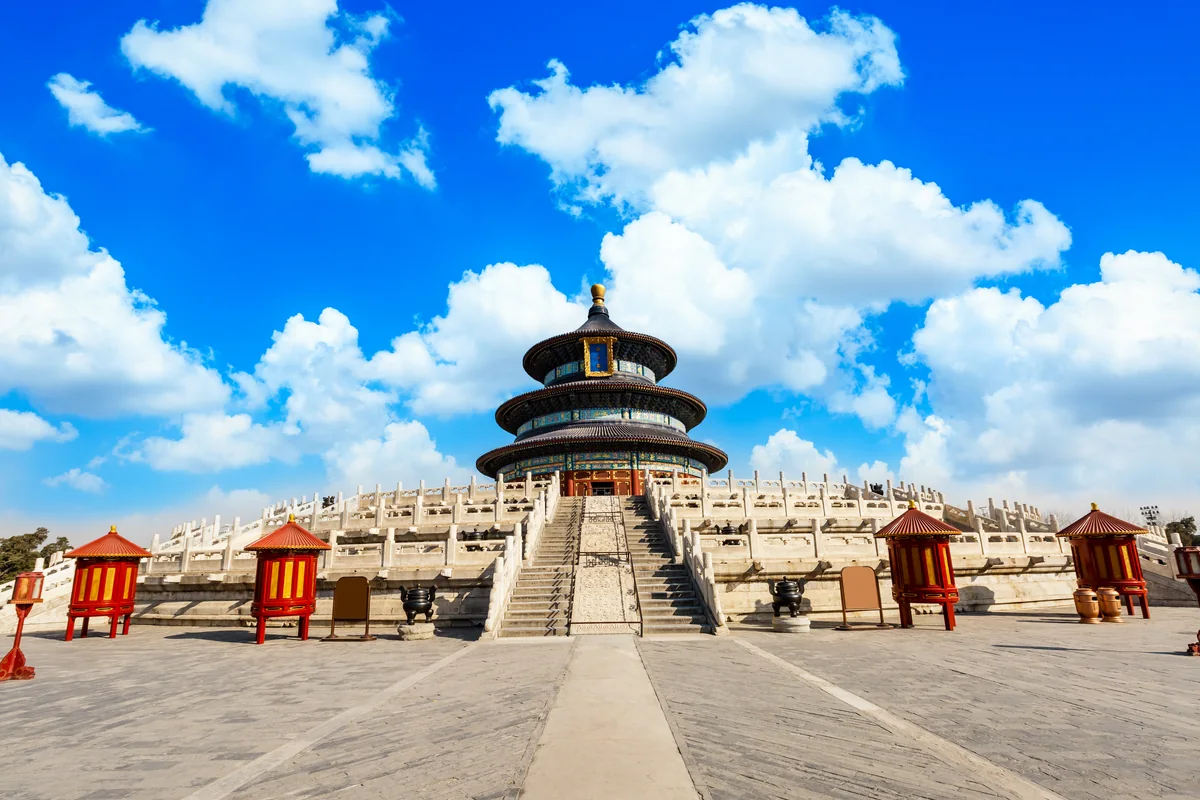
The Temple of Heaven's central ritual was the winter solstice Sacrifice to Heaven (Sitian Da Dian), performed annually by the Ming and Qing emperors from 1420 to 1914. The ritual marked the longest night of the year (around December 21-22) when yin energy peaks and yang begins to return - cosmologically the moment when Heaven's blessing of the empire is renewed. The ceremony lasted three days. Day 1-2: ritual preparation, animal sacrifices (cattle, goats), grain offerings, prayers in the Hall of Prayer for Good Harvests. Day 3 (winter solstice): the emperor processed from the Forbidden City south to the Temple of Heaven, walked the south-to-north axis, ascended the Circular Mound Altar, stood on the Heavenly Centre Stone, chanted the prayer to Heaven, and returned to the Forbidden City. The Sacrifice to Heaven was the most important imperial religious act of the year - skipping it was politically inconceivable.
- From central Beijing: Central Beijing — about 20–45 minutes by subway or taxi
- Reading time: 7-8 min
- Guide type: Cultural background
- Best for: History / ritual-curious visitors; Travellers wanting deeper cosmology context
- Less ideal for: Practical-planning visitors
Winter solstice ceremony stages
| Stage | Day | Where |
|---|---|---|
| Preparation - imperial fast | Day 1 | Hall of Abstinence (within Temple of Heaven complex) |
| Hall of Prayer rituals | Day 2 | Hall of Prayer for Good Harvests (Qiniandian) |
| Procession from Forbidden City to Temple of Heaven | Day 3 dawn | South along the imperial axis |
| Imperial Vault preparation | Day 3 early morning | Imperial Vault of Heaven (collect tablets) |
| Sacrifice to Heaven on altar | Day 3 sunrise | Circular Mound Altar top tier; Heavenly Centre Stone |
| Return procession | Day 3 late morning | North back to Forbidden City |
Why winter solstice
The winter solstice (Dongzhi - around December 21-22) is the longest night of the year - the moment when yin energy peaks (cold, dark, female, earth) and yang energy begins to return (warm, light, male, heaven). In Chinese cosmology this is the cosmological turning point: Heaven's blessing of the empire is renewed at the moment yang begins to return. The emperor's Sacrifice to Heaven at this exact moment connects the empire to the cosmic cycle - if performed correctly, the empire would have good harvests in the coming year. Performing the ritual at any other time would be cosmologically wrong. The Hall of Prayer for Good Harvests also hosted a spring sacrifice (lunar Chinese New Year area) for the spring planting blessing.
- Winter solstice (Dec 21-22): longest night.
- Yin peaks, yang begins to return.
- Cosmological turning point.
- Heaven's blessing renewed at yang return.
- Spring sacrifice also at Hall of Prayer (CNY area).
The three-day ceremony stages
Three days of escalating ritual. Day 1: imperial fast - the emperor abstains from meat, music, and his consort for purification. Day 2: rituals at the Hall of Prayer for Good Harvests including grain offerings and ancestor tablet ceremonies. Day 3 (winter solstice itself): the ceremonial climax. Dawn: imperial procession from the Forbidden City south to the Temple of Heaven (the cosmologically correct direction). Early morning: tablets collected from the Imperial Vault and carried south to the Circular Mound Altar. Sunrise on the altar: animal sacrifice (cattle, goats), grain and silk offerings, music with the imperial orchestra, the emperor ascends the 3 tiers, stands on the Heavenly Centre Stone, chants the prayer to Heaven (using the Tian title). Late morning: return procession north to the Forbidden City.
- Day 1: imperial fast (meat, music, consort).
- Day 2: Hall of Prayer grain + tablet ceremonies.
- Day 3 dawn: procession Forbidden City to Temple of Heaven.
- Day 3 sunrise: sacrifice on Circular Mound Altar.
- Animal sacrifice + grain + music + prayer.
- Emperor on Heavenly Centre Stone chants to Heaven.
The Son-of-Heaven performance
Throughout the ceremony, the emperor performs his Son-of-Heaven (Tianzi) role publicly. The ritual is not private worship - it's a public demonstration witnessed by court officials, military officers, and (in some eras) commoners gathered outside the temple walls. The emperor's performance reaffirms his Mandate of Heaven (Tianming) - Heaven's grant of authority to rule. Skipping or performing the ritual incorrectly would suggest the emperor had lost the mandate; emperors who faced political crises sometimes blamed earthquakes, floods, or famines on imperfect ritual performance. The Sacrifice to Heaven was the political theatre of imperial legitimacy. 22 emperors performed it across 494 years.
- Public demonstration, not private worship.
- Witnessed by court + officers + (some eras) commoners.
- Reaffirms Mandate of Heaven (Tianming).
- Skipping = losing the mandate.
- 22 emperors over 494 years.
Spring + summer secondary rituals
Beyond the winter solstice climax, two secondary rituals. (1) Spring sacrifice (lunar Chinese New Year area, around February): prayer for blessings on the spring planting, performed in the Hall of Prayer for Good Harvests. The Hall of Prayer's name (Qiniandian) literally means 'Hall of Prayer for [Good Harvest] Year' - this is the building's primary ritual. (2) Summer solstice prayer (around June 21-22): the cosmological mirror of winter solstice, performed at the Temple of Earth (Ditan, north of Beijing) - not at the Temple of Heaven (the Temple of Earth was built 1530 when Jiajing separated Heaven and Earth worship). The Temple of Heaven hosted the spring + winter rituals; the Temple of Earth hosted the summer + autumn rituals.
- Spring sacrifice in Hall of Prayer (CNY area).
- Hall of Prayer name literally means 'Prayer for Good Harvest Year'.
- Summer solstice at Temple of Earth (separate site north of Beijing).
- Temple of Heaven: spring + winter rituals.
- Temple of Earth: summer + autumn rituals.
Common rituals misunderstandings
Treating it as worship of a god
Tian (Heaven) is a cosmic principle, not a Christian-style god. The ritual is political-cosmological, not religious worship in the Western sense.
Confusing with the Temple of Earth
Temple of Heaven (south Beijing) hosted spring + winter rituals; Temple of Earth (north Beijing) hosted summer + autumn. Two separate sites since 1530.
Imagining the ritual was a one-day event
Three days minimum, with weeks of preparation. The winter solstice climax was the third day.
Skipping the imperial-fast detail
Day 1 abstention from meat, music, consort. Purification was part of the ritual.
Temple of Heaven + imperial rituals FAQ
- The winter solstice Sacrifice to Heaven (Sitian Da Dian) and a spring sacrifice for good harvests. The most important imperial religious rituals of the year.
- Around December 21-22 each year. The longest night - yin peaks, yang begins to return.
- Three days. Day 1: imperial fast and purification. Day 2: Hall of Prayer rituals. Day 3 (winter solstice itself): procession from Forbidden City to Temple of Heaven, sacrifice on the Circular Mound Altar at sunrise, return procession.
- Different category - it's the political-cosmological act of imperial legitimacy, not religion in the Western sense. The emperor as Son of Heaven reaffirming the Mandate of Heaven.
- The emperor personally. 22 Ming and Qing emperors performed it across 1420-1914. The last was Yuan Shikai (briefly self-proclaimed emperor) in 1914.
- Hall of Prayer (north): spring sacrifice for harvest blessing + winter ritual preparation. Circular Mound Altar (south): the climax of the winter solstice ceremony - the emperor stood on the Heavenly Centre Stone at sunrise.
Walk the ritual path with a guide
Our private Temple of Heaven day with a history-focused guide walks the south-to-north axis describing the three-day winter solstice ceremony - the emperor's procession, the imperial fast, the sunrise sacrifice on the Heavenly Centre Stone.
For the broader cosmology context, the Chinese cosmology page covers Tian, Di, and the five elements.
Plan a guided ritual-focused Temple of Heaven dayChinese cosmology