Timeline at a glance
| Era | Year | Event |
|---|---|---|
| Yongle construction | 1406-1420 | Built alongside the Forbidden City |
| Ming use | 1420-1644 | 14 Ming emperors performed winter solstice prayer |
| Jiajing rebuild | 1530 | Circular Mound Altar + Imperial Vault rebuilt in current form |
| Qing era begins | 1644- | Qing dynasty inherits the temple |
| Qianlong expansion | 1740-1751 | Largest expansion; park doubled; architecture refined |
| Guangxu rebuild | 1889-1890 | Hall of Prayer rebuilt after lightning fire |
| Last imperial ceremony | 1914 | Yuan Shikai performs winter solstice prayer |
| Public park | 1918 | Republican-era opening |
| UNESCO listing | 1998 | World Heritage Site |
Yongle's 1420 construction
The Yongle Emperor commissioned the Temple of Heaven as part of his Beijing imperial plan announced in 1406 - the same project that produced the Forbidden City, the city walls, and the urban grid. Construction took 14 years and was completed in 1420, the same year the imperial capital officially moved from Nanjing to Beijing. The original layout placed the Temple of Heaven in southeast Beijing on the south-to-north imperial axis extending from the Forbidden City - the temple's south-to-north axis is conceptually a continuation of the Forbidden City's, making the entire imperial Beijing one giant cosmological design.
- 1406-1420 construction with Forbidden City and city walls.
- Completed same year as Forbidden City (1420).
- Capital moved to Beijing in 1420.
- Temple of Heaven's axis is continuation of Forbidden City's axis.
- Imperial Beijing as one cosmological design.
Jiajing 1530 rebuild
The Jiajing Emperor (1522-1567) significantly rebuilt the Temple of Heaven in 1530. The original 1420 main structure was a combined Heaven-and-Earth temple; Jiajing separated the worship of Heaven and Earth into two sites (the Temple of Earth was built north of Beijing in this era). The Temple of Heaven was rebuilt around the dedicated Heaven sacrifice - Circular Mound Altar and Imperial Vault of Heaven were constructed in their current form in 1530. The original Hall of Prayer dates earlier but was modified.
- 1530 Jiajing rebuild.
- Original combined Heaven-Earth worship split.
- Temple of Earth built north of Beijing.
- Circular Mound Altar + Imperial Vault current form 1530.
- Hall of Prayer modified.
Qianlong 1740-1751 expansion
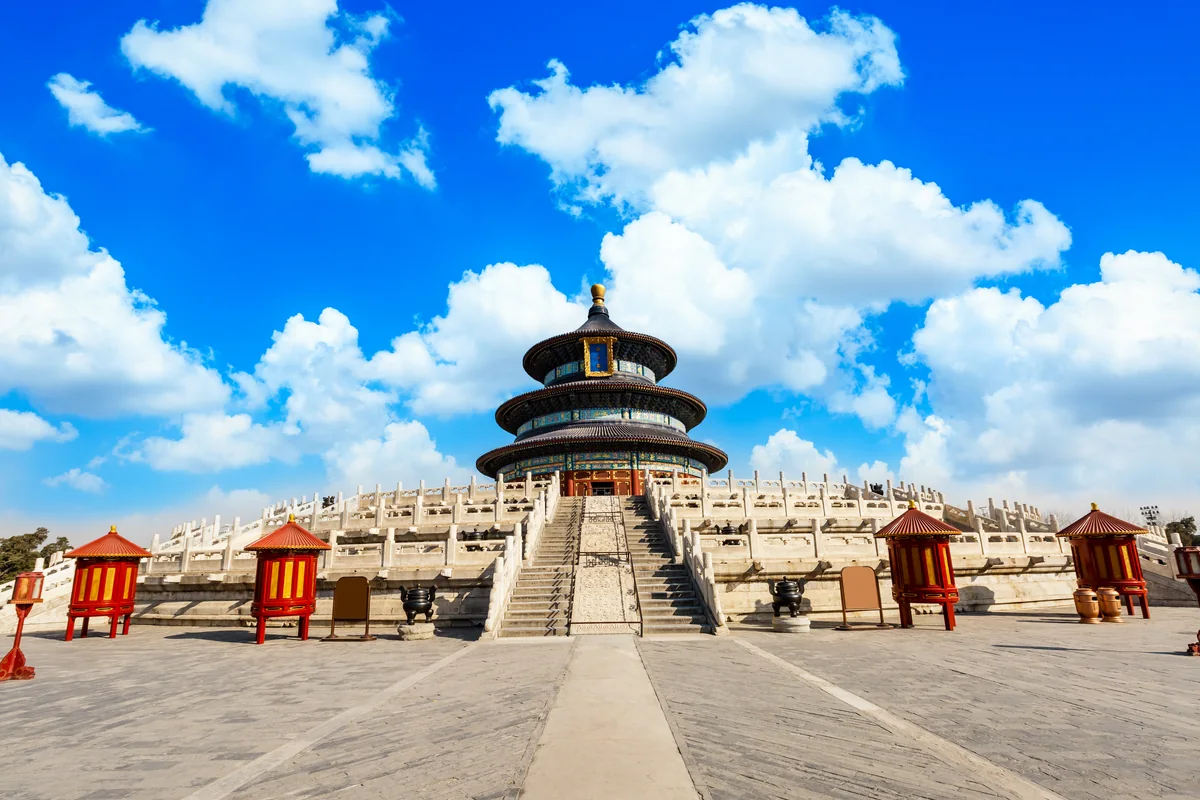
The Qianlong Emperor (1735-1796) ordered the largest expansion of the Temple of Heaven 1740-1751. The park area was doubled, the Circular Mound Altar was expanded to its current 3-tier form (1740), the Hall of Prayer's interior was refined, and the surrounding cypress parkland was planted. Qianlong was the high-Qing emperor obsessed with imperial cosmology (he also built the Summer Palace's first version, the Forbidden City's Hall of Mental Cultivation, and many other imperial sites). The temple owes much of its current 'feel' to the Qianlong-era refinement.
- 1740-1751 Qianlong expansion.
- Park doubled in size.
- Circular Mound Altar to current 3-tier (1740).
- Cypress parkland planted.
- Current 'feel' owes much to Qianlong-era.
1889 fire + 1890 rebuild + 1914 last ceremony
Three late-Qing era events. (1) 1889: Hall of Prayer struck by lightning during a thunderstorm and burnt completely (Guangxu reign). (2) 1890: Qing court immediately rebuilt the Hall of Prayer using the surviving stone foundations and the same mortise-and-tenon timber joinery as the 1420 original - the structure visitors see today is from this 1890 rebuild. (3) 1914: Yuan Shikai (Republican-era warlord briefly self-proclaiming emperor) performed the last winter solstice ceremony at the Circular Mound Altar - the end of the imperial sacrifice tradition. The site opened as a public park in 1918, four years later.
- 1889: Hall of Prayer lightning fire.
- 1890: Rebuilt with original joinery.
- 1914: Last imperial ceremony (Yuan Shikai).
- 1918: Public park opening.
- Current Hall of Prayer: 1890 rebuild.
Modern era - UNESCO 1998 + restoration
After 1949 the PRC managed the Temple of Heaven as a public park and continued restoration of the three signature structures and the cypress parkland. UNESCO inscribed it as a World Heritage Site in 1998 under the citation 'a masterpiece of architecture and landscape design which simply and graphically illustrates a cosmogony of great importance for the evolution of one of the world's great civilisations'. Major restoration of the Echo Wall (re-polishing marble, restoring acoustic surface) was completed in 2005. The site is one of Beijing's three most-visited UNESCO sites (Forbidden City, Temple of Heaven, Summer Palace), but draws fewer tourists than Forbidden City.
- 1949 PRC management.
- Continued restoration.
- UNESCO 1998 - cosmogony citation.
- Echo Wall restoration 2005.
- Beijing's third UNESCO site (after Forbidden City, Great Wall).
Common history misunderstandings
Crediting only Yongle
Yongle built it 1420; Jiajing rebuilt 1530; Qianlong doubled it 1740-1751; Guangxu rebuilt the Hall of Prayer 1890. Most of what visitors see is Qianlong-era refinement of Jiajing-era structures.
Skipping the 1889 fire story
Hall of Prayer is 1890 rebuild, not 1420 original. Important context for the architecture.
Confusing with Temple of Earth
Temple of Heaven (south) and Temple of Earth (north) were split 1530. They're two separate sites.
Treating it as 'just a temple'
Sacrifice site for imperial legitimacy. Politically important, not religious in the modern sense.
Temple of Heaven history FAQ
- Built 1420 by Yongle (same year as Forbidden City). Significantly rebuilt 1530 (Jiajing) and expanded 1740-1751 (Qianlong). Hall of Prayer rebuilt 1890 after lightning fire.
- 22 Ming and Qing emperors performed the winter solstice prayer for empire blessings from 1420 to 1914. Yuan Shikai performed the last ceremony in 1914.
- 1918, four years after the last imperial ceremony.
- The Temple of Heaven's south-to-north axis is conceptually a continuation of the Forbidden City's axis - imperial Beijing was designed as one giant cosmological diagram.
- Jiajing separated Heaven and Earth worship 1530. Temple of Heaven (south of Beijing, where Temple of Heaven is) and Temple of Earth (north of Beijing) are two separate sites.
- 1998, under the citation 'a masterpiece of architecture and landscape design which simply and graphically illustrates a cosmogony of great importance for the evolution of one of the world's great civilisations'.
Walk the history with context
Our private Temple of Heaven day with a history-focused guide tells the story through the structures - Yongle's vision, Jiajing's rebuild, Qianlong's expansion, Guangxu's rebuild after the fire, Yuan Shikai's last ceremony.
If you want the founding context, the why-was-it-built page covers the imperial sacrifice rationale.
Plan a guided history-focused Temple of Heaven dayWhy was it built?