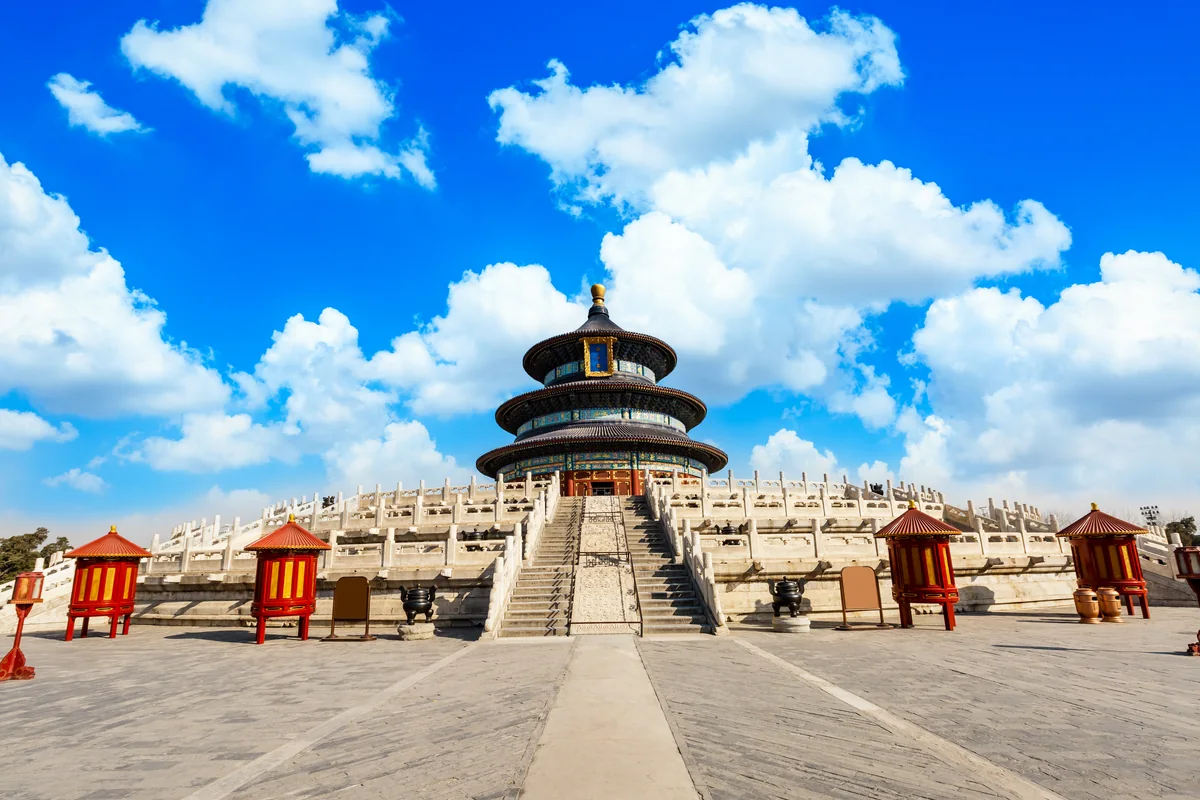
Architectural elements decoded
| Element | Meaning | Where to see |
|---|---|---|
| Round form | Heaven (Tian) in cosmology | All three signature structures |
| Square base / wall | Earth (Di) in cosmology | Walls around Circular Mound Altar + Imperial Vault |
| Blue glazed roof tiles | Sky / heaven | Hall of Prayer, Imperial Vault roofs |
| Triple-eaved roof | Imperial highest hierarchy + 3 = sacred number | Hall of Prayer for Good Harvests |
| White marble plinth | Purity + imperial rank | Hall of Prayer triple plinth; Circular Mound Altar 3 tiers |
| Mortise-and-tenon timber joinery | No nails - earthquake flex | Hall of Prayer 28 columns |
| 9-count stones / columns | Imperial number 9 (max) | Circular Mound Altar rings of 9 stones |
| Cosmological column counts | 4 seasons + 12 months + 12 two-hour periods | Hall of Prayer interior |
Round form on square base - the core formula
Every signature Temple of Heaven structure follows the same architectural formula: round form (representing heaven) on a square base or surrounded by a square wall (representing earth). The Circular Mound Altar is a round 3-tier altar within a square wall within a round wall. The Imperial Vault of Heaven is a round single-roofed hall on a square base, surrounded by the round Echo Wall. The Hall of Prayer for Good Harvests is a round triple-eaved hall on a square triple-tier marble plinth. This is the literal architecture of 'round heaven, square earth' Chinese cosmology - the temple is a 3D cosmological diagram you can walk through.
- Round form = heaven.
- Square base / wall = earth.
- Every signature structure follows this formula.
- Hall of Prayer: round hall on square plinth.
- Imperial Vault: round hall on square base + round Echo Wall.
- Circular Mound Altar: round altar in square in round wall.
Blue glazed roof tiles
Blue glazed roof tiles represent sky and heaven in Chinese imperial architecture - distinct from the yellow tiles of the Forbidden City and most other imperial buildings (yellow = imperial earth). The Temple of Heaven uses blue tiles throughout the three signature structures: Imperial Vault, Hall of Prayer, and the surrounding pavilions. The Hall of Prayer's triple-eaved blue roof is the largest blue imperial roof in China. The blue is achieved with cobalt-rich glaze fired at imperial kilns near Beijing - same technique as yellow tiles but different mineral. Standing in the Hall of Prayer plaza looking up at the triple blue roof against the sky is the architectural climax of the visit.
- Blue = sky / heaven.
- Distinct from Forbidden City's yellow (imperial earth).
- Hall of Prayer's triple blue roof: largest in China.
- Cobalt-rich glaze, imperial kilns.
- Architectural climax: blue roof against sky.
Mortise-and-tenon timber joinery
The Hall of Prayer for Good Harvests is built entirely without nails - 28 great timber columns and complex bracket sets (dougong) lock together via mortise-and-tenon joinery (wooden tenons slot into mortises and lock with wooden pegs). The same technique as the Forbidden City's halls, taken to an extreme: the 38m round structure with triple-eaved roof is held up by interlocking timber alone. The technique allows earthquake flex (1976 Tangshan earthquake damaged many Beijing buildings but the Hall of Prayer survived) and lets the entire structure be disassembled and reassembled for restoration. The 1890 rebuild after the 1889 fire used the same technique.
- No nails - mortise-and-tenon joinery.
- 28 great columns + dougong brackets.
- Earthquake flex (survived 1976 Tangshan).
- Disassemble for restoration.
- 1890 rebuild used same technique.
Cosmological number coding
Three numerical codings to spot. (1) 9 (imperial number, maximum): Circular Mound Altar has 9 concentric rings of stones per tier, ring counts in multiples of 9. (2) 4 + 12 + 12 = 28 (calendar): Hall of Prayer has 4 inner columns (4 seasons) + 12 middle (12 months) + 12 outer (12 two-hour periods of the Chinese day), total 28 (28 lunar mansions). (3) 3 (sacred): triple-tier marble plinths, triple-eaved roof, three signature structures on the axis. The architecture is a 3D mathematical / astronomical diagram. A guide makes this visible; without context, the numbers are invisible.
- 9 = imperial number (Circular Mound Altar stones).
- 4 + 12 + 12 = 28 (calendar coding, Hall of Prayer).
- 3 = sacred number (triple plinths, triple eaves, 3 structures).
- 3D mathematical / astronomical diagram.
Common architecture misunderstandings
Treating it as 'just round buildings'
Every architectural choice is cosmologically coded. Context makes it interesting.
Comparing to Western religious architecture
Different category - the Temple of Heaven is cosmological infrastructure, not worship of a god.
Missing the number coding
Count stones on the Circular Mound Altar, columns in the Hall of Prayer - the numbers are everywhere.
Skipping the Hall of Prayer interior view
The 28-column timber structure is the architectural masterpiece. Don't just photograph from outside.
Temple of Heaven architecture FAQ
- Imperial Chinese cosmological architecture: round forms (heaven) on square bases (earth), blue glazed roof tiles (sky), mortise-and-tenon timber joinery, cosmological number coding in column / stone counts.
- Blue represents sky and heaven in Chinese imperial architecture. Distinct from the Forbidden City's yellow (imperial earth). The Hall of Prayer's triple-eaved blue roof is the largest blue imperial roof in China.
- Yes - entirely mortise-and-tenon timber joinery. 28 columns + bracket sets hold the triple roof via interlocking joinery alone. Allows earthquake flex.
- Architectural expression of 'round heaven, square earth' Chinese cosmology. Round = heaven; square = earth; the temple is a 3D cosmological diagram.
- Hall of Prayer interior: 4 inner columns = 4 seasons; 12 middle = 12 months; 12 outer = 12 two-hour periods of the Chinese day; total 28 = 28 lunar mansions in Chinese astronomy.
- No - the current structure is the 1890 rebuild after a 1889 lightning fire. Same joinery technique and design; the timber itself is 130 years old.
Walk with the architecture decoder
Our private Temple of Heaven day pairs the architecture decoder with the route - counting the 28 columns, the 9-stone rings, naming the round-heaven-square-earth formula at each structure.
For the deeper cosmology, the round-and-square symbolism page covers the philosophy in more detail.
Plan a guided architecture-focused Temple of Heaven dayRound and square symbolism