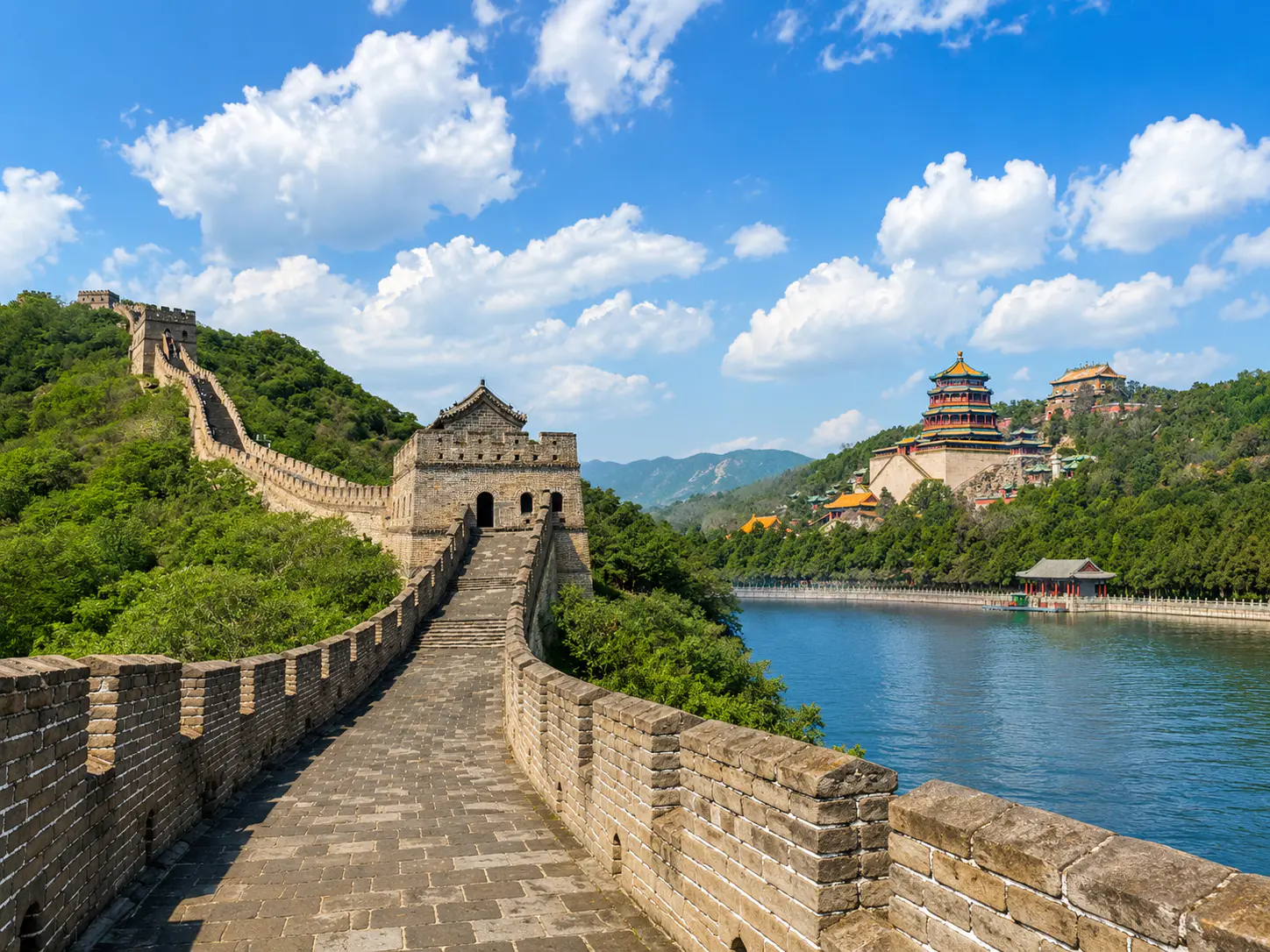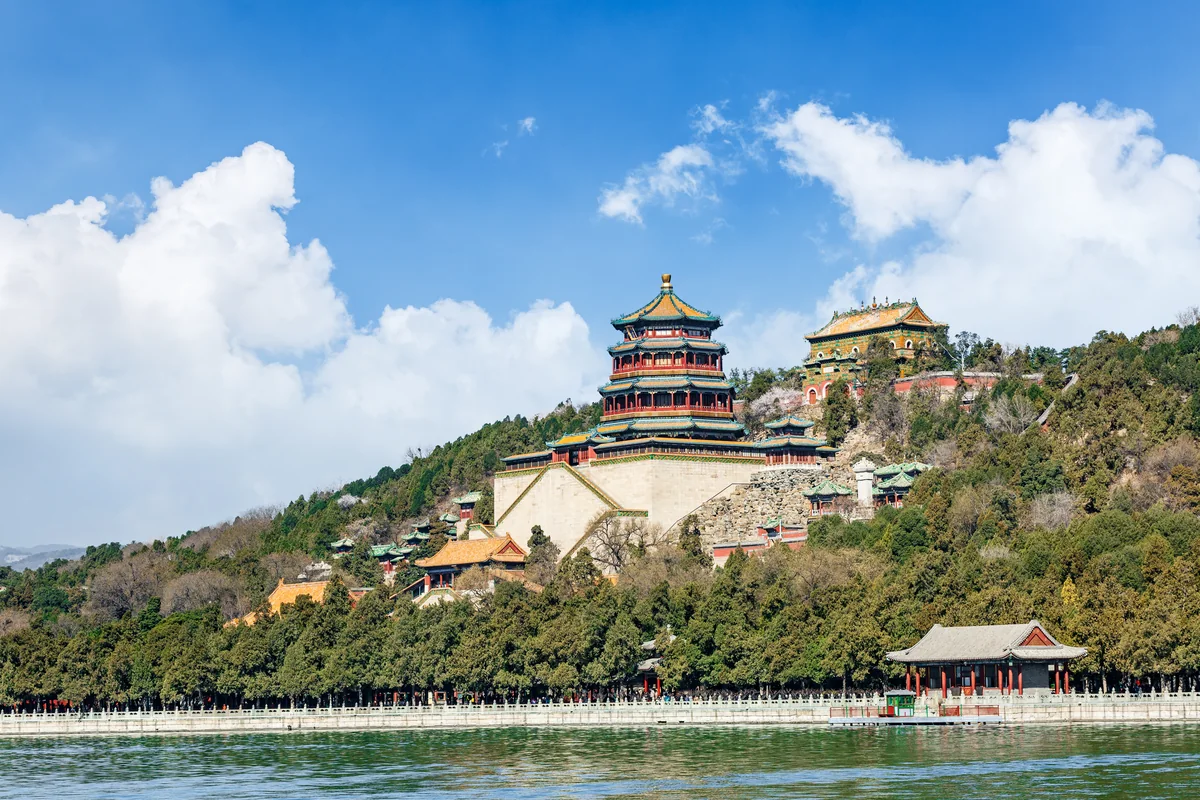
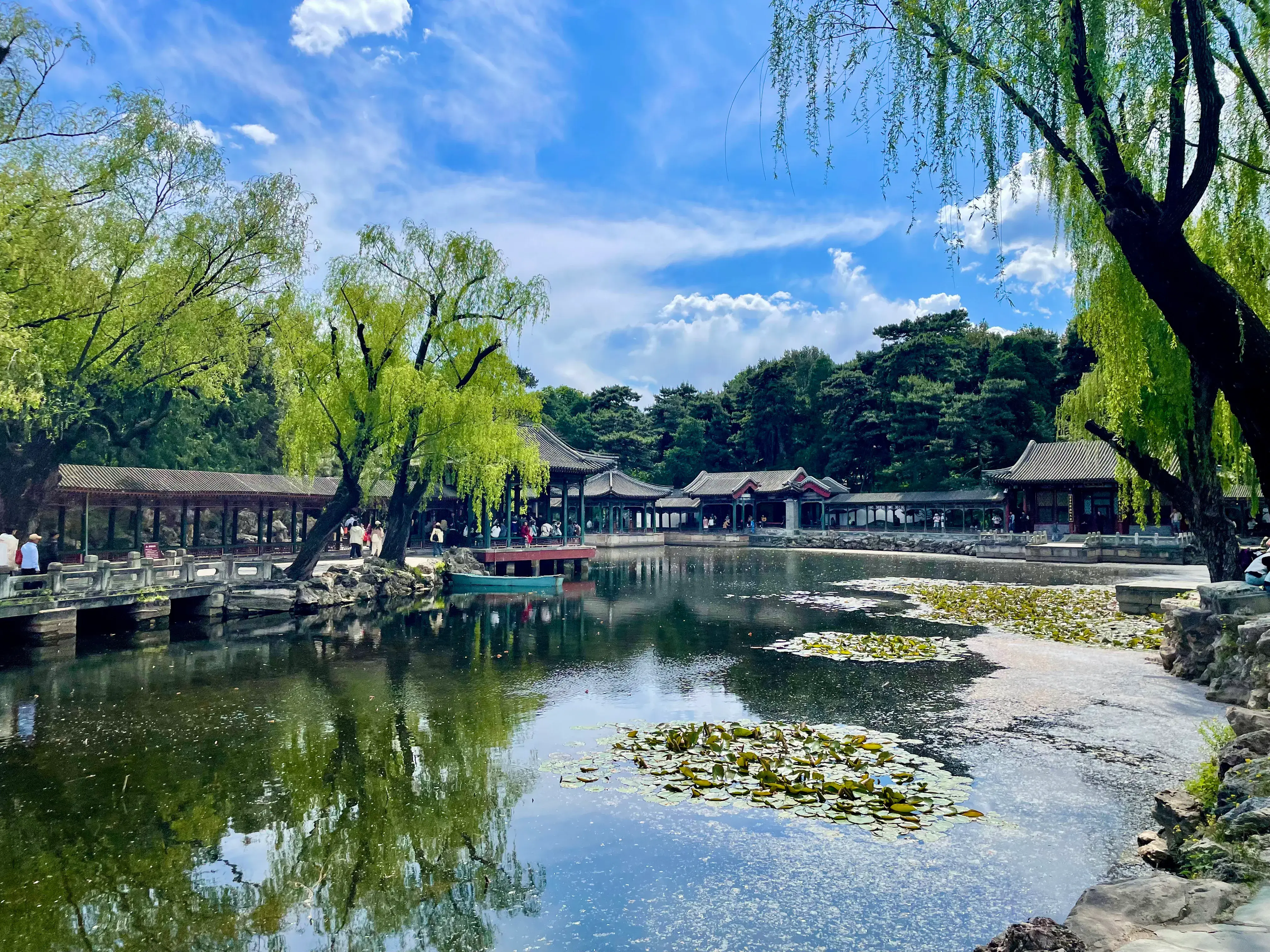
Garden of Harmonious Pleasures
Three design principles
| Principle | Mandarin term | Where to see |
|---|---|---|
| Borrowed views | Jiejing (借景) | Western Hills visible from Tower of Buddhist Incense |
| Hangzhou echo | Fang Xihu (仿西湖) | West Causeway six bridges; Suzhou Street; lake-hill composition |
| Hill-water composition | Shan-shui (山水) | Longevity Hill + Kunming Lake at 20:75 proportion |
| Framed views | Kuangjing (框景) | Pavilion windows frame specific lake or hill scenes |
| Sequence + concealment | Bie you dongtian (别有洞天) | Winding paths reveal scenes one at a time |
| Cultural quotation | Dianjing (点景) | Literature names + painted scenes on Long Corridor beams |
Hangzhou echo
Qianlong loved Hangzhou's West Lake (which he visited on multiple Southern Inspection Tours) and explicitly designed parts of the Summer Palace to evoke it. Direct quotations: (1) the West Causeway with six bridges mirrors Hangzhou's Su Causeway with six bridges - same count, same arrangement style. (2) Suzhou Street on the north side recreates a southern canal shopping street. (3) The overall hill-and-water proportions of Kunming Lake versus Longevity Hill are tuned to feel like a northern Beijing version of Hangzhou's West Lake. The cultural impulse: bring south to the north, in a court that could not travel freely.
- Qianlong loved Hangzhou's West Lake.
- West Causeway six bridges = Hangzhou's Su Causeway.
- Suzhou Street = southern canal town.
- Lake-hill proportions tuned to Hangzhou feel.
- Bring south to north in a non-travelling court.
Shan-shui hill-water composition
The classical Chinese garden formula is shan-shui ('mountain-water') - the same word that names traditional Chinese landscape painting. The Summer Palace is the maximal imperial expression: 60m artificial Longevity Hill + 2.2 km^2 expanded Kunming Lake. The proportions follow the principle that water should dominate (~75% here) and hill should punctuate (~20%), with built structures as the smaller human punctuation (~5%). The composition reads like a 3D Chinese landscape painting - which is the design intent. Pavilions and the Long Corridor are placed at exactly the points where a painter would put architecture.
- Shan-shui = mountain-water.
- Same name as traditional Chinese landscape painting.
- 75% water / 20% hill / 5% built.
- Reads as a 3D Chinese landscape painting.
- Pavilions at painter-chosen locations.
Framed views + sequence concealment
Two more principles. (1) Framed views (kuangjing): pavilions, windows, and gates frame specific scenes - a particular lake angle, a particular hill peak. Look through any pavilion window and notice the composition is intentional. (2) Sequence + concealment (bie you dongtian, 'another world inside the cave'): paths wind so that you cannot see the whole garden at once; scenes reveal one at a time as you walk. Standing at East Gate you see Long Corridor and the lake; walking the corridor, you discover Pai-yun Gate; through Pai-yun Gate you discover Hall of Dispelling Clouds; and only at the top of Longevity Hill is the entire composition visible. The slow reveal is the design experience.
- Kuangjing: pavilions frame specific scenes.
- Bie you dongtian: 'another world inside the cave'.
- Paths wind so scenes reveal slowly.
- Whole garden visible only from Tower top.
- Slow reveal is the design experience.
Framed views + sequence concealment
Two more principles. (1) Framed views (kuangjing): pavilions, windows, and gates frame specific scenes - a particular lake angle, a particular hill peak. Look through any pavilion window and notice the composition is intentional. (2) Sequence + concealment (bie you dongtian, 'another world inside the cave'): paths wind so that you cannot see the whole garden at once; scenes reveal one at a time as you walk. Standing at East Gate you see Long Corridor and the lake; walking the corridor, you discover Pai-yun Gate; through Pai-yun Gate you discover Hall of Dispelling Clouds; and only at the top of Longevity Hill is the entire composition visible. The slow reveal is the design experience.
- Kuangjing: pavilions frame specific scenes.
- Bie you dongtian: 'another world inside the cave'.
- Paths wind so scenes reveal slowly.
- Whole garden visible only from Tower top.
- Slow reveal is the design experience.
Common garden design misunderstandings
Looking for symmetry as in the Forbidden City
The Summer Palace is deliberately asymmetric - a southern-Chinese garden trait.
Missing the Western Hills as borrowed view
Climb Tower of Buddhist Incense and look beyond the garden wall - the Western Hills are part of the composition.
Treating the lake as a 'big body of water'
It's a designed shape that echoes Hangzhou's West Lake. The geometry is intentional.
Walking too fast
The design depends on slow reveal. 3-hour pace is the right pace; faster misses the unfolding.
Summer Palace garden design FAQ
- Three principles: borrowed views (Western Hills), Hangzhou echo (West Causeway, Suzhou Street), and shan-shui hill-water composition (60m artificial hill + 2.2 km^2 lake).
- A Chinese garden design technique of integrating landscapes outside the garden boundary into the composition - the view is 'borrowed' from beyond the wall.
- Qianlong loved Hangzhou's West Lake and modelled parts of the Summer Palace on it: the West Causeway with six bridges mirrors Hangzhou's Su Causeway.
- ~75% water (Kunming Lake), ~20% hill (Longevity Hill), ~5% built (Long Corridor, Tower of Buddhist Incense, pavilions, bridges).
- The Longevity Hill structures follow a strict north-south axis with symmetry. The overall layout is deliberately asymmetric - a southern-Chinese garden trait.
- Shan-shui (mountain-water) is the same term used for traditional Chinese landscape painting. The Summer Palace is designed to be experienced as a 3D landscape painting.
Walk the garden with design context
Our private SP day pairs the design context with the route - your guide names the borrowed views, the Hangzhou echo points, the framed-view pavilions.
For the broader aesthetic theory, the Chinese garden aesthetics page is the deeper companion read.