Four Great Regions
Architectural elements decoded
| Element | Function | Where to see |
|---|---|---|
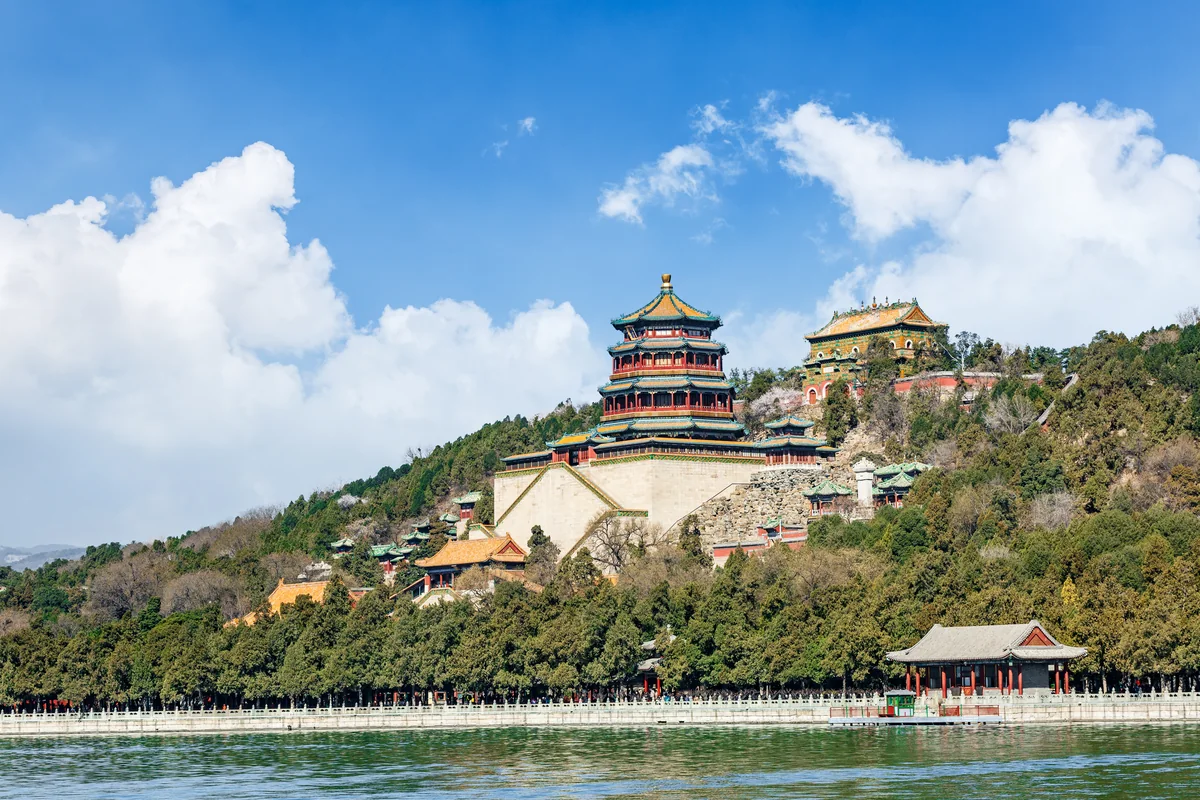
| Artificial hill (Longevity Hill) | Vertical drama, major structures | Centre north of complex |
| Constructed lake (Kunming Lake) | Horizontal expanse, reflection | Centre south of complex, 75% area |
| Covered walkway (Long Corridor) | Cultural spine, weather shelter | North shore of lake, 728m |
| Tower (Tower of Buddhist Incense) | Visual focal point, view-back-over-lake | Top of Longevity Hill |
| Hall (Hall of Dispelling Clouds) | Ceremonial space, throne hall | Mid Longevity Hill |
| Gate (Pai-yun Gate) | Threshold + ritual marker | Foot of Longevity Hill |
| Bridge (17-Arch) | Connect island to causeway | South-east lake |
| Mock town (Suzhou Street) | Imperial entertainment, southern quotation | North side, behind hill |
Yellow imperial tiles + painted beams
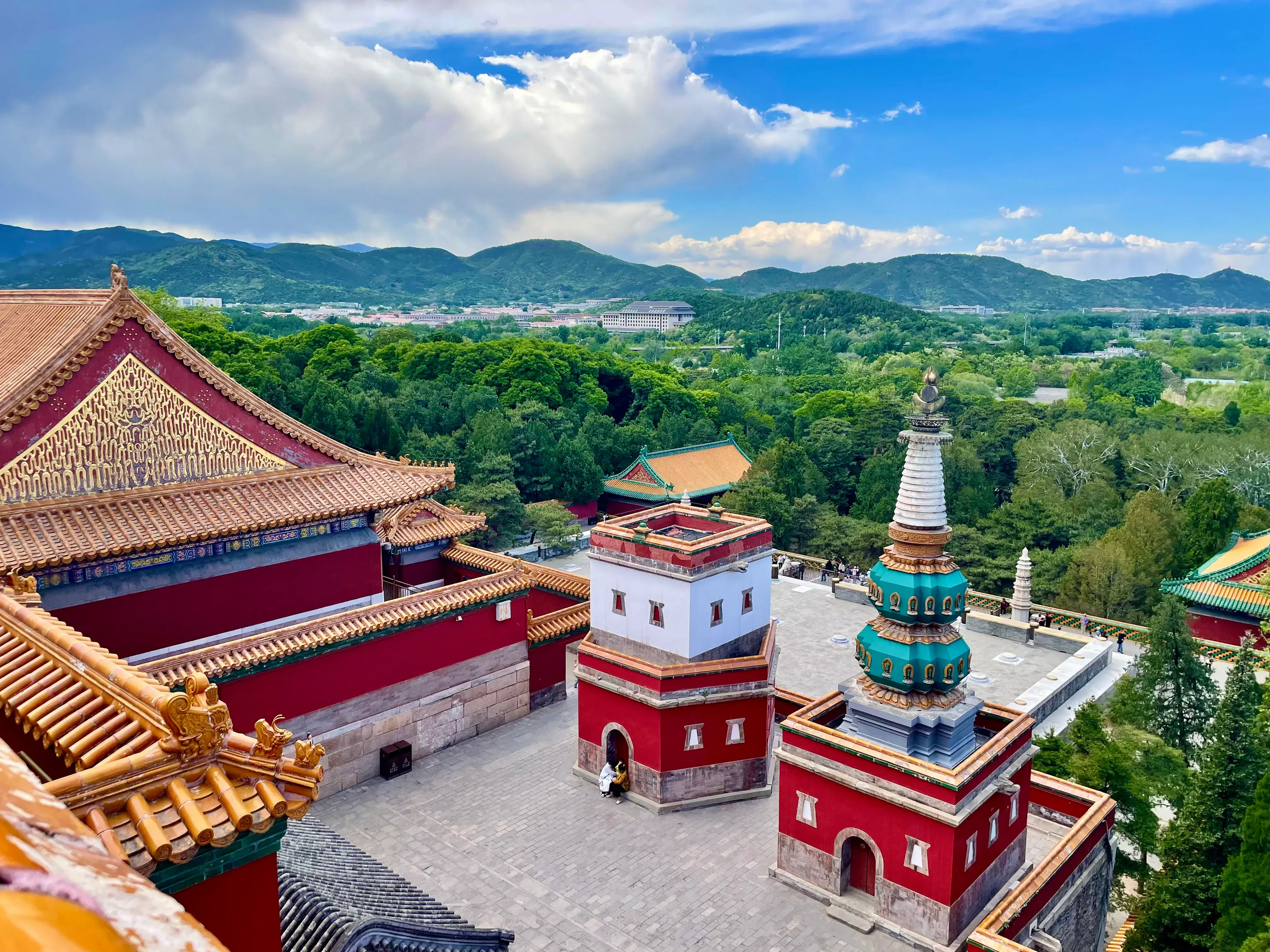
Major imperial buildings on Longevity Hill (Tower of Buddhist Incense, Hall of Dispelling Clouds, Pai-yun Gate) use yellow glazed roof tiles - the imperial-only colour, same as the Forbidden City. Wooden beams and rafters are painted in classical Qing colours: red-orange columns, green-blue ceiling panels, gold detailing. The Long Corridor's 14,000 paintings sit on the green-blue ceiling band. Lesser garden buildings (Suzhou Street shops, lakeside pavilions) use green or grey tiles, marking the architectural rank hierarchy.
- Yellow tiles: imperial-only (same as FC).
- Major hill structures yellow.
- Garden buildings green or grey tiles.
- Red-orange columns + green-blue ceilings.
- Long Corridor paintings on green-blue band.
Marble + carved stone
Carved white marble appears on plinths, balustrades, and bridge structures. The Three Great Halls of Longevity Hill (Hall of Dispelling Clouds + Tower of Buddhist Incense) sit on multi-tier marble plinths with carved dragon-cloud balustrades. The 17-Arch Bridge is entirely white marble - 544 carved lions on the balustrades, each unique. Marble Boat (Shifang) on the north-west lake corner is a marble structure shaped like a paddle steamer - Cixi's controversial naval-fund joke. Marble carries imperial rank and durability in Chinese architecture.
- White marble: plinths, balustrades, bridges.
- Hall of Dispelling Clouds: multi-tier plinth.
- 17-Arch Bridge: marble + 544 lions.
- Marble Boat: paddle-steamer shape.
- Marble carries imperial rank.
Dragon + phoenix motifs
Dragons represent the emperor; phoenixes the empress; their pairing balances yin-yang. In the Summer Palace - rebuilt by Cixi for her own residence - phoenix imagery is noticeably prominent compared to the Forbidden City. Pai-yun Gate has both dragon and phoenix carvings on its plinths. Cixi's residential halls feature phoenix motifs on screens and beam paintings. The Long Corridor pavilions include both. Five-clawed dragons are imperial-only; lesser dragons (four-clawed) appear on Suzhou Street shop facades and minor structures.
- Dragon = emperor, phoenix = empress.
- Phoenix more prominent than at FC (Cixi's residence).
- Pai-yun Gate: both dragon + phoenix.
- Cixi residence: phoenix-emphasis.
- Five-clawed dragon: imperial-only.
Dragon + phoenix motifs
Dragons represent the emperor; phoenixes the empress; their pairing balances yin-yang. In the Summer Palace - rebuilt by Cixi for her own residence - phoenix imagery is noticeably prominent compared to the Forbidden City. Pai-yun Gate has both dragon and phoenix carvings on its plinths. Cixi's residential halls feature phoenix motifs on screens and beam paintings. The Long Corridor pavilions include both. Five-clawed dragons are imperial-only; lesser dragons (four-clawed) appear on Suzhou Street shop facades and minor structures.
- Dragon = emperor, phoenix = empress.
- Phoenix more prominent than at FC (Cixi's residence).
- Pai-yun Gate: both dragon + phoenix.
- Cixi residence: phoenix-emphasis.
- Five-clawed dragon: imperial-only.
Common architecture misunderstandings
Comparing to French formal gardens
Chinese garden is hill-water-pavilion, not formal parterres. Adjust expectations.
Missing the proportions
75% water / 20% hill / 5% built. The 'built' is meant to be the smaller punctuation of the natural landscape.
Treating Long Corridor as 'just a walkway'
It's the cultural spine - the painted beams carry the entire literary tradition that frames the garden.
Not looking up
Most of the painted decoration is on ceiling beams. Look up in pavilions and in Long Corridor.
Summer Palace architecture FAQ
- Classical Chinese imperial garden: hill (Longevity Hill, artificial) + water (Kunming Lake, expanded) + pavilions (Long Corridor, Tower of Buddhist Incense, bridges).
- Yellow is imperial-only. Major imperial halls (Longevity Hill structures) use yellow; garden pavilions and Suzhou Street use green or grey, marking architectural rank.
- A 36m white-marble structure shaped like a paddle steamer, at the north-west of Kunming Lake. Built by Qianlong as a folly; Cixi expanded it during her 1888 rebuild using navy funds - widely interpreted as her bitter naval-fund joke.
- Its length matches the lake's north shore between two natural points. The 14,000 paintings on the ceiling beams are the highest concentration of painted scenes in any Chinese architectural setting.
- Mostly Cixi-era rebuilds (1886-1895) on Qianlong-era foundations (1750). Most wooden structures were burnt in 1860. Stone foundations survived.
- The Longevity Hill structures are arranged on a strict north-south axis with symmetry. The lake and overall layout are deliberately asymmetric - a southern-Chinese garden trait, not the northern court symmetry of the FC.
Walk with the architecture decoder
Our private SP day pairs the architecture decoder with the route - counting yellow tiles, naming dragon vs phoenix motifs, explaining the hill-water-pavilion formula.
If you want the deeper garden-design context, the next page covers Chinese garden aesthetics.