
A Modern Beijing Before Modern Beijing
- Location: Xiangchang New District, Xicheng District, Beijing
- Chinese name: 香厂新市区 (Xiāngchǎng Xīn Shìqū)
- Suggested visit: 2–3 hours
- Best for: Architecture, urban history, photography, cultural walks, and travelers seeking a different side of Beijing
In the heart of old Beijing, just south of Qianmen, lies a neighborhood that tells an unexpected story.
More than a century ago, long before the city's skyscrapers, shopping malls, and modern business districts, Xiangchang New District was already experimenting with a new vision of urban life.
Developed during the early Republican period, Xiangchang introduced planned streets, Shanghai-inspired residential buildings, modern hotels, and commercial entertainment venues into a city still largely defined by imperial architecture and traditional courtyard neighborhoods.
Its ambitions were remarkably modern.
In the late 1910s, the imposing New World Entertainment Complex rose above the surrounding streets, its balconies and domed tower announcing a new era of commerce and leisure. Nearby, the Beijing Oriental Hotel welcomed travelers and intellectuals, while residential developments such as Tai'an Li and Huakang Li introduced architectural forms more commonly associated with Shanghai.
The area also became closely connected with the performing arts traditions of Tianqiao, a relationship that continues through institutions such as Fenglei Peking Opera Troupe.
Much has changed since then. New World has disappeared, historic buildings have acquired new purposes, and everyday neighborhood life has replaced the bustle of the early Republican-era commercial district.
Yet Xiangchang remains one of Beijing's most fascinating places to discover the city's overlooked modern history.
1. The Birth of Xiangchang New District
Beijing at the Crossroads of Two Eras
The fall of the Qing dynasty in 1912 marked a profound turning point in Chinese history.
Beijing, which had served as an imperial capital for centuries, now faced the challenge of adapting to a changing political, economic, and social environment.
Modern urban planning was increasingly viewed as an essential part of this transformation.
New roads, commercial districts, public facilities, and residential developments promised a city better suited to modern commerce and everyday life.
During the early Republican period, the Kyoto Municipal Office (京都市政公所) promoted municipal improvement projects designed to modernize the capital.
Xiangchang became one of the most ambitious examples.
Located near Tianqiao, south of the traditional commercial center around Qianmen, the district was planned with a more regular street network, new commercial buildings, and modern residential arrangements.
An Experiment in Modern Urban Planning
Traditional Beijing was characterized by hutongs, enclosed courtyard compounds, neighborhood markets, temples, and monumental imperial architecture.
Xiangchang introduced a different urban vocabulary.
Its streets emphasized accessibility and commercial activity. Buildings increasingly faced outward toward public streets rather than inward toward private courtyards.
Architectural styles drew on influences from other Chinese cities and abroad.
The district was intended to accommodate modern businesses, hospitality, entertainment, and residential life.
Xiangchang was therefore more than a construction project. It represented an early attempt to reconsider how Beijing should function as a modern city.
2. Tai'an Li: A Piece of Old Shanghai in Beijing
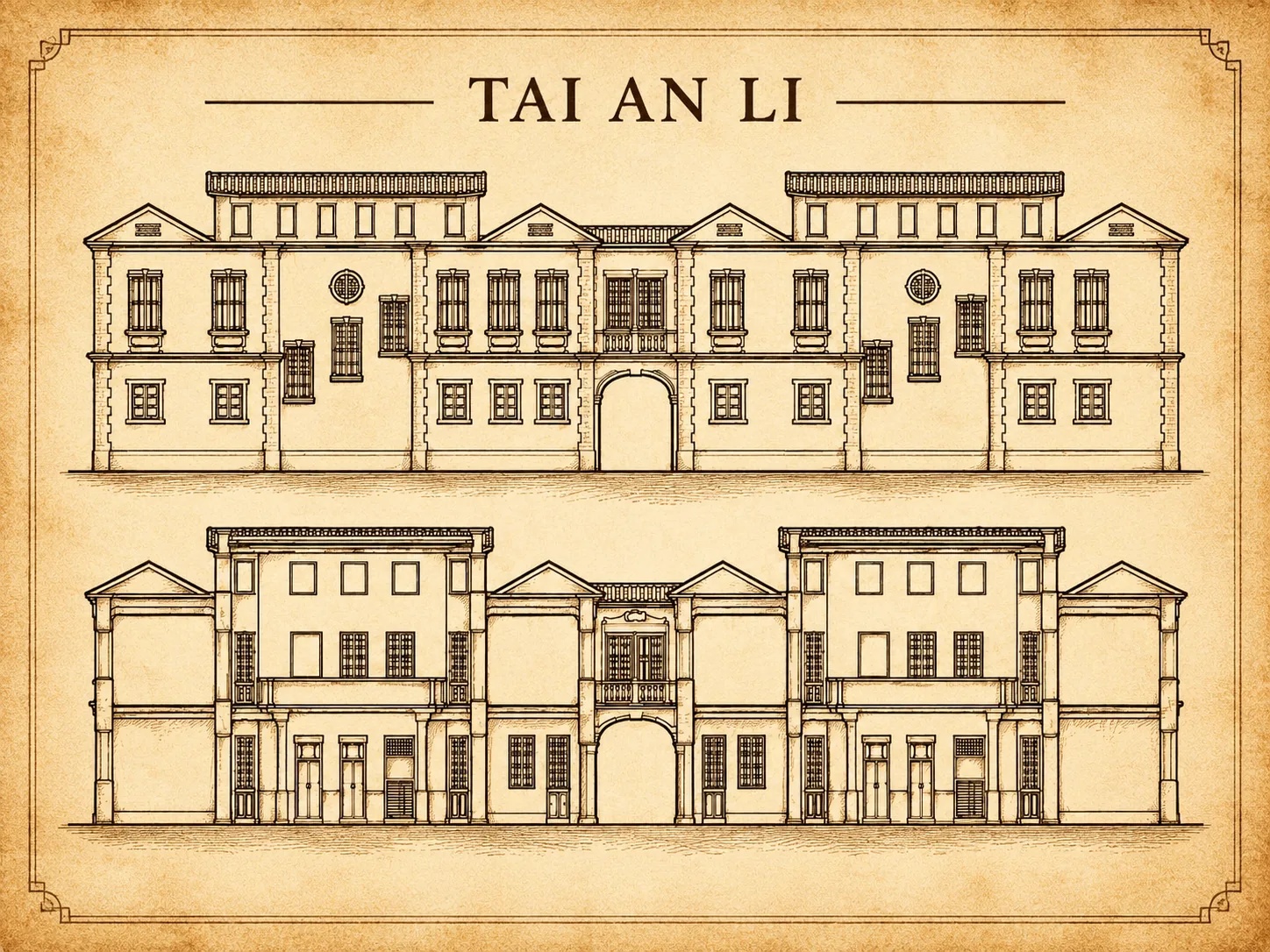
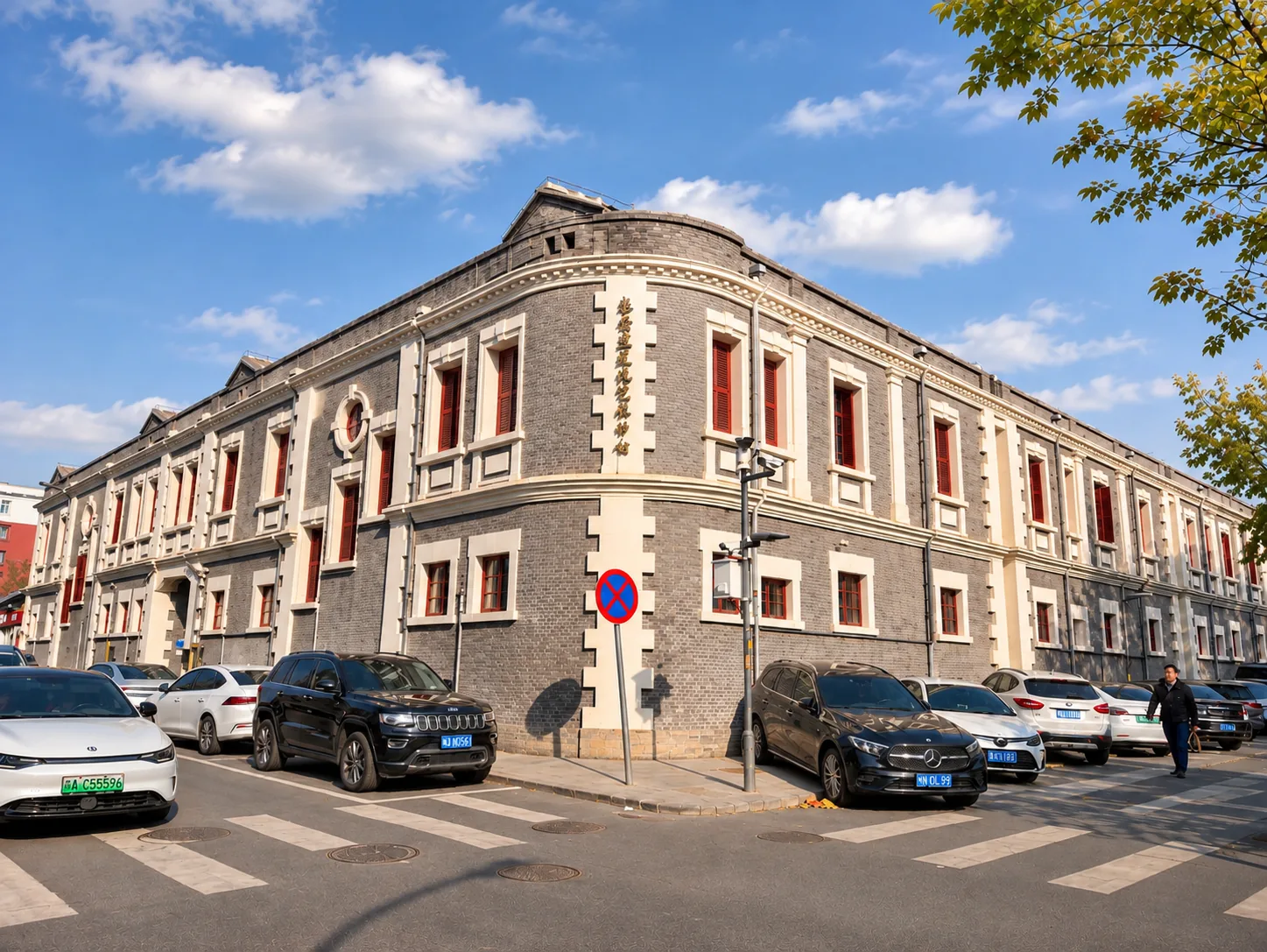
One of the most distinctive surviving landmarks of Xiangchang is Tai'an Li (泰安里).
Built during the district's early development, around 1915–1918, Tai'an Li reflects architectural ideas associated with Shanghai's *shikumen* and *lilong* residential neighborhoods.
These housing forms combined compact urban layouts with elements of Chinese and Western architecture.
Unlike Beijing's traditional courtyard houses, which typically organized living spaces around enclosed courtyards, Shanghai-style lane residences featured adjoining buildings, narrow passages, and prominent street-facing entrances.
An Unusual Architectural Encounter
Tai'an Li consists of two-story buildings arranged around an internal passage.
Its brick facades, compact proportions, and lane-based organization create an atmosphere quite different from Beijing's familiar hutongs.
The architecture recalls the residential neighborhoods of early twentieth-century Shanghai, yet the complex sits within the historical fabric of southern Beijing.
This contrast makes Tai'an Li especially interesting.
It demonstrates how urban ideas circulated between Chinese cities during the Republican period, influencing not only grand public buildings but also everyday residential architecture.
Tai'an Li Today
The complex has undergone restoration and adaptive reuse, introducing contemporary cultural activities into a historic architectural setting.
Visitors can appreciate its distinctive building arrangement, facades, entrances, and architectural details.
Tai'an Li is one of the clearest surviving expressions of Xiangchang's early modern ambitions.
What to see: Two-story historic buildings, Shanghai-inspired lane architecture, brick facades, and the internal passage.
Location: Renshou Road, Xiangchang.
 Click to enlarge
 Click to enlarge
3. Huakang Li: Everyday Life in a Modernizing City
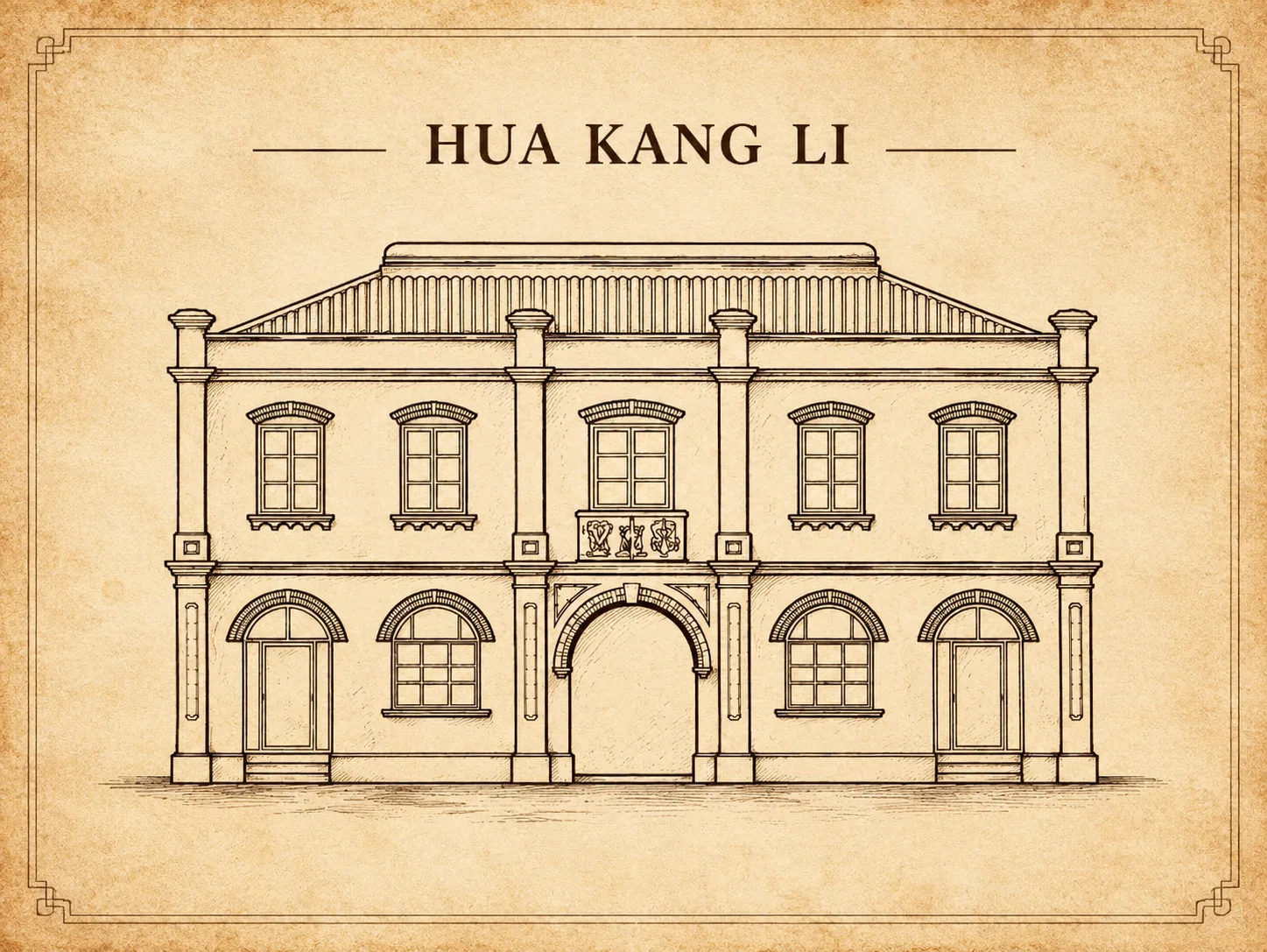
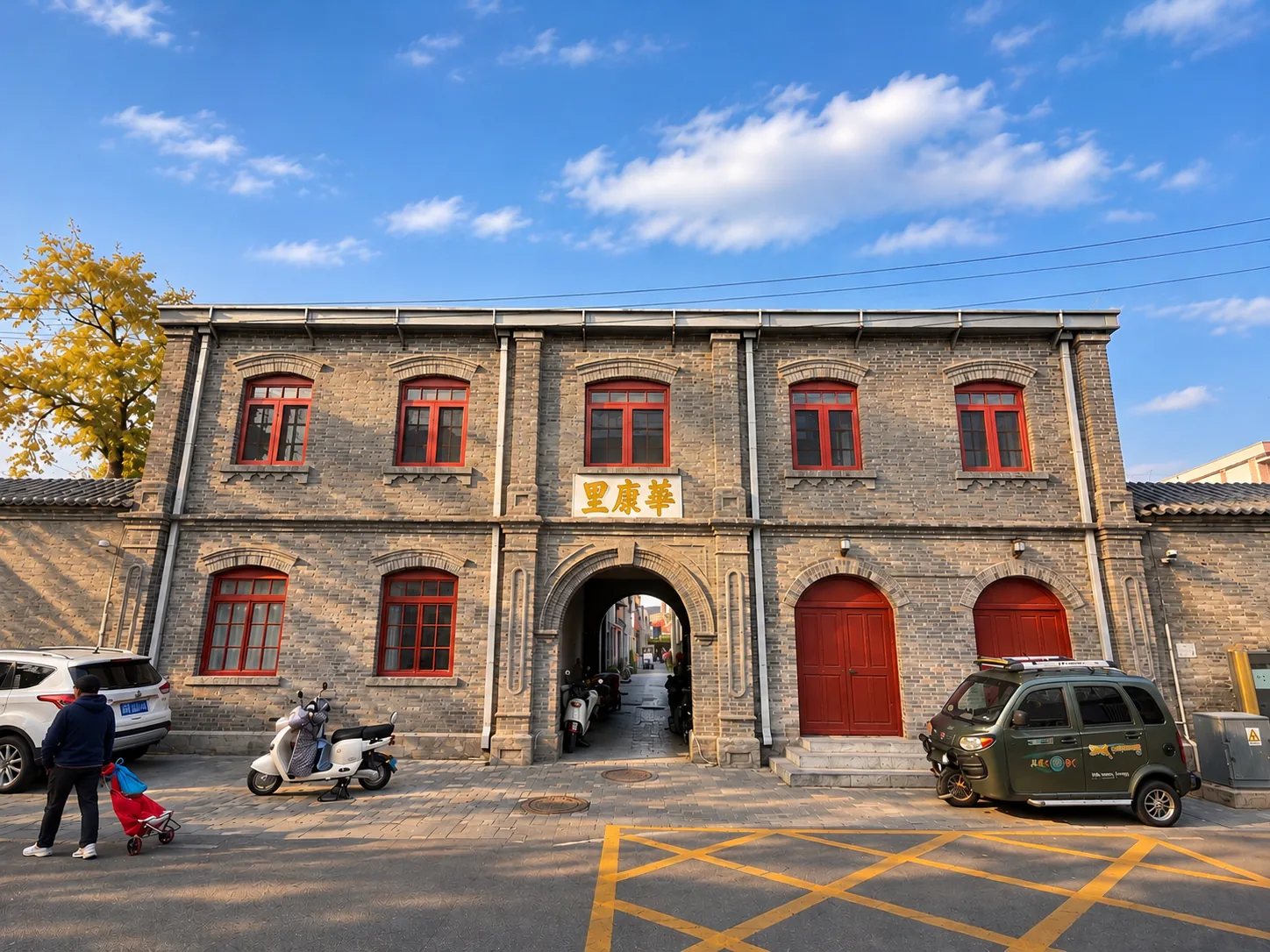
A short distance from Tai'an Li, Huakang Li (华康里) offers another glimpse into Xiangchang's residential history.
Like Tai'an Li, Huakang Li reflects the introduction of new urban housing forms during the early Republican period.
Its buildings illustrate how residential development was changing as Beijing experimented with more compact arrangements and architectural styles influenced by other cities.
Beyond the Traditional Courtyard
The traditional Beijing *siheyuan*, or courtyard house, was designed around a central enclosed space.
It reflected long-established patterns of family life, privacy, and spatial organization.
The residential forms introduced in Xiangchang followed different priorities.
More compact building arrangements made use of limited urban land, while entrances and facades established a closer relationship with the surrounding street network.
Huakang Li provides evidence of this changing approach.
Why Huakang Li Matters
Although less visually prominent than some of Xiangchang's commercial landmarks, Huakang Li is important because it represents the ordinary residential dimension of the district's modernization.
The story of Xiangchang was not only about grand hotels and entertainment complexes.
It was also about how people lived.
Together, Huakang Li and Tai'an Li reveal an early attempt to introduce new patterns of urban housing into Beijing.
What to see: Historic residential facades, building proportions, lane entrances, and surviving architectural details.
Location: Huayan Road, Xiangchang.
 Click to enlarge
 Click to enlarge
4. Beijing Oriental Hotel: Hospitality, Modernity, and Revolution
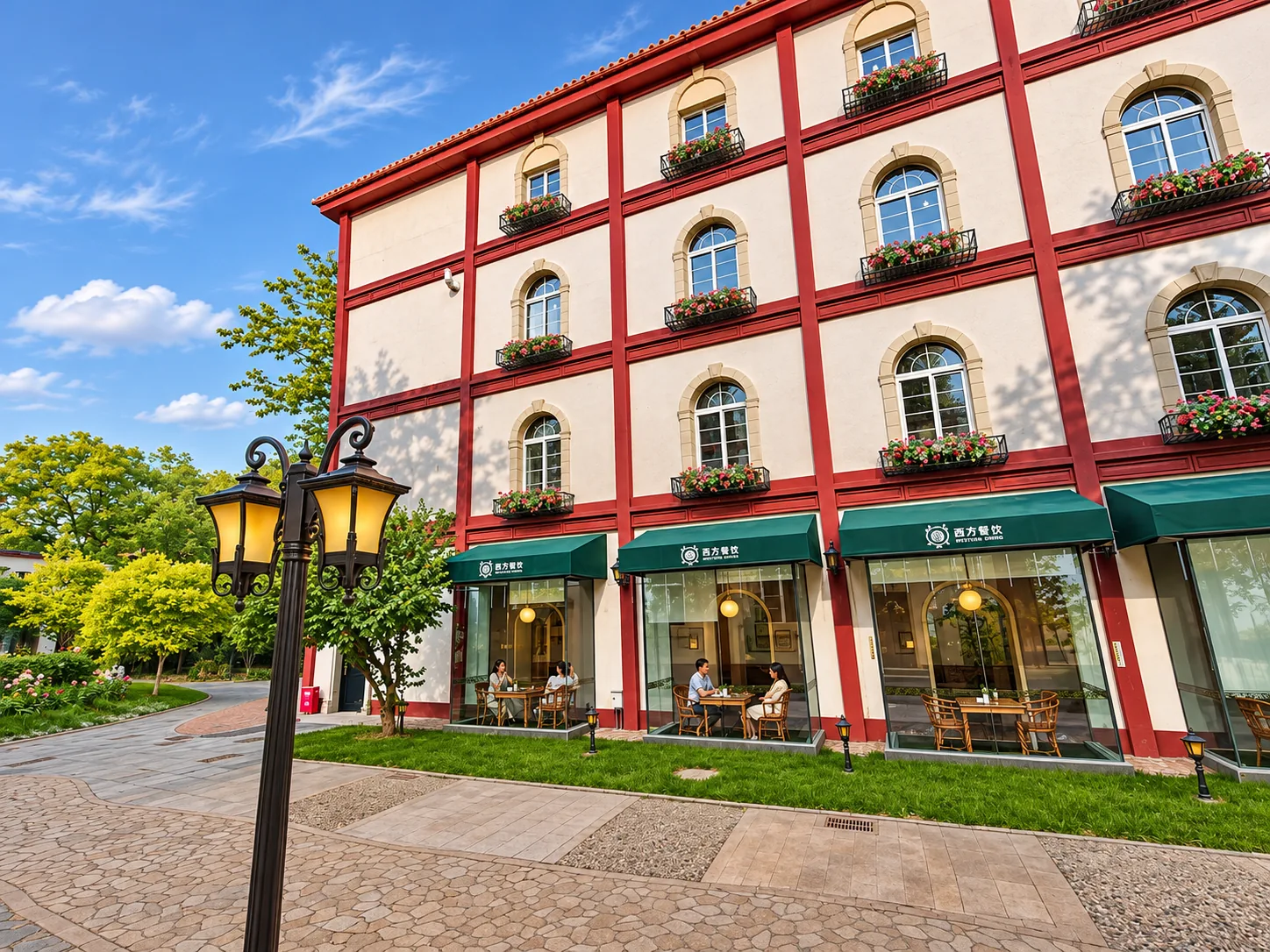
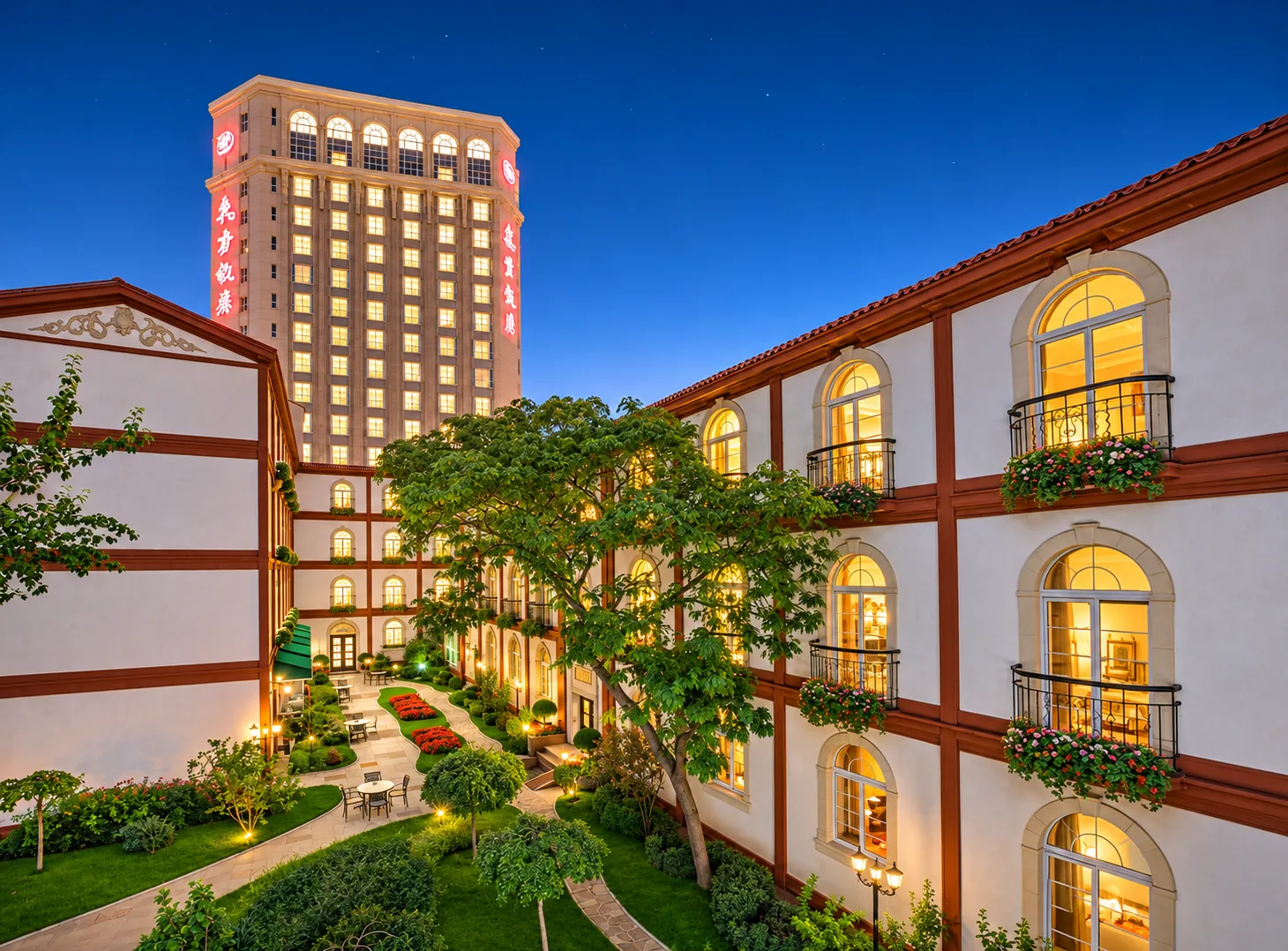
The Beijing Oriental Hotel (北京东方饭店) is among the most historically significant surviving landmarks in Xiangchang.
Opened in February 1918, the hotel represented a new standard of hospitality in early Republican-era Beijing.
At a time when traditional inns remained common, modern hotels offered a different experience.
The Oriental Hotel was noted for amenities such as heating, telephones, and elevator service, reflecting changing expectations of urban comfort and international-style accommodation.
Its architecture and facilities embodied Xiangchang's ambition to become a modern commercial district.
A Landmark of the New Culture Era
The hotel also became connected with one of the most important intellectual and political movements in modern Chinese history.
In June 1919, Chen Duxiu, a leading figure in the New Culture Movement, stayed at the Oriental Hotel.
He subsequently distributed political leaflets at the nearby New World Entertainment Complex, where he was arrested.
The incident took place during the political ferment surrounding the May Fourth Movement, when students, intellectuals, and activists were challenging established ideas and institutions.
The relationship between the hotel and New World illustrates how Xiangchang's new commercial spaces became part of a changing political and intellectual landscape.
Visiting the Oriental Hotel
The historic hotel buildings remain an important part of Wanming Road's architectural character.
Their surviving facades provide a tangible connection to the early twentieth century, when modern hospitality was becoming part of Beijing's urban identity.
What to see: Historic hotel architecture, window arrangements, decorative facades, and early Republican-era building details.
Location: 11 Wanming Road, Beijing.
 Click to enlarge
 Click to enlarge
5. New World: Beijing's Lost Entertainment Palace
In the late 1910s, one of the most distinctive buildings in Xiangchang appeared in the district.
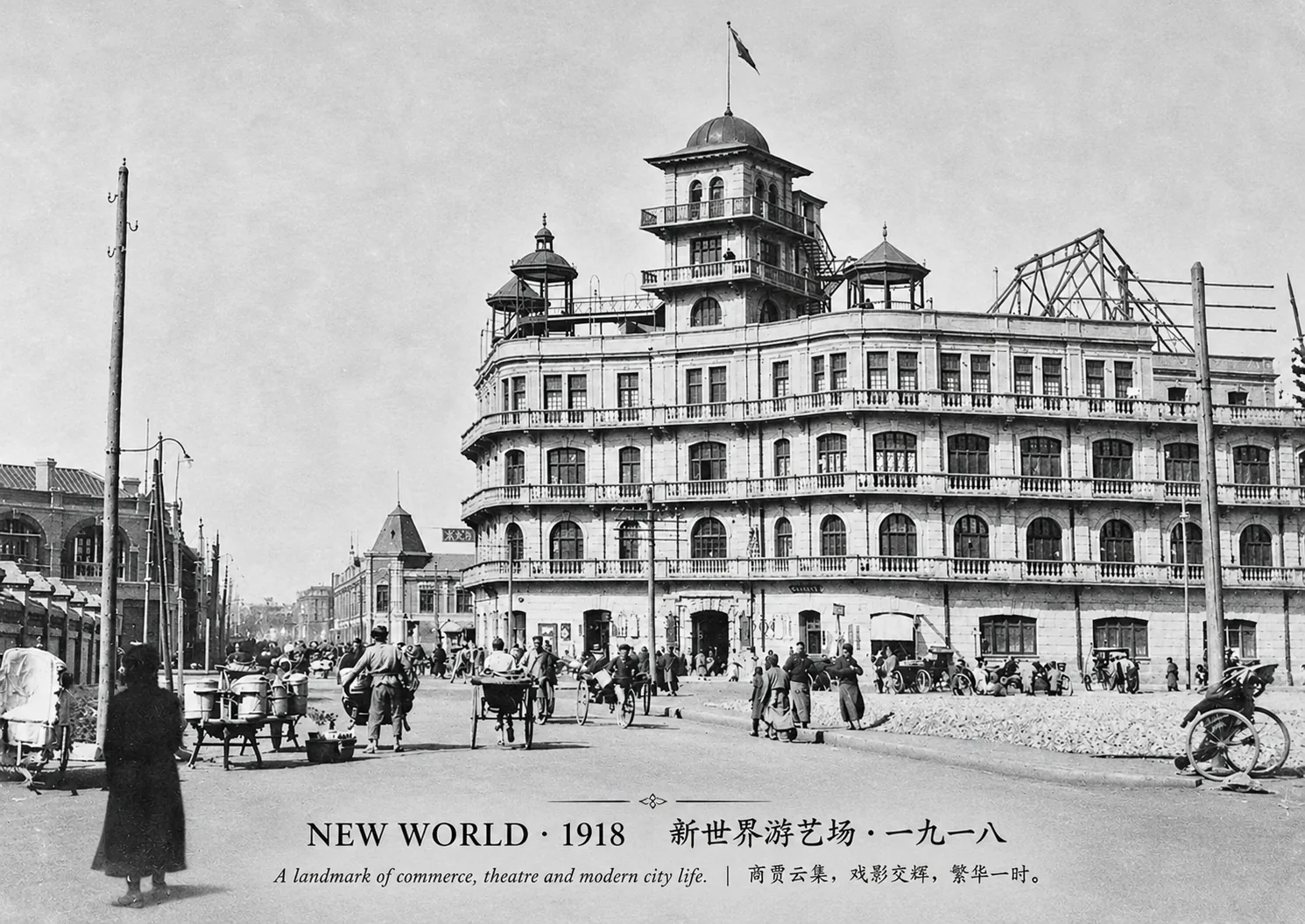
Known as New World (新世界游艺场, Xin Shijie), the complex represented an ambitious new approach to commercial entertainment and urban leisure.
Its architecture was striking.
A grand multi-story facade rose above the surrounding streets, with sweeping balconies, rows of arched windows, rooftop pavilions, and a prominent central tower crowned by a dome.
The building's scale and appearance were dramatically different from the traditional architecture of old Beijing.
It looked toward a new age.
More Than an Amusement Park
The Chinese term *youyichang* (游艺场) is sometimes translated as "amusement park," but the expression can be misleading.
New World was closer to an early urban entertainment and commercial complex.
Such establishments combined leisure, performances, social gathering, and commercial activities within purpose-built buildings.
They belonged to a new culture of urban consumption that was emerging in Chinese cities during the early twentieth century.
For residents of Republican-era Beijing, venues like New World offered a different way to spend time in the city.
Entertainment was no longer confined to temple fairs, open-air performances, and traditional markets.
Modern commercial establishments created new environments where people could gather, watch performances, and participate in urban social life.
An Architectural Symbol of Modern Beijing
Historic photographs of New World reveal the scale of Xiangchang's ambitions.
Its monumental street frontage, balconies, tower, and rooftop structures suggest a cosmopolitan architectural language that is rarely associated with the popular image of old Beijing.
The building was not simply a place of entertainment.
It was a visible symbol of the city's desire to modernize.
Chen Duxiu and the Events of 1919
New World also became the setting for an important political episode.
In June 1919, Chen Duxiu, who had been staying at the nearby Oriental Hotel, distributed political leaflets at New World and was arrested.
The incident connected the district's commercial entertainment culture with the intellectual and political movements transforming China.
Public leisure spaces could also become places where ideas circulated and political activity unfolded.
A Landmark That No Longer Exists
The original New World building has disappeared from Beijing's streetscape.
Unlike Tai'an Li, Huakang Li, and the Oriental Hotel, it cannot be visited today.
Historic photographs are therefore particularly valuable.
They preserve the image of a remarkable building and offer a glimpse of the cosmopolitan atmosphere that Xiangchang's planners hoped to create.
Although New World no longer stands, its story remains essential to understanding the district.
It represents the commercial, architectural, and cultural ambitions of an era when Beijing was beginning to imagine a different urban future.
 Click to enlarge
6. Fenglei Peking Opera Troupe: The Living Heritage of Tianqiao
Not all of Xiangchang's history is preserved in brick and stone.
The district also belongs to the wider cultural landscape of Tianqiao, historically one of Beijing's most important centers of popular entertainment.
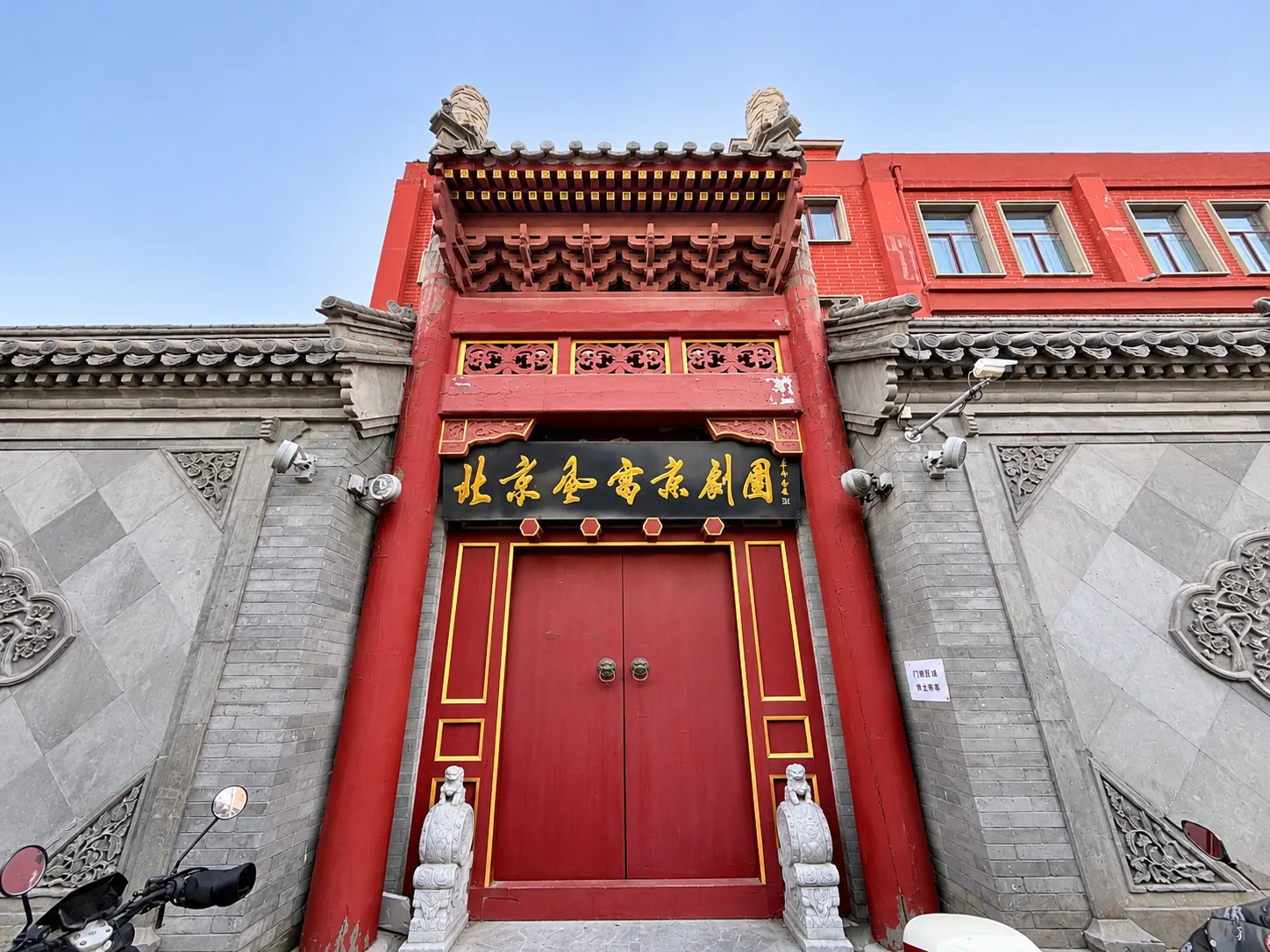
Located in Banzhang Hutong, Fenglei Peking Opera Troupe (风雷京剧团) represents a living connection with this tradition.
The troupe traces its origins to 1937 and has maintained a longstanding role in the performance and transmission of Peking opera.
Tianqiao: Beijing's Historic Entertainment District
For generations, Tianqiao attracted performers, storytellers, acrobats, merchants, and audiences from across Beijing.
Its streets were famous for public entertainment.
Peking opera, storytelling, martial arts performances, acrobatics, and other traditional arts formed part of the area's lively cultural environment.
This was a different world from the imperial institutions and formal architecture of northern Beijing.
Tianqiao reflected the tastes, commerce, and social life of ordinary urban residents.
The Art of Peking Opera
Peking opera combines singing, spoken dialogue, stylized movement, martial arts, elaborate costumes, and symbolic gestures.
Its performers undergo demanding training, developing specialized skills that are passed between generations.
Fenglei Peking Opera Troupe belongs to this continuing artistic tradition.
Its presence in the neighborhood adds an important dimension to Xiangchang's history.
The district's heritage is not only architectural.
It also includes the performing arts and cultural institutions that shaped the social life of southern Beijing.
Tradition and Modernity Side by Side
Xiangchang's early commercial development and Tianqiao's established entertainment culture existed alongside one another.
New venues introduced modern forms of commercial leisure, while traditional performing arts continued to attract audiences.
Fenglei represents this continuity.
It reminds visitors that modernization did not simply replace older cultural traditions. Different forms of entertainment and social life adapted, interacted, and evolved together.
What to see: The troupe's premises and surrounding hutong environment. Interior access and performance schedules should be confirmed separately.
Location: Banzhang Hutong, near Xiangchang.
 Click to enlarge
7. The Commercial Culture of Early Modern Beijing
The development of Xiangchang reflected broader changes in Chinese urban society.
During the early twentieth century, modern commercial institutions were transforming how people worked, shopped, traveled, and spent their leisure time.
Hotels, theaters, restaurants, recreation halls, and new forms of retail created a different urban experience.
Xiangchang was part of this transformation.
From Temple Markets to Entertainment Complexes
Traditional Beijing's public entertainment had long been associated with temples, markets, seasonal festivals, and open-air performances.
Modern commercial venues introduced more permanent and organized spaces for leisure.
New World represented this change on a particularly ambitious scale.
Its grand architecture and commercial function reflected the emergence of a new urban culture.
Architecture as an Expression of Change
Buildings were no longer designed solely around traditional residential or institutional forms.
Commercial architecture increasingly emphasized visibility, public access, decoration, and modern amenities.
Hotels advertised comfort and convenience.
Entertainment complexes attracted visitors through spectacle and novelty.
Residential developments experimented with new ways of organizing urban space.
In Xiangchang, these changes appeared within a relatively compact neighborhood.
That concentration makes the district especially valuable for understanding Beijing's early modernization.
8. Exploring Xiangchang Today
Xiangchang is not a conventional historic attraction.
There is no single entrance gate, ticket office, or official route covering every landmark.
Instead, it is a living neighborhood where historic architecture, later development, residential life, and contemporary cultural uses exist side by side.
The best way to experience Xiangchang is on foot.
Look Beyond the Street Level
Many historic facades have been altered by modern shopfronts and signage.
Look upward for original windows, decorative details, cornices, and brickwork.
Compare the Architecture
Tai'an Li and Huakang Li offer opportunities to compare Shanghai-influenced residential forms with Beijing's traditional courtyard houses.
The Oriental Hotel illustrates a different architectural response to modernization, shaped by commercial hospitality.
Imagine the Lost City
Historic photographs of New World help visitors understand how dramatically the district has changed.
Although the original building no longer survives, its image reveals the scale of the neighborhood's early twentieth-century ambitions.
Observe Everyday Life
Xiangchang remains part of contemporary Beijing.
Its streets are used by residents, businesses, and visitors.
This continuity is part of its character.
Rather than presenting a perfectly preserved historical environment, Xiangchang reveals how a city changes while retaining traces of its past.
9. Xiangchang Historical Walking Route
Suggested duration: 2–3 hours Style: Self-guided architectural and cultural walk Main themes: Urban planning, Republican-era architecture, modern hospitality, and performing arts
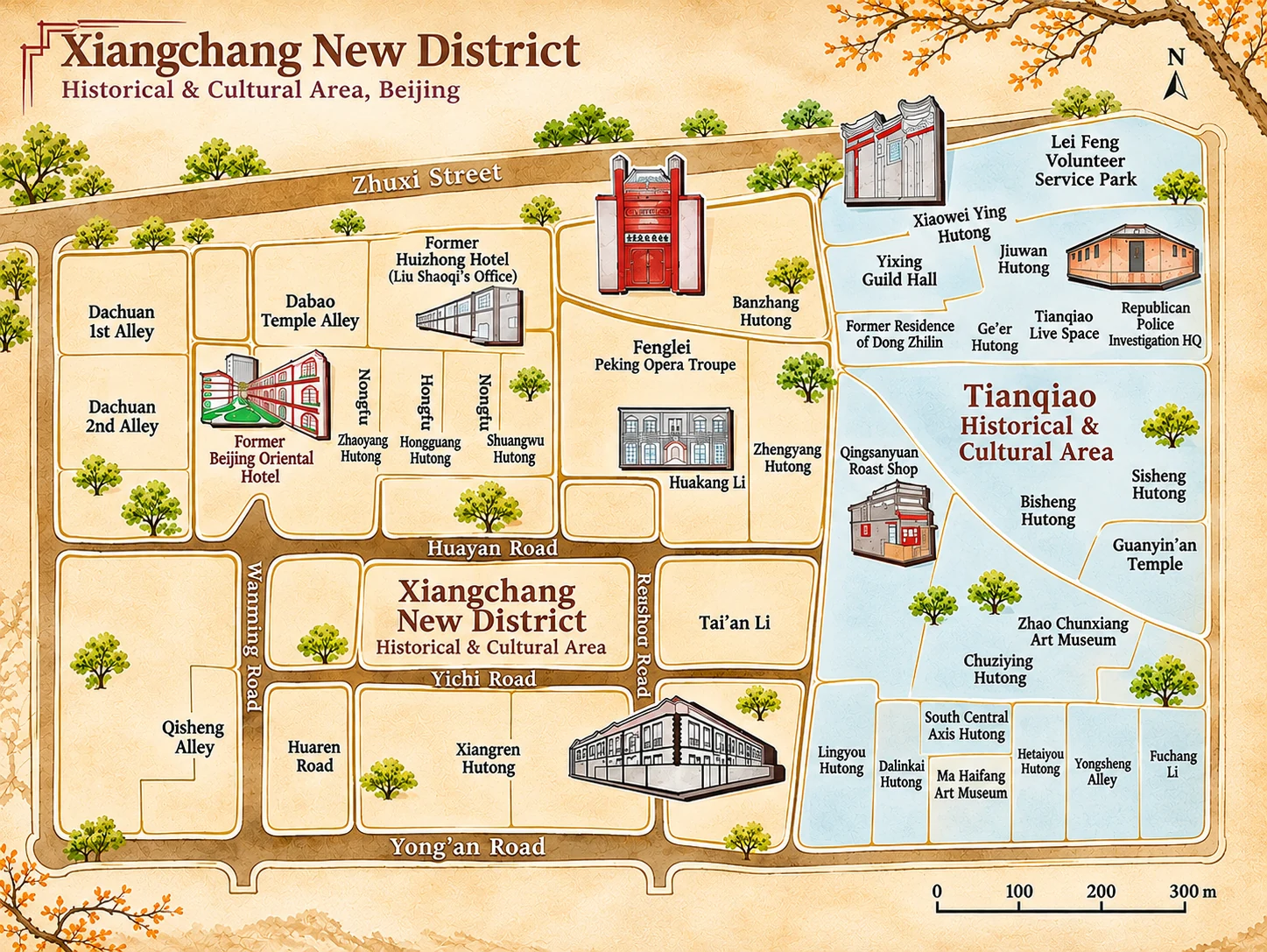 Click to enlarge
Stop 1 — Beijing Oriental Hotel
*20–30 minutes*
Begin on Wanming Road at the historic Oriental Hotel.
Observe the architecture and consider the emergence of modern hospitality in Republican-era Beijing.
Introduce the hotel's connection with Chen Duxiu and the political events of 1919.
Historical Interlude — New World Entertainment Complex
*10–15 minutes*
Use historic photographs to explore the story of New World.
The original building no longer exists, so this is a historical interpretation rather than an interior visit.
Its architecture and cultural significance provide a vivid introduction to Xiangchang's commercial ambitions.
Stop 2 — Huakang Li
*20–30 minutes*
Continue toward Huayan Road.
Explore the surviving residential architecture of Huakang Li and consider how new housing forms were introduced into early twentieth-century Beijing.
Stop 3 — Fenglei Peking Opera Troupe
*20–30 minutes*
Walk toward Banzhang Hutong.
Discover the connection between Xiangchang and Tianqiao's performing arts heritage.
The troupe's history offers a different perspective on the neighborhood, moving beyond architecture to living cultural traditions.
Stop 4 — Tai'an Li
*30–45 minutes*
Finish at Tai'an Li on Renshou Road.
Its Shanghai-inspired architecture provides a memorable conclusion to the walk.
Observe the two-story buildings, brick facades, and internal passage.
The complex demonstrates how historic architecture can acquire new cultural functions while preserving its connection with the past.
Optional Extension — Tianqiao
*Additional 45–60 minutes*
Continue toward Tianqiao to explore the wider history of Beijing's popular entertainment culture.
This extension connects Xiangchang's early modern commercial development with the traditional performance world of southern Beijing.
10. Combining Xiangchang With Other Beijing Attractions
Xiangchang and Dashilar
Dashilar (大栅栏) is one of Beijing's best-known historic commercial districts.
Its traditional shops and old streets provide a useful comparison with Xiangchang's early twentieth-century commercial architecture.
Together, the neighborhoods reveal different phases of Beijing's commercial development.
Xiangchang and the Temple of Heaven
The Temple of Heaven represents the ceremonial architecture of imperial Beijing.
Xiangchang illustrates the emergence of modern commercial and residential priorities after the end of imperial rule.
Visiting both offers a striking architectural contrast.
Xiangchang and Tianqiao
This is the most natural cultural combination.
Explore Xiangchang's early modern buildings alongside Tianqiao's performing arts heritage.
The route is especially suitable for travelers interested in Beijing's social and cultural history.
11. Practical Information
Where Is Xiangchang?
Xiangchang New District is located in Xicheng District, south of Qianmen and close to the historic Tianqiao area.
How Long Does a Visit Take?
Allow approximately two to three hours for a relaxed walk covering the principal surviving landmarks.
A half-day excursion can include Tianqiao or Dashilar.
Is Xiangchang Free to Visit?
Walking along the public streets is generally free.
Individual historic buildings may have restricted access, separate operating hours, or admission requirements.
When Is the Best Time to Visit?
Spring and autumn offer generally comfortable conditions for walking.
Morning and late afternoon are often suitable for architectural photography.
Can You Enter the Historic Buildings?
Access varies.
Some historic buildings have been restored for cultural or commercial use, while others remain privately occupied or have restricted interiors.
Visitors should respect residential privacy and confirm access arrangements in advance.
Is Xiangchang Suitable for First-Time Visitors?
Xiangchang is particularly rewarding for travelers interested in architecture, urban history, photography, and lesser-known neighborhoods.
First-time visitors with limited time may prefer Beijing's major landmarks.
For repeat visitors or travelers seeking a deeper understanding of the city, Xiangchang offers a distinctive experience.
12. Why Xiangchang Matters
Beijing's history is often presented through two familiar images.
The first is the imperial capital, with its palaces, temples, courtyard houses, and ancient streets.
The second is the contemporary metropolis, with its skyscrapers, expressways, and modern infrastructure.
Xiangchang reveals a chapter between these two worlds.
Its buildings and streets reflect a period when Chinese planners, architects, entrepreneurs, and residents were reconsidering how a modern city should function.
Tai'an Li and Huakang Li illustrate the introduction of new residential forms.
The Oriental Hotel represents modern hospitality and its connection with the intellectual currents of the Republican era.
New World, though long vanished, reveals the extraordinary ambition of early commercial entertainment architecture.
Fenglei Peking Opera Troupe connects the district with the continuing performing arts traditions of southern Beijing.
Together, these landmarks tell a story of experimentation, cultural exchange, and urban transformation.
Xiangchang reminds us that Beijing's modernization did not begin with the skyscrapers of recent decades.
Its foundations were already being laid more than a century ago, in neighborhoods that remain part of the city today.
Historical references are available in the district conservation plan, the Xicheng district history office’s New World entry, and a Beijing archives account of the Oriental Hotel.
13. Explore Historic Beijing With DragonTrail
Xiangchang offers a rewarding alternative to Beijing's conventional sightseeing routes.
For travelers interested in architecture, history, photography, or urban culture, DragonTrail can arrange private transportation and customized cultural excursions incorporating Xiangchang, Tianqiao, Dashilar, and other historic neighborhoods.
Suggested experience: Xiangchang & Historic Southern Beijing
Duration: Half day or full day Transport: Private vehicle with driver Optional: English-speaking guide, subject to availability Pickup: Beijing hotels or agreed city locations
Contact DragonTrail to arrange a customized Beijing cultural itinerary.
FAQ
- Xiangchang New District (香厂新市区) is an early twentieth-century planned urban neighborhood in southern Beijing. It introduced modern commercial buildings, new residential forms, and planned streets during the Republican period.
- Xiangchang was an early experiment in modern urban planning in Beijing. Its architecture reflects changing ideas about commerce, housing, hospitality, and public entertainment.
- The principal landmarks discussed in this guide are Tai'an Li, Huakang Li, Beijing Oriental Hotel, New World Entertainment Complex, and Fenglei Peking Opera Troupe. New World no longer survives.
- New World (新世界游艺场) was an early twentieth-century commercial entertainment complex known for its imposing multi-story architecture and modern leisure facilities. It was also the site of Chen Duxiu's arrest in June 1919.
- No. The original New World building has disappeared. Historic photographs preserve its appearance and architectural significance.
- Tai'an Li incorporates architectural ideas associated with Shanghai's *shikumen* and *lilong* residential developments, making it distinctive within Beijing's traditional urban landscape.
- Opened in 1918, the Oriental Hotel was a modern hospitality establishment associated with the early Republican period. It also has historical connections with Chen Duxiu and the events of 1919.
- No. They are neighboring historic areas. Xiangchang is especially notable for early modern urban development, while Tianqiao is known for its traditional entertainment and performing arts heritage.
- Two to three hours is generally sufficient for a relaxed historical walk. Allow half a day if combining Xiangchang with Tianqiao or Dashilar.
- Yes. The public streets can be explored independently, although historical interpretation can help visitors understand the significance of the buildings and their relationship to Beijing's modernization.