

Season snapshot
| Fact | Detail |
|---|---|
| Peak demand | May (GKP silk road tour) — confirm on quote |
| Comfort shoulders | Mar–Apr · Sep–Nov — confirm on quote |
| Heat caution | Jun–Aug Turpan / Hexi desert — confirm on quote |
| Winter | Caves possible · cold transfers — confirm on quote |
Best time for China Silk Road
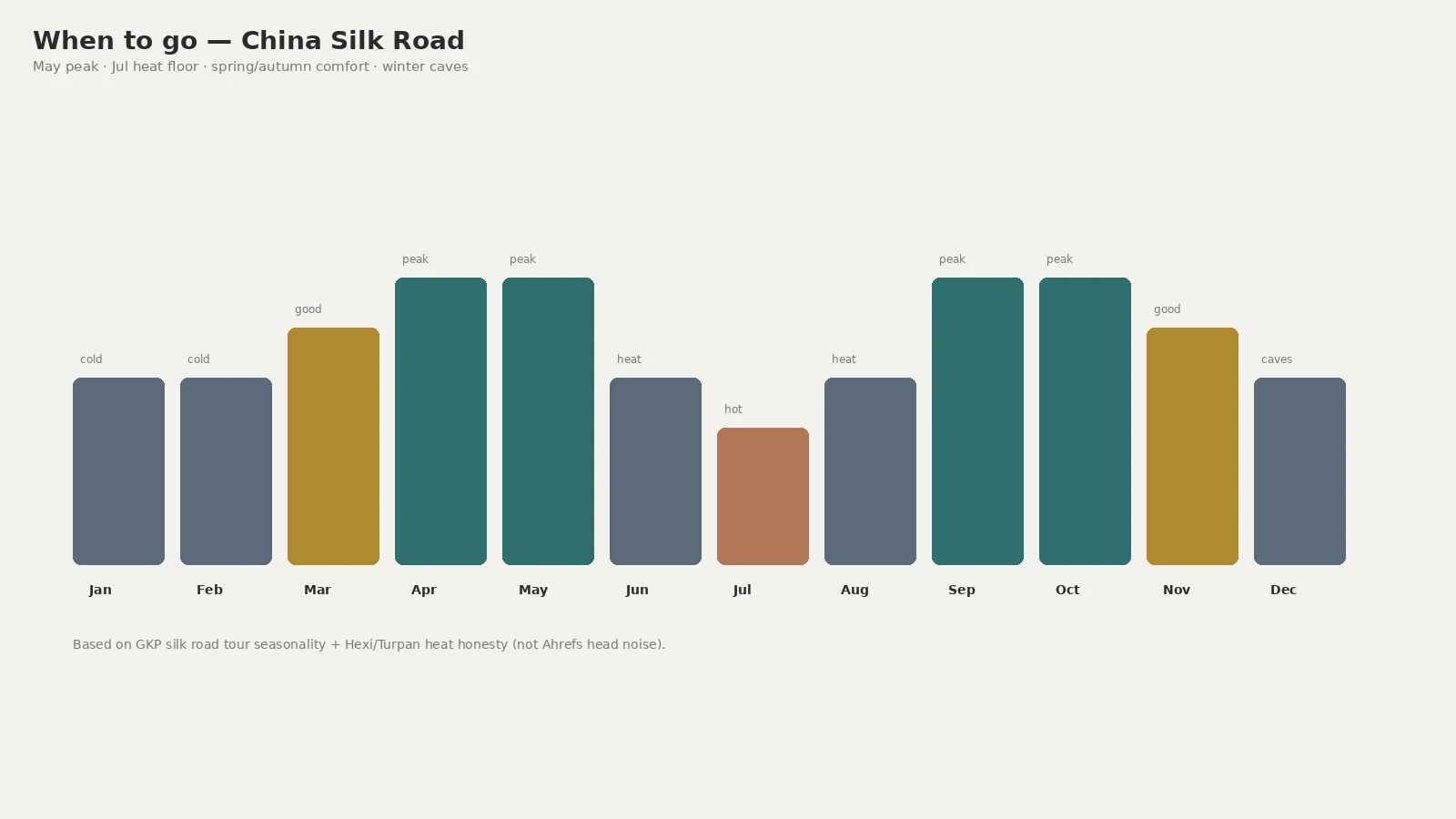
GKP seasonality for `silk road tour` peaks May; summer floors with Hexi + Turpan heat; spring and autumn shoulders are the comfort story. Winter is possible for Dunhuang caves with honest cave-hours and cold transfer notes.
Month mindset
- Mar–May — strong Classic window; May peak demand
- Jun–Aug — heat honesty for Turpan / desert Hexi; longer buffers
- Sep–Nov — excellent shoulder for multi-province
- Dec–Feb — cave-focused possible; fewer soft desert photo days
Qinghai spur note
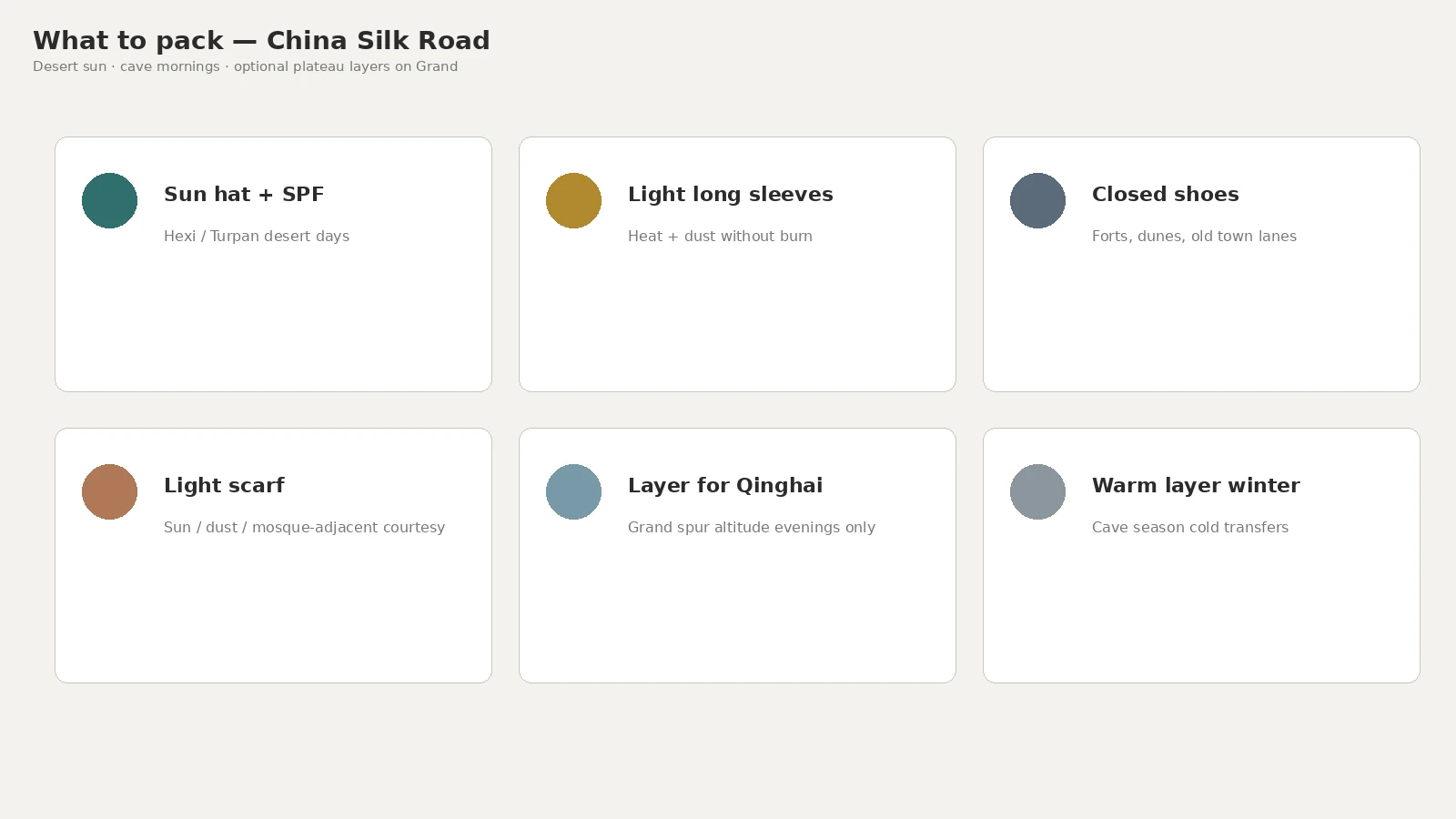
If Grand includes Qinghai Lake, add altitude and plateau shoulder logic — see Qinghai for lake-specific season depth.
Mogao hours
Cave visiting windows and booking rules change — we plan mornings inside the quote rather than promising a fixed public timetable on this page.
Planning appendix
Use this appendix when you are briefing a quote on China Silk Road private tours. It does not replace the day-by-day children — it keeps the conversation honest.
Questions worth answering once
- Arrival airport — LHW, DNH, URC, KHG, optional XIY / XNN, or mixed Classic exit
- Nights available after jet-lag / domestic-flight buffers
- Classic multi-province vs Hexi Essence vs Grand (+Xi’an / Qinghai) priority
- Whether a single-province product on Gansu, Xinjiang, or Qinghai fits better
- Heat-season flexibility for Turpan / Hexi desert days
- Mogao booking window honesty
- Interest in Xi’an curtain-raiser or Qinghai Lake spur (Grand only)
- Photography needs that change overnight towns — still not a fourth set card
Honesty rules we keep on every child
- Quote-led only — no published floor prices or currency tokens in public copy
- Classic remains the default multi-province China corridor; Essence stays Hexi-first
- Grand adds optional Xi’an / Qinghai, not a fourth commercial card
- China Silk Road ≠ Five Stans / Uzbekistan / India silk route — disambiguate whenever collision appears
- Dunhuang, Kashgar, Turpan, Zhangye, Jiayuguan, Lanzhou, Urumqi, Qinghai Lake, and Xi’an guides stay on the province hubs — not under this Silk Road guide
- Tibet / Lhasa hands to `/tours/tibet`; pure Qinghai Lake without Hexi hands to `/tours/qinghai`
Related reading loop
- Hub: China Silk Road travel guide
- Packages: tour packages
- Day bands: itinerary · 7-day · 12-day · 16-day
- Disambiguation: China vs Central Asia · parent vs province
- Season: best time
- Region depth: Gansu hub · Xinjiang hub · Qinghai hub
Closing
Keep the page practical. Match nights to Hexi-only vs multi-province distance, protect Mogao mornings and Turpan heat buffers, and send travelers to a realistic private quote — or to the right province commercial — instead of a thinned listicle.
Planning depth for Best Time for China Silk Road
This page matches the practical depth of DragonTrail’s Beijing / Shanghai / Xi’an cluster guide children: enough pacing, logistics honesty, and quote triggers that you can decide a day-band without a published floor price.
What this page is for
Use it to choose a realistic shape for Best Time for China Silk Road — not a brochure checklist. Private plans here are quote-led: share dates, party size, hotel band preference, and how hard you want to push the day. We reply with a plan that fits your hours, not a one-size package.
Time bands that usually work
- Half-day / short window: one primary focus plus buffers for transfers, tickets, and meals. Good when you are adding Best Time for China Silk Road onto a longer province or city hub day.
- Full day: primary site(s) in the best light window, a secondary stop only if transfer time stays honest, and a fixed buffer before dinner or hotel return.
- Overnight / two-day: morning priority for the signature experience, afternoon for secondary texture, next morning for overflow or a different angle — without stacking every scenic into one exhausted day.
Logistics honesty (BJ/SH/XA child standard)
Transfers, timed entry, weather, and fatigue punish optimism. Build the same buffers you would for a Forbidden City morning, a Shanghai airport-to-city move, or a Terracotta Warriors half-day: ticket windows, security lines, and road reality all belong on the clock before you add “one more stop.”
For Best Time for China Silk Road, protect:
- Arrival and departure margins on the same day you tour.
- A meal window that does not collide with the peak visit hour.
- A downgrade path if weather, crowds, or closures shift the plan.
Who this suits
Couples, families with teens, and small private parties who want a driver-led day with an English-speaking guide when interpretation matters. Larger groups and multi-generation parties need earlier quotes so vehicle size and walking load stay realistic.
How to request a private quote
Open the quote form with: travel dates, pickup city or hotel, party size and ages, interest in Best Time for China Silk Road vs nearby alternatives, and whether you want a half-day, full day, or overnight shape. No published floor price — the reply is a private plan for your constraints.
Common tradeoffs
- Depth vs coverage: one well-paced focus beats three rushed checkmarks.
- Photo light vs crowd avoidance: early starts help both; midday is usually the wrong compromise.
- Fixed tickets vs flexible order: when timed entry exists, the rest of the day should orbit that slot — same discipline as Beijing and Xi’an museum mornings.
Pairing with the hub
After you settle the Best Time for China Silk Road day-band, return to the cluster hub for multi-day sequencing, package shapes, and the next city or corridor link. The day pages decide the day; hubs decide the trip arc.
On-the-ground checklist for Best Time for China Silk Road
Before you go
Confirm open hours, ticket rules, and dress or footwear needs for Best Time for China Silk Road. Screenshot confirmations. Align pickup time with the hardest constraint (timed entry, light, or traffic), not the most optimistic map ETA.
During the visit
Keep water, sun or rain cover, and a small cash/backup payment option. Photograph signage that affects re-entry. If crowds spike, shift photo stops rather than abandoning the primary goal.
After
Note what you would repeat or skip — useful if you extend the province stay. Return to the hub for the next day-band instead of improvising a second overloaded day.
Quote checklist (copy into the form)
- Dates and pickup city/hotel
- Party size and ages
- Half-day vs full-day vs overnight for Best Time for China Silk Road
- Must-see vs nice-to-have nearby stops
- Mobility, nap, or early-start constraints
Why private pacing beats a fixed coach loop at Best Time for China Silk Road
Coach loops optimize for the average group: fixed photo stops, fixed meal shops, and a departure time that cannot wait for your light or your kids. A private day for Best Time for China Silk Road keeps the must-see first, moves secondary stops only when the clock still looks honest, and can end early when the signature experience already delivered.
English-speaking interpretation
When history, religion, or museum context matters, an English-speaking guide changes the day more than an extra scenic driveway. Ask for guide + driver when Best Time for China Silk Road is culture-heavy; driver-only when the day is mostly viewpoints and transfers.
Hotel and luggage reality
Same-day hotel changes, late train arrivals, and airport pickups all steal from Best Time for China Silk Road. Put luggage and station timing on the quote so the tour window is real — the same discipline used on Beijing PEK/PKX and Shanghai PVG/SHA transfer pages.
Sample private shapes (illustrative, not a fixed package)
- Focused half-day: one primary experience + meal buffer + hotel return.
- Classic full day: morning signature + afternoon secondary + built-in weather downgrade.
- Easy full day: later start, shorter walks, one premium stop, early dinner.
Pick a shape on the quote form; we will not pretend all three fit every date.
Field notes: Month by month along the corridor
No single month is best across the whole corridor, because the oases sit in very different climates. Lanzhou and Xi’an are mild in spring and autumn, Dunhuang is dry with large day-night swings, Turpan is among the hottest places in China in midsummer, and Kashgar is cold in winter and pleasant in late spring and early autumn. The right month depends on which end of the route matters most to you.
April and May are the gentle start of the season. Poplars and apricots leaf out along the oases, the dunes are comfortable to walk, and Turpan has not yet reached its furnace heat. Dust and wind can reduce visibility in spring, so photographers should keep a flexible day for the clearest sky. May also tends to be before the heaviest domestic holiday crowds that gather around the first week of the month.
June through August is high season for crowds and for heat. Dunhuang and Zhangye are busy, Mogao tickets sell out early, and Turpan’s midday temperatures can exceed what most visitors expect, so the plan leans on dawn starts and indoor midday rests. Qinghai, by contrast, is at its most pleasant in July, which is why summer Grand itineraries often include it. Rain in Gansu is rare but cloudbursts can close roads briefly.
September and October are often the most balanced window. Heat drops, grapes and melons are at their best in Turpan, and the low autumn light flatters the dunes and Danxia hills. The first week of October is the national holiday and should be avoided or booked far in advance. November to March is cold but quiet, with some sights on shorter hours; it suits travellers who value empty sites and can accept cold mornings and limited outdoor time.
Practical notes: Holidays, ticketing, and hours
China’s public holidays reshape the corridor. The week around the first of October and the Spring Festival period fill trains, hotels, and sights, and prices rise. Labour Day and the early summer weeks are also busy at Mogao, where advance tickets are limited daily.
Opening hours shift by season, with many sights closing earlier in winter, and some caves at Mogao open only on a rotating basis, so the exact caves you see cannot be promised far in advance. Knowing this in advance keeps expectations realistic and encourages travellers to book earlier rather than later.
Pick a trip length
Essence 6–8
Time fit: 6–8 days
Hexi corridor only · hands to Gansu · honest buffers · quote-led private shape Essence 6–8
Grand 14–18
Time fit: 14–18 days
Classic + Xi'an ± Qinghai spur · honest buffers · quote-led private shape Grand 14–18
Compare packages
Time fit: Guide
Classic / Essence / Grand · honest buffers · quote-led private shape Compare packages
Plan a China Silk Road visit
Tell us month and Classic vs Essence vs Grand — we match heat and cave windows. Share dates, party size, and whether Best Time for China Silk Road is a half-day or full-day focus. We reply with a private quote-led plan — no published floor price.
Keep planning China Silk Road
Classic · Hexi Essence · Grand compared Planning notes and quote triggers for tour packages.
6–8 · 10–14 · 14–18 day bands Planning notes and quote triggers for itinerary overview.
Multi-province Hexi → Kashgar day-by-day Planning notes and quote triggers for 12-day classic.
China Hexi–Xinjiang vs Five Stans Planning notes and quote triggers for china vs central asia.

When to book Silk Road vs Gansu / Xinjiang / Qinghai Planning notes and quote triggers for parent vs province.
May peak · Jul heat · Mogao hours · Qinghai altitude Planning notes and quote triggers for best time.
Hexi corridor · Dunhuang · Zhangye depth Planning notes and quote triggers for gansu guide.
Turpan · Kashgar · south corridor depth Planning notes and quote triggers for xinjiang guide.
China Silk Road FAQ
- No — but Turpan/Hexi need heat buffers and earlier starts.
- Often May or September for Classic comfort + demand balance.
- Usually no for a soft lake spur — altitude + cold; ask on quote.
- Often workable with hours honesty.
- Not a Silk Road desert issue — that is coastal China.
- Yes — we adjust daily order to heat and cave windows.
- No. Plans on China Silk Road private tours are quote-led after we know dates, party size, and route shape.
- DragonTrail China Silk Road products are private for your group. Coach Five Stans products are a different geography — we do not sell them here.
- Most private travelers use a half-day or full-day band for Best Time for China Silk Road, with buffers for transfers and tickets. Overnight only when the signature experience plus a second angle both matter. Share your dates and energy level on the quote form for a honest day-band.
- When timed entry or capacity caps apply, yes — treat reservations like Beijing museum mornings or Terracotta Warriors slots. We confirm the current booking path on your quote so you are not guessing from a stale blog.