
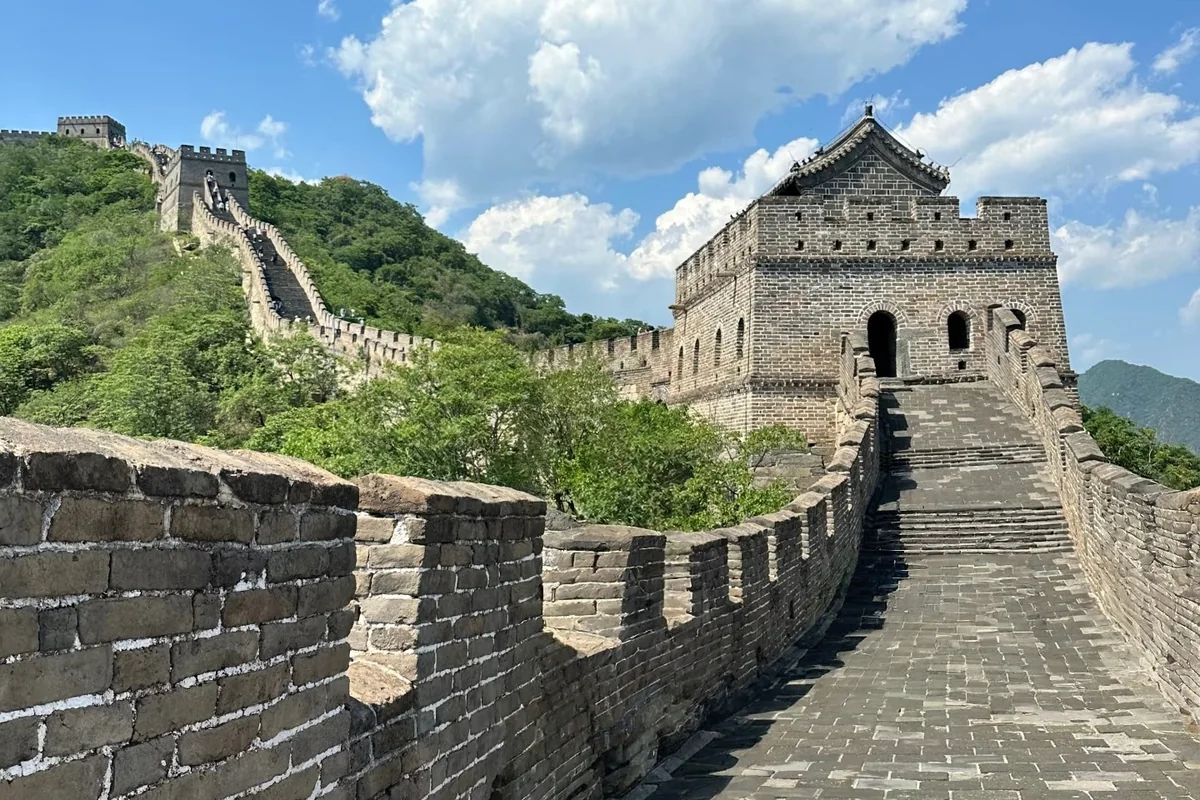
Great Wall dimensions by section
| Section | Wall height | Watchtower height | Walkway width |
|---|---|---|---|
| Mutianyu | ~7-8 m | ~10-12 m | 4-5 m |
| Badaling | ~7-8 m | ~10-12 m | 4-5 m |
| Jinshanling | ~5-8 m (terrain-driven) | ~10-12 m | 3-5 m |
| Simatai | ~5-8 m (steep ridges) | ~10-12 m | narrows to 2-3 m in places |
| Huanghuacheng | ~6-8 m | ~10-12 m | 4-5 m |
| Gubeikou | ~5-7 m (eroded) | ruined / variable | narrow in places |
Why does height vary by section?
Because Ming engineers built the wall to follow terrain, not flatten it. On ridges and exposed slopes near the capital (Mutianyu, Badaling), the wall is taller and the watchtowers are denser. On rough ridges further out (Jinshanling, Simatai), height drops where natural rock already does the defensive work.
- Capital-region sections: taller, wider, denser watchtowers.
- Frontier-region sections: lower wall, more reliance on cliffs.
- Strategic passes (Juyongguan, Shanhaiguan): tallest gate fortresses.
How tall are the watchtowers?
Most Ming watchtowers are 10 to 12 metres tall, two or three storeys, with arrow slits at parapet height and an open observation level on top. They sit roughly 100-200 metres apart along restored sections like Mutianyu.
- Standard Ming watchtower: 2-3 storeys, 10-12 m total.
- Storage space inside for soldiers, weapons, and beacon-fire fuel.
- Some passes (Juyongguan, Shanhaiguan) have larger fortress towers up to 15+ metres.
How wide is the walkway?
Typically 4 to 5 metres on Beijing-area Ming sections - enough for five soldiers abreast or a small horse cart with supplies. On wilder sections (Simatai narrows, Gubeikou) the path can shrink to 2-3 metres or break entirely into ruined wall.
- Beijing-area restored sections: 4-5 m wide.
- Wilder sections: variable; some 2-3 m or less.
- Battlements add about 1.5-2 m on the enemy side, lower wall on the friendly side.
Common mistakes about Great Wall dimensions
Treating it as a single height
The wall varies by section and within a section. Same Ming wall, very different heights from Badaling fortress to a Gubeikou ridge.
Underestimating watchtowers
Watchtowers are taller than the wall, which is what makes them visible on the skyline.
Expecting wheelchair access on the wall itself
The wall is steep; cable car gets you up the ridge but the wall walkway has stairs. Mutianyu cable car puts you at Tower 14 but the walk is still on uneven stone.
Great Wall dimensions FAQ
- Average 6-8 metres tall (about 20-26 feet); watchtowers reach 10-12 metres (33-40 ft).
- The walkway on top is typically 4-5 metres wide - room for five soldiers abreast or a small horse cart. Wilder sections narrow to 2-3 metres.
- Most Ming watchtowers are 10-12 metres (33-40 ft) and two or three storeys, set 100-200 metres apart.
- Capital-region sections (Mutianyu, Badaling) were built taller for direct defence; frontier sections rely more on cliffs and ridges, so the wall itself is lower.
- About 7-8 metres for the restored ridge, with 10-12 metre watchtowers at numbered positions 1 through 23.
- Slightly inclined to drain water, with stairs where the ridge climbs. Battlements on the enemy side are higher than the friendly-side parapet, giving the typical 'crenellated' silhouette.
Walk the wall to feel the scale
Numbers are abstract; standing on a 10-metre Ming watchtower with the wall snaking down the ridge isn't. The closest section is Mutianyu, with a cable car to Tower 14.
For a taller-feeling section with original construction in places, Jinshanling's western towers sit on a steeper ridge - real hiking, real altitude.