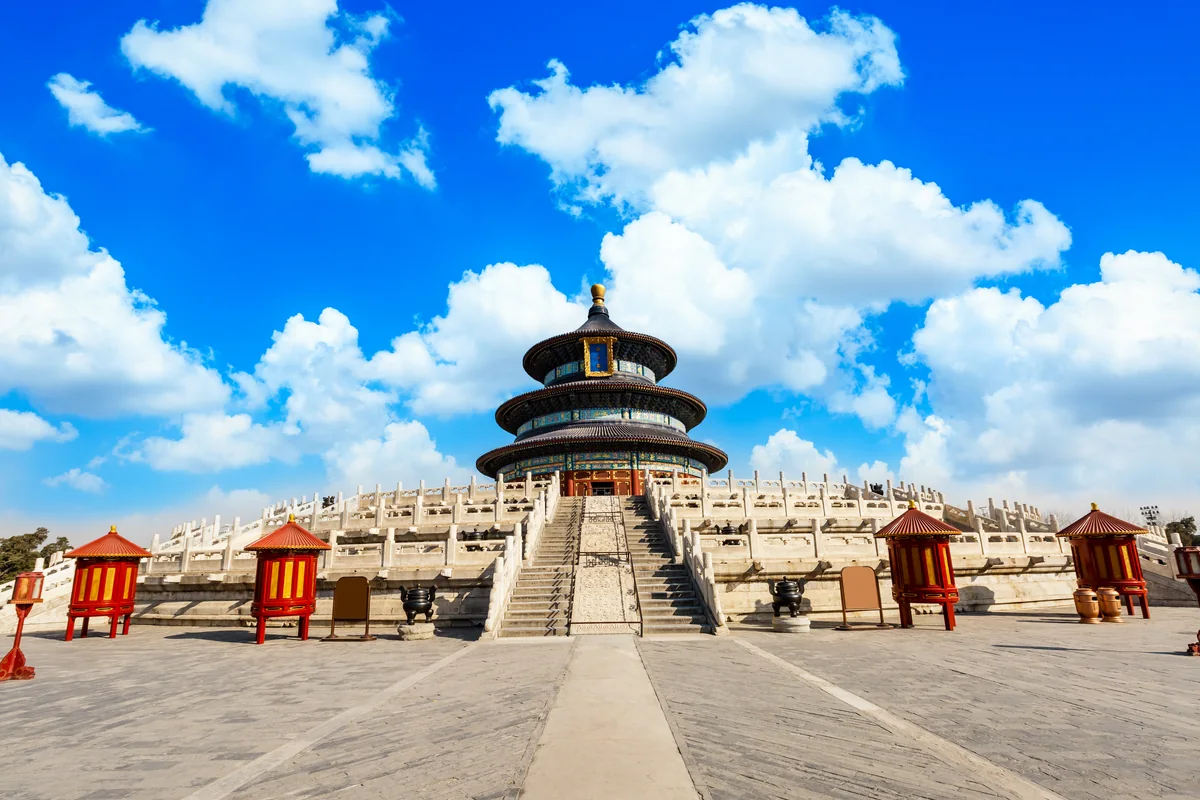
Hall of Prayer for Good Harvests at a glance
| Attribute | Detail |
|---|---|
| Height | 38 metres (125 feet) |
| Diameter | 32 metres |
| Original build | 1420 under Yongle Emperor |
| Current structure | 1890 rebuild (after 1889 lightning fire) |
| Roof | Triple-eaved blue glazed tiles (blue = sky) |
| Plinth | Triple-tier white marble |
| Interior columns | 28 timber columns: 4 + 12 + 12 (seasons / months / two-hour periods) |
| Joinery | Mortise-and-tenon - no nails |
| Ceremony venue | Spring sacrifice for harvest blessings (Ming + Qing) |
| UNESCO listing reference | 1998 inscription centrepiece |
Traditional timber joinery in the reconstructed hall
The Hall of Prayer for Good Harvests uses entirely mortise-and-tenon timber joinery - wooden tenons (projections) slot into mortises (cavities) and lock with wooden pegs. The same technique as the Forbidden City's halls, taken to an extreme: the 38m round structure is held up by 28 great timber columns + interlocking bracket sets (dougong), no nails. The technique allows the structure to flex during earthquakes and to be entirely disassembled and reassembled for restoration. The 1890 rebuild reused the same joinery method after the 1889 lightning fire.
- Mortise-and-tenon timber joinery.
- 28 great columns + dougong brackets.
- Earthquake-flex protection.
- Disassemble for restoration.
- 1890 rebuild used same technique.
The 28-column cosmological symbolism
The Hall of Prayer's interior structure encodes Chinese cosmology in its column count. (1) 4 inner columns near the centre = the four seasons (spring, summer, autumn, winter). (2) 12 middle columns surrounding them = the 12 months of the year. (3) 12 outer columns at the perimeter = the 12 two-hour periods of the Chinese day (each 'shichen' covering 2 modern hours). Total 28 columns = the 28 lunar mansions in Chinese astronomy. The architecture is a 3D astronomical / calendrical diagram - cosmology made into building structure. A guide makes this visible; without context, the columns look like ordinary timber posts.
- 4 inner = 4 seasons.
- 12 middle = 12 months.
- 12 outer = 12 two-hour periods of the Chinese day.
- Total 28 = 28 lunar mansions.
- 3D astronomical / calendrical diagram.
Why blue tiles
Blue glazed roof tiles represent the sky and heaven in Chinese imperial architecture. The Hall of Prayer's triple-eaved blue roof is the largest blue-roofed imperial structure in China. Compare with the Forbidden City's yellow tiles (yellow = imperial earth). At the Temple of Heaven (a heaven-sacrifice site), blue is used throughout for the three signature structures - Circular Mound Altar's surroundings, Imperial Vault, and Hall of Prayer. Same iron-rich glaze technique as yellow imperial tiles, fired at imperial kilns near Beijing, but with cobalt for the blue colour.
- Blue = sky / heaven in Chinese imperial architecture.
- Yellow (Forbidden City) = imperial earth.
- Largest blue-roofed imperial structure in China.
- Cobalt iron-rich glaze.
- Fired at imperial kilns.
The 1889 lightning fire and 1890 rebuild
The original 1420 Hall of Prayer survived for 469 years but was struck by lightning during a thunderstorm in 1889 (Guangxu reign) and burnt to the ground. The Qing court immediately rebuilt it 1890 using the surviving stone foundations and the same mortise-and-tenon timber joinery as the original. The rebuild is conceptually identical to the 1420 structure but the timber itself is from 1890. A few interior carvings and bronze pieces survived the fire and are now displayed in the smaller side halls.
- 1889 lightning fire during thunderstorm.
- Original 1420 structure burnt completely.
- 1890 rebuild used surviving foundations.
- Same mortise-and-tenon joinery.
- Conceptually identical; timber from 1890.
Common Hall of Prayer mistakes
Photographing only from outside
Climb the triple marble plinth and look through the open doors at the interior 28-column structure - that's the architecturally important view.
Missing the column symbolism
Without context, the columns look ordinary. A guide makes the 4 + 12 + 12 cosmological coding visible.
Treating it as 1420 original
It's a 1890 rebuild on 1420 foundations. The current timber is 130 years old, not 600.
Going at midday for the photo
Harsh top-down light. 8-9 AM or 4-5 PM golden hour.
Hall of Prayer for Good Harvests FAQ
- The iconic Temple of Heaven structure - a 38.2-metre triple-eaved blue-roofed round hall at the north end of the temple's south-to-north axis. Ritual complex originated in 1420 under Yongle; the hall’s form evolved under later Ming and Qing emperors and was reconstructed after the 1889 fire.
- Mortise-and-tenon timber joinery - wooden tenons slot into mortises and lock with wooden pegs. 28 great columns + bracket sets hold the triple roof with traditional timber joinery. The technique allows flexibility during earthquakes.
- 4 inner columns = 4 seasons. 12 middle = 12 months. 12 outer = 12 two-hour periods of the Chinese day. Total 28 = 28 lunar mansions. The architecture is a 3D astronomical diagram.
- Blue represents sky / heaven in Chinese imperial architecture. The Forbidden City uses yellow (imperial earth); the Temple of Heaven uses blue (sky).
- No - the current structure is the 1890 rebuild after a 1889 lightning fire destroyed the original. The foundations and design are from 1420; the timber is from 1890.
- Yes through the open doors with the through-ticket; you view the interior 28-column structure from the threshold without entering the central altar space.
Walk the structure with a guide
Our private Temple of Heaven day pairs the Hall of Prayer climb with the cosmological column-count explanation - the 4 + 12 + 12 + 28 symbolism is what makes the visit memorable.
If you want the full axis context, the route guide covers the south-to-north walk including this hall.