Six main palaces - three Outer, three Inner
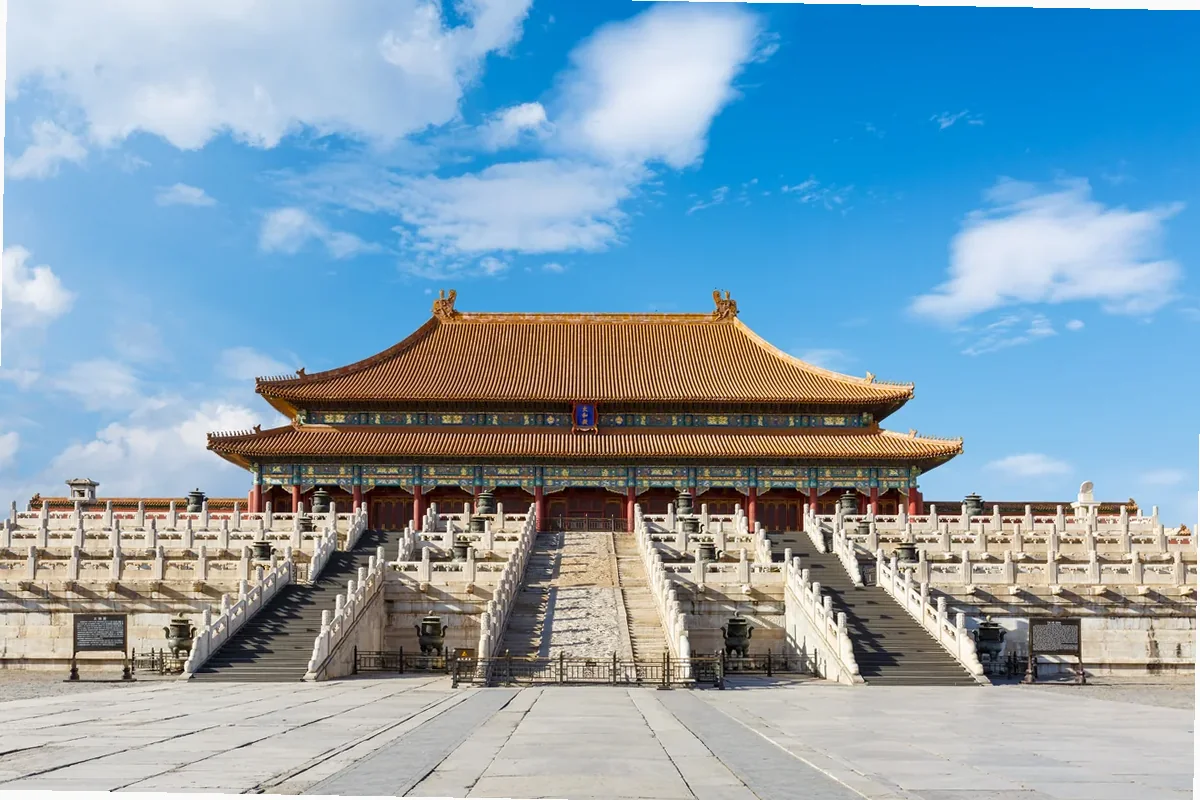
The Three Great Halls of the Outer Court sit on a single triple-tier marble plinth at the heart of the Forbidden City. The Hall of Supreme Harmony (Taihedian) is the largest and most important - 35 metres tall, used for emperor's coronations and major state ceremonies, with the imperial throne flanked by gilded dragon columns. The Hall of Central Harmony (Zhonghedian) is a small square hall behind it where the emperor rested before ceremonies. The Hall of Preserving Harmony (Baohedian) at the back was used for state banquets and the highest imperial examinations. Together the three are the architectural climax of the central axis.
- From central Beijing: Central Beijing — about 20–45 minutes by subway or taxi
- Reading time: 6-8 min; visit: 30-40 min on Three Great Halls + 30 min on Inner Court halls
- Difficulty: Easy walking, 10-15 marble steps onto each plinth
- Crowds: Hall of Supreme Harmony is the densest crowd point
- Best for: Architecture and history-curious; Photographers chasing the iconic throne shot
- Less ideal for: Time-poor visitors - photograph from outside, move on
Six main palaces side by side
| Hall | Court | Function | Must-stop? |
|---|---|---|---|
| Hall of Supreme Harmony (Taihedian) | Outer | Coronations + major ceremonies | Yes - the icon |
| Hall of Central Harmony (Zhonghedian) | Outer | Emperor's pre-ceremony rest | Photo stop |
| Hall of Preserving Harmony (Baohedian) | Outer | State banquets + top imperial exams | Yes |
| Hall of Heavenly Purity (Qianqinggong) | Inner | Emperor's bedroom + working hall | Yes |
| Hall of Union (Jiaotaidian) | Inner | Imperial seal storage | Photo stop |
| Hall of Earthly Tranquility (Kunninggong) | Inner | Empress's chambers + emperor's wedding night | Yes |
Hall of Supreme Harmony
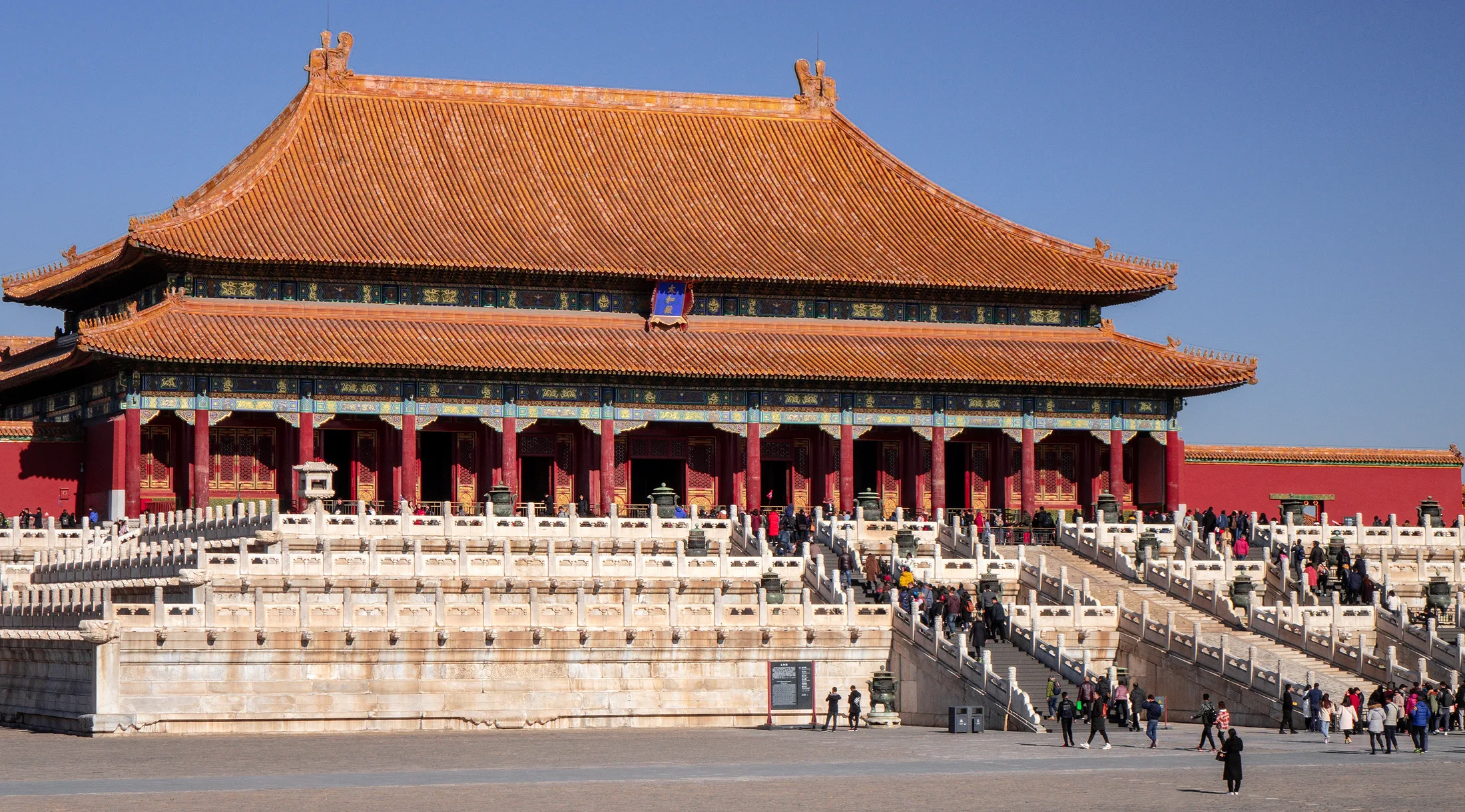
Hall of Supreme Harmony, the largest and highest-ranking hall within the Forbidden City complex. Photo: Peter K Burian / CC BY 4.0 via Wikimedia Commons.
Taihedian is the largest surviving timber-frame hall in the Forbidden City and the most important building in the Forbidden City. 35 metres tall, 60 m wide, on a triple-tier marble plinth at the heart of the Outer Court. Used for the most important imperial events: coronations, the empress's investiture, the New Year audience, the emperor's birthday. Inside: the dragon throne flanked by six gilded dragon columns; the ceiling features a single carved-and-painted dragon clutching a pearl. Photographing the throne is the canonical Forbidden City shot.
- 35 m tall, 60 m wide.
- Largest surviving timber-frame hall in the Forbidden City.
- Coronations + major ceremonies.
- Dragon throne with six gilded columns.
Hall of Central Harmony
Zhonghedian is the small square hall behind the Hall of Supreme Harmony. The emperor used it for resting and preparation before walking out to Taihedian for ceremonies, receiving senior officials' final reports, and approving documents that would be announced publicly. The square footprint is unusual - most halls are rectangular - and the lighter scale gives it a more intimate feel.
- Square hall, behind Taihedian.
- Emperor's pre-ceremony rest.
- Reviewed reports + approved documents.
- Smaller than other halls - intimate scale.
Hall of Preserving Harmony
Baohedian is the third of the Three Great Halls. Used for state banquets honouring foreign delegations and for the highest level of the imperial civil service examinations (the dianshi, conducted by the emperor personally). Smaller than Taihedian but still imposing. After the imperial exams reformed in the Qing era, this hall became the venue for the top-ranking exam results.
- Behind Zhonghedian.
- State banquets + top imperial exams.
- Imperial dianshi exam (emperor-led).
- Qing era: top exam results announced here.
Hall of Heavenly Purity
Qianqinggong was the emperor's bedroom and working hall in the Inner Court - where he actually lived. The Yongle Emperor through to Yongzheng used it as bedroom and study; later emperors (including Qianlong) moved to the Hall of Mental Cultivation off the central axis. Today the hall displays a recreated imperial bedroom + working setup, with the calligraphy 'Just and Honourable' (zheng da guang ming) above the throne - reportedly where the emperor's secret succession edict was hidden by Yongzheng.
- Emperor's bedroom + working hall.
- Yongle through Yongzheng used it.
- Later emperors moved to Hall of Mental Cultivation.
- Famous calligraphy: 'Just and Honourable'.
Hall of Earthly Tranquility
Kunninggong was the empress's chambers under the Ming dynasty and the venue for the emperor's wedding night under both Ming and Qing. Each new empress traditionally spent her first wedding night here regardless of where she normally lived. Under the Qing, the building also took on a Manchu ritual function - shamanic sacrifices were performed here in a Manchu-style stove room.
- Empress's chambers (Ming).
- Imperial wedding night venue.
- Qing era: also Manchu shamanic stove room.
- Yongle to early Qing: empress lived here.
Common halls mistakes
Photographing Taihedian without going to the plinth
The iconic throne shot needs you on the plinth looking through the open central doors.
Skipping the Inner Court halls
Three of the six main halls are in the Inner Court. Skip and you miss half the story.
Trying to enter the halls
Most halls are viewed through the open doorway from the plinth; interior tours are not standard.
Forbidden City main halls FAQ
- Six. Outer Court Three Great Halls: Hall of Supreme Harmony (Taihe), Central Harmony (Zhonghe), Preserving Harmony (Baohe). Inner Court three halls: Hall of Heavenly Purity (Qianqing), Union (Jiaotai), Earthly Tranquility (Kunning).
- Hall of Supreme Harmony (Taihedian) - largest surviving timber-frame hall in the Forbidden City, used for coronations and major ceremonies.
- Hall of Heavenly Purity (Inner Court) up to the early Qing; later emperors moved to the Hall of Mental Cultivation off the central axis.
- Most halls are viewed through open doorways from the plinth - the interior throne or bedroom display is visible from outside.
- Triple-tier plinths were reserved for the highest imperial rank - the only example in China.
- Off the central axis, west of the central Inner Court (west of the Hall of Heavenly Purity, south of the Western Six Palaces). Reopened on December 26, 2025 after around a decade of conservation. Used by later Qing emperors as their private working office. Famous for the Kangxi and Qianlong emperor residences.
Walk the six main halls
A guide explains each hall's function while you stand on the plinth - the iconic photos plus the cultural depth. Our private Forbidden City day covers all six.
If you want the broader layout context, the layout page covers Outer Court vs Inner Court.
Plan a guided Forbidden City dayLayout (Outer + Inner Court)