Two zones, one south-north axis
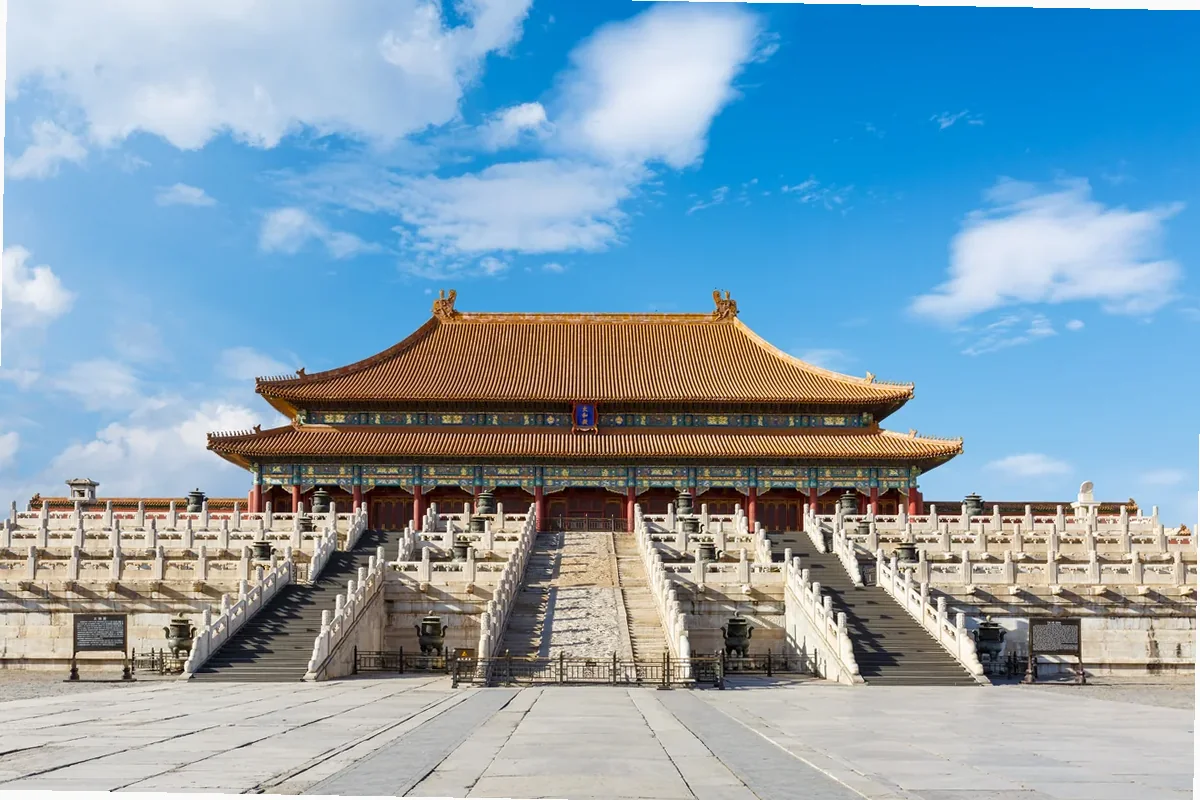
The Forbidden City layout splits into two functional zones along the south-north axis. The Outer Court (south, closer to the Meridian Gate) was the formal ceremonial space - state audiences, coronations, imperial weddings - centred on the Three Great Halls. The Inner Court (north, beyond the Gate of Heavenly Purity) was the emperor's private residence, with the Hall of Heavenly Purity (emperor's bedroom), Hall of Union (ceremonial), Hall of Earthly Tranquility (empress's chambers), and the Imperial Garden at the northern end.
- From central Beijing: Central Beijing — about 20–45 minutes by subway or taxi
- Reading time: 5 min
- Guide type: Cultural background
- Best for: First-time visitors planning what to see; Architecture and history-curious
- Less ideal for: Already familiar with the layout
Outer Court vs Inner Court
| Attribute | Outer Court | Inner Court |
|---|---|---|
| Position | South of axis | North of axis |
| Function | Ceremonial / state | Private residential |
| Main buildings | Hall of Supreme Harmony, Central Harmony, Preserving Harmony | Hall of Heavenly Purity, Union, Earthly Tranquility |
| Decoration emphasis | Dragons (emperor) | Phoenixes (empress) |
| Plinth | Triple marble (Three Great Halls) | Double marble |
| Crowd density today | Heaviest at Hall of Supreme Harmony | Quieter than Outer Court |
| Gate threshold | South: Meridian Gate | Between: Gate of Heavenly Purity |
Outer Court - ceremonial
The Outer Court was the formal stage of imperial rule. State audiences, coronations, imperial wedding ceremonies, and the highest-level imperial examinations took place in the Three Great Halls. The emperor sat on the throne in Taihedian for these events; officials and dignitaries stood on the marble plinth below. Decoration emphasises imperial power - dragons everywhere, the largest hall (Taihedian) in the Forbidden City.
- Three Great Halls: Taihe, Zhonghe, Baohe.
- State audiences + coronations.
- Imperial weddings + exams.
- Dragon decoration dominates.
Inner Court - private
The Inner Court was the emperor's private residence and the home of the imperial family. The Hall of Heavenly Purity (Qianqinggong) was the emperor's bedroom and private working hall. The Hall of Union (Jiaotaidian) held the imperial seals. The Hall of Earthly Tranquility (Kunninggong) was the empress's chambers - the only inner-court building used for an actual wedding (the emperor's wedding night). Phoenixes (empress symbol) appear more here than in the Outer Court.
- Hall of Heavenly Purity: emperor's bedroom.
- Hall of Union: imperial seal storage.
- Hall of Earthly Tranquility: empress's chambers.
- Phoenix decoration emphasis.
Imperial Garden - northern terminus
The Imperial Garden (Yuhuayuan) caps the Inner Court at the northern end. About 130 m long by 90 m wide, the garden combines 800-year cypresses, the Hall of Imperial Peace at the centre, Lake Tai rockeries, and pavilions. It was the only outdoor space the imperial family could use for daily strolls. Today it's the final stop before the North Gate exit.
- Northern end of Inner Court.
- 800-year cypresses.
- Hall of Imperial Peace at centre.
- Imperial family's outdoor space.
Eastern and Western Six Palaces
Two clusters of smaller palaces flank the central Inner Court - the Western Six Palaces (yikun gong, chuxiu gong, etc.) and the Eastern Six Palaces (jingyang gong, yongshou gong, etc.). Each cluster housed imperial concubines and the women of the court. They are individually small (each a single courtyard with a hall) but together they form the residential periphery of the Inner Court. Skip if time-tight; visit one cluster if 3.5+ hours.
- Flanking Inner Court.
- Concubine + women residences.
- 12 palaces total.
- Time: 30-45 min per cluster.
Common layout mistakes
Skipping the Inner Court
The Outer Court is ceremonial; the Inner Court is where emperors actually lived. Skip and miss half the story.
Thinking the Imperial Garden is huge
It's 130x90 m - smaller than visitors expect. The 800-year cypresses are the highlight.
Trying to visit all 12 Six Palaces
Too many. Pick one cluster (Western or Eastern) if you have time.
Forbidden City layout FAQ
- Two zones along a south-north axis. Outer Court (south, ceremonial) with the Three Great Halls; Inner Court (north, private) with the emperor and empress's chambers; Imperial Garden caps the north end.
- The southern ceremonial zone. Three Great Halls (Taihe, Zhonghe, Baohe) used for state audiences, coronations, imperial weddings, top imperial exams.
- The northern private zone. Emperor's bedroom (Hall of Heavenly Purity), Hall of Union (imperial seals), empress's chambers (Hall of Earthly Tranquility), Imperial Garden.
- The threshold between Outer Court (south) and Inner Court (north). Marks where ceremonial space ends and private space begins.
- Flanking the central Inner Court - Western Six Palaces to the west, Eastern Six Palaces to the east. Each housed concubines and court women.
- Cosmological pairing - Heavenly Purity (emperor / heaven) plus Earthly Tranquility (empress / earth). The Hall of Union between them symbolises their balance.
Walk the two-zone axis
A guide makes the Outer Court / Inner Court split visible at the Gate of Heavenly Purity. Our private Forbidden City day paces both zones with cultural context.
If you want the halls in detail, the main-halls page covers each of the six main palaces.