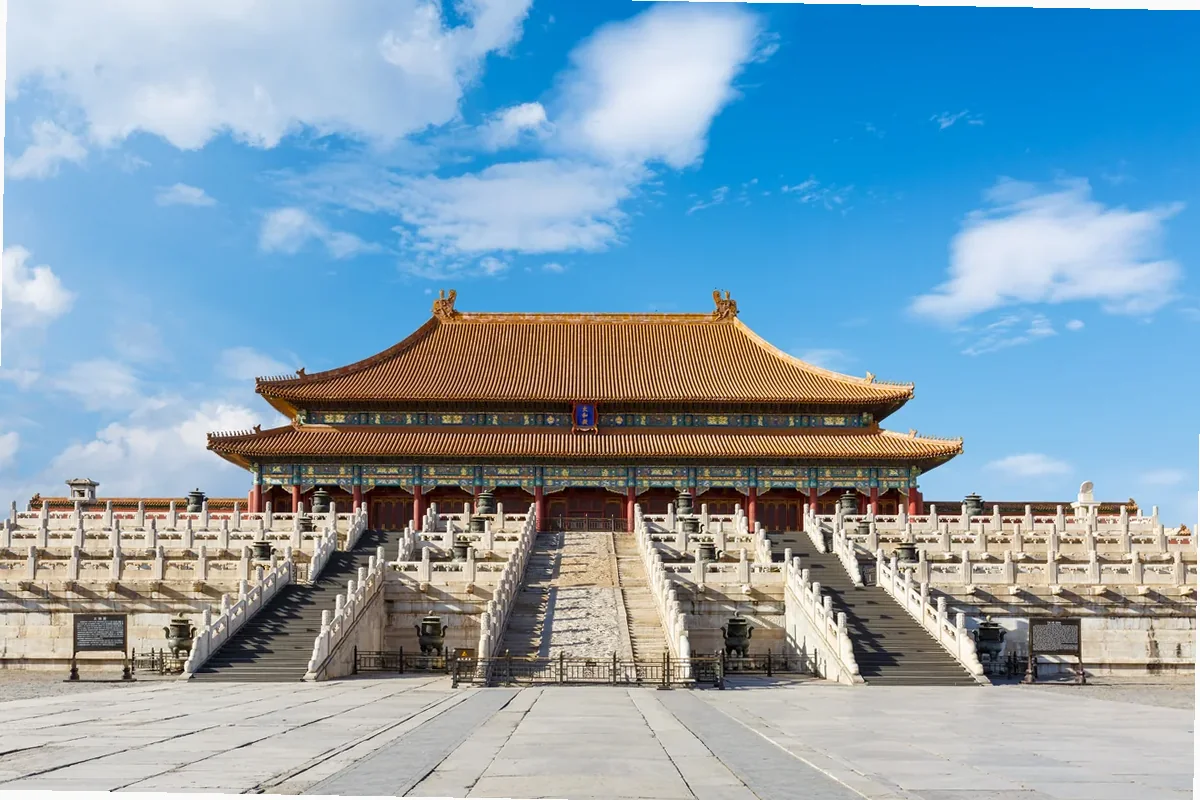
Architectural elements decoded
| Element | Meaning | Where to see |
|---|---|---|
| Mortise-and-tenon timber | No nails; flexes in earthquakes | Every hall interior column |
| Yellow glazed roof tiles | Imperial colour - emperor only | Three Great Halls + Inner Court |
| Triple marble plinth | Highest imperial rank | Hall of Supreme Harmony |
| Roof-edge mythical animals | Status indicator - more = higher | 10 on Taihe Hall (the only roof with ten) |
| Red-painted walls | Celebration + protection | All exterior walls |
| Dragon motif | Emperor symbol | Throne, columns, ceiling |
| Phoenix motif | Empress symbol | Inner Court palaces, jewellery |
| Axial symmetry | Cosmological centre-of-world | Whole site layout |
Mortise-and-tenon timber framing
Halls use interlocking mortise-and-tenon timber joinery that minimises iron nails. Wooden tenons (projections) slot into mortises (cavities) and lock with wooden pegs. The technique allows the structure to flex during earthquakes, which is why Beijing's 600-year-old halls survive when stone equivalents would crack. Bracketing systems (dougong) at the top of each column distribute the heavy roof weight across multiple beams.
- Mortise-and-tenon joinery, minimal iron nails.
- Earthquake-flex protection.
- Dougong: bracketing at column tops.
- 600 years of survival.
Yellow glazed roof tiles
Yellow was the imperial colour - only buildings used by the emperor and his immediate family could use yellow tiles. The tiles were fired at imperial kilns in Liuli Qu near Beijing using a specific iron-rich glaze. Buildings outside the imperial hierarchy (princely residences, official offices) used green or grey tiles. The yellow Forbidden City roofline against blue Beijing sky is the visual signature of imperial China.
- Yellow = imperial only.
- Fired at Liuli Qu kilns.
- Princely residences: green tiles.
- Officials' offices: grey tiles.
Roof-edge mythical animals
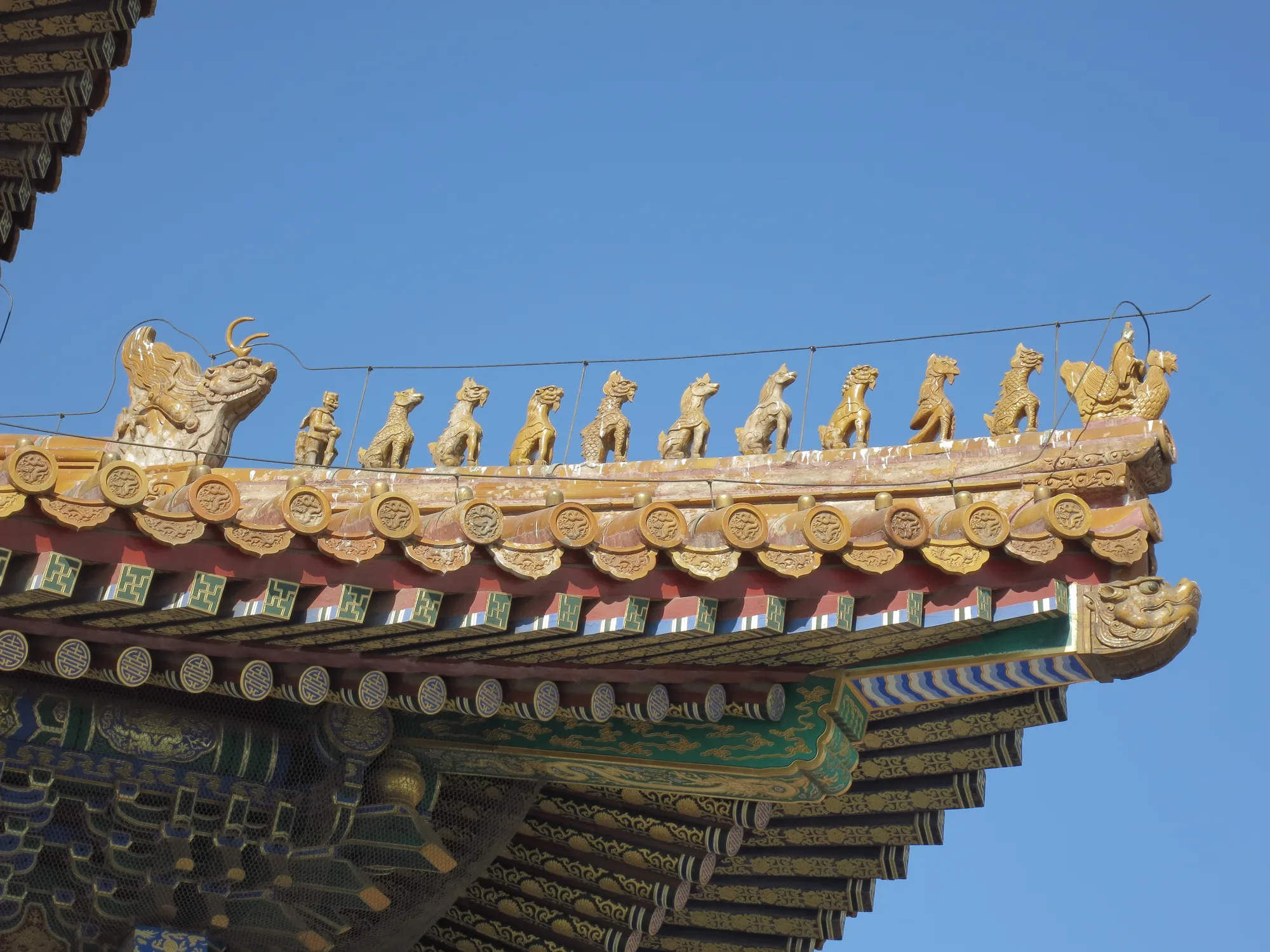
The Hall of Supreme Harmony has 10 roof-edge mythical beasts — an exceptional count reflecting the building's rank. Photo: Autumn Horizontal Lake / CC BY-SA 3.0 via Wikimedia Commons.
Look at the corner ridge of every major hall. A line of small animal figures sits there - a man riding a chicken at the front (a Tang-dynasty official sent to certain death), then a dragon, phoenix, lion, sea horse, heavenly horse, and so on. The number of animals indicates the building's imperial rank. The Hall of Supreme Harmony has 10 - the only roof in China with ten (the leading immortal rider is not counted among them); other major halls have 9 or fewer; smaller buildings have 3 or 5; minor structures have 1.
- Corner ridge: line of animals.
- Number = imperial rank.
- Hall of Supreme Harmony: 10 (the only roof with ten).
- Other major halls: 7.
Triple marble plinths
The Three Great Halls share a single triple-tier marble plinth - the only building in China with this distinction. Each tier rises about 2 metres and is bounded by carved marble balustrades with dragon-cloud motifs. The triple plinth is reserved for the most important imperial halls; lower-rank buildings have single or double plinths. The total plinth height for Taihe Hall is over 6 metres above courtyard ground level.
- Three Great Halls share one plinth.
- Triple tier = highest rank.
- Each tier ~2m.
- Total height: 6m+ above courtyard.
Dragon and phoenix motifs
Dragons represent the emperor; phoenixes the empress. Their pairing on imperial objects symbolises balance and harmony. Dragon imagery dominates the Outer Court (ceremonial halls used by the emperor); phoenix imagery dominates the Inner Court (private residences including the empress's chambers). Five-clawed dragons are imperial-only; four-clawed dragons could appear on princely objects; three-clawed dragons on noble objects.
- Dragon = emperor; phoenix = empress.
- Outer Court: dragons dominate.
- Inner Court: phoenixes dominate.
- Five-clawed dragon = imperial-only.
Common architecture misunderstandings
Counting roof animals wrong
Count from the corner ridge inward. The figure on the rooster is not counted; the count starts at the first mythical animal.
Assuming yellow tiles meant 'rich'
Yellow was strictly imperial. Rich officials could not use yellow tiles.
Confusing dragon claws
Five-clawed = imperial. Four-clawed = princely. Three-clawed = noble. Look at the claws on every dragon you photograph.
Forbidden City architecture FAQ
- Ming-Qing palatial - timber-frame halls on marble plinths, yellow glazed roofs, axial symmetry.
- Mortise-and-tenon joinery flexes during earthquakes. Stone or nailed structures would crack.
- Imperial colour reserved for the emperor's buildings. Others used green or grey.
- Status indicators - more animals = higher imperial rank. Hall of Supreme Harmony has 10 - the only roof in China with ten.
- Stone base that elevates the major halls. The Three Great Halls share a triple-tier plinth, the highest rank in Chinese architecture.
- Five-clawed = imperial only; four-clawed = princely; three-clawed = noble. The claw count indicates rank.
Walk with the architecture decoder
A guide makes the architecture visible - count the roof animals, point out the dragon claws, explain the yellow tiles. Our private Forbidden City day pairs the route with the cultural decode.
If you want the layout (Outer Court vs Inner Court), the next page covers it.
Plan a guided architecture-focused Forbidden City dayLayout (Outer + Inner Court)