
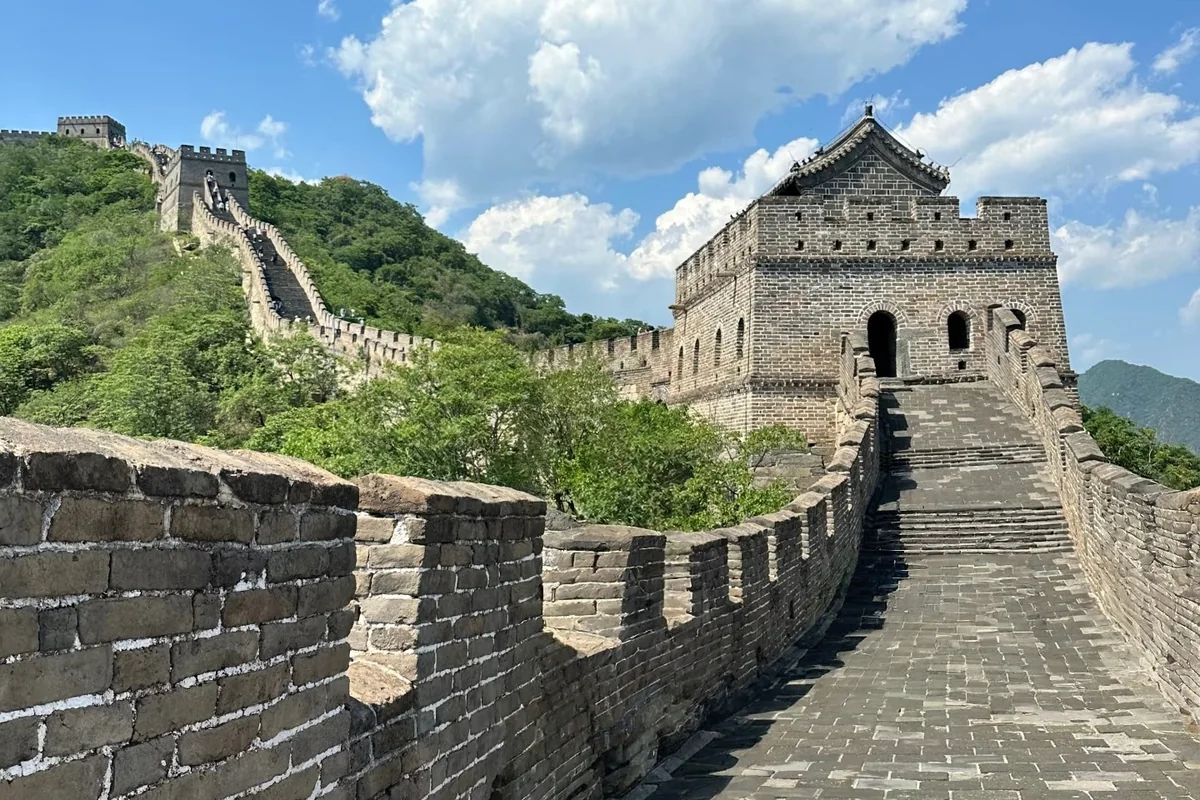
The Main Concern for Layover Travelers
"Will I miss my next flight if I leave the airport?" That question is the main reason many travelers hesitate to explore during a Beijing layover. The answer is: leaving the airport can be safe when you plan with a clear return buffer and realistic time estimates. The key is buffer planning: reserving enough time before your departure for delays and re-entry; rather than squeezing in as much as possible.
The Four Time Risks in a Layover Trip
Every layover trip that leaves the airport faces four sources of delay. Understanding them helps you set a realistic schedule and a safe return time.
1. Immigration delay
From wheels-down to leaving the terminal, plan for 45–75 minutes. Factors include visa-free transit processing (if applicable), passport control queues and baggage claim. Do not schedule a pickup before you have cleared the airport. Sixty minutes is a safe default when in doubt.
2. Traffic variability
Driving time depends on time of day, rush hour and highway congestion. Use a range, not a single number. Examples: PEK → Mutianyu: 1–1.5 hours; PKX → Mutianyu: 2–2.5 hours. Build your plan around the longer end of the range so a bad traffic day does not eat into your return buffer.
3. Attraction visit time
Travelers often underestimate how long they will want to stay. A typical Great Wall visit with cable car up and down is 2–3 hours. If you budget only one hour, you will either cut the visit short or risk being late. Plan a fixed block (e.g. 2.5 hours) and stick to it.
4. Airport re-entry time
You need to be back at the airport with time to spare. For international departures, arrive at least 3 hours before your flight. That covers security lines, terminal distance and occasional bottlenecks. Do not assume you can show up 90 minutes before an international departure during a layover; one slow queue can put your connection at risk.
Risk timeline: from arrival to departure
A layover trip follows a single sequence. Each step has variability; the return buffer is what protects you at the end.
Arrival→Immigration→Outbound drive→Visit→Return drive→Airport buffer→Departure
The Layover Safety Buffer
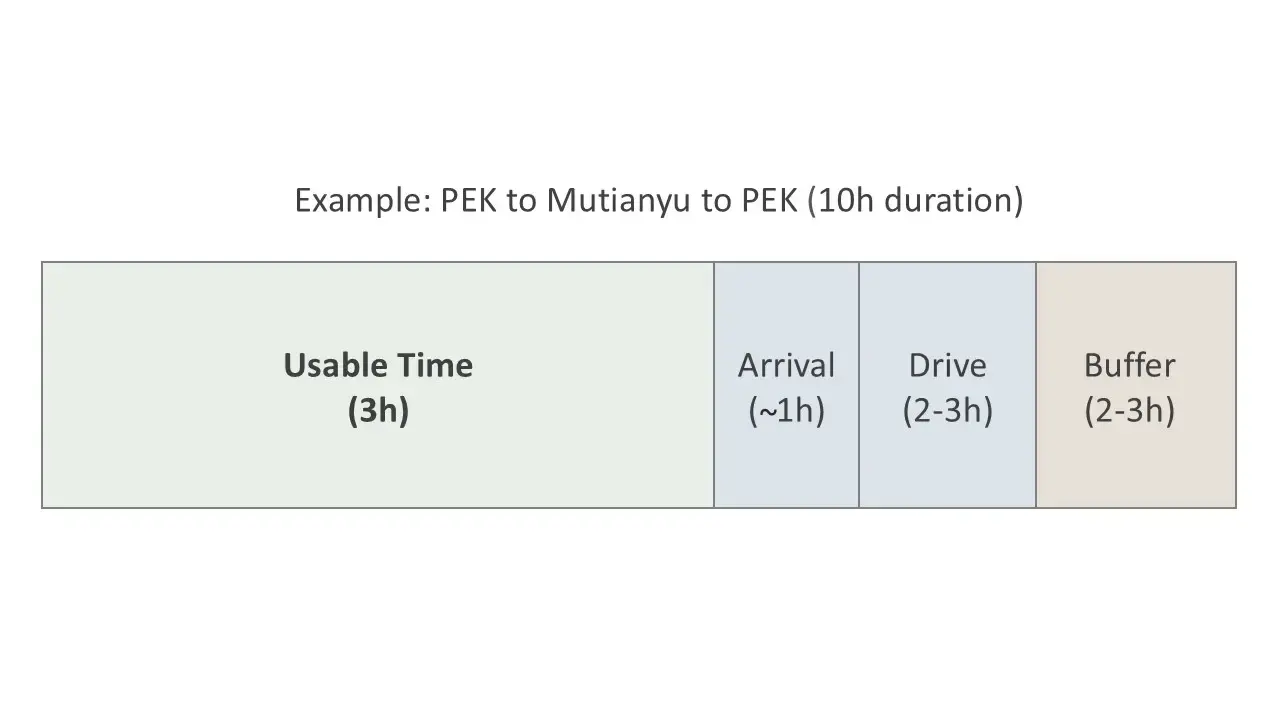
The main planning rule: always reserve a return buffer. A typical recommendation is 2.5–3 hours before your next departure. That buffer protects against traffic delays on the way back, long security and immigration lines and the distance from the curb to your gate. Reducing the buffer to gain more time at the attraction increases the risk of missing your flight. For international connections, 3–3.5 hours at the airport before departure is safer.
Practical risk scenarios
Example 1: 10-hour layover
- Airport exit: ~1 hour
- Outbound drive: ~1–1.5 hours
- Mutianyu visit: ~2–2.5 hours
- Return drive: ~1–1.5 hours
- Protected airport buffer: ~3 hours
A 10-hour PEK connection can work, but it is a compressed itinerary and actual slack depends on airport processing and traffic. Do not treat two hours of guaranteed slack as a planning promise. From PKX the longer round-trip drive usually requires a 12–15 hour layover for Mutianyu.
Example 2: 6-hour layover
Same blocks would need at least 8 hours. A 6-hour layover is too tight for a Great Wall visit. There is no safe return buffer. Stay at the airport or limit yourself to a very short stop nearby if you have a driver and a fixed return time.
Key principles for safe layover trips
- Choose attractions with predictable travel time (e.g. Mutianyu with a fixed pickup and return).
- Avoid distant or hard-to-reach locations when your window is short.
- Keep the visit flexible: agree in advance how long you will stay so the driver can plan the return.
- Maintain a return buffer of 2.5–3 hours (or 3–3.5 for international) before your next departure.
- Do not assume immigration or traffic will be faster than the high end of the range.
Layover planning guides
Use this framework together with our layover guides to build a realistic itinerary.
- Beijing Layover Guide: time planning and sample windows
- Great Wall Layover Time Model: exit, drive, exploration, return buffer
- 10 Hour Layover in Beijing
- 15 Hour Layover in Beijing
- PEK vs PKX Layover Comparison
More resources
For whether you can leave the airport at all: Leave Beijing Airport During a Layover? For which Great Wall section fits a layover: Best Great Wall for a Beijing Layover.