
The Layover Time Model
Layover time = Airport exit + Outbound drive + Wall time + Return drive + Airport buffer
Alternatively, combine the two drives: Layover time = Airport exit + Round-trip drive + Wall time + Airport buffer. The return drive is not the same thing as the protected airport buffer.
1. Airport Exit Time
From wheels-down to leaving the terminal, plan for 45–75 minutes. This includes immigration (and, if you use visa-free transit, the transit counter), possible baggage claim and customs. Do not schedule a pickup before you have cleared the airport. Queues vary; 60 minutes is a safe default.
2. Drive Time to Mutianyu
Mutianyu is the most practical Great Wall section for a layover (see below). Drive time depends on which airport you use.
| Airport | Drive Time (one way) |
|---|---|
| PEK (Capital) | 1–1.5 hours |
| PKX (Daxing) | 2–2.5 hours |
Round-trip drive time is therefore roughly 2–3 hours from PEK and about 4–5 hours from PKX. Traffic, weather and holidays can increase these planning ranges.
3. Exploration Time
A realistic minimum at Mutianyu is 2–3 hours. That covers cable car or chairlift up and down, walking a section of the wall and a bit of rest or photos. Rushing below 2 hours is possible but not recommended; you will have little margin for queues or delays.
4. Return Drive
Plan the drive back to the airport as its own block using the same one-way ranges above. Do not fold return driving into the airport buffer.
5. Airport Buffer
Once you are back at the airport, protect 2.5–3 hours before departure for international flights: re-entry, check-in or bag drop, security and boarding. Cutting this short is the main cause of missed flights. Buffers are non-negotiable; when in doubt, use 3 hours.
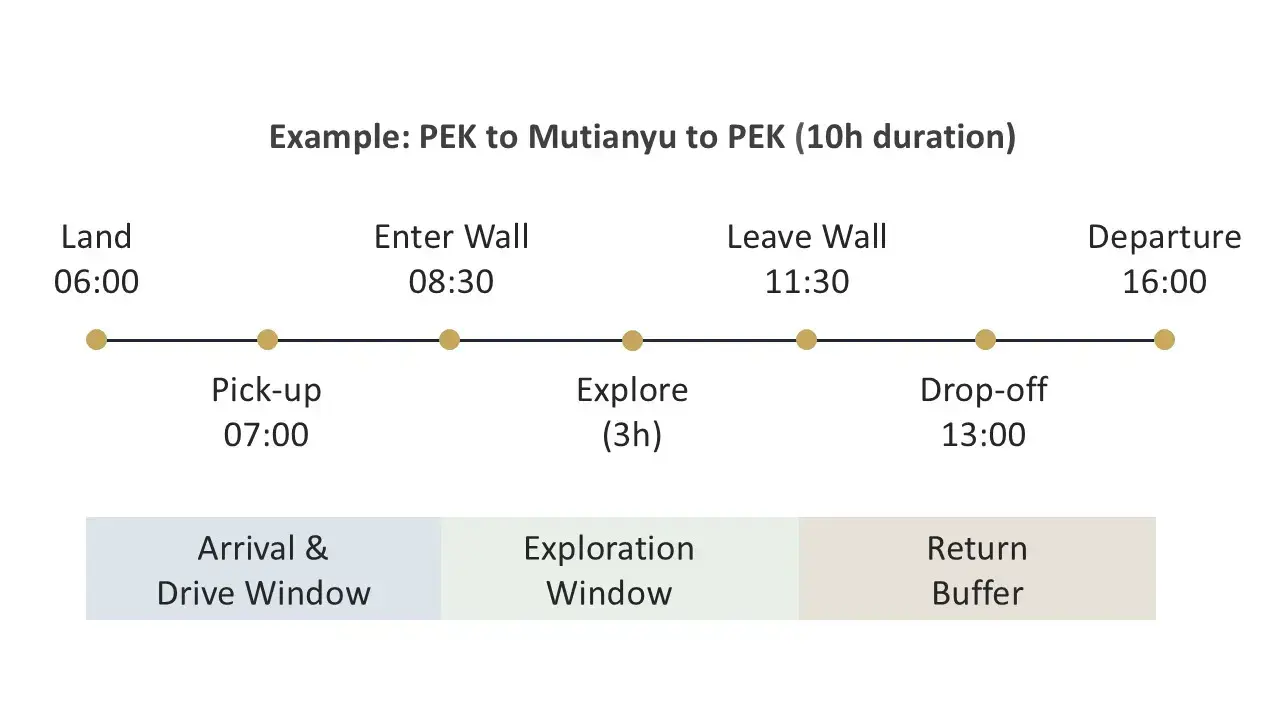
Visual Timeline Example
A 10-hour layover (06:00 arrival, 16:00 departure) with a Mutianyu visit from PEK could look like this:
| Stage | Time |
|---|---|
| Arrival | 06:00 |
| Airport exit | 07:00 |
| Arrive Mutianyu (drive) | 09:00 |
| Explore (Arrival & Drive → Exploration) | 09:00–12:00 |
| Leave Mutianyu / return drive | 12:00 |
| Back at airport | 13:30 |
| Airport buffer in place | 13:30–16:00 |
| Departure | 16:00 |
Minimum Layover Recommendations
| Layover length | Feasibility (Great Wall) |
|---|---|
| 6–7 hours | Very tight; not recommended |
| 8–10 hours | Possible from PEK; one stop only. From PKX, 10h is not enough. |
| 12–15 hours | Comfortable from both airports |
| 18+ hours | Can add city stops |
Why Mutianyu Works Best for Layovers
- Closer to the airports than Badaling in practical drive time from both PEK and PKX.
- Cable car (and chairlift): no long climb, so 2–3 hours on-site is enough.
- Less crowded than Badaling, so less time lost in queues.
- Easier to plan for a fixed window: up, walk, down, drive back.
For other sections and general planning, see our Great Wall Guide.
Layover Scenarios: Next Steps
Use the time model above to see how your layover length and airport fit. For scenario-specific guidance:
- Layover Risk Management: four time risks, buffer strategy and safe layover principles
- 10 Hour Layover in Beijing: one stop only; PEK vs PKX feasibility
- 15 Hour Layover in Beijing: two-stop options and risk levels
- 18 Hour Layover in Beijing: Great Wall + Forbidden City itinerary
- 20 Hour Layover in Beijing: Great Wall + Forbidden City + evening Beijing
- PEK vs PKX for Beijing Layover: which airport is better for drive time and feasibility
- Beijing Layover Guide: time planning, sample windows and common pitfalls
More resources
For whether you can leave the airport: Can I Leave Beijing Airport During a Layover?