
Kashgar at a glance
| Detail | Plan |
|---|---|
| Air | KHG from Urumqi |
| Walk | Old city alleys |
| Market | Sunday livestock fair seasonal |
| Mosque | Active site etiquette |
| Drive | Pamir needs permits |
| Heat | Summer dry heat |
Most travelers fly URC–KHG; rail exists but is a commitment measured in hours and scenery.
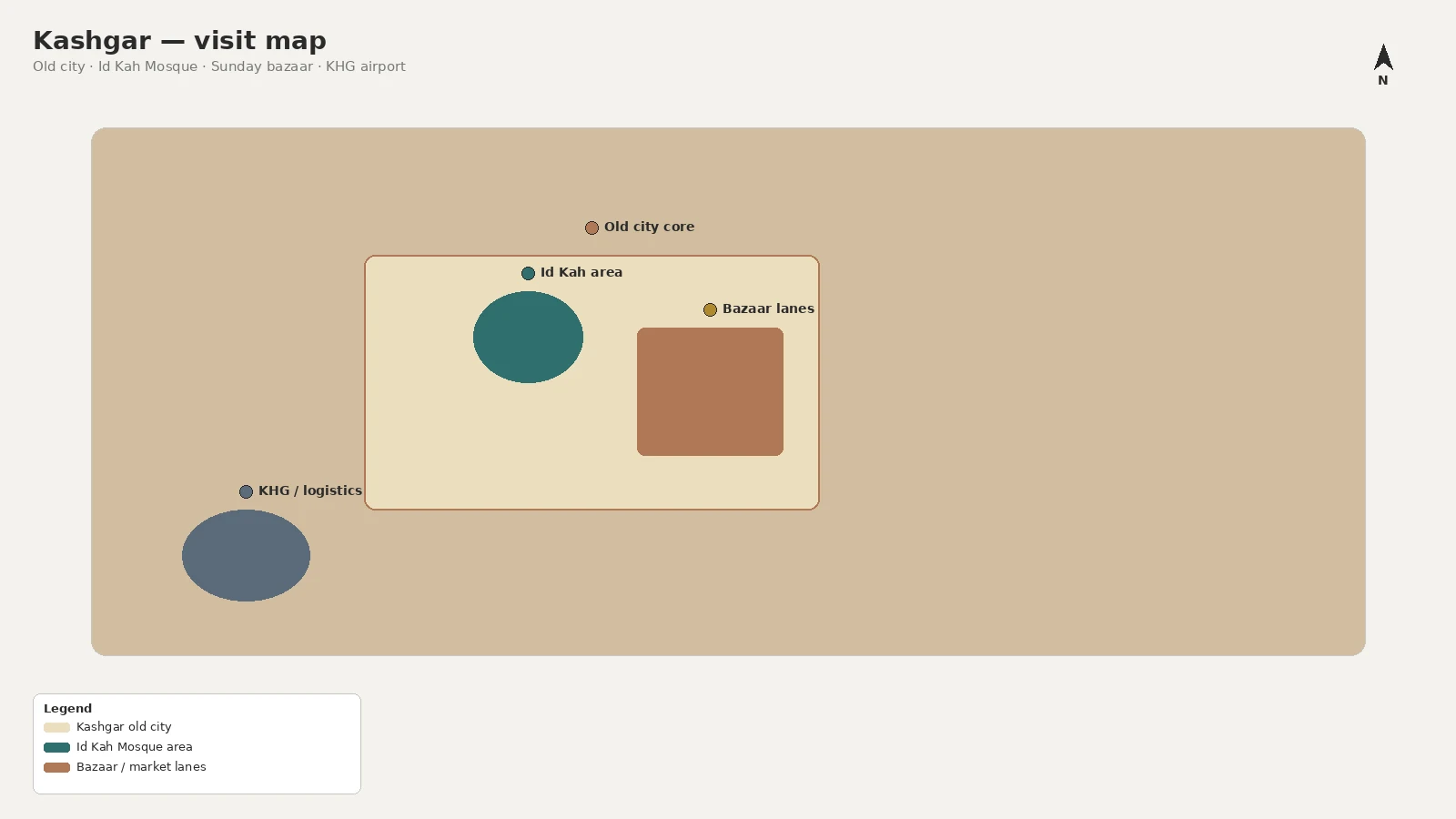
Airport and railway names matter
Kashgar airport (KHG) is short from the old city by taxi. Urumqi flights dominate schedules.
Copy the station name from the ticket into your message to a driver. High-speed stations with similar city names are a common reason for a meet at the wrong door.
City transport versus a private car
Metro and taxis work for central districts when luggage is light and the hour is not rush hour. A private vehicle earns its place on airport arrivals, the bazaar quarter road days, and any itinerary with two hotel changes.
Start from Urumqi or the Xinjiang guide. Dunhuang is the eastern cave counterpart.
How to choose
| Choice | Fit | Skip when |
|---|---|---|
| Make this the focus | When this page is the reason for the day | When it is only a name on a list |
| Pair it | With one nearby stop | With a second full excursion |
| Leave it | If the main stay is already full | If you have the night it needs |
Where to stay for shorter transfers
Sleep near the old city for dawn walks; newer districts are quieter but add taxi time.
See the itinerary for how nights line up with the old city and the bazaar quarter.
Luggage and late arrivals
If you land after 20:00, treat the first evening as recovery. Pick up tickets for the old city online when possible so the first morning is only about walking, not queuing.
Practical notes for the week
Travelers who only know Kashgar from a single photo often underestimate transfer time. Kashgar airport (KHG) is short from the old city by taxi. Urumqi flights dominate schedules. Build the first day as if the afternoon does not exist unless you landed before 14:00 local time.
Alleys fork constantly; a guide or a downloaded offline map saves backtracking. If you are deciding whether to hire a guide, use one on the first visit to the old city when signage is thin or when your group mixes adults and children with different walking speeds.
Livestock fair days are seasonal and early. Crafts and food halls are year-round but still morning-biased. Treat the bazaar quarter as the second major ticket in the week, not as a free extra because it appeared on a map near the hotel.
Sleep near the old city for dawn walks; newer districts are quieter but add taxi time. Hotels that look central on a province-scale map can still cost forty minutes each morning once rush hour starts.
Start from Urumqi or the Xinjiang guide. Dunhuang is the eastern cave counterpart.
When rain or sandstorms appear in the forecast, swap outdoor ridges for covered halls and accept that Kashgar is still worth the trip in grey light.
Meals are part of pacing: a long lunch near the old city beats returning across town to a hotel buffet that steals the afternoon.
Evening walks matter in Kashgar when the ticketed sites close at 17:00 or 18:00. Plan one low-stakes neighborhood stroll so the day does not end in a ride-hailing queue only.
Photography ethics: ask before close portraits in minority regions and religious sites; drones are commonly banned at the old city even when they are allowed at the hotel rooftop.
Children need shorter vertical segments. Split the old city into a morning highlight and an optional return later in the week instead of forcing the full route once.
Older travelers should budget escalators and rest points. the bazaar quarter may have stairs without alternatives; read the venue map before promising a full loop.
If you are combining Kashgar with a high-speed rail triangle, hold one flex morning with no tickets. That buffer is how you recover from a delayed train without losing the bazaar quarter.
Shopping streets that sell the same souvenirs on every corner are optional. Spend that hour on the old city or on sleep, especially the night before an early entry.
Winter visits trade shorter days for fewer people. Confirm opening hours for the bazaar quarter; some courtyards close earlier than summer schedules suggest.
Summer visits demand water and hats. Midday is for museums or hotel rest, not for exposed sections of the old city.
Spring and autumn shoulder seasons are when Kashgar feels most walkable. Shoulder season still includes Chinese public holidays — check May 1–5 and the first week of October.
Local holidays can close offices but open tourist sites wider. The opposite also happens: a site may close for maintenance while the city hotels are full.
Language: download offline maps and save the hotel address in Chinese characters. Taxi apps help, but drivers still confirm which gate you mean at the old city.
Cashless payment works in many city shops, yet small vendors near the bazaar quarter may prefer QR wallets linked to Chinese bank cards. Keep a little cash for edge cases.
Insurance and medical care are ordinary travel concerns. Altitude, heat, and stairs at heritage sites are the practical triggers for taking symptoms seriously in Kashgar.
If your itinerary includes a night train, pack a smaller bag for the sleeper and leave the large suitcase at a hotel storage desk when possible.
Two travelers with different interests should split for one hour at the old city rather than compromise both into resentment. Meet at a named gate with a time.
Sunrise chasers should verify whether the old city even opens at dawn. Many national sites open at 08:00 or 08:30; a lakeshore or old town may be the real dawn walk instead.
Sunset chasers should know last-entry times. Security lines eat thirty minutes at popular gates; arrive before the posted cutoff, not at it.
Accessibility requests exist at major sites, but rural roads to the bazaar quarter may still be steps-only. Email the hotel with concrete needs before booking non-refundable nights.
Pack light for cobblestones and stairs. Rolling bags fight ancient town lanes if Kashgar includes pedestrian cores.
Review related guides when the week is longer than four days: Urumqi Travel Guide (Urumqi City Guide), Dunhuang Travel Guide (Dunhuang City Guide), Xi'an Travel Guide (Xian City Guide).
On your last morning in Kashgar, keep one easy win — a river walk, a single museum wing, or a return to a favorite gate at the old city — instead of a new ticket you cannot finish.
Guidebooks list ten sights; this cluster lists two anchors on purpose. the old city and the bazaar quarter are the spine. Everything else is optional garnish.
Travelers who only know Kashgar from a single photo often underestimate transfer time. Kashgar airport (KHG) is short from the old city by taxi. Urumqi flights dominate schedules. Build the first day as if the afternoon does not exist unless you landed before 14:00 local time.
Alleys fork constantly; a guide or a downloaded offline map saves backtracking. If you are deciding whether to hire a guide, use one on the first visit to the old city when signage is thin or when your group mixes adults and children with different walking speeds.
Livestock fair days are seasonal and early. Crafts and food halls are year-round but still morning-biased. Treat the bazaar quarter as the second major ticket in the week, not as a free extra because it appeared on a map near the hotel.
Ways to plan the days
These shapes match the Kashgar tours page. They are starting points, not fixed departures.
Kashgar Core
Time fit: 3 days
Old city, Id Kah area, and bazaar morning.
- Kashgar
- Kashgar Core
Why choose it: Old city, Id Kah area, and bazaar morning.
Kashgar Depth
Time fit: 4 days
Second old-city wander and craft streets.
- Kashgar
- Kashgar Depth
Why choose it: Second old-city wander and craft streets.
Southern Xinjiang
Time fit: 8+ days
With Xinjiang guide spine.
- Kashgar
- Southern Xinjiang
Why choose it: With [Xinjiang guide](/travel-guide/xinjiang-guide) spine.
Want help shaping the Kashgar days?
Kashgar is the western climax, not a day trip from Urumqi. Tell us your flight days before adding Pamir ideas.
Keep planning
Kashgar

Restored lanes and the Sunday market rhythm define Kashgar — mornings for walks, not coach mid-days.

The mosque square anchors the old quarter — dress modestly and avoid prayer times for tourism noise.
When to visit Kashgar for weather, crowds, and light.
Day-by-day Kashgar pacing matched to the tour shapes.
Compare Kashgar tour shapes — quote-led, no listed package price.
Questions people ask
- No. Dates, hotels, and whether a second city is included change the quote. The tours page is inquiry-led.
- Not always. Driver pages price the car. The city guide cluster explains pacing; the tours page prices the packaged visit when you are ready.
- For ticketed anchors, plan to be at the gate at opening or within the first hour. Afternoon coach groups change the feel of the site.
- For ticketed anchors, plan to be at the gate at opening or within the first hour. Afternoon coach groups change the feel of the site.
- For ticketed anchors, plan to be at the gate at opening or within the first hour. Afternoon coach groups change the feel of the site.
- For ticketed anchors, plan to be at the gate at opening or within the first hour. Afternoon coach groups change the feel of the site.
Plan a Kashgar visit
Share flight from Urumqi and whether Karakoram Highway is requested. We reply with old-city walking days.