
This page explains the 240-hour scheme only. For the China-wide policy overview, see our China 240-Hour Visa-Free Transit Guide. For general eligibility rules, see the main airport exit guide.
Who Qualifies?
As of August 20, 2026, eligible travelers from 57 countries can use China’s 240-hour visa-free transit policy at participating ports. The policy covers 65 designated ports in 24 provincial-level regions. Confirm your nationality against current National Immigration Administration lists before you book.
You must be transiting through China toward a third country or region and remain within the permitted policy areas and time window. Hong Kong and Macau can serve as third-region destinations for transit-policy purposes. A domestic leg inside the permitted travel area is not by itself the reason an itinerary fails.
You must have an eligible ordinary passport and confirmed onward transit arrangements showing departure within the permitted window. Without proof of onward travel to a third country or region, entry under this scheme can be refused.
You must enter and exit through participating ports under the 240-hour policy.
You must not have violated previous Chinese visa or entry conditions.
What Counts as a Third Country or Region?
The core rule is transit through China toward a third country or region. The following are valid examples:
- London → Beijing → Tokyo (Japan is a third country)
- New York → Beijing → Hong Kong (Hong Kong can count as a third-region destination)
- Singapore → Beijing → London (UK is a third country)
- London → Beijing → Shanghai → Tokyo (a domestic leg inside the permitted area does not automatically invalidate a qualifying third-country itinerary)
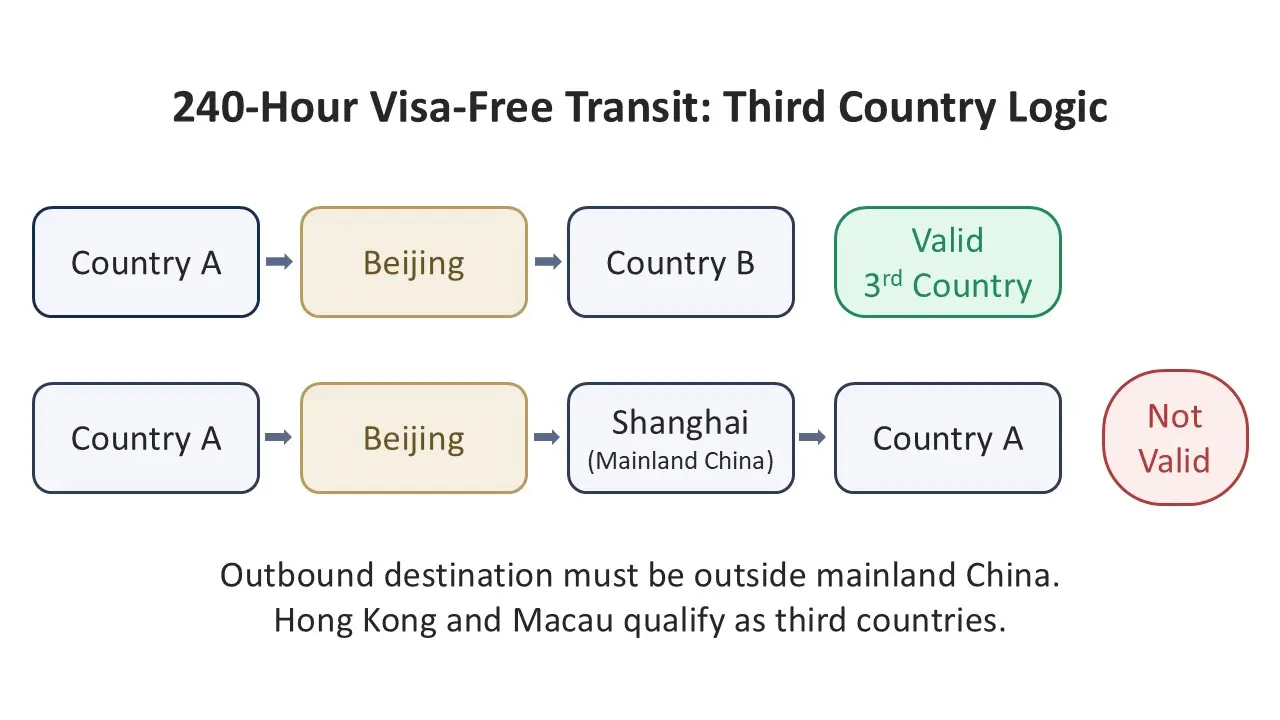
The following does not qualify: London → Beijing → Shanghai → London. The onward international destination is the same country the traveler came from, so the itinerary does not form transit to a third country or region. Shanghai itself is not the reason the itinerary fails.
In short: you must be continuing to a third country or region. Do not describe Hong Kong or Macau as sovereign countries; treat them as third-region destinations where the policy allows.
Where Can You Travel During 240 Hours?
Eligible 240-hour transit travelers may travel within the officially permitted stay areas of the participating regions, including cross-provincial travel where the policy allows it. The permitted area is not the whole of China, and some participating provinces have only specified cities or areas.
Stay within the permitted stay areas for the duration of your stay. Exceeding the allowed area or overstaying the 240-hour window can result in penalties and affect future entry. Verify the current permitted areas before you travel.
Time Window Clarification
For the 240-hour visa-free transit policy, the permitted stay is calculated from 00:00 on the day following the day of entry. Travelers must still follow the departure deadline and conditions shown by immigration. Overstaying, even by hours, can lead to refusal of future entry.
Airports Covered
Beijing Capital International Airport (PEK) and Beijing Daxing International Airport (PKX) both participate in the 240-hour visa-free transit scheme. On arrival, follow signs for the 240-hour transit counter (or equivalent). Present your passport and confirmed onward ticket to a third country or region. If approved, you receive a temporary entry permit authorizing stay within the permitted areas.
For a step-by-step outline of the process at PEK and PKX: including immigration, onward ticket verification and return buffer: see our Can I Leave Beijing Airport During a Layover? page.
Common Reasons 240-Hour Transit Is Refused
Understanding why entry is often refused helps you avoid the main risks.
- No confirmed onward ticket: Without proof of booked onward travel to a third country or region within the permitted window, the officer may refuse the permit. Do not rely on verbal plans or unconfirmed bookings.
- Return to the same country without a third country or region: If your itinerary is effectively round-trip to your country of origin without a qualifying third-country or third-region leg (e.g. London → Beijing → London with no Hong Kong or other qualifying destination), you do not meet the transit rule.
- Airline denies boarding: Carriers can refuse to board you if they are not satisfied you will be admitted. Carry printed or digital proof of your onward ticket and check current requirements with your airline before the flight.
- Immigration discretion: Even with valid documents, entry is at the discretion of the officer. Inconsistent information, missing documents or other concerns can lead to refusal.
- Overstaying the window: You must leave within 240 hours of arrival. Overstaying can result in penalties and affect future travel to China.
If in doubt, confirm your eligibility and documents with your airline and with official sources before you travel.
Is 240 Hours Relevant for Layovers?
For short layovers: typically under 24 hours: the 24-hour visa-free transit often applies. A traveler using 24-hour visa-free transit must receive a temporary entry permit from immigration before leaving the port restricted area. You do not need to rely on the 240-hour scheme for a same-day or overnight connection.
The 240-hour rule is more relevant when you have an extended stopover of several days and plan to leave the airport. It gives you a defined window (up to 10 days) to stay within the officially permitted areas before your onward flight to a third country or region.
For eligibility and process details that apply to both 24-hour and 240-hour transit, see Can I Leave Beijing Airport During a Layover?. For time feasibility and layover time planning (how much usable time you have), see the Beijing Layover Guide. For what fits into a 15-hour window, see 15 Hour Layover in Beijing.
Frequently Asked Questions
More resources
If you are planning to leave the airport during a multi-day stopover, structured options are available.